


The reporting that sparked this guide: H-1B Visa Lottery Changes for FY2027 (Legal News)
What This News Means for Immigrants in Orlando and Across Florida
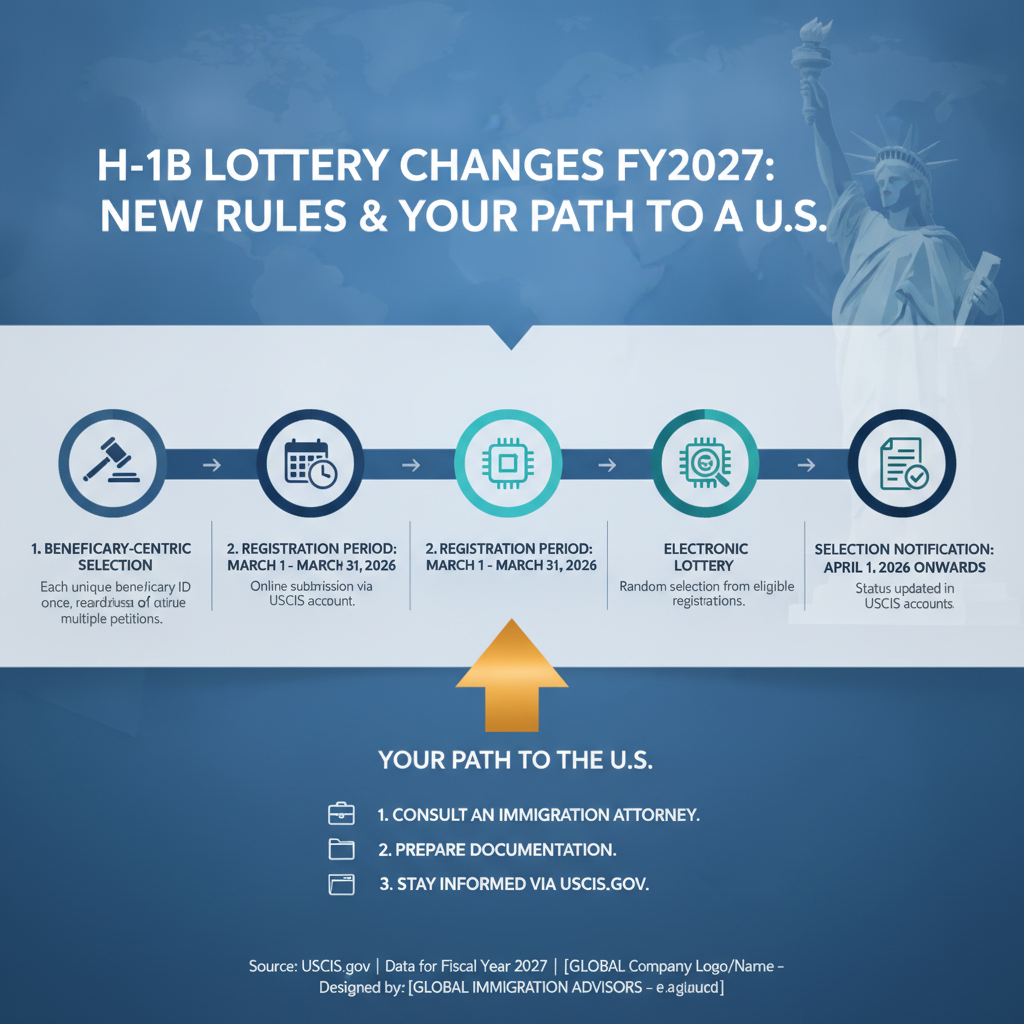
The landscape of U.S. immigration is constantly evolving, and few areas are as dynamic or as critical for skilled foreign workers as the H-1B visa program. As an immigration law firm based in Orlando, Florida, Imigrar understands the immense opportunities and challenges this visa presents. The recent news regarding significant changes to the H-1B visa lottery process for Fiscal Year 2027 (FY2027) is not just a headline; it's a pivotal development that could shape the careers and lives of thousands.
Why this news is showing up now
The U.S. Citizenship and Immigration Services (USCIS) has finalized new regulations impacting the H-1B cap registration process, specifically designed to combat fraud and ensure a fairer selection for eligible beneficiaries. These changes, part of a broader effort to modernize and secure the immigration system, were first proposed and then finalized in the lead-up to the FY2025 lottery, with their full impact becoming clear for subsequent years, including the upcoming **FY2027** cycle. The core of these new rules is a shift from a "registrant-centric" to a "**beneficiary-centric selection**" process. This means that instead of allowing multiple employers to submit registrations for the same individual, potentially inflating selection odds, USCIS will now select based on each unique beneficiary. This change aims to level the playing field and ensure that every eligible individual has a genuine and fair chance.
How it can affect Florida residents
For immigrants living in Orlando, Central Florida, and across the Sunshine State, these changes have profound implications. Florida's economy, particularly in key sectors like technology, healthcare, aerospace, and tourism, relies heavily on a skilled workforce. The I-4 corridor, stretching from Tampa Bay through Orlando to Daytona Beach, is a hub for innovation and specialized industries that frequently sponsor H-1B visas. If you are a student graduating from a Florida university, a professional working in a specialized field, or an employer seeking top talent, these changes directly impact your strategy:
- For Beneficiaries: You can no longer rely on multiple employers submitting registrations on your behalf to increase your chances. Your focus must now be on securing one strong, legitimate job offer from a sponsoring employer. Accuracy of your personal information, especially your passport details, is paramount during the registration phase.
- For Employers: The new rules require heightened due diligence. Employers must ensure they are submitting only one registration per unique beneficiary. Any attempt to circumvent this rule will result in the invalidation of all registrations for that beneficiary, potentially wasting time and resources. Florida companies, particularly those in competitive tech and engineering fields, must adapt their recruitment and sponsorship strategies.
- Increased Scrutiny: USCIS is signaling a clear intent to crack down on fraud. This means all applications, particularly those from Florida-based companies, may face increased scrutiny. Legitimate job offers, a clear employer-employee relationship, and robust documentation are more critical than ever.
Understanding these shifts is not merely about compliance; it's about strategizing effectively to achieve your immigration goals. Imigrar is here to provide the clarity and guidance you need.
What H-1B Visa Lottery Changes for FY2027 Is (and Why It Matters)
The H-1B visa program is a cornerstone of the U.S. economy, allowing American employers to temporarily employ foreign workers in specialty occupations. However, due to its immense popularity, the demand for H-1B visas consistently exceeds the annual supply, necessitating a lottery system. The changes for **FY2027** are a direct response to past abuses and aim to restore integrity to this vital program.
A plain-English definition
The **H-1B visa** is a non-immigrant visa that permits U.S. employers to temporarily hire foreign workers in "specialty occupations." These are jobs that generally require a bachelor's degree or higher in a specific field, such as IT professionals, engineers, doctors, architects, and scientists. Each year, there's a limited number of H-1B visas available, known as the **H-1B Cap** (currently 65,000 for the regular cap and an additional 20,000 for those with a U.S. master's degree or higher). Because demand far outstrips supply, USCIS conducts an electronic lottery to select which registrations can proceed to file a full petition.
The "changes for **FY2027**" refer to new rules, finalized by the Department of Homeland Security (DHS), that alter *how* USCIS conducts this lottery. Previously, multiple employers could register the same foreign worker, and each registration counted as an entry, theoretically increasing the worker's chances. The new rule, effective for **FY2027**, shifts to a "**beneficiary-centric selection**." This means USCIS will now identify each unique individual (beneficiary) by their valid passport information. If multiple registrations are submitted for the same individual, *all* those registrations for that individual will be deemed invalid, effectively disqualifying them from the lottery for that year. This change is designed to stop fraudulent practices where individuals might have had dozens of registrations submitted on their behalf by various entities, often without a genuine job offer.
Key terms you need to know
- H-1B Cap: The annual statutory limit on the number of H-1B visas issued each fiscal year. Currently, it's 65,000 for the regular cap and an additional 20,000 for those with a U.S. master's degree or higher (the "master's cap").
- Lottery (Selection Process): When the number of H-1B registrations exceeds the annual cap, USCIS conducts a random computer-generated selection process to determine which registrants can file an **H-1B petition**.
- Beneficiary: The foreign worker who is the subject of the H-1B petition. Their qualifications and unique identity are now central to the lottery.
- Registrant/Petitioner: The U.S. employer who intends to hire the foreign worker and files the H-1B petition on their behalf.
- Specialty Occupation: A profession that requires theoretical and practical application of a body of highly specialized knowledge, and requires a bachelor's degree or higher in a specific specialty (or its equivalent) as a minimum for entry into the occupation.
- DHS Final Rule: The regulation published by the Department of Homeland Security that officially implements the changes to the H-1B lottery process. This rule specifically codified the **beneficiary-centric selection** process.
- FY2027 (Fiscal Year 2027): The U.S. government's fiscal year, which begins on October 1, 2026, and ends on September 30, 2027. H-1B visas approved under the **FY2027** cap will typically become effective on October 1, 2026.
- Beneficiary-Centric Selection: The critical new rule where USCIS selects unique beneficiaries for the H-1B cap. Each unique beneficiary can only be the subject of one registration in a given lottery period. USCIS uses the beneficiary's passport information to identify uniqueness.
Navigating the H-1B changes can be complex. Our Orlando immigration team is ready to assist. Call +1 786-791-3106 for a free consultation, or message us online. Se Habla Español.
Current Immigration Law: The Foundation
The H-1B visa program is governed by specific sections of the Immigration and Nationality Act (INA) and further elaborated by federal regulations. Understanding these foundational laws is crucial for both employers and beneficiaries.
Federal requirements
The H-1B visa falls under Section **101(a)(15)(H)(i)(b)** of the **Immigration and Nationality Act (INA)**. The numerical limitations (the annual cap) are specified in **INA §214(g)**. Key federal requirements for an H-1B visa include:
- Specialty Occupation: The job must qualify as a specialty occupation, meaning it requires a theoretical and practical application of highly specialized knowledge and a bachelor's degree or higher in a specific field (or its equivalent).
- Educational Attainment: The beneficiary must possess at least a U.S. bachelor's degree or its foreign equivalent, or a state license, or authorization to practice the specialty occupation, or work experience equivalent to a bachelor's degree.
- Employer Sponsorship: An employer must sponsor the H-1B visa. Self-employment is generally not permitted unless a genuine employer-employee relationship can be established.
- Prevailing Wage: The employer must pay the H-1B worker at least the prevailing wage for the occupational classification in the area of employment, or the actual wage paid to other employees with similar experience and qualifications, whichever is higher. This is determined via a **Labor Condition Application (LCA)**, **Form ETA-9035**, certified by the U.S. Department of Labor (DOL official website).
- Annual Cap: As mentioned, there's an annual limit of 65,000 H-1B visas (the regular cap) and an additional 20,000 for those with a U.S. master's degree or higher. Certain employers, such as institutions of higher education, non-profit research organizations, and government research organizations, are exempt from the cap.
- The DHS Final Rule (Beneficiary-Centric Selection): The most significant recent change for the lottery process. This rule, effective for the upcoming **FY2027** lottery cycle, mandates that USCIS will now select registrations based on unique beneficiaries. This means each unique individual (identified by valid passport information) can only have one registration submitted on their behalf in a given lottery period. If multiple registrations are submitted for the same beneficiary, USCIS will invalidate *all* registrations for that individual.
The primary USCIS form for the H-1B petition is **Form I-129, Petition for a Nonimmigrant Worker**. When represented by an attorney, **Form G-28, Notice of Entry of Appearance as Attorney or Accredited Representative**, is also filed.
For official information and forms, always refer to the USCIS official website.
Florida-specific considerations
Florida's dynamic economy creates unique demands and opportunities for H-1B visa holders. The state is a magnet for talent in various specialized fields:
- Tech Hubs: Cities like Orlando, Tampa, and Miami are emerging tech hubs, attracting software developers, data scientists, and IT specialists. Companies in the I-4 corridor frequently sponsor H-1B visas.
- Healthcare: Florida's growing population fuels demand for healthcare professionals, from specialized nurses to medical researchers, making the H-1B visa critical for hospitals and clinics.
- Aerospace & Defense: The Space Coast (Merritt Island, Cape Canaveral) and other areas have a strong presence in aerospace and defense, requiring engineers and scientists.
- Tourism & Hospitality (Specialized Roles): While many roles in tourism are not specialty occupations, there are specialized positions in marketing, analytics, and management within the hospitality industry that qualify for H-1B.
For Central Florida residents, the Orlando USCIS Field Office may be relevant for certain in-person services, although H-1B petitions are typically processed at service centers. The competitive nature of the H-1B lottery means that for those seeking employment in Orange County or elsewhere in Florida, having a strong, legitimate job offer and meticulously prepared application is more important than ever under the new rules.

How to Navigate the New H-1B Visa Lottery for FY2027: A Complete Step-by-Step Guide
The H-1B cap season is a high-stakes period. With the new **beneficiary-centric selection** rule for **FY2027**, precision and proactive planning are paramount. Here's a comprehensive step-by-step guide:
1) Employer Identifies a Specialty Occupation Position and Potential Beneficiary
The process begins with a U.S. employer identifying a need for a worker in a **specialty occupation** that aligns with the beneficiary's qualifications. This is not just about finding a job; it's about ensuring the job itself meets specific legal criteria.
- Detailed Explanation: The employer must demonstrate that the position requires a bachelor's degree or higher in a specific field. They must also confirm that the beneficiary possesses the necessary academic credentials or equivalent work experience. This initial assessment is crucial to avoid issues later.
- Required Documents (Initial Assessment):
- Comprehensive job description outlining duties, responsibilities, and minimum educational requirements.
- Beneficiary's resume or Curriculum Vitae (CV).
- Beneficiary's academic transcripts and degree certificates (e.g., Bachelor's, Master's, PhD).
- Any relevant professional licenses or certifications.
- If foreign degrees, a credential evaluation report to determine U.S. equivalency.
2) Employer Registers Beneficiary for the H-1B Cap Lottery
This is the most critical step impacted by the **FY2027** changes. The employer must submit an electronic registration for each unique beneficiary they intend to sponsor.
- Detailed Explanation: The employer (or their authorized representative, like Imigrar) creates a USCIS online account and submits the registration. For **FY2027**, the registration fee is **$10**. This step requires basic information about the employer and, critically, the beneficiary's unique identifying information from their valid passport. **Important:** Under the new **beneficiary-centric selection** rule, USCIS will use the beneficiary's valid passport information (name, date of birth, country of birth, and passport number) to identify unique individuals. If multiple registrations are submitted by different employers for the *same beneficiary*, all registrations for that individual will be invalidated. This is a **fatal error** and must be avoided at all costs.
- Required Documents (for Registration):
- Beneficiary's valid passport (passport number, expiration date, name, date of birth, country of birth).
- Employer's Federal Employer Identification Number (FEIN).
- Employer's legal name, doing-business-as name (if any), and U.S. mailing address.
- Employer's authorized signatory information.
- Timeline: The registration period typically opens in early March (e.g., March 1-17, 2026, for the **FY2027** cap season).
3) USCIS Conducts the Lottery and Notifies Selected Registrants
After the registration period closes, USCIS conducts the random lottery.
- Detailed Explanation: USCIS uses a computer-generated random selection process. First, they select enough registrations to meet the regular cap, then, if applicable, enough from the remaining master's degree holders to meet the master's cap exemption. Notifications are sent electronically to the online accounts of the registrants (employers or their attorneys).
- Required Documents: None at this stage.
- Timeline: Lottery results are typically announced by late March.
4) Prepare and File the H-1B Petition (Form I-129)
If a registration is selected, the employer has a specific window to file the full H-1B petition.
- Detailed Explanation: This is where the comprehensive documentation comes into play. The employer must prepare and submit **Form I-129, Petition for a Nonimmigrant Worker**, along with various supporting documents, to USCIS. This petition must meticulously demonstrate that the job is a **specialty occupation** and that the beneficiary is qualified for it. An approved **Labor Condition Application (LCA)** from the Department of Labor is a prerequisite for filing the **Form I-129**.
- Required Documents (for I-129 Petition):
- Certified **Form ETA-9035, Labor Condition Application (LCA)**.
- Original **Form I-129** and H-1B Data Collection and Filing Fee Exemption Supplement.
- Employer's detailed letter of support explaining the job, the beneficiary's qualifications, and the need for a foreign worker.
- Copy of the beneficiary's educational degrees, academic transcripts, and foreign credential evaluations (if applicable).
- Beneficiary's resume/CV, professional licenses, and certifications.
- Copies of the beneficiary's passport, visa, and **Form I-94** (Arrival/Departure Record).
- Evidence of the employer's business operations (e.g., business license, tax returns, financial statements, organizational charts, marketing materials).
- Proof of a valid employer-employee relationship (e.g., employment contract, offer letter).
- If applicable, **Form G-28, Notice of Entry of Appearance as Attorney or Accredited Representative**.
- Any other evidence proving the job is a **specialty occupation** and the beneficiary is qualified.
- Timeline: Typically a 90-day filing window, starting April 1st.
5) USCIS Processes the H-1B Petition
Once filed, USCIS reviews the petition and supporting evidence.


