


Navigating the complex world of U.S. immigration law requires vigilance, especially when significant changes are announced. For those aspiring to work in specialty occupations in the United States, the H-1B visa program is often the primary pathway. Each year, the demand for H-1B visas far outstrips the available supply, necessitating a lottery system. Now, prospective H-1B beneficiaries and their employers face substantial new rules for the upcoming Fiscal Year (FY) 2027 H-1B lottery.
At Imigrar, an immigration law firm based in Orlando, Florida, we are committed to keeping families together and empowering individuals to achieve their professional dreams. Our team closely monitors all developments from U.S. Citizenship and Immigration Services (USCIS) to provide our clients with accurate, timely, and actionable advice. The recent changes to the H-1B lottery process are among the most impactful in years, designed to enhance integrity and reduce fraud, but they also introduce new complexities for applicants and employers alike.
This comprehensive guide will break down everything you need to know about the H-1B visa lottery changes for FY2027. We’ll explain the new beneficiary-centric selection process, detail the steps involved, offer practical tips, and answer your most pressing questions. Our goal is to equip you with the knowledge to confidently approach the upcoming H-1B cap season.
Need Expert H-1B Guidance? The FY2027 changes are significant. Don't navigate them alone. Our Orlando immigration team is ready to assist you and your employer. Call +1 786-791-3106 for a free consultation, or message us online. Se Habla Español.
The reporting that sparked this guide: H-1B Visa Lottery Changes for FY2027 (Legal News)
What This News Means for Immigrants in Orlando and Across Florida
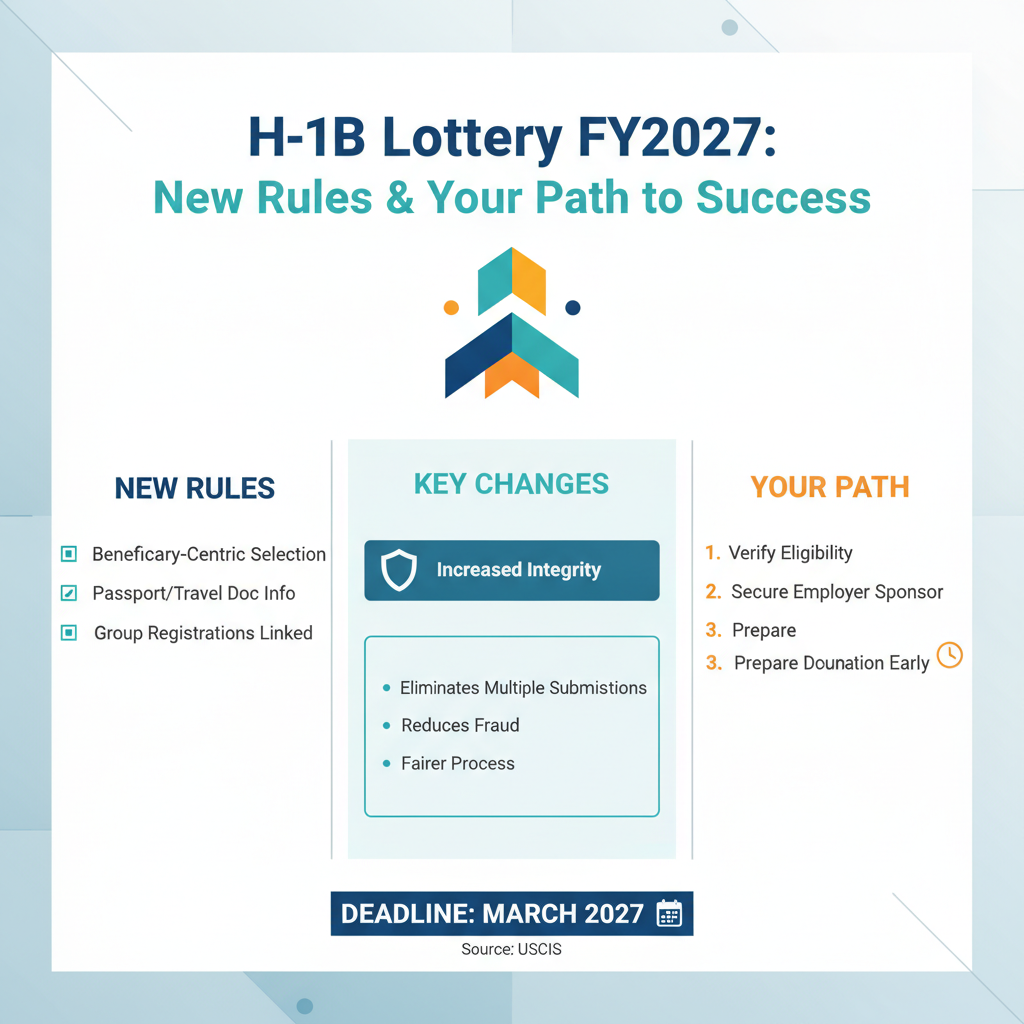
The landscape of U.S. immigration is constantly evolving, and the H-1B visa program, a cornerstone for highly skilled foreign workers, is no exception. The recent announcement of new rules for the H-1B lottery for Fiscal Year 2027 marks a pivotal moment for thousands of hopeful immigrants and their sponsoring employers, especially those in dynamic regions like Florida.
Why this news is showing up now
USCIS, under the Department of Homeland Security (DHS), has finalized new rules impacting the H-1B cap registration process, specifically for the upcoming FY2027 lottery. While the H-1B cap season typically kicks off with registration in March for a fiscal year starting October 1st, the agency often announces significant policy changes well in advance to allow petitioners and beneficiaries time to prepare. Given today's date, September 13, 2026, these changes would have been announced earlier in 2026, or are being solidified now to provide clarity for the H-1B cap registration period scheduled for March 2027.
These changes are largely a response to ongoing concerns about fraud and system abuse, particularly the practice of multiple employers submitting registrations for the same beneficiary, artificially inflating their chances of selection. USCIS has explicitly stated its intent to bolster the integrity of the H-1B lottery process and ensure that every eligible beneficiary has an equal and fair opportunity. This shift aims to make the selection process truly "beneficiary-centric," prioritizing the individual applicant over the number of employers willing to sponsor them.
How it can affect Florida residents
Florida, a state known for its thriving tourism, rapidly expanding technology sector, robust healthcare industry, and growing aerospace and engineering fields, relies heavily on skilled foreign talent. Cities like Orlando, Tampa, Miami, and Jacksonville are magnets for innovation and professional growth, attracting companies that frequently utilize the H-1B program to fill specialty occupation roles. For immigrants residing in Florida, or those looking to move here for H-1B sponsored employment, these changes have direct implications:
- Increased Competition for Selection: While the new rules aim for fairness, they also mean that a beneficiary will no longer benefit from having multiple employers submit registrations on their behalf. This levels the playing field, but it also means that a single, well-prepared registration is paramount.
- Strategic Employer Coordination: If you are a prospective H-1B beneficiary with offers from multiple Florida-based employers, you will now need to coordinate with them to select *one* employer to submit your registration. This requires careful consideration and communication, as submitting more than one registration for the same beneficiary will lead to disqualification of *all* registrations for that individual.
- Heightened Scrutiny for Employers: Florida employers, particularly those in the tech corridor along I-4 in Central Florida or the robust healthcare networks around Orlando, must now ensure meticulous compliance. USCIS will be actively scrutinizing registrations for potential fraud, making it more critical than ever for employers to have legitimate job offers and to adhere strictly to the new one-registration-per-beneficiary rule.
- Demand for Legal Expertise: The complexity of these changes underscores the need for expert legal guidance. Whether you are an individual seeking an H-1B visa in Orlando or an employer in Orange County looking to sponsor foreign talent, understanding and correctly implementing these new rules is crucial for success.
The H-1B program is vital for many Florida businesses and professionals. These changes are designed to bring fairness and integrity to the system, but they also demand a more strategic and compliant approach from everyone involved. Imigrar is here to help you navigate these new waters effectively.
What H-1B Visa Lottery Changes for FY2027 Is (and Why It Matters)
The H-1B visa program is a cornerstone of U.S. immigration policy, enabling U.S. employers to temporarily employ foreign workers in specialty occupations. These occupations generally require a bachelor's degree or higher in a specific field. However, due to the annual cap on available H-1B visas, the demand consistently exceeds supply, necessitating a lottery system. The changes introduced for FY2027 directly address the mechanics of this lottery, making them crucial for anyone involved in the process.
A plain-English definition
The H-1B visa is a non-immigrant visa that allows U.S. employers to temporarily hire foreign workers in "specialty occupations." A specialty occupation is one that requires a theoretical and practical application of a body of highly specialized knowledge, and a bachelor's degree or higher in a specific specialty, or its equivalent, as a minimum for entry into the occupation. Examples include roles in IT, engineering, medicine, education, and many other professional fields.
Because there's an annual limit (or "cap") on how many H-1B visas can be issued each fiscal year – currently 65,000 for the regular cap and an additional 20,000 for those with a U.S. master's degree or higher – USCIS conducts an electronic lottery if the number of registrations significantly exceeds the available visas. The "H-1B Lottery Changes for FY2027" refers to new rules that fundamentally alter how this lottery will be conducted. The most significant change is the shift to a beneficiary-centric selection process. This means that USCIS will now select registrations based on the unique beneficiary, rather than the number of registrations submitted by different employers for that beneficiary. In essence, each individual person applying for an H-1B visa can only have *one* registration entered on their behalf for the lottery, regardless of how many companies want to sponsor them.
This matters immensely because it aims to eliminate the practice where multiple employers would register the same individual, effectively giving that person (and those employers) an unfair statistical advantage in the lottery. The new rule ensures that every unique beneficiary has an equal chance of being selected, promoting fairness and integrity in the system.
Key terms you need to know
Understanding the terminology is essential when navigating the H-1B process, especially with the new changes:
- H-1B Visa: A non-immigrant visa that permits U.S. employers to temporarily employ foreign workers in specialty occupations.
- Specialty Occupation: An occupation that requires the theoretical and practical application of a body of highly specialized knowledge and a bachelor's degree or higher in a specific specialty, or its equivalent, as a minimum for entry into the occupation in the United States.
- Cap-Subject H-1B: Refers to H-1B petitions that are subject to the annual numerical limit (currently 65,000 regular cap and 20,000 for U.S. master's degree holders).
- Cap-Exempt H-1B: H-1B petitions filed by certain institutions (e.g., higher education institutions, non-profit research organizations) that are not subject to the annual cap. These petitions can be filed at any time.
- Petitioner: The U.S. employer who files the H-1B petition on behalf of the foreign worker.
- Beneficiary: The foreign worker for whom the H-1B petition is filed. Under the new rules, the beneficiary's unique identifier (like a passport number) is paramount.
- H-1B Registration Period: The specific window (typically in March) during which prospective petitioners (employers) must electronically register beneficiaries for the H-1B lottery.
- Selection Process: The method USCIS uses to choose which registered beneficiaries will be eligible to have an H-1B petition filed on their behalf when the number of registrations exceeds the annual cap. The FY2027 changes refer specifically to this process, shifting to a beneficiary-centric model.
- Form I-129, Petition for a Nonimmigrant Worker: The primary form filed by the employer after a beneficiary is selected in the lottery.
- LCA (Labor Condition Application): Form ETA-9035, which the employer must file with the U.S. Department of Labor (DOL) and have certified before filing Form I-129. It attests to wages and working conditions.
- FY (Fiscal Year): The U.S. government's fiscal year runs from October 1st to September 30th. An H-1B visa granted through the FY2027 lottery would typically become effective on October 1, 2027.
- DHS (Department of Homeland Security): The federal department that oversees USCIS.
- USCIS (U.S. Citizenship and Immigration Services): The government agency responsible for processing immigration petitions, including H-1B. You can find official information and forms on the USCIS official website.
- Request for Evidence (RFE): A letter from USCIS requesting additional information or documentation to support an H-1B petition.
- Premium Processing: An optional service offered by USCIS that guarantees processing of certain petitions (like H-1B) within a specific timeframe, typically 15 calendar days, for an additional fee.
Confused by H-1B Jargon? Our team at Imigrar can clarify every term and guide you through the process. Reach out for a free consultation at +1 786-791-3106. Se Habla Español.

Current Immigration Law: The Foundation
The H-1B visa program operates under the comprehensive framework of the Immigration and Nationality Act (INA), specifically codified under INA § 101(a)(15)(H)(i)(b), which defines the H-1B nonimmigrant classification. The regulations governing its implementation are found in Title 8 of the Code of Federal Regulations (8 CFR). While the recent changes primarily affect the *process* of the H-1B lottery, the foundational laws and requirements for eligibility remain largely intact.
Federal requirements
To qualify for an H-1B visa, both the employer (petitioner) and the foreign worker (beneficiary) must meet specific federal requirements:
- Specialty Occupation: The job offered must meet the definition of a specialty occupation, meaning it requires a bachelor's degree or higher in a specific field as a minimum requirement. The employer must demonstrate that the position qualifies as such.
- Beneficiary Qualifications: The beneficiary must possess the required bachelor's degree or its equivalent, or hold an unrestricted state license, or possess work experience equivalent to a bachelor's degree in the specialty occupation field. Educational credentials obtained outside the U.S. often require a credential evaluation to determine their U.S. equivalency.
- Employer-Employee Relationship: A valid employer-employee relationship must exist between the petitioner and the beneficiary.
- Labor Condition Application (LCA): Before filing an H-1B petition, the employer must file and have certified by the U.S. Department of Labor (DOL) a Form ETA-9035, Labor Condition Application. This form attests that the employer will pay the H-1B worker at least the prevailing wage for the occupation in the area of employment, and that working conditions will not adversely affect other workers.
- Annual Cap: The H-1B program is subject to an annual cap of 65,000 visas, with an additional 20,000 reserved for beneficiaries holding a U.S. master's degree or higher. This cap is typically reached quickly, triggering the lottery.
- New FY2027 Beneficiary-Centric Selection: This is the critical change. Previously, multiple employers could submit separate registrations for the same beneficiary, each increasing the beneficiary's chance of selection. For FY2027, USCIS will select registrations based on the unique beneficiary. This means:
- Only one registration may be submitted for a single beneficiary in a given fiscal year, regardless of the number of job offers or interested employers.
- If USCIS identifies multiple registrations for the same beneficiary (using unique identifiers like passport numbers), all registrations for that beneficiary will be deemed invalid and disqualified from the lottery. This is a severe penalty designed to prevent fraud.
- The beneficiary must coordinate with their potential employers to decide which single employer will submit their registration.
- Fraud Prevention: USCIS has significantly enhanced its capabilities to detect and investigate fraud related to H-1B registrations and petitions. This includes scrutinizing multiple registrations, suspicious employer data, and verifying the legitimacy of job offers.
The primary form used for filing an H-1B petition is Form I-129, Petition for a Nonimmigrant Worker. This form, along with extensive supporting documentation, is filed *after* a beneficiary has been selected in the lottery.
For the most up-to-date information on federal requirements and forms, always refer to the USCIS official website and the USCIS Forms page.
Florida-specific considerations
While there are no state-specific H-1B laws in Florida (H-1B is a federal program), the state's economic landscape and local immigration infrastructure are important considerations:
- High Demand in Key Industries: Florida's robust sectors, including information technology, healthcare, aerospace, and hospitality management, generate significant demand for H-1B talent. This means competition for H-1B visas among Florida-based employers and prospective employees can be intense.
- Prevailing Wage Determination: Employers in Florida must adhere to the prevailing wage requirements for their specific occupation and geographic area, as determined by the Department of Labor. This is crucial for the LCA and ensures fair compensation.
- Local Legal Expertise: While H-1B petitions are processed by USCIS Service Centers (not local field offices), having an immigration attorney familiar with the local job market and employer needs in areas like Orlando, Tampa, or Miami can be invaluable. Attorneys can provide tailored advice on navigating the process within the context of Florida's economic realities. The Orlando USCIS Field Office primarily handles


