


The landscape of U.S. immigration law is constantly evolving, and for those seeking to live and work in the United States, staying informed is paramount. As we approach the next H-1B visa cap season for Fiscal Year 2027, significant changes have been implemented by U.S. Citizenship and Immigration Services (USCIS) that will profoundly impact applicants and employers alike. At Imigrar, your trusted immigration law firm in Orlando, Florida, we understand the anxieties and complexities these changes can bring. Our mission, "Keep Families Together," extends to ensuring that skilled professionals and their families have the clearest path to achieving their American dreams.
This comprehensive guide is designed to break down the latest H-1B visa lottery changes, offering practical advice, detailed timelines, and essential requirements to help you navigate this critical period. Whether you are an individual aspiring to work in a specialty occupation or an employer seeking to sponsor global talent, understanding these updates is the first step toward a successful application.
Need Help? Our Orlando immigration team is ready to assist. Call +1 786-791-3106 for a free consultation, or message us online. Se Habla Español.
The reporting that sparked this guide
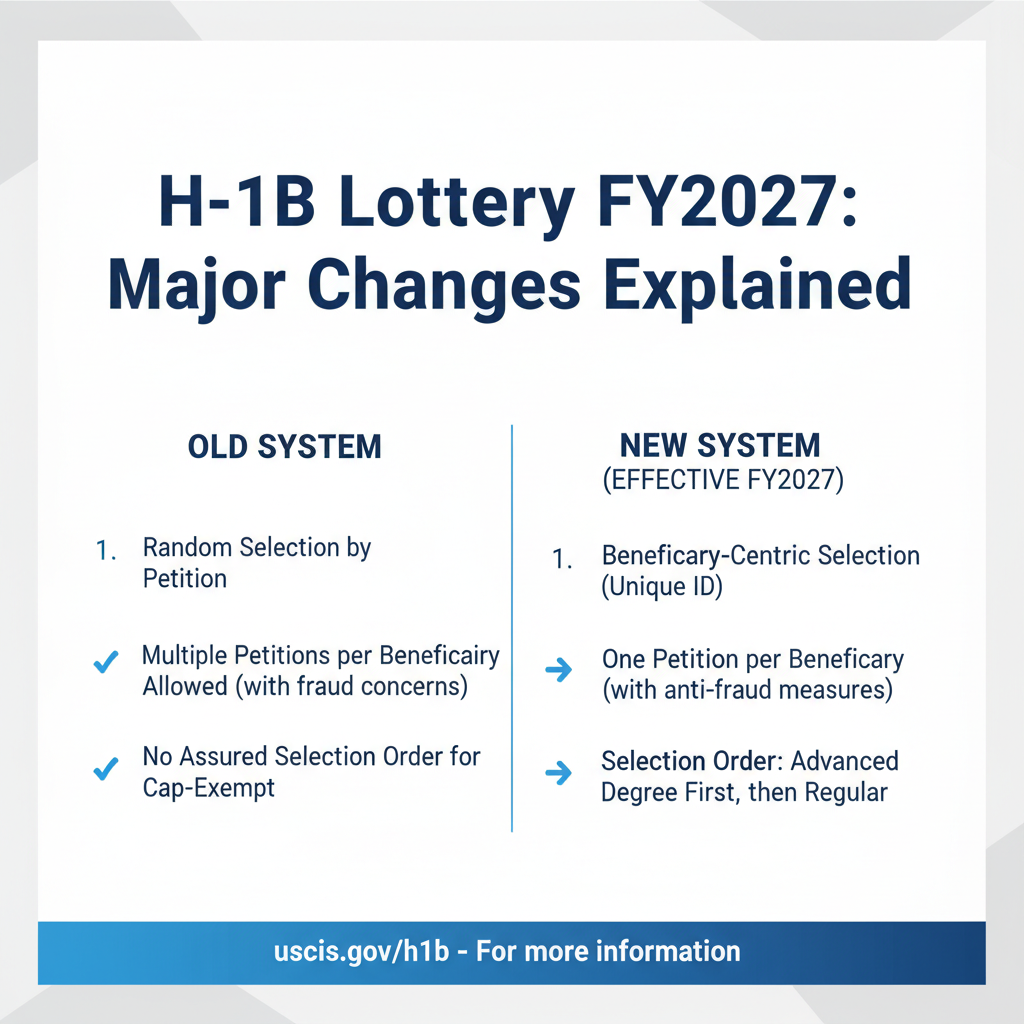
Our commitment to keeping you informed is driven by continuous monitoring of legal news and official government announcements. The insights and guidance in this article are a direct response to the latest developments surrounding the H-1B visa program:
H-1B Visa Lottery Changes for FY2027 (Legal News)
What This News Means for Immigrants in Orlando and Across Florida
The H-1B visa program is a cornerstone for many seeking to pursue professional careers in the United States. Its annual lottery system, known for its intense competition, has seen critical updates for the upcoming Fiscal Year 2027. These changes are designed to enhance the integrity of the lottery process and ensure greater fairness for all eligible applicants. For immigrants living in Orlando, across Florida, and indeed nationwide, understanding these shifts is not just beneficial—it's essential for strategizing your path forward.
Why this news is showing up now
The H-1B visa program operates on a fiscal year cycle, which begins on October 1st. To allow sufficient time for petition filing and adjudication, USCIS conducts its electronic registration process and lottery months in advance. Typically, the registration period for a given fiscal year (e.g., FY2027) occurs in early March of the preceding calendar year (e.g., March 2026). This timing necessitates that USCIS announces any procedural or regulatory changes well in advance of the registration window opening. The news you're seeing now reflects USCIS’s proactive efforts to inform the public about the new rules affecting the FY2027 H-1B cap season, particularly those aimed at curbing fraud and improving the selection process. The high demand for H-1B visas—often exceeding the available cap by several multiples—makes every cap season a critical period for employers and prospective employees, pushing USCIS to continually refine the system.
How it can affect Florida residents
Florida, with its booming economy, diverse industries, and vibrant cultural landscape, is a magnet for global talent. Major metropolitan areas like Orlando, Miami, Tampa, and Jacksonville are hubs for technology, healthcare, aerospace, tourism, and engineering—all sectors that heavily rely on H-1B visa holders. For residents of Florida, and especially those in Central Florida along the I-4 corridor, these changes have direct implications:
- Increased Fairness for Applicants: The new rules, particularly the beneficiary-centric selection process, aim to prevent individuals from gaining an unfair advantage through multiple employer registrations. This means that if you are a prospective H-1B beneficiary residing in Orlando or elsewhere in Florida, your chances are now based on your unique eligibility, not on how many employers register on your behalf.
- Employer Compliance: Florida-based employers, from tech startups in Lake Nona to established hospitality giants in Orange County, must adapt their H-1B sponsorship strategies to comply with the updated registration requirements. This includes verifying beneficiary information carefully and understanding the implications of the new selection methodology.
- Competitive Landscape: While the new rules aim for fairness, the inherent competition for H-1B visas remains. Florida's attractive job market means that even with a level playing field, demand will likely continue to outstrip supply. This underscores the need for meticulous preparation and timely action for both employers and beneficiaries.
- Strategic Planning: For international students graduating from Florida universities (like UCF, UF, FIU) currently on Optional Practical Training (OPT), understanding these changes is vital for long-term career planning and transitioning from student to worker status.
These changes underscore the importance of professional legal guidance. Imigrar, based in Orlando, is uniquely positioned to assist individuals and businesses across Florida in navigating these complex new regulations, ensuring compliance and maximizing the chances of success.
What H-1B Visa Lottery Changes for FY2027 Is (and Why It Matters)
The H-1B visa program allows U.S. employers to temporarily employ foreign workers in specialty occupations. These occupations generally require a bachelor's degree or higher in a specific field. Due to overwhelming demand, USCIS conducts an annual lottery to select petitions when the number of registrations exceeds the congressionally mandated annual cap.
A plain-English definition
Imagine a highly competitive job market where there are far more qualified applicants than available positions. The H-1B visa is similar: the U.S. government sets a limit, or "cap," on how many H-1B visas can be issued each year. Because demand from U.S. employers to hire foreign professionals usually far exceeds this cap, USCIS uses a lottery system to decide which employers get to file a full H-1B petition for their prospective employees. For FY2027, USCIS has introduced critical changes, primarily focusing on how individuals are entered into this lottery. Previously, an individual could have multiple registrations submitted on their behalf by different employers, potentially increasing their statistical chances. The new rule changes this: now, each individual (the "beneficiary") can only have one registration entered into the lottery, regardless of how many employers offer them a job. This is called a beneficiary-centric selection process. It aims to make the lottery fairer by preventing a single individual from dominating multiple spots, thereby improving the odds for all unique applicants.
Key terms you need to know
Navigating the H-1B process requires familiarity with specific terminology. Here are some key terms:
- H-1B Visa: A non-immigrant visa that allows U.S. employers to temporarily employ foreign workers in specialty occupations.
- Specialty Occupation: An occupation that requires theoretical and practical application of a body of highly specialized knowledge and a bachelor's or higher degree in the specific specialty (or its equivalent) as a minimum for entry into the occupation in the United States.
- Cap-Subject H-1B: H-1B petitions that are subject to the annual statutory cap.
- Cap-Exempt H-1B: Certain H-1B petitions that are not subject to the annual cap, such as those filed by institutions of higher education, non-profit organizations affiliated with higher education, or non-profit research organizations.
- Beneficiary: The foreign national worker for whom the H-1B visa is being sought. Under the new rules, the focus is heavily on the unique beneficiary.
- Petitioner: The U.S. employer who is sponsoring the foreign national for the H-1B visa.
- H-1B Cap: The annual limit on the number of H-1B visas issued. Currently, it's 65,000 for the regular cap and an additional 20,000 for those with a U.S. master's degree or higher (the "U.S. Master's Cap").
- Electronic Registration Period: The specific window (usually in March) during which employers must electronically register prospective H-1B beneficiaries with USCIS, paying a small fee. This is the entry point to the lottery.
- Lottery Selection: The random process USCIS uses to select registrations when the number of eligible registrations exceeds the annual cap.
- Selection Notice: The notification from USCIS indicating that a registration has been selected in the lottery, allowing the employer to file an H-1B petition.
- Form I-129: The Petition for a Nonimmigrant Worker, which is the primary form filed by an employer on behalf of a selected H-1B beneficiary.
- Labor Condition Application (LCA): Form ETA-9035. An application filed with the Department of Labor by the employer, attesting to specific conditions regarding wages and working conditions for the H-1B worker. This must be certified before filing the H-1B petition.
- Premium Processing: An optional service offered by USCIS that guarantees processing of certain petitions (including H-1B) within a specified timeframe (currently 15 calendar days) for an additional fee.
Understanding these terms is crucial for anyone involved in the H-1B process, especially with the new beneficiary-centric approach that emphasizes the individual's unique identity throughout the registration and selection phases.
Considering an H-1B visa in Orlando or anywhere in Florida? Don't navigate the new rules alone. Imigrar provides expert guidance to individuals and employers. Call +1 786-791-3106 for a free consultation. Se Habla Español.
Current Immigration Law: The Foundation of the H-1B Visa
The H-1B visa program is rooted in federal immigration statutes, primarily the Immigration and Nationality Act (INA). Understanding these foundational laws is essential, as the recent changes for FY2027 are procedural adjustments within this established legal framework, not fundamental alterations to the H-1B visa's core purpose or eligibility criteria.
Federal requirements
The H-1B visa category is defined under **INA Section 101(a)(15)(H)(i)(b)** and further elaborated in **INA Section 214(g)**, which sets the annual cap. Key federal requirements include:
- Specialty Occupation: The position offered by the employer must qualify as a specialty occupation, meaning it typically requires a bachelor's degree or higher in a specific field. USCIS evaluates whether the job duties themselves, the industry practice, or the complexity of the position necessitate such a specialized degree.
- Beneficiary Qualifications: The foreign national (beneficiary) must possess the required qualifications for the specialty occupation. This generally means holding a U.S. bachelor's or higher degree (or its foreign equivalent), an unrestricted state license, or work experience equivalent to a bachelor's degree.
- Employer-Employee Relationship: A valid employer-employee relationship must exist between the petitioning U.S. employer and the H-1B beneficiary. This means the employer has the right to control the beneficiary's work.
- Prevailing Wage: The employer must agree to pay the H-1B worker at least the prevailing wage for the occupation in the area of intended employment, or the actual wage paid to other employees with similar experience and qualifications, whichever is higher. This is attested to in the Labor Condition Application (LCA) (Form ETA-9035) filed with the U.S. Department of Labor.
- Annual Cap: As stipulated by Congress, the annual cap for H-1B visas is 65,000, with an additional 20,000 reserved for beneficiaries who have earned a U.S. master's degree or higher. This cap resets each fiscal year on October 1st.
- Electronic Registration: Before an H-1B cap-subject petition can be filed, the prospective employer must first electronically register the beneficiary with USCIS during a designated period. This is the gateway to the lottery.
These requirements are strictly enforced by USCIS. Employers must file Form I-129, Petition for a Nonimmigrant Worker, along with various supporting documentation, once a registration has been selected in the lottery.
For official information and forms, always refer to the USCIS official website.
Florida-specific considerations
While H-1B law is federal, its practical application has unique nuances in states like Florida. For Central Florida residents and employers, specific considerations often arise:
- Industry Demand: Florida's diverse economy means H-1B demand spans multiple sectors. In Orlando, there's significant demand in simulation and training, hospitality management, healthcare (especially in the Lake Nona Medical City area), and technology. Employers in these industries must be acutely aware of the H-1B process.
- Prevailing Wage Determinations: The Department of Labor's prevailing wage data varies by geographic area. An Orlando-based employer will have different prevailing wage requirements than one in Silicon Valley, for example. Accurate wage determination is critical for LCA certification.
- Local USCIS Field Office: While H-1B petitions are generally processed at USCIS service centers, individuals undergoing a Change of Status or seeking other immigration benefits in conjunction with an H-1B may interact with the Orlando USCIS Field Office for interviews or biometrics appointments.
- Competitive Environment: The sheer volume of businesses and educational institutions in Florida means a highly competitive environment for H-1B visas. Employers must ensure their petitions are robust and fully compliant to stand out.
At Imigrar, we understand these local dynamics and integrate them into our strategy for Florida-based clients, providing tailored advice that goes beyond federal mandates.

How to Navigate the FY2027 H-1B Lottery Changes: A Complete Step-by-Step Guide
The H-1B lottery process for FY2027 incorporates crucial changes, particularly the beneficiary-centric selection model. This guide outlines the steps involved, with a focus on these new regulations.
1) Understand the New Beneficiary-Centric Registration Process
This is the most significant change for FY2027. Previously, an employer could submit a registration for a beneficiary, and if multiple employers offered a job to the same beneficiary, each could submit a separate registration. This system allowed some individuals to have multiple entries in the lottery. The new rule changes this:
- One Registration Per Beneficiary: Regardless of how many employers offer a job to a foreign national, only ONE registration can be submitted on behalf of a unique beneficiary in any given fiscal year.
- Identification: USCIS will use the beneficiary's valid passport or travel document information (name, date of birth, country of birth, passport number) to identify unique individuals.
- Consequence of Multiple Submissions: If USCIS determines that more than one registration was submitted for the same beneficiary by different employers, ALL registrations for that beneficiary will be deemed invalid and denied. This is a severe penalty designed to prevent fraud and ensure fairness.
What this means for you: For beneficiaries, you must choose one employer to register you, or ensure that if multiple employers are interested, only one actually submits the registration. For employers, you must confirm with your prospective employee that no other employer is registering them or that they have chosen you as their sole registrant. This requires clear communication.
Required Documents (for registration):
- Beneficiary's valid passport or travel document details (number, country of issuance, expiration date).
- Beneficiary's full legal name, date of birth, country of birth, gender.
- Beneficiary's educational credentials (to determine eligibility for U.S. Master's Cap, if applicable).
- Employer's legal name, **Employer Identification Number (EIN)**, mailing address.
- Attorney or representative information (if applicable).
2) Employer and Beneficiary Preparation
Before the registration window even opens, thorough preparation is key. This phase focuses on establishing eligibility and gathering necessary documentation.
- Employer Due Diligence: The employer must confirm the position qualifies as a specialty occupation and that they can pay the prevailing wage. They should also verify their own eligibility to petition for H-1B workers.
- Beneficiary Qualification: The beneficiary must ensure they meet the educational or experiential requirements for the specialty occupation. This often involves obtaining a foreign degree evaluation if their degree is from outside the U.S.
- Communication: Open and honest communication between the employer and beneficiary is paramount, especially regarding the new one-registration-per-beneficiary rule.
Required Documents:
- Job description, including duties, responsibilities, and minimum educational requirements.
- Beneficiary's updated resume/CV.
- Copies of all academic degrees, diplomas, and transcripts.
- Foreign credential evaluation report (if applicable).
- Professional licenses (if required for the occupation).
- Employer's company details (e.g., business license, financial statements, tax returns).
3) H-1B Electronic Registration Period
This is the formal entry point into the lottery. USCIS designates a specific period, typically in early March (e.g., March 2026 for FY2027), for electronic registration.
- myUSCIS Account: The employer (or their authorized legal representative) must


