

The reporting that sparked this guide
The information and analysis presented in this guide are inspired by recent discussions and updates in immigration law news:
H-1B Visa Lottery Changes for FY2027 (Legal News)
Today is June 12, 2026. The H-1B Cap Registration for Fiscal Year 2027 has concluded, and results have been announced. Petitions for selected registrations are now being filed, and our focus is on ensuring applicants understand the new landscape and succeed in their journey.
What This News Means for Immigrants in Orlando and Across Florida
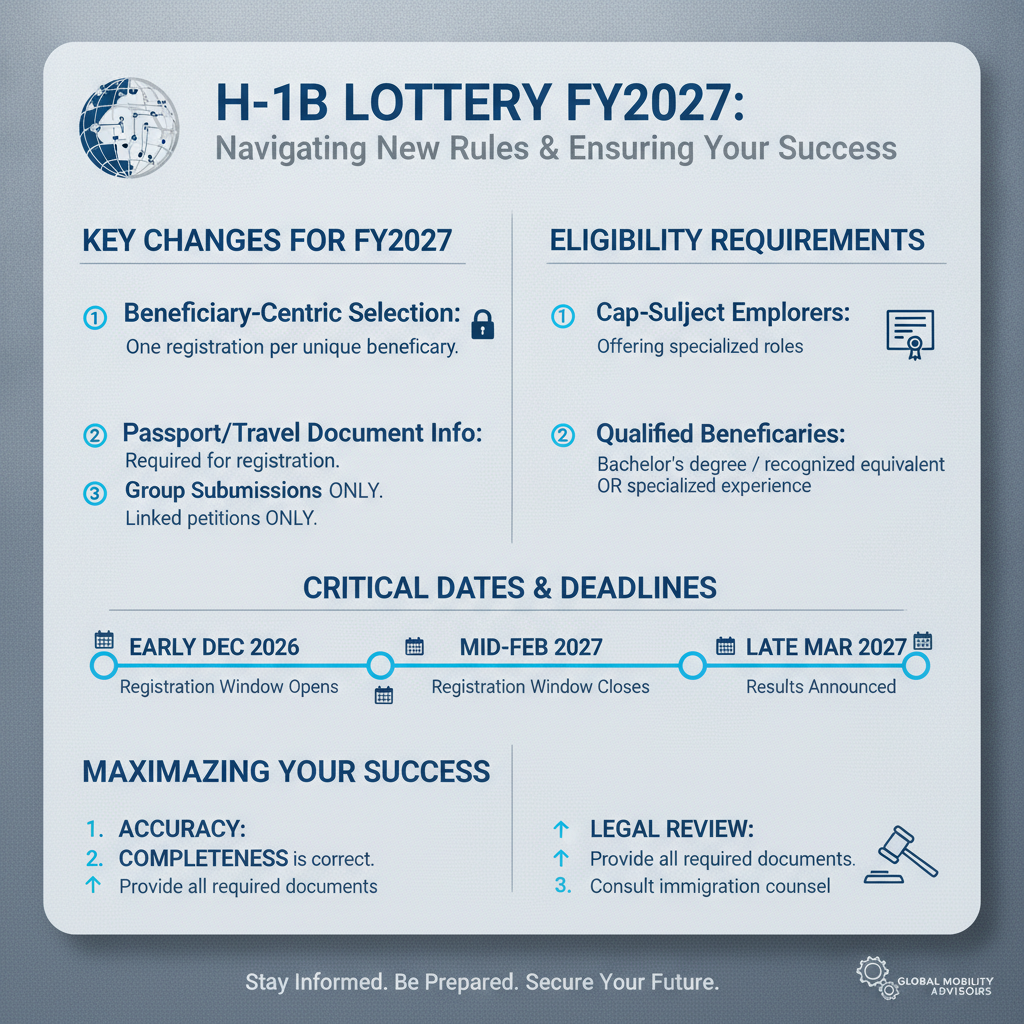
The H-1B visa program is a cornerstone for skilled foreign workers seeking opportunities in the United States, particularly in dynamic job markets like Florida. For Fiscal Year 2027 (FY2027), the U.S. Citizenship and Immigration Services (USCIS) has implemented significant changes to the H-1B cap registration and lottery process. These modifications, building upon previous efforts to enhance program integrity, are designed to combat fraud, ensure fair selection, and streamline the application process for legitimate employers and beneficiaries.
Why this news is showing up now
The H-1B cap registration for FY2027 typically opens in early March of the calendar year preceding the fiscal year (i.e., March 2026 for FY2027). The lottery results are usually announced by the end of March or early April. Therefore, as of June 2026, employers and beneficiaries who were selected in the lottery are in the crucial phase of preparing and filing their full H-1B petitions. The "news" refers to the *implementation* and *impact* of these new rules, which were announced by USCIS prior to the FY2027 registration period, likely in late 2025 or early 2026. The trending nature of this news now reflects the real-world consequences and challenges faced by those preparing their petitions under the new regime, especially concerning increased scrutiny and stricter compliance requirements. USCIS is continuously refining its processes, and for FY2027, the emphasis has been on solidifying the integrity of the beneficiary-centric selection process introduced in prior years, alongside potential adjustments to fees and enforcement measures.
How it can affect Florida residents
Florida, with its booming tech sector, robust healthcare industry, growing aerospace presence, and world-renowned tourism and hospitality, heavily relies on skilled foreign talent. Cities like Orlando, Miami, Tampa, and Jacksonville are hubs for industries that frequently sponsor H-1B visas. The new H-1B lottery changes for FY2027 have several direct impacts on Florida residents and businesses:
- For H-1B Beneficiaries Living in Florida: If you are an international student graduating from a Florida university (like UCF, UF, FIU, or USF) on an F-1 visa with Optional Practical Training (OPT), or a professional already working in Florida on another nonimmigrant visa, these changes directly affect your chances of securing an H-1B. The enhanced beneficiary-centric selection aims to prevent multiple registrations for the same individual, theoretically improving the odds for those with a single, legitimate job offer. However, it also means greater scrutiny on the legitimacy of the job offer and the sponsoring employer.
- For Florida Employers: Companies in Orlando, along the I-4 corridor, and throughout Florida that rely on H-1B workers (especially in STEM fields) must now navigate a more stringent registration and petition process. This includes ensuring their initial H-1B registrations are meticulously prepared and that their job offers are genuinely made to the beneficiary. Increased registration fees and potential for more rigorous site visits or requests for evidence (RFEs) mean higher compliance costs and administrative burdens.
- Impact on Workforce Planning: Florida businesses need to adjust their workforce planning strategies to account for these changes. The uncertainty of the lottery, coupled with stricter rules, might influence recruitment strategies, potentially leading to earlier planning for H-1B sponsorships or exploring alternative visa options.
- Legal Support Becomes Even More Critical: Given the heightened scrutiny, the role of experienced immigration legal counsel, such as Imigrar in Orlando, becomes indispensable. Navigating the complexities, understanding the nuances of the new rules, and preparing a robust petition are crucial for success, especially for those in Central Florida.
Navigating H-1B changes can be complex. Don't risk your future or your business's talent pipeline. Our Orlando immigration team at Imigrar is here to help you understand the new H-1B rules for FY2027 and develop a winning strategy. Call +1 786-791-3106 for a free consultation, or message us online. Se Habla Español.
What H-1B Visa Is (and Why It Matters)
The H-1B visa is a nonimmigrant visa that allows U.S. employers to temporarily employ foreign workers in specialty occupations. A specialty occupation generally requires a bachelor's degree or higher in a specific specialty, or its equivalent. These positions typically include fields such as IT, engineering, medicine, science, and certain specialized business roles.
A plain-English definition
Think of the H-1B visa as a special work permit for highly skilled professionals. If a U.S. company needs someone with a specific, advanced degree (like an engineer, a software developer, or a doctor) and they can't find a qualified American worker, they can apply for an H-1B visa to bring in a foreign expert. It's a temporary visa, usually granted for three years initially, and can be extended for up to a total of six years. For some individuals, it can be extended beyond six years if they are on the path to a Green Card.
The "lottery" part comes in because there are more qualified applicants than available visas each year. Congress sets an annual cap on the number of H-1B visas issued, which is currently 65,000 for the regular cap and an additional 20,000 for those with a U.S. master's degree or higher. When demand exceeds these numbers, USCIS conducts a lottery to select which registrations will be allowed to file a full petition.
Key terms you need to know
- H-1B Cap: The annual limit on the number of H-1B visas issued. Currently, it's 65,000 regular visas plus 20,000 for those with a U.S. master's degree or higher.
- Specialty Occupation: An occupation that requires theoretical and practical application of a body of highly specialized knowledge, and a bachelor's degree or higher in the specific specialty, or its equivalent.
- Petitioner: The U.S. employer who files the H-1B petition on behalf of the foreign worker.
- Beneficiary: The foreign worker who will be employed in the specialty occupation.
- H-1B Cap Registration: An electronic process where prospective petitioners (employers) submit basic information about the company and the prospective H-1B beneficiary to USCIS during a designated period. This is the first step to enter the lottery.
- Lottery/Selection: If USCIS receives more registrations than available visas under the annual cap, it conducts a random selection process (the lottery) to determine which registrations are eligible to file an H-1B petition.
- LCA (Labor Condition Application): A form (Form ETA-9035) certified by the U.S. Department of Labor (DOL) that attests to the employer's compliance with wage and working condition requirements for H-1B workers. This must be certified before filing the H-1B petition.
- Form I-129: The "Petition for a Nonimmigrant Worker." This is the primary form filed with USCIS for H-1B petitions after a registration has been selected.
- Premium Processing: An optional service offered by USCIS that guarantees processing of certain petitions (including H-1B) within a specific timeframe (currently 15 calendar days) for an additional fee.
- Consular Processing: If the beneficiary is outside the U.S. when the H-1B petition is approved, they must attend an interview at a U.S. embassy or consulate abroad to obtain the H-1B visa stamp in their passport.
- Change of Status: If the beneficiary is already in the U.S. in a valid nonimmigrant status (e.g., F-1 OPT, L-1, H-4) when the H-1B petition is approved, they can request to change their status to H-1B without leaving the country.
Current Immigration Law: The Foundation
The H-1B visa program is governed by the Immigration and Nationality Act (INA) and its corresponding regulations. Understanding these foundational laws is crucial for compliance.
Federal requirements
The core legal framework for the H-1B visa is found in the Immigration and Nationality Act. Specifically:
- INA § 101(a)(15)(H)(i)(b): Defines the H-1B nonimmigrant classification for specialty occupations.
- INA § 214(g): Establishes the annual numerical limitations (the cap) for H-1B visas.
- 8 CFR Part 214.2(h): Contains the specific regulations governing the H-1B nonimmigrant classification, including eligibility, petition requirements, and duration of stay.
For FY2027, USCIS has further refined the H-1B cap registration process, making the "beneficiary-centric selection" the definitive method. This means that selections are based on unique beneficiaries, not on the number of registrations submitted on their behalf. If a beneficiary has multiple registrations submitted by different employers, they are still only counted once in the selection pool. This change aims to reduce the inflated selection rates seen in previous years due to fraudulent multiple registrations. The new rules also include stricter penalties for employers and representatives found to have engaged in fraudulent or abusive practices related to the H-1B program.
Key federal requirements for an H-1B petition include:
- The employer must offer a job in a specialty occupation.
- The beneficiary must meet the minimum educational and/or experience requirements for that specialty occupation.
- The employer must pay the H-1B worker at least the prevailing wage for the occupation in the area of intended employment, or the actual wage paid to other employees with similar experience and qualifications, whichever is higher. This is verified through the Labor Condition Application (LCA), Form ETA-9035, certified by the U.S. Department of Labor.
- The employer must file Form I-129, Petition for a Nonimmigrant Worker, with USCIS, along with all supporting documentation and fees, within the designated filing window after a registration is selected.
You can find official forms and detailed instructions on the USCIS official website. Always refer to the latest editions of forms and instructions.
Florida-specific considerations
While H-1B is a federal program, its implementation has regional nuances. For Florida residents and employers, understanding the local context is important:
- Prevailing Wage Determinations: The prevailing wage for a specialty occupation varies significantly by geographical area. For an H-1B petition filed for a position in Orlando, the Department of Labor will determine the prevailing wage based on data specific to the Orlando-Kissimmee-Sanford Metropolitan Statistical Area. This ensures fair wages for H-1B workers relative to local market conditions.
- Orlando USCIS Field Office: While H-1B petitions are processed by USCIS service centers (e.g., California or Vermont Service Centers), the Orlando USCIS Field Office may be involved in certain ancillary processes, such as interviews for adjustment of status if an H-1B worker later applies for a Green Card, or for certain biometrics appointments. Knowledge of local USCIS operations can be beneficial.
- Industry Demand: Florida's specific industry needs (e.g., simulation and training in Orlando, aerospace on the Space Coast, biotech in Gainesville/Lake Nona, finance in Miami) shape the types of H-1B positions most commonly sponsored in the state. Ensuring the job offer aligns with a genuine specialty occupation in these sectors is key.
How to Navigate the H-1B Lottery Changes for FY2027: A Complete Step-by-Step Guide
The H-1B process is multi-faceted, and with the FY2027 changes, meticulous attention to detail is more important than ever. Here's a comprehensive guide:
1) Employer and Beneficiary Eligibility Assessment
Before even considering registration, both the employer and the prospective H-1B worker must meet fundamental eligibility criteria. This step is crucial under the new rules, which emphasize the legitimacy of the employer-employee relationship and the specialty nature of the occupation.
- For the Employer:
- Must be a U.S. employer (or agent).
- Must offer a job in a specialty occupation that requires a bachelor's degree or higher in a specific field.
- Must have an Employer Identification Number (EIN).
- Must be able to pay the required wage to the H-1B worker.
- New for FY2027: USCIS is scrutinizing employer bona fides more closely. Ensure your company has a genuine need for a specialty occupation worker and is not merely acting as a "body shop" without a direct employer-employee relationship with the beneficiary.
- For the Beneficiary:
- Must possess a bachelor's degree or its equivalent, or a higher degree, required by the specialty occupation.
- Must hold any necessary state licenses to practice the specialty occupation, if applicable (e.g., medical licenses for doctors, engineering licenses).
- Must have specific experience or education directly related to the offered position.
- Important: Under the beneficiary-centric selection, ensure that only one employer registers on your behalf if you have multiple job offers, or that you are fully aware of all registrations made for you and their legitimacy. USCIS is actively working to identify and reject petitions based on fraudulent multiple registrations.
2) Labor Condition Application (LCA) Certification
The LCA is a critical precursor to the H-1B petition. It's filed with the Department of Labor (DOL) and attests that the employer will pay the H-1B worker at least the prevailing wage and provide working conditions that will not adversely affect other workers.
- Process: The employer, or their attorney, prepares and files Form ETA-9035 online through the DOL's FLAG system.
- Required Information:
- Employer's name, address, and EIN.
- Beneficiary's job title and description.
- Location(s) of employment (e.g., Orlando, FL).
- Proposed wage and prevailing wage determination.
- Attestations regarding working conditions, strikes, and notice to employees.
- Timeline: The DOL typically certifies an LCA within 7 business days. This step must be completed *before* filing the Form I-129.
- Warning: Any inaccuracies or misrepresentations on the LCA can lead to significant penalties, including denial of the H-1B petition and debarment from sponsoring future H-1B workers.
3) H-1B Cap Registration (If Applicable for FY2027 and Not Already Done)
Assuming the FY2027 registration period has already passed (as of June 2026), this step would have been completed in March 2026. However, understanding it is vital for future reference and for those who were selected.
- Electronic Registration: Employers (or their attorneys) must register prospective H-1B beneficiaries through the USCIS online system during the designated registration period.
- Required Information:
- Employer's name, address, EIN.
- Beneficiary's full name, date of birth, country of birth, country of citizenship, passport number.
- Beneficiary's gender.
- Whether the beneficiary holds a U.S. master's or higher degree.
- Registration Fee: For FY2027, the H-1B registration fee increased from $10 to $215 per beneficiary. This fee is non-refundable.
- Beneficiary-Centric Selection: USCIS's system ensures that each unique beneficiary is entered into the lottery only once, regardless of how many employers register on their behalf. If selected, USCIS will then randomly pick *one* of the employers who registered that beneficiary to be eligible to file a petition. This change for FY2027 aims to eliminate the advantage gained by filing multiple registrations for the same individual.
4) H-1B Lottery Selection and Notification
After the registration period closes, USCIS conducts the lottery if the number of registrations exceeds the annual cap.
- Selection Process: USCIS first selects enough registrations to meet the U.S. Master's cap, then selects from the remaining pool (including unselected U.S. Master's candidates) to meet the regular cap.
- Notification: USCIS notifies selected registrants (employers/attorneys) through their online accounts. The selection notice will specify the filing period for the petition.
- Warning: Only selected registrations can proceed to the next step. If your registration was not selected for FY2027, you generally cannot file an H-1B cap-subject petition unless you qualify for a cap-exempt category (e.g., employment at a university or non-profit research organization).
5) Preparing and Filing the H-1B Petition (Form I-129)
This is the most critical and document-intensive phase for those selected in the FY2027 lottery. The filing window is specified in the selection notice, typically allowing a 90-day period.
- Key Forms and Documents:
- Form I-129, Petition for a Nonimmigrant Worker, and its relevant supplements (e.g., H Classification Supplement, H-1B Data Collection and Filing Fee Exemption Supplement).
- Certified Labor Condition Application (LCA) Form ETA-9035.
- Letter of Support from the U.S. Employer, detailing the job offer, specialty occupation duties, and beneficiary's qualifications.
- Beneficiary's educational documents (diplomas, transcripts, degree evaluations if foreign degree).
- Beneficiary's professional licenses, if applicable.
- Beneficiary's resume/CV.
- Beneficiary's passport biographical page, visa stamps, I-94 records, and previous U.S. immigration documents (e.2., I-20s, EAD cards, I-797 approval notices).
- Employer's business documents (articles of incorporation, federal tax ID, financial statements, office lease, client contracts, organizational charts, etc.) to demonstrate legitimacy and ability to pay.
- Evidence of employer-employee relationship (employment agreement, offer letter, etc.).
- Any Requests for Evidence (RFEs) responses, if applicable.
- Filing Fees:
- Form I-129 Base Fee: $460 (as of 2026, subject to change)
- American Competitiveness and Workforce Improvement Act (ACWIA) Fee: $750 (for employers with 1-25 full-time equivalent employees) or $1,500 (for employers with 26 or more full-time equivalent employees).
- Fraud Prevention and Detection Fee: $500.
- Public Law 114-113 Fee (if applicable): $4,000 for employers with 50 or more employees where more than 50% are on H-1B or L-1 status.
- Premium Processing Fee (optional): $2,805 (as of 2026, subject to change).
- Submission: The complete petition package is mailed to the USCIS Service Center specified in the selection notice.
- Reminder: The new beneficiary-centric selection for FY2027 means USCIS will be more vigilant about the legitimacy of the petition itself. Ensure the job offer is genuine, the salary is consistent with the LCA, and all supporting documents are authentic and clearly demonstrate eligibility.
6) USCIS Processing and Adjudication
Once filed, USCIS reviews the petition. This stage can involve RFEs or even site visits.
- Receipt Notice: USCIS will issue a Form I-797C, Notice of Action, acknowledging receipt of your petition.
- Requests for Evidence (RFEs): USCIS may issue an RFE if they need more information or clarification on any aspect of the petition. Responding comprehensively and promptly is critical. Common RFE topics include specialty occupation requirements, employer-employee relationship, and availability of work.
- Site Visits: USCIS conducts site visits to H-1B employers to verify information provided in the petition, confirm the employer's operations, and ensure the H-1B worker is performing the duties as described. Be prepared for this, especially with the increased integrity measures for FY2027.
- Approval/Denial: If approved, USCIS issues a Form I-797, Notice of Action, approving the H-1B petition. If denied, a detailed explanation will be provided.
- Processing Times: Check current USCIS processing times for Form I-129 at the relevant service center: USCIS Processing Times. Premium processing guarantees a 15-calendar day turnaround.
7) Visa Stamping (Consular Processing) or Change of Status
Upon H-1B petition approval, the final step depends on the beneficiary's location.
- Consular Processing (Outside U.S.):
- Schedule an interview at a U.S. embassy or consulate.
- Complete Form DS-160, Online Nonimmigrant Visa Application.
- Pay visa application fees.
- Attend the interview with all required documents (passport, I-797 approval notice, DS-160 confirmation, LCA, employer letter, educational documents, etc.).
- If approved, the visa stamp will be placed in the passport.
- Entry into the U.S. on or after October 1st of the fiscal year for which the visa was approved (e.g., October 1, 2026, for FY2027).
- Change of Status (Inside U.S.):
- If the beneficiary is already in the U.S. in a valid nonimmigrant status (e.g., F-1 OPT, L-1, H-4, B-1/B-2 where applicable), and a change of status was requested with the Form I-129, their status automatically changes to H-1B on October 1st, provided the petition is approved.
- No need to leave the U.S. for a visa stamp, but a stamp will be required for future international travel.
- Reminder: Maintain valid underlying nonimmigrant status until October 1st.
Overwhelmed by the H-1B process? Imigrar's experienced immigration attorneys simplify the journey, ensuring every detail is perfect. Our Orlando team serves clients nationwide. Reach us at +1 786-791-3106 for a free consultation. Se Habla Español.

Practical Steps You Can Take Today
Even if the FY2027 lottery results are out, there's much to do to prepare for the petition filing or plan for future years. Proactive preparation is key to success, especially with the increased scrutiny under the new rules.
Actionable Checklist:
- For Selected Beneficiaries & Employers (FY2027):
- Verify Selection Notice: Confirm all details on your USCIS online account and the selection notice.
- Review Job Offer Details: Ensure the job description, salary, and work location align precisely with the LCA and the H-1B petition.
- Gather All Documents: Begin compiling every required document immediately. Create a detailed checklist and cross-reference with your attorney.
- Financial Preparedness: Ensure the employer is ready to pay all USCIS filing fees and legal fees.
- Prepare for RFEs/Site Visits: Discuss potential RFE topics with your attorney and prepare responses proactively. Understand what to expect during a site visit.
- Maintain Status: If you are in the U.S., ensure your current nonimmigrant status remains valid until October 1, 2026.
- For Those Not Selected (or Planning for FY2028 and Beyond):


