

The H-1B visa program is a cornerstone of the U.S. economy, allowing American employers to temporarily employ foreign workers in specialty occupations. For many aspiring immigrants and U.S. companies, the annual H-1B lottery is a critical gateway. As we move through 2026 and look ahead to the next fiscal year, FY2027, significant changes to the lottery process have been finalized and implemented, aiming to enhance fairness and combat fraud. These developments are vital for anyone considering an H-1B petition, particularly those in Florida's booming tech and specialized industries.
The reporting that sparked this guide:
H-1B Visa Lottery Changes for FY2027 (Legal News)
What This News Means for Immigrants in Orlando and Across Florida
Why this news is showing up now
The U.S. Citizenship and Immigration Services (USCIS) regularly reviews and updates its processes to adapt to evolving needs and address systemic challenges. The recent changes to the H-1B lottery process, specifically the beneficiary-centric selection and enhanced integrity measures, were initially finalized and implemented for the FY2025 lottery. As of today, April 27, 2026, these rules have now completed their second cycle of implementation with the FY2027 lottery registration and selection process having just concluded in March 2026. The "news" now centers on the impact and effectiveness of these finalized rules, their implications for future cycles, and any further refinements or observations USCIS may be making based on the recent FY2027 experience. This ongoing discussion ensures that the H-1B program remains robust, fair, and aligned with its intended purpose.
For individuals and employers, understanding these finalized rules is no longer about preparing for an upcoming change, but rather comprehending the established reality of the H-1B lottery. These changes represent a fundamental shift in how petitions are selected, directly impacting strategy and compliance for all stakeholders.
How it can affect Florida residents
Florida, particularly the Orlando metropolitan area, is a hub for innovation, technology, tourism, and healthcare. Companies along the I-4 corridor, from startups to major corporations, frequently rely on the H-1B program to fill specialized roles that require specific expertise. This includes positions in software development, engineering, finance, medical research, and theme park technology.
For Florida residents, both employers and prospective H-1B beneficiaries, these changes have several significant implications:
- Increased Fairness for Beneficiaries: The shift to beneficiary-centric selection means that each individual, regardless of how many employers register them, has only one chance in the lottery. This significantly reduces the advantage held by those who previously had multiple employers file on their behalf, making the playing field more level for all eligible candidates in Orlando and beyond.
- Reduced Fraudulent Registrations: The enhanced integrity measures directly target fraudulent multiple registrations. This protects the integrity of the lottery and ensures that genuine petitions have a better chance of selection, which benefits legitimate Florida businesses and their prospective employees.
- Strategic Planning for Employers: Florida employers must now ensure they are only registering eligible beneficiaries and that their registrations are valid. This requires thorough internal vetting and potentially closer collaboration with legal counsel to avoid issues.
- Impact on Local Workforce: A fairer H-1B process can mean that skilled workers are more effectively matched with Florida companies that truly need their expertise, fostering economic growth and innovation within the state.
- Orlando's Tech Sector: With a growing tech sector in Orange County and surrounding areas, many talented individuals seeking opportunities in Central Florida are directly affected by these lottery dynamics. Understanding the new rules is paramount for those hoping to secure a position in places like Lake Nona's Medical City or the simulation and gaming industries.
Navigating the H-1B lottery can be complex, especially with new rules. Our Orlando immigration team at Imigrar is here to help you understand the changes and strategize your application. Call +1 786-791-3106 for a free consultation, or message us online. Se Habla Español.
What H-1B Visa Lottery Changes for FY2027 Is (and Why It Matters)
A plain-English definition
The H-1B visa is a non-immigrant visa that allows U.S. employers to temporarily employ foreign workers in specialty occupations. These occupations generally require a bachelor's degree or higher in a specific specialty. Examples include IT professionals, engineers, scientists, architects, and certain medical professionals. The demand for H-1B visas consistently exceeds the annual supply, which is capped by Congress. Because of this high demand, USCIS conducts a lottery (officially called a "random selection process") each year to select enough petitions to meet the annual quota.
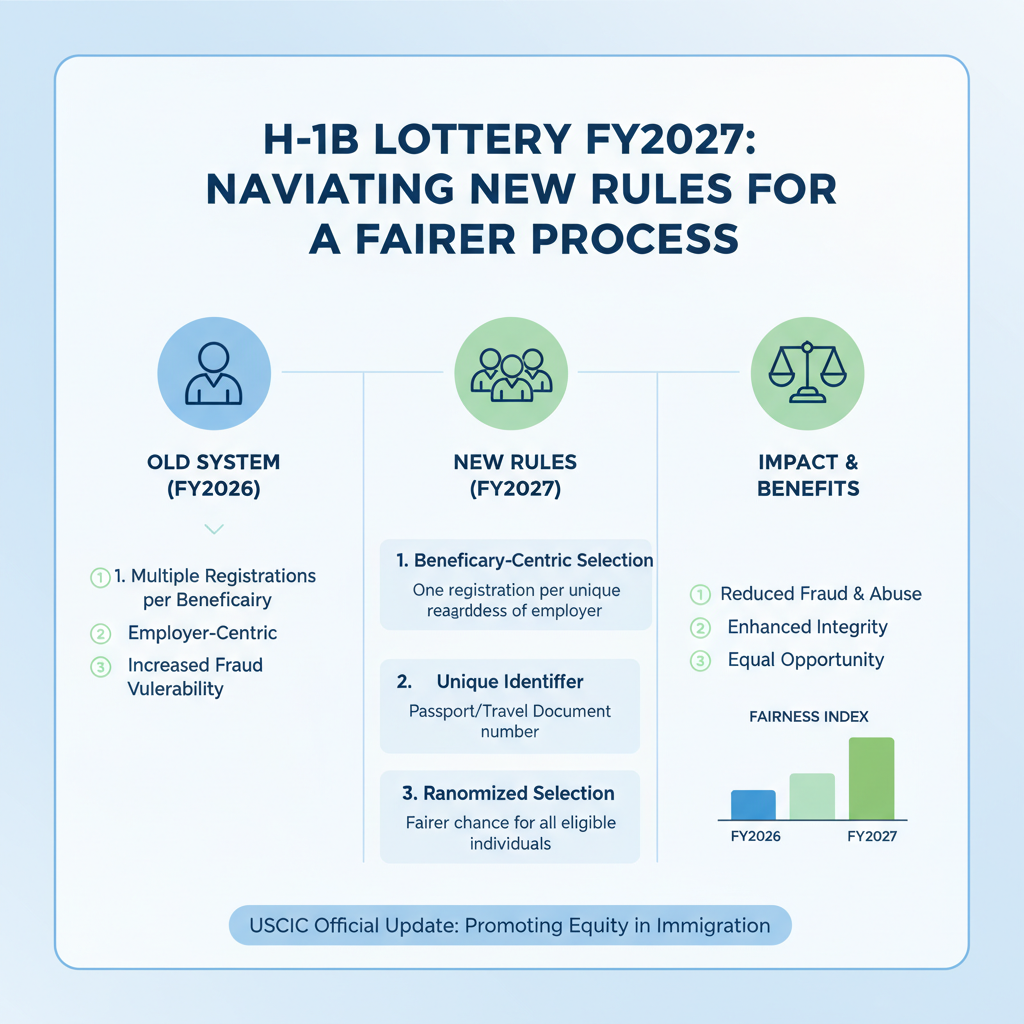
The "H-1B Visa Lottery Changes for FY2027" refers to the significant modifications implemented by USCIS to this annual selection process. Primarily, these changes involve a shift from an "employer-centric" selection to a "beneficiary-centric" one, coupled with enhanced measures to detect and deter fraud. This means that instead of each employer registration counting as one entry, each unique beneficiary (the foreign worker) now gets only one entry into the lottery, regardless of how many employers register on their behalf. This aims to create a fairer system where every eligible individual has an equal chance.
Key terms you need to know
Understanding these terms is crucial when discussing the H-1B program and its recent changes:
- Beneficiary: The foreign national worker who is seeking the H-1B visa.
- Petitioner: The U.S. employer who is sponsoring the foreign national for the H-1B visa.
- Specialty Occupation: An occupation that requires a theoretical and practical application of a body of highly specialized knowledge, and a bachelor's or higher degree in the specific specialty (or its equivalent) as a minimum for entry into the occupation in the United States.
- Annual Cap: The congressionally mandated limit on the number of H-1B visas issued each fiscal year. The current annual cap is 65,000, with an additional 20,000 visas reserved for those with a U.S. master's degree or higher (the "master's cap").
- Lottery/Random Selection: The process USCIS uses to select enough H-1B registrations to meet the annual cap when demand exceeds availability.
- Cap-Subject: H-1B petitions that are subject to the annual cap. Most private sector petitions fall into this category.
- Cap-Exempt: Certain H-1B petitions are exempt from the annual cap. This typically includes beneficiaries employed by institutions of higher education, related non-profit entities, or non-profit research organizations, or governmental research organizations.
- Labor Condition Application (LCA): Form ETA-9035. An application that employers must file with the U.S. Department of Labor (DOL) before filing an H-1B petition with USCIS. It attests to certain conditions, including paying the H-1B worker at least the prevailing wage or the actual wage paid to similarly qualified workers, whichever is higher.
- Prevailing Wage: The average wage paid to similarly employed workers in a specific occupation in the geographic area of intended employment.
- Beneficiary-Centric Selection: The new selection process where each unique beneficiary is entered into the lottery only once, regardless of the number of registrations submitted on their behalf by different employers. This is a key change for FY2027.
- H-1B Registration: The initial online process where prospective petitioners (employers) submit basic information about the company and the beneficiary to enter the lottery. This takes place annually, usually in March.
- Selection Notice: The notification sent by USCIS to petitioners whose registrations have been selected in the lottery, granting them the opportunity to file a full H-1B petition.
Current Immigration Law: The H-1B Foundation
The H-1B visa program is authorized under the Immigration and Nationality Act (INA), specifically INA Section 101(a)(15)(H)(i)(b), which defines the H-1B nonimmigrant classification, and INA Section 214(g), which establishes the annual numerical limitations (the cap). The regulations governing the H-1B program are found in 8 CFR Part 214.2(h).
The recent changes for FY2027 were implemented through a final rule published by USCIS, titled "Improving the H-1B Program," which became effective on January 29, 2024. This rule codified the beneficiary-centric selection process and strengthened program integrity measures, impacting the FY2025 lottery and subsequent lotteries, including FY2027.
Federal requirements
To qualify for an H-1B visa, both the employer (petitioner) and the foreign worker (beneficiary) must meet specific federal requirements:
For the Employer (Petitioner):
- Specialty Occupation: The employer must demonstrate that the position offered qualifies as a specialty occupation, meaning it requires theoretical and practical application of a body of highly specialized knowledge and a bachelor's degree or higher (or its equivalent) as a minimum for entry into the occupation.
- Employer-Employee Relationship: A valid employer-employee relationship must exist between the petitioner and the beneficiary.
- Labor Condition Application (LCA): The employer must file and obtain a certified LCA (Form ETA-9035) from the U.S. Department of Labor before filing the H-1B petition. The LCA attests that the employer will:
- Pay the H-1B worker at least the prevailing wage for the occupational classification in the area of employment or the actual wage paid to other employees with similar experience and qualifications, whichever is higher.
- Provide working conditions that will not adversely affect the working conditions of U.S. workers similarly employed.
- There is no strike or lockout in the occupational classification at the place of employment.
- Notice of the LCA filing has been provided to employees.
- Employer Identification Number (EIN): The employer must have a valid EIN.
For the Foreign Worker (Beneficiary):
- Specialty Occupation Qualifications: The beneficiary must possess qualifications that meet the requirements of the specialty occupation, typically a bachelor's degree or its equivalent in the specific field. Equivalence can be demonstrated through a combination of education, specialized training, and/or work experience.
- Licensure (if applicable): If the occupation requires a state license to practice, the beneficiary must possess that license. For example, medical professionals in Florida would need a Florida medical license.
- No Prior H-1B Cap-Exemption: Unless exempt, the beneficiary must not have already used their full six years of H-1B status under the cap (though extensions are possible under certain circumstances).
All H-1B petitions are filed with USCIS using Form I-129, Petition for a Nonimmigrant Worker. Employers seeking premium processing for faster adjudication (if available) also file Form I-907, Request for Premium Processing Service.
For official information and detailed requirements, always refer to the USCIS official website.
Florida-specific considerations
While federal law governs the H-1B program, local economic and industry factors in Florida can influence its application:
- Industry Demand: Florida's growing sectors, such as information technology, aerospace, healthcare, and advanced manufacturing, create significant demand for H-1B workers. Tech companies in Orlando, medical facilities, and even the hospitality sector (for specialized management or IT roles) frequently sponsor H-1B visas.
- Prevailing Wage Levels: The prevailing wage is determined by the geographic area. For instance, the prevailing wage for a software developer in Orlando, Florida, might differ from that in Miami or a rural part of the state. Employers must ensure they are meeting the specific prevailing wage for their location.
- Educational Institutions: Florida boasts numerous universities and colleges, such as the University of Central Florida (UCF) in Orlando, the University of Florida, and Florida State University. Graduates from these institutions, particularly those with master's degrees, are often highly sought after by Florida employers for H-1B sponsorship and may qualify for the master's cap.
- Local USCIS Field Offices: While H-1B petitions are processed by specific USCIS Service Centers, the Orlando USCIS Field Office may handle certain ancillary services or interviews if a beneficiary is undergoing a change of status and has local issues. However, the primary adjudication occurs at the service centers.
- State Licensing Boards: For occupations requiring state licensure (e.g., nurses, physical therapists, engineers, architects), Florida's specific licensing boards will have their own requirements that must be met *before* the H-1B worker can practice in the state. This is a crucial step that runs parallel to the immigration process.
Don't risk your H-1B application. Our experienced immigration lawyers understand the nuances of federal and Florida-specific requirements. Contact Imigrar for a free consultation at +1 786-791-3106. Se Habla Español.
How to Navigate the H-1B Lottery Changes for FY2027: A Complete Step-by-Step Guide
The H-1B lottery process for FY2027 has concluded its registration and selection phases. This guide focuses on understanding the rules that governed it and preparing for the subsequent petition filing, or for future cycles.
1) Understand the New Rules for FY2027: Beneficiary-Centric Selection and Anti-Fraud Measures
The most crucial change is the shift to beneficiary-centric selection. For the FY2027 lottery, if a beneficiary had multiple registrations submitted on their behalf by different employers, they were still entered into the lottery only once. USCIS used the beneficiary's valid passport or travel document information to identify unique individuals. This means the advantage of multiple registrations is gone, leveling the playing field.
Key Takeaway: Employers should only register beneficiaries with whom they have a legitimate job offer and intent to employ. Beneficiaries should be transparent with all potential employers about other registrations to avoid any perceived fraud, though under the new rules, this simply means their entry won't be duplicated.
Required Documents/Information for this step (Conceptual):
- Review of USCIS official guidance on the "Improving the H-1B Program" final rule.
- Internal employer policies for H-1B sponsorship.
- Beneficiary's valid passport information.
2) Employer Verifies Eligibility and Prepares LCA (Form ETA-9035)
Before any H-1B registration or petition can be filed, the employer must ensure both the position and the beneficiary meet the H-1B specialty occupation requirements. This involves a thorough assessment of the job duties, required qualifications, and the beneficiary's academic credentials and experience. Once eligibility is confirmed, the employer must file a Labor Condition Application (LCA), Form ETA-9035, with the U.S. Department of Labor (DOL).
Important: The LCA must be certified by the DOL before the H-1B petition (Form I-129) can be filed with USCIS. The LCA includes attestations regarding wages and working conditions.
Required Documents for this step:
- Detailed job description for the specialty occupation.
- Beneficiary's academic transcripts, diplomas, and degree evaluations (if foreign degree).
- Beneficiary's resume/CV documenting work experience.
- Employer's wage records for similarly employed U.S. workers.
- Prevailing wage determination (often obtained from DOL's Foreign Labor Certification Data Center or private wage surveys).
- Employer's Federal Employer Identification Number (EIN).
3) Beneficiary and Employer Register for the Lottery (Online through USCIS Portal)
This step typically occurs in March each year. For FY2027, the registration period was likely in March 2026. Employers, or their authorized representatives (like Imigrar), created a USCIS online account and submitted an electronic registration for each prospective H-1B beneficiary. A registration fee (currently $10, though USCIS has proposed increasing it for future cycles) was paid for each submission.
Reminder: Under the new rules, employers must provide the beneficiary's valid passport or travel document information. This is critical for USCIS to identify unique beneficiaries and prevent multiple entries for the same person.
Required Information for this step:
- Employer's legal name, EIN, and address.
- Employer's authorized signatory information.
- Beneficiary's full legal name, date of birth, country of birth, country of citizenship.
- Beneficiary's valid passport number or other valid travel document number.
- Beneficiary's gender.
- Whether the beneficiary qualifies for the U.S. master's cap.
- Registration fee payment.
4) Await Lottery Results (Selection Notice)
After the registration period closes, USCIS conducts the random selection process. For FY2027, selection notifications were made by March 31, 2026. Employers whose registrations were selected received a "Selection Notice" in their USCIS online account. This notice indicates that they are eligible to file an H-1B cap-subject petition for the named beneficiary.
Warning: A selection notice does NOT mean the H-1B visa is approved. It only grants permission to file the full petition.
Required Documents/Information for this step (Post-Selection):
- USCIS Selection Notice (printout from online account).
5) File the H-1B Petition (Form I-129, Supporting Documents)
If a registration is selected, the employer then has a specific filing window (typically 90 days from the selection date) to submit the complete H-1B petition package to USCIS. This includes Form I-129, Petition for a Nonimmigrant Worker, the certified LCA, and extensive supporting documentation.
Important: The petition must be filed by the employer who submitted the selected registration. Petitions filed by an employer who did not receive a selection notice for that beneficiary will be rejected.
Required Documents for this step:
- Form I-129, completed and signed.
- Certified Form ETA-9035 (LCA).
- USCIS Selection Notice.
- Educational documents: Diplomas, transcripts, foreign degree evaluations.
- Beneficiary's resume/CV.
- Letters of experience from previous employers.
- Employer support letter detailing the job offer, specialty occupation justification, and terms of employment.
- Company financial documents (e.g., tax returns, annual reports) to demonstrate ability to pay wage.
- Articles of incorporation, business licenses (for employer).
- Organizational charts.
- Contracts with clients (if applicable, especially for consulting firms).
- Beneficiary's passport biographical page, previous visa stamps, I-94 records.
- Filing fees for Form I-129, American Competitiveness and Workforce Improvement Act (ACWIA) fee, Fraud Prevention and Detection Fee (if applicable), and Public Law 114-113 fee (if applicable).
6) Premium Processing (Optional, Form I-907)
Employers can elect to pay an additional fee for premium processing, using Form I-907, Request for Premium Processing Service. This guarantees USCIS will take action on the petition (approve, deny, RFE, or NOID) within 15 calendar days. This option is highly recommended for those needing a quicker decision, but it does not affect the lottery selection itself.
Required Documents for this step:
- Form I-907, completed and signed.
- Premium processing fee payment.
7) Decision and Next Steps (Change of Status, Consular Processing)
After USCIS reviews the petition, they will issue a decision. Possible outcomes include:
- Approval: If approved, and the beneficiary is already in the U.S. on a valid nonimmigrant status, their status may be changed to H-1B effective October 1, 2026 (for FY2027 petitions). If the beneficiary is outside the U.S., they will need to attend a visa interview at a U.S. embassy or consulate abroad (consular processing) to obtain the H-1B visa stamp in their passport.
- Request for Evidence (RFE): USCIS may ask for additional information or documents if the initial petition is not clear or complete. Responding to an RFE requires careful attention and often legal guidance.
- Notice of Intent to Deny (NOID): A NOID indicates USCIS intends to deny the petition but gives the petitioner an opportunity to submit a rebuttal.
- Denial: If denied, the petitioner may have options to appeal or refile, depending on the reason for denial.
Reminder: For those undergoing a change of status in the U.S., the earliest an H-1B status can begin is October 1st of the fiscal year for which the petition was approved. For FY2027, this means October 1, 2026.
Required Documents for this step (Post-Approval):
- USCIS Approval Notice (Form I-797).
- For consular processing: Passport, DS-160 confirmation, interview appointment letter, supporting documents as requested by the embassy/consulate.

Practical Steps You Can Take Today
Even though the FY2027 lottery registration has passed, there are still crucial steps you can take, whether you were selected, are awaiting a decision, or planning for future H-1B cycles.
Feeling overwhelmed by the H-1B process? Let Imigrar simplify it for you. We provide expert guidance and support every step of the way. Call us today for a free consultation: +1 786-791-3106. Se Habla Español.
Actionable Checklist:
- Review Your Selection Status (if applicable): If you were part of the FY2027 lottery, ensure you know your status. If selected, confirm your employer has received the selection notice and is preparing the petition within the 90-day filing window.
- Gather All Required Documents: Proactively collect all educational transcripts, diplomas, foreign degree evaluations, resumes, and letters of experience. For employers, gather company financials, job descriptions, and client contracts. Having these ready expedites the petition filing process.
- Consult with an Immigration Attorney: This is arguably the most important step. An expert attorney can assess your eligibility, review your documents, ensure compliance with the new rules, and strategize the strongest possible petition. This is especially vital for navigating complex RFEs or potential denials.
- Understand LCA Requirements: Employers should verify their internal processes for determining prevailing wages and ensuring compliance with LCA attestations. This includes posting notice of the LCA and maintaining public access files.
- Stay Informed on USCIS Updates: Regularly check the USCIS official website for any further announcements, fee changes, or policy updates that might affect current or future H-1B cycles.
- Plan for Potential Consular Processing: If you are outside the U.S. or plan to travel, understand the consular processing procedures at the U.S. Department of State website.
- Consider Alternatives: If not selected, discuss alternative visa options with your employer and attorney (e.g., O-1 for extraordinary ability, L-1 for intracompany transfers, E-3 for Australians, TN for Canadians/Mexicans, or F-1 OPT extensions).
Document Preparation Guidance:
- Accuracy is Key: Ensure all information on forms and supporting documents is accurate and consistent. Discrepancies can lead to RFEs or denials.
- Translations: Any document not in English must be accompanied by a certified English translation.
- Organize Meticulously: USCIS prefers well-organized petitions. Use tabs, cover sheets, and a clear table of contents to make your submission easy to review.
- Photocopies: Generally, submit clear photocopies of documents unless originals are specifically requested. Keep your own set of originals and copies.
Timeline Expectations:
- LCA Certification: Typically takes 7-10 business days for DOL to certify.
- H-1B Petition Filing Window: If selected in the lottery, employers usually have a 90-day window to file the full petition. For FY2027, this window likely started around April 1, 2026, and would extend into late June/early July 2026.
- USCIS Processing Times: Standard processing for Form I-129 can range from 3 to 10 months or even longer,


