


The landscape of U.S. immigration is constantly evolving, and for skilled professionals seeking to work in the United States, few changes are as impactful as those affecting the H-1B visa program. As we look ahead to the Fiscal Year (FY) 2027 H-1B lottery, significant rule adjustments are set to reshape the application process, particularly focusing on fairness and integrity. For individuals and employers in Orlando, across Florida, and nationwide, understanding these shifts is not just beneficial—it’s absolutely essential.
At Imigrar, we believe in keeping families together by providing clear, actionable legal guidance. This comprehensive guide breaks down the latest H-1B visa lottery changes, offering practical advice, timelines, and official references to help you navigate this complex process successfully.
Need Help? Our Orlando immigration team is ready to assist. Call +1 786-791-3106 for a free consultation, or message us online. Se Habla Español.
The reporting that sparked this guide
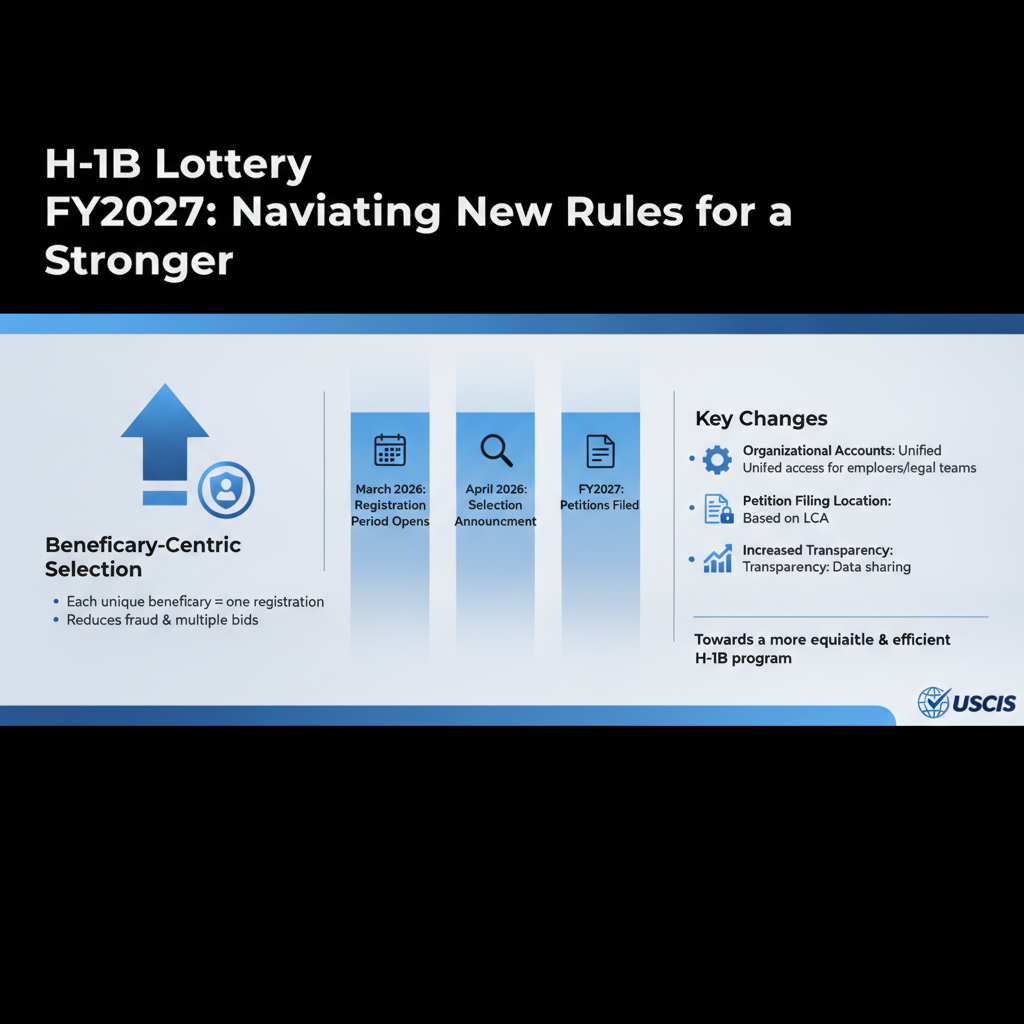
This comprehensive guide is informed by recent discussions and announcements regarding critical updates to the H-1B visa lottery system, reflecting a continued effort by U.S. Citizenship and Immigration Services (USCIS) to enhance fairness and reduce fraud within the program. While specific regulations for FY2027 are still pending their final official release, the direction of these changes has been clearly signaled by USCIS’s recent actions and proposed rules. We monitor these developments closely to provide the most current and accurate information. For ongoing news and updates, you can refer to:
H-1B Visa Lottery Changes for FY2027 (Legal News)
What This News Means for Immigrants in Orlando and Across Florida
Why this news is showing up now
As of July 15, 2026, the discussions around the H-1B visa lottery for Fiscal Year 2027 are gaining significant traction. This timing is typical as USCIS usually finalizes and announces changes well in advance of the next registration period. The H-1B fiscal year begins on October 1st, and the lottery registration period traditionally opens in early March of the calendar year it precedes. For FY2027, this means the registration is expected to open in early March 2027. The current news cycle is a critical window for potential beneficiaries and employers to understand and prepare for the upcoming changes, especially given the significant reforms recently implemented by USCIS to combat fraud and improve the integrity of the lottery process. These reforms, initially rolled out for FY2025 and continued for FY2026, are expected to be solidified and possibly expanded for FY2027.
How it can affect Florida residents
Florida, particularly the Orlando and Central Florida region, is a hub for innovation, technology, tourism, and healthcare. Companies along the I-4 corridor, including major tech firms, theme parks, and medical research institutions, heavily rely on the H-1B program to bring in specialized talent that fills critical skill gaps. For residents in Orlando, Tampa, Miami, and other parts of the Sunshine State who are either H-1B hopefuls or employers sponsoring such visas, these changes have direct implications:
- Increased Fairness for Beneficiaries: The shift to a beneficiary-centric selection process (explained below) means that each individual H-1B registrant will have an equal chance, regardless of how many employers register them. This directly benefits qualified individuals in Florida by leveling the playing field.
- Enhanced Scrutiny for Employers: Florida employers, especially those who may have historically relied on multiple registrations for the same individual, will need to adjust their strategies. USCIS is implementing stronger anti-fraud measures, requiring more diligent compliance.
- Preparation is Key: For both individuals working in Florida on other nonimmigrant visas (like F-1 OPT) and Florida-based companies, understanding the new registration requirements and deadlines for FY2027 is crucial for a successful application cycle.
- Impact on Local Talent Pool: The H-1B program directly impacts the availability of specialized foreign talent in Florida's key industries, influencing economic growth and innovation within the state.
The Orlando USCIS Field Office, while primarily handling family-based petitions and naturalization applications, is part of the broader federal system that adjudicates H-1B petitions. Understanding federal changes is paramount, as they directly influence how petitions are prepared and processed nationwide.
What H-1B Visa Lottery Changes for FY2027 Is (and Why It Matters)
A plain-English definition
The H-1B visa program allows U.S. employers to temporarily employ foreign workers in specialty occupations. These occupations generally require a bachelor's degree or higher in a specific field. Examples include IT professionals, engineers, scientists, and certain healthcare workers. Due to high demand, USCIS holds an annual lottery because the number of petitions typically far exceeds the congressionally mandated annual cap of 65,000 visas, plus an additional 20,000 for those with a U.S. master’s degree or higher (the "master's cap").
The "changes" for FY2027 primarily refer to significant reforms USCIS has implemented to combat fraud and ensure that the lottery process is fair and equitable for all eligible beneficiaries. The most prominent change is the shift from an employer-centric selection process to a beneficiary-centric selection process. This means that selections are now made based on each unique beneficiary, rather than on each registration submitted by an employer on behalf of a beneficiary. This is a critical distinction that aims to prevent multiple registrations for the same individual by different employers from inflating their chances of selection.
Key terms you need to know
- H-1B Visa: A nonimmigrant visa that allows U.S. employers to temporarily employ foreign workers in specialty occupations.
- Specialty Occupation: An occupation that requires a theoretical and practical application of a body of highly specialized knowledge, and a bachelor's or higher degree in the specific specialty (or its equivalent) as a minimum for entry into the occupation in the United States.
- Cap-Subject H-1B: Refers to H-1B petitions that are subject to the annual statutory cap. Most new H-1B petitions fall under this category.
- Cap-Exempt H-1B: Certain employers are exempt from the annual cap, such as institutions of higher education, non-profit organizations affiliated with higher education, and government research organizations.
- Fiscal Year (FY): The U.S. government's fiscal year runs from October 1st to September 30th. For H-1B, visas approved for FY2027 typically allow employment to begin on October 1, 2027.
- Beneficiary: The foreign national worker for whom the H-1B petition is filed.
- Petitioner: The U.S. employer filing the H-1B petition on behalf of the beneficiary.
- H-1B Registration Period: The specific window (usually in March) when prospective petitioners (employers) must electronically register each beneficiary they wish to sponsor for the H-1B lottery.
- Lottery Selection: The process by which USCIS randomly selects enough registrations to meet the annual H-1B cap.
- Unique Beneficiary Identification: A key aspect of the new rules, requiring specific, verifiable passport information for each beneficiary to prevent duplicate entries.
- Cap Gap: A provision that allows certain F-1 students with H-1B petitions filed on their behalf to extend their F-1 status and employment authorization until October 1st.
The shift to a beneficiary-centric selection process is the most significant change. Previously, if multiple employers registered the same individual, each registration was treated equally in the lottery. This allowed for a higher statistical chance of selection for those with multiple job offers. Now, USCIS will consider each unique beneficiary only once, regardless of how many employers register them. If a beneficiary is selected, all employers who registered them will be notified, and any one of those employers can then file a petition on the beneficiary's behalf. This change aims to drastically reduce the incentive for fraudulent or abusive multiple registrations and ensures that every individual has a truly equal shot at selection.
Additionally, USCIS has increased filing fees for certain forms and implemented more robust integrity measures, including enhanced data sharing and site visits, to detect and deter fraud throughout the H-1B program.
Need Help? Our Orlando immigration team is ready to assist. Call +1 786-791-3106 for a free consultation, or message us online. Se Habla Español.
Current Immigration Law: The Foundation
The H-1B visa program is governed by the Immigration and Nationality Act (INA), primarily found under INA §101(a)(15)(H)(i)(b), which defines nonimmigrant workers in specialty occupations. Further regulations are detailed in 8 CFR Part 214.2(h). These legal frameworks establish the requirements for both the employer (petitioner) and the foreign worker (beneficiary).
Federal requirements
To qualify for an H-1B visa, both the position and the beneficiary must meet specific criteria:
For the Position (Specialty Occupation):
- The job requires a bachelor's degree or higher in a specific field, or its equivalent.
- The degree requirement is common for the industry in similar positions, or the job is so complex or unique that only a person with a degree can perform it.
- The employer normally requires a degree or its equivalent for the position.
- The nature of the specific duties is so specialized and complex that it requires theoretical and practical application of a body of highly specialized knowledge.
For the Beneficiary:
- Possess a U.S. bachelor's or higher degree required by the specialty occupation from an accredited college or university.
- Hold a foreign degree that is determined to be equivalent to a U.S. bachelor's or higher degree.
- Hold a state license that is required to practice a specialty occupation and be performing that specialty occupation in the state of licensure.
- Have work experience in the specialty occupation that is recognized as equivalent to a bachelor's degree or higher. (Generally, three years of progressive work experience is considered equivalent to one year of college education).
Employers must also demonstrate the ability to pay the required wage to the H-1B worker and adhere to labor condition application (LCA) requirements, ensuring that H-1B workers are paid at least the prevailing wage for their occupation in the area of intended employment, or the actual wage paid to other employees with similar experience and qualifications, whichever is higher.
The primary form used for H-1B petitions is Form I-129, Petition for a Nonimmigrant Worker. This form is filed by the U.S. employer on behalf of the foreign national.
For official information and detailed guidance, always refer to the USCIS official website.
Florida-specific considerations
While H-1B laws are federal, their application can have state-level nuances. Florida's robust economy and diverse industries mean a wide range of companies seek H-1B talent. For instance:
- Tech Sector: Companies in Orlando's "Medical City" or Tampa's growing tech parks frequently sponsor H-1B visas for software engineers, data scientists, and IT specialists.
- Healthcare: Hospitals and medical facilities across Florida utilize H-1B for specialized medical professionals, researchers, and physical therapists.
- Education: Florida's numerous universities, such as the University of Central Florida in Orlando, are often cap-exempt for their H-1B employees, allowing them to hire foreign faculty and researchers outside the lottery system.
Employers in Florida must ensure they comply with both federal H-1B regulations and any relevant state labor laws. The prevailing wage determination is localized, meaning wages will vary based on the specific metropolitan statistical area (MSA) within Florida where the H-1B worker will be employed (e.g., Orlando-Kissimmee-Sanford MSA vs. Miami-Fort Lauderdale-Pompano Beach MSA). Consulting with an experienced immigration attorney, especially one familiar with the Florida job market, is crucial for accurate wage determination and compliance.
How to Navigate the New H-1B Lottery System: A Complete Step-by-Step Guide
The FY2027 H-1B lottery process, building on recent reforms, requires meticulous preparation from both employers and beneficiaries. Here’s a detailed step-by-step guide:
1) Understand the New Rules and Eligibility
Before anything else, familiarize yourself with the core changes, especially the beneficiary-centric selection process. This means that each beneficiary will be entered into the lottery only once, regardless of how many employers register them. If selected, any employer who registered that beneficiary can proceed with filing a petition.
Beneficiary Eligibility: Ensure the foreign national meets the educational or experience requirements for a specialty occupation.
Employer Eligibility: The U.S. employer must have a valid U.S. federal employer identification number (EIN) and offer a position that qualifies as a specialty occupation.
Reminder: For FY2027, USCIS will require the beneficiary’s valid passport or travel document information during registration. This is crucial for verifying unique beneficiary identification.
2) Employer and Employee Preparation
This phase involves gathering necessary information and ensuring all parties are ready for the registration window.
For the Employer (Petitioner):
- Identify the specific specialty occupation position and confirm it meets H-1B requirements.
- Determine the proposed wage and ensure it meets or exceeds the prevailing wage for the occupation and location (e.g., Orlando, FL).
- Gather company information: legal name, EIN, address, contact person.
- Prepare to pay the H-1B registration fee (currently $10 per registration, though this fee is subject to change for FY2027).
For the Employee (Beneficiary):
- Provide the employer with a valid passport or travel document information. This is now mandatory for registration.
- Share educational documents (degrees, transcripts) and professional licenses.
- Provide a detailed resume/CV outlining work experience.
- Ensure all personal information (name, date of birth, country of birth, citizenship) is accurate and consistent across all documents.
Important: The beneficiary should only submit their information to employers with genuine job offers. Under the new rules, USCIS is actively monitoring for fraudulent registrations.
3) H-1B Electronic Registration Process (Early March 2027)
This is the initial step for cap-subject H-1B petitions.
- Timeline: The registration period for FY2027 is expected to open in early March 2027 and typically lasts for about two to three weeks. USCIS will announce the exact dates.
- Process: The prospective employer (petitioner) must create a USCIS online account if they don't already have one.
- Data Required: For each beneficiary, the employer must provide:
- Employer’s name, EIN, and contact information.
- Beneficiary’s full name, date of birth, country of birth, country of citizenship.
- Beneficiary’s valid passport or travel document number.
- Whether the beneficiary holds a U.S. master’s degree or higher.
- Fee: Submit the non-refundable registration fee for each beneficiary.
Warning: Multiple registrations by related entities for the same beneficiary are strictly prohibited under the new rules and can lead to denial or even fraud investigations. Each unique beneficiary can only be entered once into the lottery system.
4) Lottery Selection and Notification (Late March 2027)
After the registration period closes, USCIS conducts the lottery.
- Process: USCIS conducts the lottery, first selecting enough registrations to meet the master's cap, then selecting from the remaining master's and all bachelor's registrations to meet the regular cap.
- Notification: USCIS typically notifies selected employers (and their legal representatives) through their online accounts by the end of March. The status of the registration will change to "Selected." Non-selected registrations will show "Not Selected" or "Denied" (if there was an issue).
Reminder: If a beneficiary is selected, all employers who registered that beneficiary will see a "Selected" status. The beneficiary must then choose which employer to proceed with.
5) Filing the H-1B Petition (April 1, 2027, onwards)
Only employers with a "Selected" registration can file an H-1B petition.
- Timeline: The filing window usually begins on April 1, 2027, and extends for a 90-day window.
- Required Forms:
- Form I-129, Petition for a Nonimmigrant Worker
- Form I-129 H Classification Supplement
- Form I-129 Data Collection and Filing Fee Exemption Supplement
- Form I-907, Request for Premium Processing Service (optional, for expedited processing)
- Required Documents (Key Examples):
- Certified Labor Condition Application (LCA), Form ETA-9035.
- Beneficiary’s educational documents (degrees, transcripts, evaluations of foreign degrees).
- Beneficiary’s resume, letters of experience from previous employers.
- Copies of beneficiary’s passport, visa, I-94 record, and previous U.S. immigration documents (if applicable).
- Employer's business documents (company profile, financial statements, tax returns).
- Detailed job description, including duties, responsibilities, and required qualifications.
- Organizational charts and project plans demonstrating the specialty occupation nature of the role.
- Employer-employee agreement or offer letter.
- Evidence of employer's ability to pay the proffered wage.
- Any specific evidence requested by USCIS based on the new integrity measures.
Important: All documents must be accurate and consistent with the registration information. Discrepancies can lead to a Request for Evidence (RFE) or denial.
6) Petition Adjudication and Visa Stamping
After filing, USCIS reviews the petition.
- Adjudication: USCIS processes petitions. This can take several months for regular processing or 15 calendar days for premium processing (if requested and available).
- Approval: If approved, USCIS sends an I-797 Approval Notice.
- Consular Processing (for those outside the U.S.): Beneficiaries outside the U.S. must attend an interview at a U.S. embassy or consulate in their home country to obtain an H-1B visa stamp in their passport.
- Change of Status (for those inside the U.S.): If the beneficiary is already in the U.S. and the petition requested a change of status, their status will automatically change on October 1st.
7) Starting Employment (October 1, 2027)
The earliest an H-1B worker can begin employment under a new cap-subject petition is October 1st of the fiscal year for which the petition was approved.
- Arrival: If coming from abroad, the beneficiary can enter the U.S. up to 10 days before October 1st.
- Employment Start: Employment with the sponsoring employer can officially begin on October 1, 2027.
Need Help? Our Orlando immigration team is ready to assist. Call +1 786-791-3106 for a free consultation, or message us online. Se Habla Español.
Practical Steps You Can Take Today for the FY2027 H-1B Lottery
Preparation is paramount, especially with the new beneficiary-centric rules and enhanced scrutiny. Here’s an actionable checklist:
- Verify Beneficiary Eligibility: Ensure the foreign national genuinely meets the educational and experience requirements for a specialty occupation. Review their resume, transcripts, and any professional licenses. For those currently on F-1 OPT in Orlando, confirm their OPT expiration date relative to the October 1, 2027 H-1B start date for cap-gap eligibility.
- Secure a Genuine Job Offer: For beneficiaries, focus on securing a legitimate job offer from a U.S. employer. For employers, ensure the job offered truly qualifies as a specialty occupation and that you intend to employ the individual.
- Gather Essential Documents Now:
- Beneficiary: Valid passport, birth certificate, marriage certificate (if applicable), all educational degrees and transcripts (U.S. and foreign), foreign degree evaluations, professional licenses, detailed resume, and any prior U.S. visa documents (I-20s, EADs, I-797s).
- Employer: Company formation documents, EIN verification, financial statements, office lease, detailed job description, and organizational charts.
- Consult an Experienced Immigration Attorney: This is arguably the most crucial step. An attorney from Imigrar can assess eligibility, guide both employer and beneficiary through the new rules, ensure compliance with anti-fraud measures, and meticulously prepare all documentation. This is especially vital for employers in Central Florida navigating prevailing wage requirements and ensuring specialty occupation definitions are met.
- Plan for Timelines and Costs: Understand the expected registration period (March 2027) and filing window (April 2027). Factor in USCIS filing fees (which have recently increased for Form I-129 and other forms, and may be adjusted again for FY2027), legal fees, and potential premium processing fees.
- Review Public Data for Prevailing Wages: Employers in Orlando should review the Department of Labor’s Foreign Labor Certification Data Center to understand prevailing wage levels for their specific occupation and geographic location.
- Stay Informed: Regularly check official USCIS announcements. Subscribing to updates from reputable immigration law firms like Imigrar can keep you abreast of any last-minute changes or clarifications.
Timeline Expectations (Estimated for FY2027):
- Late 2026: USCIS announces final rules and specific dates for FY2027 H-1B cap season.
- Early March 2027: H-1B electronic registration period opens.
- Late March 2027: Lottery selection results announced.
- April 1, 2027 – June 30, 2027 (approx.): H-1B petition filing window for selected registrations.
- October 1, 2027: Earliest H-1B employment start date for approved petitions.
Document Preparation Guidance:
Organize all documents systematically. Create digital copies and keep originals secure. For foreign documents, ensure certified English translations are obtained. Any work experience used to substitute for a degree must be meticulously documented with detailed letters from previous employers. Accuracy and completeness are key to avoiding RFEs and potential denials.

How Imigrar Helps Immigrants in Orlando and Nationwide
At Imigrar, our mission is to "Keep Families Together." We understand the hopes and anxieties that come with navigating the U.S. immigration system, especially complex processes like the H-1B lottery. Based in Orlando, Florida, we proudly serve clients nationwide, offering expert legal guidance in both English and Spanish (Se Habla Español).
Our experienced immigration attorneys specialize in employment-based visas, including the H-1B program. We are intimately familiar with the latest USCIS regulations, including the beneficiary-centric selection process and enhanced anti-fraud measures for FY2027. We work diligently to provide:
- Comprehensive Eligibility Assessment: We evaluate both the employer's and beneficiary's qualifications to ensure they meet the stringent H-1B requirements, including specialty occupation criteria and prevailing wage compliance for your specific location, whether in Orlando, Miami, or across the country.
- Strategic Guidance: We advise employers on best practices for H-1B sponsorship under the new rules, helping to avoid common pitfalls and ensure compliance. For beneficiaries, we help clarify expectations and gather necessary documentation.
- Meticulous Registration and Petition Preparation: Our team ensures that all electronic registrations are accurately completed, and if selected, we meticulously prepare and file Form I-129 and all supporting documents, minimizing the risk of RFEs or denials.
- Proactive Communication: We keep you informed at every stage of the process, from registration to adjudication, providing clarity and peace of mind.
- Fraud Prevention: We guide clients through USCIS's increased scrutiny, helping to build strong, verifiable cases that demonstrate genuine intent and qualifications.
Don


Have Questions About Your Case?
Schedule a free consultation with our attorney-reviewed team today