


Welcome to Imigrar, your trusted immigration law firm based in Orlando, Florida. We are dedicated to keeping families together and empowering individuals to achieve their American dreams. Today, we delve into significant updates concerning the H-1B visa lottery for Fiscal Year 2027, news that has critical implications for skilled foreign workers and employers nationwide, including here in the Sunshine State.
The reporting that sparked this guide
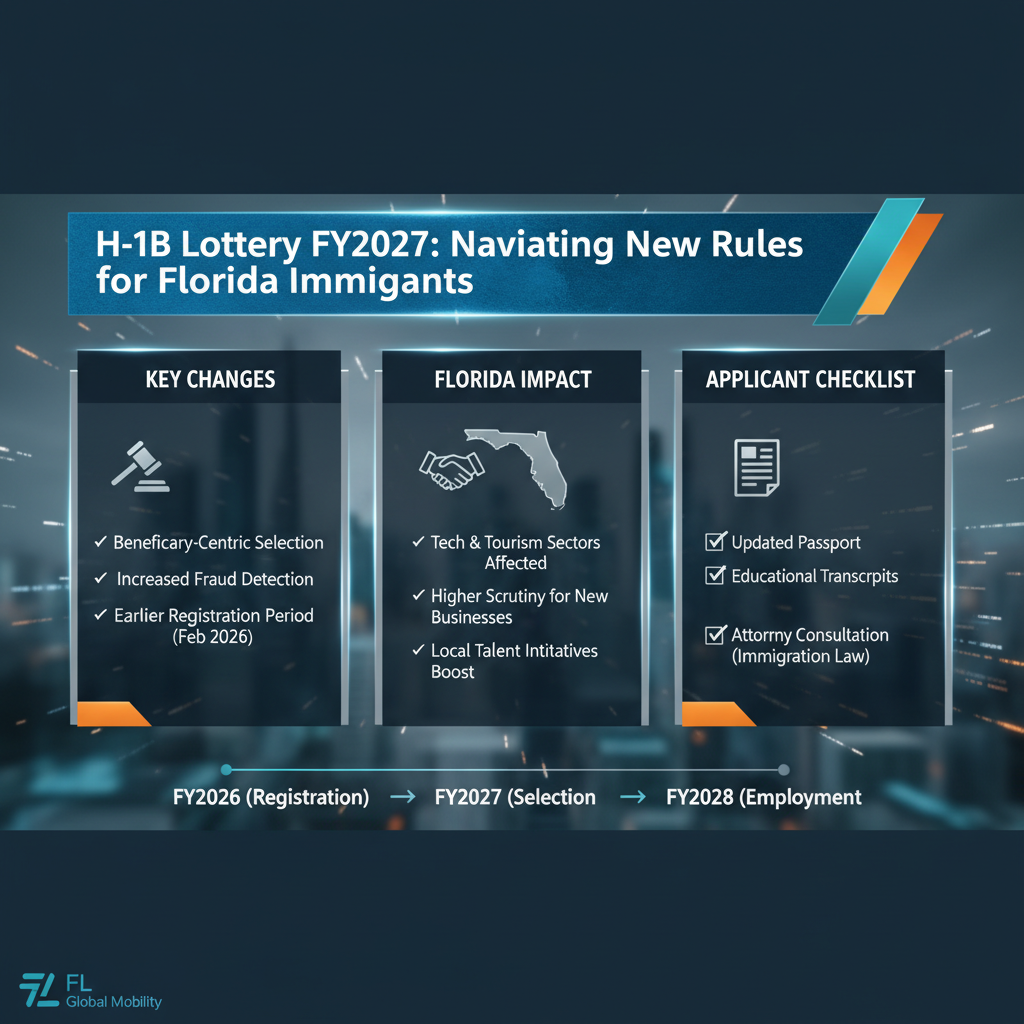
Our comprehensive guide is inspired by recent developments in immigration law, particularly concerning the H-1B visa program. We track these updates closely to provide timely and accurate information to our clients and the wider immigrant community.
H-1B Visa Lottery Changes for FY2027 (Legal News)What This News Means for Immigrants in Orlando and Across Florida
The H-1B visa program is a cornerstone for many skilled professionals seeking to work in the U.S. and for American companies needing specialized talent. The changes announced for the FY2027 H-1B lottery are not merely procedural; they represent a fundamental shift designed to enhance fairness and integrity. For immigrants and employers in Florida, understanding these updates is paramount to successful planning and application.
Why this news is showing up now
As of April 2, 2026, discussions and official announcements regarding the H-1B visa lottery for Fiscal Year 2027 are at the forefront for several reasons. USCIS typically finalizes rules and policy updates well in advance of the annual H-1B cap registration period, which usually opens in March. The agency has been committed to addressing concerns about fraud and abuse in the H-1B program, particularly regarding multiple registrations for the same beneficiary. The beneficiary-centric selection process, which debuted for the FY2025 lottery and was fully embraced for FY2026, is now the established norm, and any further refinements or fee adjustments for FY2027 are being communicated. This proactive communication allows employers and prospective H-1B workers to prepare meticulously for the upcoming lottery cycle, ensuring compliance and maximizing their chances of selection.
How it can affect Florida residents
Florida, with its booming tech industry, growing healthcare sector, and vibrant tourism and hospitality businesses, is a significant hub for H-1B professionals. Cities like Orlando, Tampa, Miami, and Jacksonville attract a diverse pool of talent in IT, engineering, finance, and other specialty occupations. The changes to the H-1B lottery directly impact:
- Prospective H-1B workers in Florida: If you are an international student graduating from a Florida university (like UCF, UF, or FIU) on an F-1 visa with Optional Practical Training (OPT), or a professional already working in Florida on another nonimmigrant visa, these changes critically affect your strategy for securing an H-1B. The shift to a beneficiary-centric selection model means that your employer can only submit one registration on your behalf, regardless of how many job offers you might have. This emphasizes the importance of a strong, legitimate job offer and a well-prepared application.
- Florida employers: Tech companies, hospitals, and other businesses along the I-4 corridor and across the state rely on H-1B visas to fill highly specialized roles. The new rules demand greater diligence from employers to ensure their registrations are legitimate and comply with the single-beneficiary rule, preventing disqualification. It also means less competition from fraudulent multiple entries, potentially leveling the playing field for genuine employers.
- Overall immigration landscape in Central Florida: The integrity measures aim to restore public confidence in the H-1B program, ensuring that visas are allocated to the most qualified individuals and legitimate employers. For the Orlando USCIS Field Office and local immigration attorneys, these changes mean a renewed focus on accurate documentation and adherence to updated procedures.
Need Help? Our Orlando immigration team is ready to assist. Call +1 786-791-3106 for a free consultation, or message us online. Se Habla Español.
What H-1B Visa Lottery Changes for FY2027 Is (and Why It Matters)
The H-1B visa program allows U.S. employers to temporarily employ foreign workers in specialty occupations. These occupations generally require a bachelor's degree or higher in a specific field. Due to high demand, USCIS conducts a lottery to select petitions when the number of registrations exceeds the annual cap.
A plain-English definition
For Fiscal Year 2027 (which begins October 1, 2026), the H-1B visa lottery refers to the annual selection process conducted by U.S. Citizenship and Immigration Services (USCIS) to determine which employers can file H-1B petitions. The "changes" for FY2027 primarily solidify and reinforce the "beneficiary-centric" selection process, meaning that each unique beneficiary (the foreign worker) can only have one registration submitted on their behalf in a given lottery cycle. This is a significant departure from previous years where multiple employers could register the same beneficiary, which led to concerns about unfair advantages and potential fraud. The goal is to make the lottery fairer and increase the chances for genuine job offers to be selected.
Key terms you need to know
- H-1B Visa: A nonimmigrant visa that allows U.S. employers to temporarily employ foreign workers in specialty occupations.
- Specialty Occupation: An occupation that requires theoretical and practical application of a body of highly specialized knowledge and a bachelor's degree or higher in the specific specialty (or its equivalent) as a minimum for entry into the occupation in the United States.
- USCIS: U.S. Citizenship and Immigration Services, the government agency responsible for administering immigration and naturalization benefits.
- Beneficiary: The foreign worker who is the subject of the H-1B petition.
- Petitioner: The U.S. employer filing the H-1B petition on behalf of the beneficiary.
- Cap-Subject H-1B: H-1B petitions that are subject to the annual statutory numerical limits (caps). There are 65,000 regular cap visas and an additional 20,000 for those with a U.S. master's degree or higher (the "Master's Cap").
- H-1B Cap-Exempt: Certain employers (e.g., institutions of higher education, non-profit research organizations) are exempt from the annual cap.
- H-1B Registration Period: The designated period, typically in March, when employers must electronically register prospective H-1B beneficiaries with USCIS.
- Lottery Selection: The random selection process USCIS conducts when the number of registrations exceeds the available H-1B visas.
- LCA (Labor Condition Application): Form ETA-9035, filed with the Department of Labor, certifying that the employer will pay the H-1B worker at least the prevailing wage or the actual wage paid to other employees with similar qualifications, and that working conditions will not adversely affect other workers. This must be certified *before* filing the H-1B petition.
- Premium Processing: An expedited processing service offered by USCIS for certain petitions, including H-1B. For an additional fee, USCIS guarantees processing within 15 calendar days.
Current Immigration Law: The Foundation
The H-1B visa program is governed by the Immigration and Nationality Act (INA), primarily found in Section 101(a)(15)(H)(i)(b) and Section 214(g). These statutes establish the requirements for specialty occupations, the annual numerical cap, and the eligibility criteria for both employers and beneficiaries. Regulatory changes, such as those impacting the FY2027 lottery, are implemented through rulemaking by USCIS under the authority granted by the INA.
Important: Staying updated with the latest regulations directly from official sources is crucial. You can always verify information on the USCIS official website.
Federal requirements
To qualify for an H-1B visa, both the employer (petitioner) and the foreign worker (beneficiary) must meet specific federal requirements:
- For the Employer:
- Must offer a job in a specialty occupation.
- Must demonstrate an employer-employee relationship with the beneficiary.
- Must file and receive certification for a Labor Condition Application (LCA) (Form ETA-9035) from the U.S. Department of Labor (DOL) before filing the H-1B petition.
- Must pay the H-1B worker at least the prevailing wage for the occupation in the area of employment or the actual wage paid to other similarly qualified employees, whichever is higher.
- Must comply with all attestations made on the LCA.
- For the Beneficiary:
- Must possess a bachelor's degree or its equivalent, or a license in a specialty occupation field, or work experience equivalent to a bachelor's degree.
- The proposed employment must be in a specialty occupation.
- If currently in the U.S., must maintain a valid nonimmigrant status until the H-1B start date.
Florida-specific considerations
While H-1B requirements are federal, the practical application often has local nuances. In Florida:
- High Demand Industries: Orlando, Tampa, and Miami are major hubs for information technology, engineering, healthcare, finance, and aerospace. This means a high volume of H-1B petitions originating from employers in these sectors.
- University Graduates: Florida's robust university system (e.g., University of Central Florida, University of Florida, Florida International University) produces a large number of international graduates who are prime candidates for H-1B visas, particularly those pursuing STEM fields and utilizing OPT extensions.
- Prevailing Wage: The prevailing wage for a specific occupation can vary significantly by geographic location. Employers in Orlando, for instance, must ensure they are meeting the prevailing wage for Orange County or the specific metropolitan statistical area (MSA) as determined by the DOL.
- Local USCIS Engagement: While H-1B petitions are processed at service centers, the Orlando USCIS Field Office handles other immigration matters that may intersect with H-1B status, such as inquiries about dependent visas (H-4) or other status changes.
How to Navigate the New H-1B Lottery Process for FY2027: A Complete Step-by-Step Guide
The H-1B lottery process for FY2027, building on the integrity measures from previous years, requires meticulous preparation. Here’s a detailed guide to help you and your employer navigate it successfully.
1) Understand the New Rules & Eligibility for FY2027
The most significant change for FY2027 is the continued implementation of the beneficiary-centric selection process. This means that USCIS will select registrations based on the unique beneficiary, regardless of the number of registrations submitted on their behalf. If a beneficiary has multiple registrations, USCIS will only count them once. If selected, any employer who submitted a registration for that beneficiary is eligible to file a petition. This aims to prevent abuse where multiple employers (sometimes related or fraudulent) would register the same individual to increase their odds.
- Action: Both beneficiaries and petitioners must thoroughly understand this rule. Beneficiaries should communicate clearly with all potential employers that only one registration should be submitted for them. Employers must confirm that the beneficiary has not been registered by another entity for the same lottery cycle, though USCIS will technically handle the deduplication.
- Required Documents/Information:
- Beneficiary's full legal name, date of birth, country of birth, country of citizenship.
- Beneficiary's passport number.
- Whether the beneficiary has a U.S. master's or higher degree (for the Master's Cap).
- Employer's legal name, EIN, and contact information.
- Attorney or representative information (if applicable).
2) Employer Pre-Registration and LCA Filing Preparation
Before the H-1B cap registration period opens, the employer must prepare. This includes determining the prevailing wage for the occupation and location of employment and ensuring the job meets the specialty occupation criteria.
- Action: The employer must initiate the process by determining the appropriate prevailing wage through the Department of Labor's Foreign Labor Certification Data Center or private wage surveys. This wage information is crucial for the subsequent Labor Condition Application (LCA).
- Required Documents/Information:
- Detailed job description, including duties, responsibilities, and minimum educational requirements.
- Proposed salary for the H-1B worker.
- Worksite location(s).
- Employer's EIN and business information.
3) H-1B Lottery Registration
This is the initial, crucial step. USCIS conducts an electronic registration process to streamline the lottery. The registration period typically runs for a few weeks in March for the fiscal year starting October 1st.
- Action: The employer (or their authorized representative, like Imigrar) must electronically submit a registration for each prospective H-1B beneficiary via the USCIS online portal. A non-refundable registration fee (which may have increased for FY2027; historically $10) is required for each submission.
- Reminder: Under the new beneficiary-centric rule, only one registration per unique beneficiary will be considered. If multiple registrations are submitted by different employers for the same beneficiary, USCIS will select the beneficiary once and any of the associated employers may file a petition. This places the onus on USCIS to deduplicate, but it's still best practice for beneficiaries to avoid confusion and ensure legitimate offers.
- Required Documents/Information for Registration:
- Employer's name, EIN, and mailing address.
- Authorized signatory's name, title, and contact information.
- Beneficiary's full legal name, gender, date of birth, country of birth, country of citizenship.
- Beneficiary's passport number.
- Whether the beneficiary holds a U.S. master's degree or higher.
4) LCA Filing and Petition Preparation (If Selected)
If your registration is selected in the lottery, USCIS will notify the registrant. This notification typically occurs by the end of March or early April. Upon selection, the employer must then proceed with filing the full H-1B petition.
- Action: The employer must file a Labor Condition Application (LCA) (Form ETA-9035) with the U.S. Department of Labor. This must be certified by the DOL before the H-1B petition can be filed with USCIS. This step can take 7-10 business days. While the LCA is pending, the employer can begin preparing the Form I-129, Petition for a Nonimmigrant Worker, along with all supporting documentation.
- Required Documents for LCA:
- Employer's name and address.
- Beneficiary's occupation and wage.
- Period of employment.
- Worksite location(s).
5) H-1B Petition Filing
Once the LCA is certified, the employer has a specific window (usually 90 days from the selection notification) to file the complete H-1B petition with USCIS.
- Action: Submit Form I-129, Petition for a Nonimmigrant Worker, along with the certified LCA, all required supporting documents, and the applicable filing fees to the correct USCIS Service Center.
- Required Documents for I-129 Petition:
- Certified LCA (Form ETA-9035).
- Form I-129 and H-1B Data Collection and Filing Fee Exemption Supplement.
- Employer’s letter of support outlining the job duties, specialty occupation nature, and beneficiary’s qualifications.
- Beneficiary’s educational documents (transcripts, diplomas, evaluations of foreign degrees).
- Beneficiary’s resume and any professional licenses/certifications.
- Evidence of beneficiary’s current immigration status (e.g., Form I-94, EAD card, visa stamp).
- Employer's business documents (e.g., articles of incorporation, financial statements, tax returns, office lease).
- Any contracts between the employer and the beneficiary.
- Photocopies of beneficiary’s passport, visa, and birth certificate.
- Filing fees (base fee, ACWIA fee, fraud prevention and detection fee, public law fee, potentially a new asylum fee for FY2027).
6) Adjudication and Decision
After filing, USCIS will process the petition. This can take several months, or 15 calendar days if Premium Processing is requested.
- Action: Monitor the case status. USCIS may issue a Request for Evidence (RFE) if they need more information. Respond to RFEs promptly and thoroughly.
- Timeline: Regular processing can take 6-12 months. Premium Processing guarantees a response (approval, denial, RFE, or Notice of Intent to Deny) within 15 calendar days.
7) Visa Stamping (for those outside the U.S.) or Change of Status (for those inside the U.S.)
Upon approval, the beneficiary takes the next step to gain H-1B status.
- Action:
- If outside the U.S.: Schedule an interview at a U.S. embassy or consulate in your home country to obtain the H-1B visa stamp.
- If inside the U.S. (e.g., on OPT): If the petition requested a change of status, your status will automatically change to H-1B on October 1st, provided your previous status was valid until that date (e.g., through Cap-Gap extension for F-1 students).
- Required Documents for Visa Interview:
- Approved Form I-797 (Approval Notice).
- Passport valid for at least six months beyond the intended period of stay.
- Form DS-160 (Nonimmigrant Visa Application) confirmation page.
- Visa interview appointment confirmation.
- Passport-style photographs.
- All supporting documents submitted with the I-129 petition.
Overwhelmed by the changes? Imigrar has extensive experience with H-1B petitions and the new lottery system. Let us handle the complexities for you. Call +1 786-791-3106 for expert guidance. Se Habla Español.
Practical Steps You Can Take Today
Preparing for the H-1B lottery requires foresight and action. Here’s how you can proactively position yourself for success:
Actionable Checklist:
- Verify Eligibility: For beneficiaries, confirm your educational qualifications meet the specialty occupation criteria. For employers, ensure the job truly requires a bachelor’s degree in a specific field.
- Communicate with Employers: If you are a beneficiary with multiple potential job offers, inform all employers about the beneficiary-centric rule. Discuss who will register you to avoid confusion, though USCIS will handle deduplication.
- Gather Essential Documents: Start compiling your academic transcripts, diplomas, foreign degree evaluations, resume, passport, and current immigration documents. Employers should prepare business financials and employment verification letters.
- Consult an Experienced Immigration Attorney: This is arguably the most critical step. An attorney can assess eligibility, advise on the new rules, ensure compliance, and prepare a robust petition.
- Understand Timelines: Mark the anticipated H-1B registration period (typically early March) and subsequent filing window (if selected) on your calendar.
- Review Prevailing Wage Data: Employers should research prevailing wage determinations for the specific occupation and worksite location in Florida to ensure compliance.
- Financial Preparedness: Be aware of all potential fees (registration, filing, premium processing, attorney fees) and plan accordingly. USCIS fees can be found at USCIS Forms and Fees.
Document Preparation Guidance:
- Accuracy is Key: Ensure all names, dates, and numbers on documents precisely match your passport and other official records.
- Certified Translations: Any foreign-language documents must be accompanied by a complete and accurate English translation certified by a competent translator.
- Organize Digitally: Create organized digital folders for all documents. This streamlines the process for your employer and attorney.
- Proofread Everything: A small error can lead to an RFE or even a denial. Double-check all forms and supporting letters.
Timeline Expectations (Approximate for FY2027):
- Late 2026: Employers and beneficiaries begin preparing for the lottery, consulting attorneys, and gathering initial information.
- Early March 2027: H-1B electronic registration period opens (typically lasts 2-3 weeks).
- Late March 2027: USCIS announces lottery results and notifies selected registrants.
- April 1 to June 30, 2027: Filing window for selected H-1B petitions. Employers must file LCAs and then Form I-129 during this period.
- October 1, 2027: H-1B fiscal year begins. Approved H-1B petitions become effective.
Warning: These dates are estimates based on previous years. Always refer to the official USCIS announcements for precise dates for FY2027.

How Imigrar Helps Immigrants in Orlando
At Imigrar, our mission is to "Keep Families Together." We understand the complexities and anxieties surrounding U.S. immigration law, especially with critical programs like the H-1B visa. Based in Orlando, Florida, we serve clients not only across Central Florida (including Orange County, Seminole County, and Osceola County) but nationwide, providing expert legal counsel and unwavering support.
Our experienced team specializes in employment-based visas, including H-1B petitions. We stay abreast of the latest regulatory changes, such as the new beneficiary-centric lottery system for FY2027, to provide you with the most current and effective strategies. We offer:
- Expert Guidance: We demystify the complex H-1B process, explaining the new rules in plain language.
- Comprehensive Petition Preparation: From LCA filing to drafting compelling support letters and organizing extensive documentation, we ensure your petition is robust and compliant.
- RFE Response Strategy: Should USCIS issue an RFE, we have the


