

The landscape of U.S. immigration law is constantly evolving, and for those pursuing a future in the United States, staying informed is not just helpful—it's essential. At Imigrar, we understand the profound impact these changes have on individuals and families, and our mission is to provide clarity and expert guidance, especially for the communities we serve in Orlando, across Florida, and nationwide. Today, we delve into critical updates concerning one of the most sought-after nonimmigrant visas: the H-1B.
Need Help Navigating H-1B Changes? Our Orlando immigration team is ready to assist. Call +1 786-791-3106 for a free consultation, or message us online. Se Habla Español.
The reporting that sparked this guide:
H-1B Visa Lottery Changes for FY2027 (Legal News)
What This News Means for Immigrants in Orlando and Across Florida
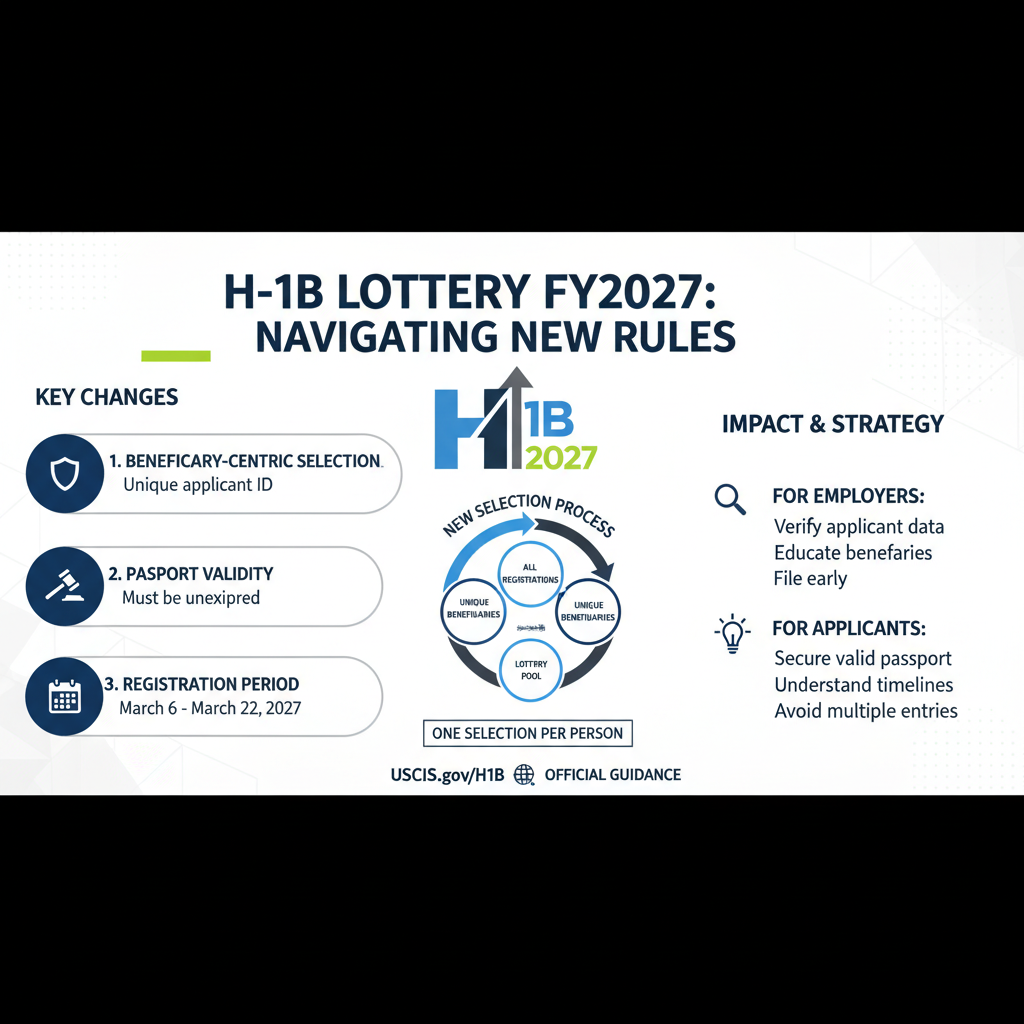
The H-1B visa program is a lifeline for many skilled foreign professionals seeking to work in specialty occupations in the U.S., and for American businesses relying on global talent. The announcement of significant changes to the H-1B lottery process for Fiscal Year 2027 (FY2027) is not just a technical update; it represents a fundamental shift in how candidates are selected, directly impacting countless aspiring immigrants and their sponsoring employers.
Why this news is showing up now
Today, May 11, 2026, this news is particularly relevant because the U.S. Citizenship and Immigration Services (USCIS) has finalized and implemented new rules affecting the upcoming H-1B cap registration period for FY2027. The H-1B fiscal year begins on October 1st, and the electronic registration period for the lottery typically occurs in March of the preceding calendar year. Therefore, for FY2027, the registration window was in March 2026, and selections were announced shortly after. These changes, often proposed and debated for months or even years, are now officially in effect, meaning they shaped the most recent lottery and will continue to define future ones. USCIS's primary goal with these modifications is to enhance the integrity of the H-1B program, reduce the potential for fraud, and ensure a more equitable selection process by shifting to a "beneficiary-centric" model. This move reflects a concerted effort by the Department of Homeland Security (DHS) to address long-standing concerns about abuses within the lottery system.
How it can affect Florida residents
Florida, with its booming technology sector, robust healthcare industry, and vibrant tourism and hospitality businesses, is a major hub for both employers seeking highly skilled talent and foreign professionals looking for opportunities. Cities like Orlando, Miami, Tampa, and Jacksonville attract a diverse pool of international graduates from local universities and experienced professionals globally. For Central Florida residents, especially those on F-1 OPT visas or other nonimmigrant statuses, the H-1B visa is often the next crucial step in their career path. The new lottery changes directly impact how they, or their prospective employers in Orange County and along the I-4 corridor, approach the H-1B application process. Specifically:
- For Beneficiaries: The shift to a beneficiary-centric selection means that an individual can only be entered into the lottery once, regardless of how many employers offer them a job. This aims to level the playing field, preventing individuals from gaining an unfair advantage through multiple entries by different employers. While it may reduce the overall number of entries (by eliminating duplicate submissions for the same person), it ensures that each unique beneficiary has an equal chance.
- For Employers: Florida employers, from tech startups in Orlando to large corporations, must now adapt their H-1B sponsorship strategies. They can still register multiple beneficiaries, but they must ensure that each beneficiary is registered only once across all potential petitioners. This requires greater coordination and due diligence.
- Increased Scrutiny: The new rules often come with increased scrutiny on employer-employee relationships and the legitimacy of job offers, which means both Florida employers and beneficiaries must be meticulously prepared.
Understanding these impacts is crucial for anyone involved in the H-1B process in Florida. The team at Imigrar, located in Orlando, is uniquely positioned to assist clients throughout the state in navigating these complex changes.
What H-1B Visa Lottery Changes for FY2027 Is (and Why It Matters)
The H-1B visa program allows U.S. employers to temporarily employ foreign workers in specialty occupations. These occupations generally require a bachelor's degree or higher in a specific field. Due to high demand, USCIS typically conducts a lottery each year to select enough registrations to meet the annual cap. The changes for FY2027 fundamentally alter this selection mechanism, making it fairer and more transparent.
A plain-English definition
Think of the H-1B visa as a special work permit for highly skilled professionals, like engineers, doctors, IT specialists, and researchers. Every year, the U.S. government sets a limit, or "cap," on how many new H-1B visas can be issued (currently 65,000 for the regular cap and an additional 20,000 for those with a U.S. master's degree or higher). Because far more people want these visas than are available, USCIS runs an electronic lottery. In the past, an individual could have multiple employers submit registrations on their behalf, effectively giving them multiple "tickets" in the lottery. The new change for FY2027, known as "beneficiary-centric selection," means that now, no matter how many employers want to hire you, you only get *one* entry into the lottery. If you are selected, then *any* of the employers who registered you can proceed with filing a petition. This dramatically reduces the chances of fraud and ensures that everyone has an equal shot, based on the individual, not on the number of employers willing to register them.
Key terms you need to know
- H-1B Visa: A nonimmigrant visa that allows U.S. employers to temporarily employ foreign workers in specialty occupations.
- Specialty Occupation: An occupation that requires theoretical and practical application of a body of highly specialized knowledge, and a bachelor's or higher degree in the specific specialty (or its equivalent) as a minimum for entry into the occupation in the United States.
- Cap-Subject: Refers to H-1B petitions that are subject to the annual statutory numerical limit (currently 65,000 for the regular cap and an additional 20,000 for those with a U.S. master's degree or higher).
- Cap-Exempt: Certain employers (e.g., institutions of higher education, non-profit research organizations) are exempt from the annual cap.
- Lottery (or "Selection Process"): The electronic random selection process conducted by USCIS when the number of eligible H-1B registrations exceeds the annual cap.
- Beneficiary: The foreign national worker who is seeking the H-1B visa.
- Petitioner: The U.S. employer who files the H-1B petition on behalf of the beneficiary.
- Beneficiary-Centric Selection: The core new rule for FY2027, where each unique beneficiary is entered into the lottery only once, regardless of how many employers submit registrations on their behalf.
- DHS (Department of Homeland Security): The federal agency responsible for U.S. immigration and border security.
- USCIS (U.S. Citizenship and Immigration Services): An agency within DHS that administers the country's naturalization and immigration system. USCIS official website
- LCA (Labor Condition Application): A form (**Form ETA-9035**) filed with the Department of Labor by an employer seeking to hire an H-1B nonimmigrant. It attests that the employer will pay the H-1B worker at least the prevailing wage or the actual wage, whichever is higher, and provide working conditions that will not adversely affect other workers.
- Form I-129: The Petition for a Nonimmigrant Worker, which is the primary form filed by the employer for an H-1B visa.
- Premium Processing: An optional service that allows petitioners to request expedited processing of certain immigration petitions, including H-1B, for an additional fee using Form I-907.
Current Immigration Law: The Foundation
The H-1B visa program is rooted in federal immigration law, primarily the Immigration and Nationality Act (INA). Specifically, the H-1B category falls under INA §101(a)(15)(H)(i)(b), which defines the nonimmigrant classification for temporary workers in specialty occupations. Further regulatory details are found in 8 CFR 214.2(h), which outlines the specific requirements, conditions, and procedures for H-1B petitions.
Federal requirements
To qualify for an H-1B visa, both the employer and the beneficiary must meet stringent federal requirements:
- Employer Requirements:
- The employer must offer a position that qualifies as a specialty occupation.
- The employer must file and obtain certification for a Labor Condition Application (LCA), Form ETA-9035, from the U.S. Department of Labor (DOL) before filing the H-1B petition. This LCA attests to the employer's commitment to pay the H-1B worker at least the prevailing wage or actual wage, whichever is higher, and provide working conditions that do not adversely affect U.S. workers.
- The employer must demonstrate a valid employer-employee relationship with the beneficiary.
- If the employer is cap-subject, they must participate in the electronic registration process and be selected in the H-1B lottery.
- Beneficiary Requirements:
- The beneficiary must hold a U.S. bachelor's or higher degree, or its equivalent from a foreign institution, directly related to the specialty occupation.
- Alternatively, the beneficiary may possess an unrestricted state license, or certifications in a specialty occupation field, or have work experience equivalent to a bachelor's degree through a "three-for-one" rule (three years of progressive experience for every one year of college education).
- The beneficiary must meet the minimum requirements for the specific specialty occupation position offered.
The new rules for FY2027 do not alter these fundamental eligibility requirements but rather the *process* of selection for cap-subject petitions. The implementation of beneficiary-centric selection means that all H-1B registrations submitted for a single beneficiary are grouped together, and that beneficiary is entered into the lottery only once. If selected, any of the employers who properly registered that beneficiary may then file a petition on their behalf. This is a critical integrity measure designed to combat fraud and ensure fairness.
Florida-specific considerations
While immigration law is federal, its application has local nuances. Florida's dynamic economy means a high demand for H-1B workers, particularly in industries like information technology, engineering, healthcare, and finance. Many companies in Orlando, Tampa, and South Florida actively sponsor H-1B visas. For individuals living in Florida, especially those graduating from universities like the University of Central Florida (UCF) or the University of Florida, understanding the H-1B process is paramount for transitioning from student visas (like F-1 OPT) to work visas.
The Orlando USCIS Field Office (located at 5449 S. Semoran Blvd, Orlando, FL 32822) serves as a local point of contact for many immigration matters, though H-1B petitions are generally processed at regional service centers. However, local considerations might arise for interviews or specific requests. Our Orlando-based firm, Imigrar, is intimately familiar with the local context and the types of employers and beneficiaries in the region, ensuring tailored advice and support.
Reminder: All H-1B petitions, whether for Florida residents or those nationwide, must be filed using Form I-129, Petition for a Nonimmigrant Worker, along with all required supporting documentation and applicable fees.
Facing H-1B Challenges? Don't navigate the new rules alone. Imigrar is here to help. Call +1 786-791-3106 for a free consultation. Se Habla Español.

How to Navigate the H-1B Visa Lottery Changes for FY2027: A Complete Step-by-Step Guide
The H-1B process, especially with the FY2027 changes, requires meticulous planning and execution. This step-by-step guide outlines the journey, focusing on the new beneficiary-centric selection process.
1) Employer and Beneficiary Preparation (Pre-Registration)
This crucial initial phase sets the foundation for a successful H-1B application. It involves both the prospective employer and the foreign national taking proactive steps well before the official registration period.
- Employer's Role:
- Job Analysis: The employer must confirm that the offered position truly qualifies as a specialty occupation, requiring a bachelor's degree or higher in a specific field.
- Wage Determination: Research the prevailing wage for the position in the intended area of employment (e.g., Orlando, FL) to ensure compliance with DOL requirements.
- Company Legitimacy: Ensure the company has a legitimate business need for the H-1B worker and can demonstrate the ability to pay the required wage.
- Beneficiary's Role:
- Credential Evaluation: Obtain official transcripts and, if applicable, a foreign academic credential evaluation to confirm that your degree is equivalent to a U.S. bachelor's or higher degree and is relevant to the specialty occupation.
- Resume & Experience: Update your professional resume to clearly highlight your qualifications, skills, and experience relevant to the H-1B position.
- Passport & Visa Status: Ensure your passport is valid and gather all documentation related to your current immigration status (e.g., F-1 visa, I-20, EAD card, I-94 record).
- Documents to Prepare (Pre-Registration):
- Beneficiary's valid passport and travel history.
- Beneficiary's academic degrees, diplomas, and official transcripts (with certified translations if not in English).
- Any professional licenses or certifications.
- Beneficiary's detailed resume/CV.
- Employer's Federal Employer Identification Number (EIN).
- Detailed job description, including duties, responsibilities, and minimum requirements.
2) H-1B Electronic Registration Process (March 2026 for FY2027)
This is where the new "beneficiary-centric" selection rule comes into play. The registration period for FY2027 typically opened in early March 2026 and lasted for a few weeks.
- Employer Action:
- The employer (or their authorized representative, like Imigrar) creates or accesses a "registrant" account on the myUSCIS online portal.
- For each prospective H-1B beneficiary, the employer submits an electronic registration. This registration requires basic information about both the employer and the beneficiary.
- Critical Change: Under the new rule, the registration is now tied to the unique beneficiary. If multiple employers wish to sponsor the same beneficiary, they must each submit a registration for that beneficiary. However, USCIS will consolidate these multiple registrations, and the beneficiary will only be entered into the lottery *once*. Any attempt to circumvent this by creating multiple registrations for the same beneficiary through different means will result in all registrations for that beneficiary being invalidated.
- Pay the non-refundable H-1B registration fee. Important: As of April 1, 2024, the H-1B registration fee increased from $10 to $215. This increased fee applies to the FY2027 lottery.
- Documents for Registration:
- Beneficiary's full legal name, date of birth, country of birth, country of citizenship, passport number.
- Employer's legal name, Federal Employer Identification Number (EIN), address, and the name/title of the authorized signatory.
- Attorney or representative information (if applicable).
3) Lottery Selection and Notification (Late March 2026)
After the registration period closes, USCIS conducts the lottery.
- Selection Process: USCIS first selects registrations for the master's cap (20,000), then for the regular cap (65,000). The new beneficiary-centric method ensures fairness by selecting unique individuals.
- Notification: USCIS notifies petitioners (employers) of selection results through their myUSCIS online accounts. This typically happens by the end of March. Only selected registrations will be eligible to file an H-1B petition.
- What to Expect: If selected, the status in the myUSCIS account will change to "Selected." If not selected, it will show "Not Selected" or "Denied" (if deemed a duplicate).


