

The landscape of U.S. immigration is ever-evolving, and few areas demand as much attention and strategic planning as the H-1B visa program. As we look towards the Fiscal Year 2027 (FY2027) H-1B lottery, significant changes are on the horizon, promising to reshape how U.S. employers recruit and retain vital foreign talent. For skilled professionals and their prospective employers in Orlando, across Florida, and nationwide, understanding these updates is not just beneficial—it's essential for success.
Navigating the H-1B lottery can be complex. Our experienced Orlando immigration team at Imigrar is here to help you understand the new FY2027 rules and prepare a strong application. Call +1 786-791-3106 for a free consultation, or message us online. Se Habla Español.
NEWS SOURCE REFERENCE SECTION
The reporting that sparked this guide: H-1B Visa Lottery Changes for FY2027 (Legal News)
What This News Means for Immigrants in Orlando and Across Florida
The H-1B visa program is a lifeline for U.S. companies seeking highly skilled foreign workers, particularly in science, technology, engineering, and mathematics (STEM) fields. These workers contribute significantly to innovation, economic growth, and global competitiveness. The news of changes to the FY2027 H-1B lottery is therefore a critical development, impacting thousands of lives and countless businesses.
Why this news is showing up now
Immigration regulations, particularly those governing high-demand visa categories like the H-1B, are subject to continuous review and adjustment by U.S. Citizenship and Immigration Services (USCIS). For FY2027, the changes primarily stem from USCIS's ongoing efforts to enhance the integrity of the H-1B cap registration process, deter fraud, and ensure a more equitable selection system. These changes, often proposed and finalized in the preceding year (typically late 2025 or early 2026 for FY2027), aim to address past challenges, such as the submission of multiple registrations for the same beneficiary by different employers, which inflated selection odds unfairly.
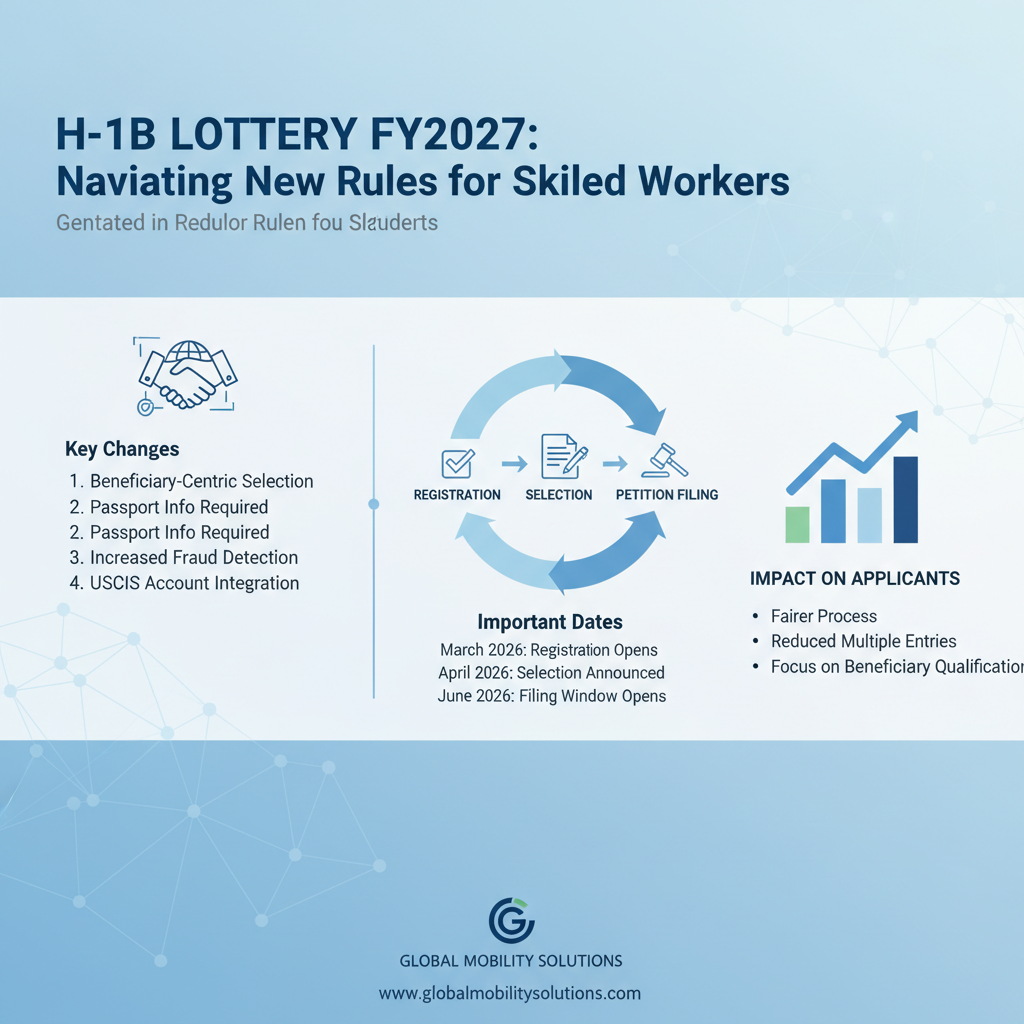
The most significant shift, which was initially implemented for FY2025 and is expected to continue and be refined for FY2027, is the move to a beneficiary-centric selection process. This means that instead of selecting registrations based on employer submissions, the lottery prioritizes unique beneficiaries. This fundamental change is designed to level the playing field, giving every eligible individual an equal chance regardless of how many employers register them.
How it can affect Florida residents
Florida, especially the Orlando metropolitan area along the I-4 corridor, is a hub for growth in technology, aerospace, simulation, healthcare, and tourism. These sectors heavily rely on skilled foreign talent to fill specialized roles that U.S. workers may not always possess in sufficient numbers. The new H-1B lottery rules for FY2027 will have several key impacts:
- For Employers in Orlando and Central Florida: Companies in Orange County and surrounding areas, ranging from tech startups to established theme park corporations and medical facilities, will need to adapt their recruitment strategies. The beneficiary-centric selection should deter fraudulent multiple filings, potentially leading to a more predictable and fairer lottery outcome. However, it also means employers cannot rely on "strength in numbers" by encouraging multiple registrations for a single candidate.
- For Prospective H-1B Beneficiaries in Florida: Graduates from Florida universities (such as UCF, UF, USF) or those already working on Optional Practical Training (OPT) in Orlando and other cities will find the lottery process more transparent and equitable. Each individual will have one chance in the lottery, simplifying the process and reducing stress associated with potential fraud from other employers. This also means that securing a strong, legitimate job offer from a single, committed employer is paramount.
- Increased Emphasis on Bona Fide Job Offers: USCIS will likely scrutinize petitions more closely to ensure a genuine employer-employee relationship and a legitimate "specialty occupation." This is particularly relevant in dynamic markets like Florida, where various types of businesses seek H-1B workers.
- Strategic Planning is Crucial: Both employers and beneficiaries will need to engage in more rigorous and earlier planning. Identifying suitable candidates, preparing necessary documentation, and understanding the precise requirements of the new rules will be key to navigating the FY2027 lottery successfully.
These changes underscore the importance of accurate, compliant, and timely preparation. Imigrar, located in Orlando, is uniquely positioned to assist Florida residents and businesses in understanding and adapting to these critical updates.
What the H-1B Visa Is (and Why It Matters)
The H-1B visa is a nonimmigrant visa that allows U.S. employers to temporarily employ foreign workers in specialty occupations. These occupations generally require a bachelor's degree or higher in a specific field. It's a cornerstone for bridging skill gaps in the American workforce and is highly sought after by international professionals.
A plain-English definition
Think of the H-1B visa as a special work permit for highly skilled jobs. If you have a college degree (or equivalent work experience) in a field like engineering, IT, medicine, or finance, and a U.S. company wants to hire you for a job that specifically requires that degree, the H-1B visa might be your pathway. The "specialty occupation" part is key – it means the job isn't something just anyone can do; it requires very specific academic knowledge.
Because there are more people who want these visas than available spots each year (there's an annual cap), USCIS uses a lottery system to select who gets to apply. The changes for FY2027 are about making that lottery fairer and reducing fraud.
Key terms you need to know
- USCIS (U.S. Citizenship and Immigration Services): The government agency that oversees lawful immigration to the United States. This is the primary agency you'll interact with. USCIS official website
- Beneficiary: The foreign worker who will be employed under the H-1B visa.
- Petitioner: The U.S. employer who files the H-1B petition on behalf of the beneficiary.
- Specialty Occupation: An occupation that requires theoretical and practical application of a body of highly specialized knowledge and a bachelor's degree or higher in the specific specialty (or its equivalent) as a minimum for entry into the occupation in the United States.
- H-1B Cap: The annual numerical limit on the number of H-1B visas issued. Currently, it's 65,000 regular cap visas and an additional 20,000 for those with a U.S. master's degree or higher (the "master's cap").
- H-1B Lottery (Cap Lottery): The random selection process conducted by USCIS when the number of H-1B registrations exceeds the annual cap.
- FY (Fiscal Year): The U.S. government's fiscal year runs from October 1st to September 30th. For example, FY2027 begins on October 1, 2026.
- LCA (Labor Condition Application): Form ETA-9035. An application filed with the U.S. Department of Labor by the employer, attesting to specific conditions regarding wages and working conditions for H-1B employees. This must be certified before filing the H-1B petition.
- Registration Period: The designated window during which prospective H-1B employers submit electronic registrations for the lottery. For FY2027, this typically occurs in March 2026.
- Selection Notice: Notification from USCIS to employers whose registrations were selected in the lottery, authorizing them to file an H-1B petition.
- Petition: The actual application (Form I-129) filed by the employer on behalf of the selected beneficiary.
- Premium Processing: An optional service (Form I-907) that allows petitioners to request expedited processing of certain immigration forms, including Form I-129, for an additional fee.
- Change of Status: Applying to change from one nonimmigrant status (e.g., F-1 student) to another (e.g., H-1B worker) while remaining in the U.S.
- Consular Processing: Applying for an H-1B visa at a U.S. embassy or consulate abroad and then entering the U.S. with the visa stamp.
Confused by immigration jargon? Our team at Imigrar speaks your language – literally. We offer clear, actionable advice in English and Spanish. Contact us at +1 786-791-3106 for a free consultation. Se Habla Español.
Current Immigration Law: The Foundation for H-1B Visas
The H-1B visa program is governed primarily by the Immigration and Nationality Act (INA), specifically sections INA 101(a)(15)(H)(i)(b), INA 214(g), and INA 212(n), along with corresponding federal regulations found in 8 CFR Part 214.2(h). These laws establish the criteria for eligibility, the annual cap, and the procedural requirements for both employers and beneficiaries.
Federal requirements
To qualify for an H-1B visa, both the employer and the beneficiary must meet stringent federal requirements:
- For the Employer (Petitioner):
- Bona Fide Job Offer: The employer must have a genuine job offer for the beneficiary in a specialty occupation.
- Employer-Employee Relationship: USCIS requires a valid employer-employee relationship, meaning the employer has the right to control how and where the beneficiary performs their work. This is particularly scrutinized for third-party placement models.
- LCA Certification: Before filing the H-1B petition, the employer must obtain a certified Labor Condition Application (Form ETA-9035) from the U.S. Department of Labor (DOL). This attests that the employer will pay the H-1B worker at least the prevailing wage for the occupation in the area of intended employment, or the actual wage paid to other employees with similar experience and qualifications, whichever is higher. It also ensures working conditions will not adversely affect U.S. workers.
- Employer Identification Number (EIN): The employer must have a valid EIN.
- For the Beneficiary (Employee):
- Specialty Occupation Qualification: The beneficiary must meet one of the following criteria:
- Hold a U.S. bachelor's or higher degree required by the specialty occupation from an accredited college or university.
- Hold a foreign degree that is equivalent to a U.S. bachelor's or higher degree required by the specialty occupation from an accredited college or university.
- Hold a state license that is required to practice a specialty occupation and be engaged in that specialty in the state of intended employment.
- Have work experience in the specialty occupation equivalent to a bachelor's degree. (Generally, three years of progressive work experience is considered equivalent to one year of college education).
- Licensing: If the occupation requires a state license (e.g., doctors, nurses, some engineers), the beneficiary must possess that license.
- Specialty Occupation Qualification: The beneficiary must meet one of the following criteria:
Important: The FY2027 changes primarily impact the *selection* process (the lottery itself), not the fundamental eligibility criteria for the H-1B visa. However, increased scrutiny of registrations and petitions means that demonstrating compliance with these foundational legal requirements is more critical than ever.
For official information and forms, always refer to the USCIS official website.
Florida-specific considerations
While H-1B laws are federal, their impact and application can have unique nuances in different states. Florida's vibrant economy and specific industry needs create particular considerations for H-1B employers and beneficiaries:
- High Demand in Tech and Tourism: The Orlando area, in particular, has a booming tech sector, a world-renowned tourism industry, and a growing medical and simulation industry. Companies in these fields often seek H-1B workers for roles like software developers, data scientists, engineers, financial analysts, and specialized healthcare professionals.
- University Graduates: Florida boasts a robust higher education system, with institutions like the University of Central Florida (UCF), University of Florida (UF), and University of South Florida (USF) producing thousands of international graduates each year who are often eligible for OPT and seek H-1B sponsorship. The competition for H-1B visas among these graduates is fierce.
- Prevailing Wage Determinations: Prevailing wages are determined by geographic location. Employers in Orlando or other Florida cities must ensure they meet the specific prevailing wage for their occupation in their specific Florida Metropolitan Statistical Area (MSA) or region, as determined by the Department of Labor.
- Orlando USCIS Field Office: While H-1B petitions are processed at USCIS service centers, residents of Central Florida might interact with the Orlando USCIS Field Office for other immigration matters or in specific follow-up situations.
Reminder: Staying informed about local economic trends and labor market data can also help employers justify the need for H-1B workers in specific Florida locations.
Common USCIS Forms for H-1B:
- Form I-129, Petition for a Nonimmigrant Worker: The core form for H-1B petitions.
- Form I-907, Request for Premium Processing Service: Used to expedite processing for an additional fee.
- Form ETA-9035, Labor Condition Application (LCA): Filed with the Department of Labor prior to Form I-129.
How to Navigate the H-1B Visa Process with the New FY2027 Rules: A Complete Step-by-Step Guide
The H-1B process, especially with the FY2027 changes, requires meticulous attention to detail and adherence to strict timelines. Here’s a comprehensive step-by-step guide:
1) Understand the New FY2027 Lottery Rules and Prepare Strategically
The most significant change for FY2027 (building on previous years) is the beneficiary-centric selection process. This means:
- One Chance Per Beneficiary: Regardless of how many employers register a single beneficiary, that beneficiary will only be entered into the lottery once. If selected, all valid petitions filed on their behalf by any registered employer will be considered eligible.
- Increased Scrutiny: USCIS will likely continue to enhance fraud detection and prevention efforts. Employers must ensure the legitimacy of the job offer and the employer-employee relationship.
Actionable Advice:
- Employers: Focus on identifying highly qualified candidates and preparing a strong, legitimate job offer. Do not encourage multiple registrations for the same beneficiary from different entities you control, as this could lead to denial or even legal repercussions.
- Beneficiaries: Work closely with your prospective employer to ensure all personal information is accurate and consistent across any registrations submitted on your behalf. You should ideally have only one employer registering you, or at least be aware of all registrations and ensure they are legitimate.
Key Documents/Information for Strategic Preparation:
- Beneficiary's full legal name, date of birth, country of birth, country of citizenship.
- Beneficiary's passport number.
- Beneficiary's educational background (degree, major, university).
- Employer's legal name, EIN, and address.
- Job title, duties, and proposed annual salary.
- Location of employment (e.g., Orlando, FL).
2) Employer Files H-1B Registration Electronically (March 2026 for FY2027)
The H-1B cap registration period typically opens in early March. For FY2027, expect the registration window to be around March 1st to March 17th, 2026 (these dates are estimates based on historical patterns and should be confirmed by official USCIS announcements closer to the date). During this period, employers must electronically submit a registration for each prospective H-1B beneficiary they wish to sponsor.
Required Documents/Information for Registration:
- Employer's legal name, address, and EIN.
- Employer's authorized signatory information.
- Beneficiary's full legal name, gender, date of birth, country of birth, country of citizenship, and passport number.
- Beneficiary's highest level of education and institution.
- Whether the beneficiary qualifies for the master's cap (U.S. Master's degree or higher).
- A non-refundable registration fee (e.g., $10 for FY2025, subject to change for FY2027).
Warning: Ensure all information is accurate. Errors can lead to disqualification. Consulting with an immigration attorney like Imigrar during this crucial phase is highly recommended.
3) Lottery Selection and Notification (Late March 2026)
Once the registration period closes, USCIS conducts the random lottery selection process. With the beneficiary-centric approach, USCIS selects unique beneficiaries. Notification of selection typically occurs by the end of March.
What Happens:
- USCIS will notify registered employers via their online accounts whether their registration(s) have been selected.
- Selected registrants will receive a "Selection Notice" that authorizes them to file a full H-1B petition for the named beneficiary.
Important: Selection in the lottery does *not* mean the H-1B visa is approved; it only grants permission to file the detailed petition.
4) Prepare and File the H-1B Petition (Form I-129)
For selected registrations, employers have a specific filing window (typically 90 days, from April 1st to June 30th for FY2027) to submit the complete H-1B petition. This is the most extensive part of the application process.
Required Documents/Information for H-1B Petition (Form I-129):
- Certified LCA (Form ETA-9035): Obtained from the Department of Labor.
- Form I-129, Petition for a Nonimmigrant Worker: Filled out accurately and completely.
- Employer Support Letter: Explaining the company, the specialty occupation, the beneficiary's qualifications, and the terms of employment.
- Beneficiary's Educational Documents:
- Copies of diplomas, degrees, and academic transcripts.
- Foreign degree evaluations (if applicable) demonstrating equivalence to a U.S. bachelor's or master's degree.
- Beneficiary's Professional Documents:
- Copies of professional licenses (if applicable).
- Resumes/CVs.
- Letters of experience from previous employers (if relying on work experience for qualification).
- Beneficiary's Identity Documents:
- Copy of passport biographical page.
- Copy of current U.S. visa (if applicable).
- Copy of Form I-94 (Arrival/Departure Record).
- Copies of previous Form I-20 (for F-1 students) or Form DS-2019 (for J-1 exchange visitors) and EAD cards (for OPT).
- Employer Business Documents:
- Articles of incorporation, business licenses, tax returns, financial statements.
- Organizational charts, client contracts (especially for consulting firms).
- Evidence of ability to pay the proffered wage.
- Filing Fees:
- Form I-129 filing fee.
- Fraud Prevention and Detection Fee.
- ACWIA Fee (American Competitiveness and Workforce Improvement Act).
- Public Law 114-113 Fee (for employers with 50 or more employees, where more than 50% are in H-1B or L-1 status).
- Optional: Form I-907 fee for Premium Processing.
Recommendation: Given the volume of documents and the complexity, professional legal assistance from a firm like Imigrar is invaluable here. We ensure all forms are correctly filled, supporting documents are complete, and the petition meets all legal requirements.
5) Await USCIS Decision and Potential RFE
After filing, USCIS reviews the petition. Processing times can vary significantly. If Premium Processing was selected, a decision or a Request for Evidence (RFE) is typically issued within 15 calendar days. Standard processing can take several months.
- Approval: If approved, USCIS sends an approval notice (Form I-797A/B). If the beneficiary is in the U.S. and changing status, the Form I-797A will include a new Form I-94.
- Request for Evidence (RFE): USCIS may issue an RFE if they need more information or clarification. This is a common occurrence. Responding to an RFE accurately and thoroughly within the given deadline (usually 60-90 days) is critical.
- Denial: A petition can be denied if it does not meet requirements or an RFE response is insufficient.
Actionable Advice: If you receive an RFE while in Orlando or anywhere in Florida, contact Imigrar immediately. Our attorneys have extensive experience crafting comprehensive and persuasive RFE responses.
6) Visa Interview (for those outside the U.S.) or Change of Status (for those inside)
This step depends on the beneficiary's current location:
- Consular Processing (Outside U.S.): Once the H-1B petition is approved, the beneficiary schedules an interview at a U.S. embassy or consulate in their home country. They will need to bring the Form I-797B approval notice, passport, visa application forms (DS-160), and supporting documents to the interview. If approved, the H-1B visa stamp is placed in their passport, allowing entry to the U.S.
- Change of Status (Inside U.S.): If the beneficiary is already in the U.S. in a valid nonimmigrant status (e.g., F-1 OPT), and USCIS approved their change of status (indicated by Form I-797A with a new Form I-94), they do not need to leave the U.S. for a visa interview. Their status automatically changes to H-1B on the effective date.
Reminder: For those undergoing consular processing, check the U.S. Department of State website for specific embassy/consulate requirements and interview availability.
7) Begin Employment on October 1st (FY2027)
The earliest an H-1B worker can begin employment under a cap-subject petition is October 1st of the fiscal year for which the petition was approved. For FY2027, this means October 1, 2026. If an individual's H-1B status becomes effective while they are in the U.S. (via Change of Status), they can begin working on this date. If they are entering the U.S. with an H-1B visa, they must ensure their entry date aligns with or is after October 1st.
Important: Ensure all employment terms match the approved petition. Any significant changes in job duties, salary, or work location may require an amended H-1B petition.

Practical Steps You Can Take Today for FY2027 H-1B Success
Proactive preparation is paramount. Here's what you can do now:
Actionable Checklist:
- Consult an Immigration Attorney: This is the most crucial first step. Engage with an expert at Imigrar as early as possible to understand the FY2027 changes and strategize your approach.
- Educate Yourself and Your Team (Employers): Ensure HR and recruiting teams fully understand the beneficiary-centric selection process and the implications for candidate selection and registration.
- Gather Personal Documents (Beneficiaries): Collect and organize your passport, birth certificate, academic transcripts, degrees, resume, and any professional licenses. Ensure your passport is valid for at least six months beyond your intended H-1B stay.
- Verify Educational Credentials: If you have a foreign degree, consider obtaining an educational equivalency evaluation from a reputable NACES-approved organization if you haven't already.
- Review Job Descriptions (Employers): Ensure the job offered clearly meets the "specialty occupation" criteria. Document the specific educational requirements for the role.
- Understand Prevailing Wage (Employers): Research the prevailing wage for the specific occupation and location (e.g., Orlando, FL) to ensure compliance with DOL requirements.
- Plan for Fees: Budget for registration fees, filing fees, and legal fees. Remember premium processing is an additional cost.
- Stay Informed: Regularly check official USCIS announcements for any updates regarding the FY2027 H-1B lottery timeline or rule modifications.
Document Preparation Guidance:
- Accuracy is Key: Double-check


