The reporting that sparked this guide: H-1B Visa Lottery Changes for FY2027 (Legal News)
What This News Means for Immigrants in Orlando and Across Florida
Why this news is showing up now
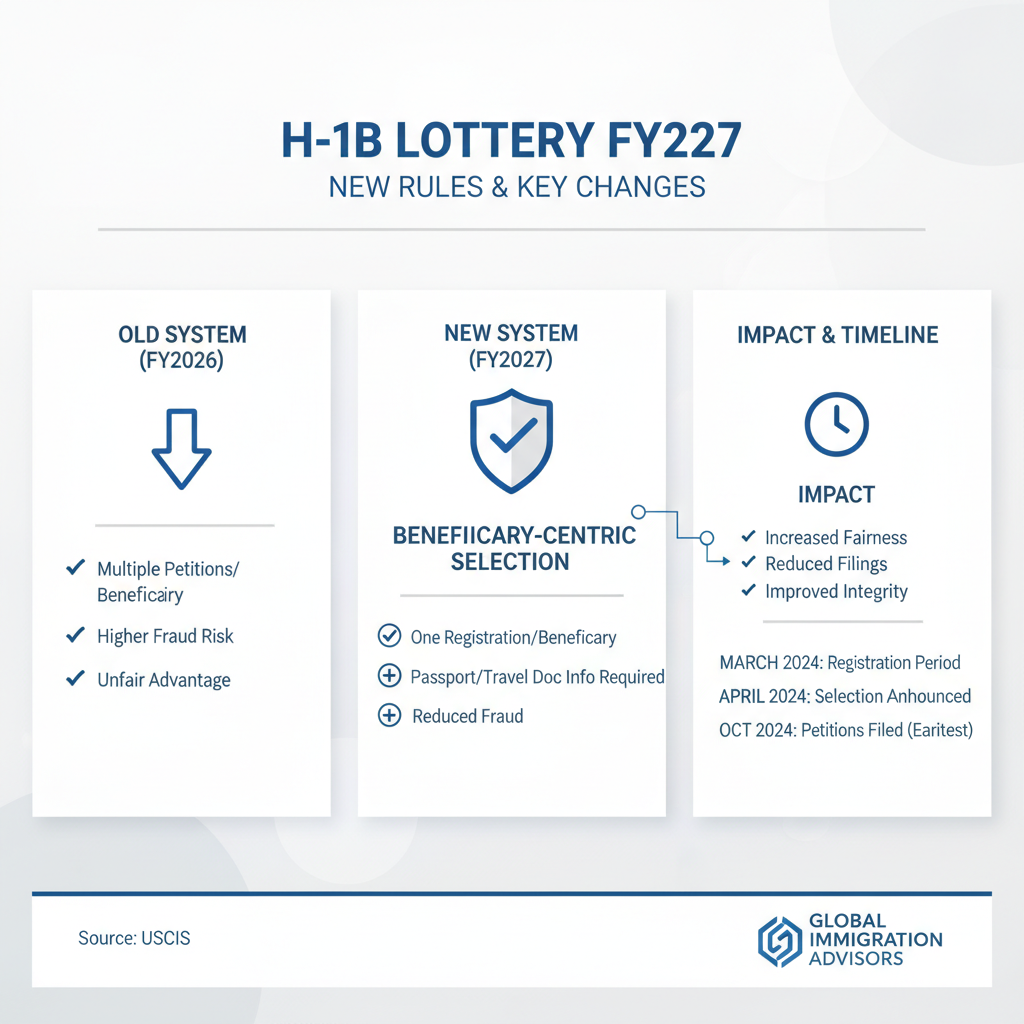
The H-1B fiscal year (FY) begins on October 1st. For FY2027, the earliest that petitions can be filed is April 1, 2027, for employment starting on October 1, 2027. This means the lottery registration period typically opens in March 2027. USCIS often announces or finalizes rules, procedures, and fee adjustments several months in advance of the registration period to give employers and prospective beneficiaries time to prepare. The "changes" referenced in the news likely pertain to procedural updates, rule clarifications, or even substantive shifts in how the lottery is conducted, building upon modifications introduced in recent years. Specifically, the most significant change in recent history, and one that continues to shape the FY2027 lottery, is the shift to a beneficiary-centric selection process. This crucial update, aimed at increasing fairness and reducing fraud, was implemented starting with the FY2025 lottery. As we approach the FY2027 cycle, understanding how this and any other forthcoming adjustments affect your strategy is paramount. These announcements are critical because they dictate the eligibility, preparation, and submission requirements that can make or break an H-1B application.How it can affect Florida residents
Florida, particularly the Orlando metropolitan area, is a hub for tourism, technology, aerospace, healthcare, and advanced manufacturing. These industries heavily rely on a skilled workforce, often attracting foreign talent through programs like the H-1B visa. * **For Employers in Florida:** Tech companies along the I-4 corridor, hospitality groups in Orange County, and research institutions across Central Florida often sponsor H-1B visas. Changes to the lottery process, especially those designed to combat fraud, mean that Florida employers must ensure their registrations are impeccably accurate and tied to genuine job offers. The new beneficiary-centric model aims to level the playing field, potentially increasing the odds for employers with legitimate needs who might have been outmaneuvered by fraudulent multiple registrations in the past. This could lead to a more predictable and equitable process for securing highly skilled talent for Florida’s growing industries. * **For Prospective H-1B Beneficiaries in Florida:** Many international students graduating from Florida universities (like UCF, UF, USF) or professionals working in Florida on other visa statuses (e.g., F-1 OPT, L-1, TN) aspire to obtain an H-1B visa. The changes, particularly the beneficiary-centric approach, directly impact their chances. It means that while having multiple employers register on your behalf won't increase your individual selection odds, securing a strong, legitimate job offer from one employer remains your best strategy. For those living in Orlando, working for local companies, or attending educational institutions here, navigating these changes successfully is key to their long-term career prospects in the U.S. * **Increased Scrutiny:** With an emphasis on reducing fraud, all H-1B registrations and petitions, including those from Florida-based entities, may face enhanced scrutiny. This underscores the need for meticulous preparation and adherence to all USCIS guidelines. Understanding these implications is the first step toward a successful H-1B journey for FY2027. Imigrar is here to provide the expert guidance needed to navigate these complex regulations effectively.Need Help? Our Orlando immigration team is ready to assist. Navigating H-1B changes can be complex, but you don't have to do it alone. Call +1 786-791-3106 for a free consultation, or message us online. Se Habla Español.
What H-1B Visa Lottery Changes for FY2027 Is (and Why It Matters)
The H-1B visa program is a nonimmigrant visa that allows U.S. employers to temporarily employ foreign workers in specialty occupations. These occupations require theoretical and practical application of a body of highly specialized knowledge and a bachelor's degree or higher in the specific specialty (or its equivalent). Common H-1B fields include IT, engineering, medicine, education, and architecture. The "H-1B Lottery Changes for FY2027" refers to the evolving rules and procedures that USCIS implements for selecting H-1B registrations when demand exceeds the annual cap. For FY2027, the primary "change" that continues to be significant is the beneficiary-centric selection process, which was introduced for the FY2025 lottery. This fundamental shift aims to eliminate the unfair advantage gained by beneficiaries who had multiple employers submit registrations on their behalf, a practice that inflated selection odds and contributed to fraud.A plain-English definition
Imagine a highly sought-after job that only a limited number of people can get each year. Because so many qualified people apply, they decide to pick names out of a hat – that's the lottery. The H-1B visa is like that job, and the lottery is how USCIS decides who gets a chance to apply for it when there are more applicants than available visas. The "changes" for FY2027 essentially mean USCIS has refined the rules for putting names into that hat. The biggest refinement is that no matter how many employers want to sponsor you, *your name only gets put into the hat once*. This makes the process fairer because it stops people from getting an artificial boost in their chances by having multiple entries. It ensures that each unique individual has an equal shot, rather than individuals with more employers having a statistically higher chance. This is crucial because it ensures the lottery is truly random and based on the individual, not the number of employers willing to register them.Key terms you need to know
Understanding these terms is vital for navigating the H-1B process effectively: * **H-1B Visa:** A nonimmigrant visa that allows U.S. employers to temporarily employ foreign workers in specialty occupations. * **Specialty Occupation:** An occupation that requires a bachelor's degree or higher in a specific specialty, or its equivalent, as a minimum for entry into the occupation. * **Cap-Subject H-1B:** H-1B petitions that are subject to the annual statutory limit (cap) set by Congress. * **Cap-Exempt H-1B:** H-1B petitions filed by certain employers (e.g., institutions of higher education, non-profit research organizations) that are not subject to the annual cap. * **Beneficiary:** The foreign worker who will be employed in the specialty occupation. * **Petitioner:** The U.S. employer who files the H-1B petition on behalf of the beneficiary. * **LCA (Labor Condition Application):** Form ETA-9035. An application filed with the U.S. Department of Labor (DOL) that attests to the employer's compliance with wage and working condition requirements for H-1B workers. This must be certified before filing the H-1B petition. * **Master's Cap (or Advanced Degree Exemption):** An additional 20,000 H-1B visas reserved for beneficiaries who have earned a U.S. master's degree or higher. These are selected before the regular cap. * **H-1B Registration:** An electronic registration process where prospective petitioners (employers) submit basic information about their company and the prospective H-1B beneficiary to USCIS during a designated period. This is the entry point for the lottery. * **Lottery Selection:** If USCIS receives more registrations than available H-1B visas (including the Master's Cap), it conducts a random selection process. * **Beneficiary-Centric Selection:** The current lottery system (effective FY2025 onwards) where each unique beneficiary is entered into the lottery only once, regardless of how many employers register on their behalf. This means one beneficiary, one chance. * **FY2027:** Refers to Fiscal Year 2027, which begins on October 1, 2026, and ends on September 30, 2027. H-1B petitions selected in the March 2027 lottery would be for employment starting on October 1, 2027. These updates matter immensely because the H-1B visa is a highly competitive program. Any change, even seemingly minor, can alter strategies for both employers seeking talent and foreign nationals hoping to work in the U.S. The beneficiary-centric model, in particular, levels the playing field, making honest, well-prepared applications more crucial than ever.Current Immigration Law: The Foundation
The H-1B visa program is rooted in the **Immigration and Nationality Act (INA)**, specifically Section 101(a)(15)(H)(i)(b), which defines the H-1B nonimmigrant classification. Further regulations are codified in 8 CFR Part 214.2(h). These laws and regulations govern everything from eligibility criteria and petition requirements to the annual numerical cap and the lottery process. The annual cap for H-1B visas is currently set by Congress at 65,000, with an additional 20,000 visas reserved for those with a U.S. master's degree or higher (the Master's Cap). This 85,000 total cap has remained constant for many years despite fluctuating demand.Federal requirements
To qualify for an H-1B visa, both the employer (petitioner) and the foreign worker (beneficiary) must meet specific federal requirements: **For the Employer (Petitioner):** * **Specialty Occupation:** The employer must prove that the position offered qualifies as a specialty occupation, requiring at least a bachelor's degree in a specific field. * **Employer-Employee Relationship:** There must be a valid employer-employee relationship as defined by USCIS. * **Wages:** The employer must pay the H-1B worker at least the prevailing wage for the occupation in the area of intended employment or the actual wage paid to other employees with similar experience and qualifications, whichever is higher. This is attested to in the Labor Condition Application (LCA). * **Working Conditions:** The employer must attest that the employment of the H-1B worker will not adversely affect the working conditions of similarly employed U.S. workers. * **Filing Fees:** The employer must pay various USCIS filing fees, including the base filing fee, ACWIA fee, fraud prevention and detection fee, and potentially a public law 114-113 fee. **For the Foreign Worker (Beneficiary):** * **Educational Qualification:** The beneficiary must hold a U.S. bachelor's or higher degree, or its foreign equivalent, in a field related to the specialty occupation. Alternatively, they may possess an unrestricted state license, or have work experience equivalent to a bachelor's degree (determined by a credentials evaluation). * **Job Offer:** The beneficiary must have a job offer from a U.S. employer in a specialty occupation. * **Professional Qualification:** If required by state law, the beneficiary must possess a license to practice in the specialty occupation (e.g., doctors, nurses, architects). The primary form used for H-1B petitions is **Form I-129, Petition for a Nonimmigrant Worker**. This form is extensive and requires detailed information about the petitioner, beneficiary, and the proposed employment. For detailed information and forms, always refer to the USCIS official website.Florida-specific considerations
While H-1B visa laws are federal, their impact and practical considerations can vary by state and region. Florida's diverse economy means H-1B workers are sought after in a wide array of fields. * **Growing Industries:** Florida's robust technology sector, burgeoning space industry (especially around Cape Canaveral), and expanding healthcare systems in cities like Orlando, Tampa, and Miami are major consumers of H-1B talent. Employers in these sectors are highly attuned to H-1B changes. * **Orlando's Tech Hub:** The Orlando area, with its strong presence of simulation and modeling companies, theme park technology, and burgeoning startup scene, frequently requires specialized skills. Local companies often rely on H-1B visas to fill critical roles. * **Educational Institutions:** Florida is home to many universities that attract international students, such as the University of Central Florida (UCF) in Orlando, the University of Florida, and the University of South Florida. Many of these students pursue H-1B visas after graduation, particularly those on F-1 OPT (Optional Practical Training). The Master's Cap is especially relevant for these graduates. * **Prevailing Wage Determinations:** The specific prevailing wage for an occupation can vary significantly based on the geographic area within Florida (e.g., Orlando vs. Miami vs. a rural area). Employers must ensure they are meeting the correct prevailing wage for their specific location. * **Local USCIS Field Office:** While H-1B petitions are typically processed at USCIS service centers, individuals may interact with the Orlando USCIS Field Office for certain follow-up actions or other immigration matters. The H-1B program is a dynamic one, and staying informed about the latest regulations is crucial. Imigrar, located in Orlando, is uniquely positioned to assist both Florida employers and beneficiaries in navigating these complex federal requirements with an understanding of local market dynamics.Considering an H-1B petition for FY2027? Don't leave your future to chance. Imigrar provides personalized legal strategies for employers and professionals across Florida. Contact our Orlando office at +1 786-791-3106 for a free consultation. Se Habla Español.
How to Navigate the FY2027 H-1B Visa Lottery Changes: A Complete Step-by-Step Guide
The H-1B lottery process, particularly with the beneficiary-centric changes, demands careful planning and execution. This guide outlines the key steps for employers and beneficiaries aiming for an H-1B visa in FY2027.1) Understand the New Rules & Eligibility
Before any action is taken, it's paramount to fully grasp the current H-1B regulations, especially the **beneficiary-centric selection process** and any other updates USCIS may announce for FY2027. * **Beneficiary-Centric Selection:** This is the most critical update. For FY2027, each unique beneficiary (the foreign worker) will only be entered into the lottery once, regardless of how many employers submit registrations on their behalf. This aims to reduce fraud and ensure a fair chance for all eligible individuals. * **Employer Eligibility:** The employer must be a legitimate U.S. entity with a valid Employer Identification Number (EIN). They must offer a specialty occupation position. * **Beneficiary Eligibility:** The beneficiary must meet the educational requirements (bachelor's degree or equivalent) for a specialty occupation. * **Job Offer:** A genuine job offer for a specialty occupation position must exist. **Required Documents/Information for Step 1:** * Detailed job description for the proposed position. * Beneficiary's educational credentials (transcripts, diplomas, foreign degree evaluations). * Beneficiary's resume/CV. * Employer's business details and EIN.2) Employer Registration Process
The H-1B cap-subject petition process begins with electronic registration. This typically occurs in March of the calendar year prior to the fiscal year for which the visa is sought (e.g., March 2027 for FY2027). * **Create a USCIS Online Account:** The employer (or their authorized representative, like an attorney) must create a USCIS online account. * **Submit Registration:** During the designated registration period (e.g., March 2027), the employer submits an electronic registration for each prospective H-1B beneficiary. Each registration requires basic information about the employer and the beneficiary. * **Pay Registration Fee:** A non-refundable fee (currently $10, but subject to change for FY2027) must be paid for each registration. * **Beneficiary-Centric Compliance:** Under the new rules, USCIS collects the beneficiary's valid passport or travel document information during registration to verify uniqueness. **Warning:** Submitting more than one registration for the same beneficiary by related entities (e.g., parent/subsidiary, affiliates) with the intent to increase selection chances is considered fraud and will result in denial of all petitions filed on behalf of that beneficiary. **Required Documents/Information for Step 2:** * Employer's legal name, EIN, mailing address. * Authorized signatory's name, title, contact information. * Beneficiary's full legal name, date of birth, country of birth, country of citizenship, passport number, gender. * Beneficiary's U.S. Master's degree information (if applicable). * Confirmation of a valid job offer. * Payment method for the registration fee.3) Lottery Selection & Notification
Once the registration period closes, if USCIS receives more registrations than available visas, they conduct a random lottery selection. * **Master's Cap First:** USCIS first selects registrations for the 20,000 Master's Cap. * **Regular Cap:** Unselected Master's Cap registrations are then entered into the regular 65,000 cap lottery. * **Notification:** USCIS typically notifies selected petitioners (and their legal representatives) through their online accounts by the end of March. The status for selected registrations will change to "Selected." Unselected registrations will eventually show "Not Selected." **Important:** Selection in the lottery *does not* mean approval of the H-1B visa. It merely grants the employer permission to file an H-1B petition on behalf of the selected beneficiary.4) Petition Filing (Form I-129)
If a registration is selected, the employer has a specific filing window (typically 90 days, starting April 1st) to submit the full H-1B petition package. * **Prepare LCA:** The employer must first file and obtain a certified **Form ETA-9035, Labor Condition Application (LCA)**, from the U.S. Department of Labor. This process can take 7-10 business days. * **Complete Form I-129:** Fill out **Form I-129, Petition for a Nonimmigrant Worker**, meticulously. * **Gather Supporting Documents:** Collect all necessary evidence to prove eligibility for both the employer and beneficiary, and that the position qualifies as a specialty occupation. * **Submit Petition & Fees:** Mail the completed **Form I-129**, certified LCA, all supporting documents, and required filing fees to the correct USCIS service center. **Required Documents for Step 4 (Partial List):** * Certified **Form ETA-9035, Labor Condition Application (LCA)**. * Completed and signed **Form I-129, Petition for a Nonimmigrant Worker**. * **Form I-129 H Classification Supplement**. * **Form G-28, Notice of Entry of Appearance as Attorney or Accredited Representative** (if represented by an attorney). * Beneficiary's educational documents (diplomas, transcripts, foreign degree evaluations). * Beneficiary's resume/CV. * Copies of beneficiary's passport, visa, I-94 record, EAD (if applicable). * Letters from previous employers demonstrating experience. * Employer's business license, articles of incorporation, financial statements, tax returns. * Detailed job offer letter and job description. * Evidence that the position is a specialty occupation (e.g., industry standards, expert opinions). * Evidence of employer-employee relationship (e.g., contracts, organizational charts). * Checks for all required filing fees (base fee, ACWIA fee, fraud prevention fee, public law fee, premium processing fee if applicable).5) Premium Processing (Optional)
Employers can opt for Premium Processing by filing **Form I-907, Request for Premium Processing Service**, along with an additional fee. * **Expedited Adjudication:** This service guarantees that USCIS will take action on the petition (approval, denial, Request for Evidence, or Notice of Intent to Deny) within 15 calendar days. * **Availability:** USCIS may temporarily suspend Premium Processing for certain H-1B petitions during periods of high volume. Check the USCIS official website for current availability. **Required Documents for Step 5:** * Completed **Form I-907, Request for Premium Processing Service**. * Separate check for the Premium Processing fee.6) Decision & Visa Stamping/Change of Status
After USCIS reviews the petition, they will issue a decision. * **Approval:** If approved, USCIS will send an I-797 Approval Notice. * **Change of Status (COS):** If the beneficiary is already in the U.S. in a valid nonimmigrant status (e.g., F-1 OPT) and the H-1B was requested as a COS, their status automatically changes to H-1B on October 1st. * **Consular Processing:** If the beneficiary is outside the U.S. or requested consular processing, they will need to schedule an interview at a U.S. embassy or consulate abroad to get the H-1B visa stamp in their passport. * **Request for Evidence (RFE):** USCIS may issue an RFE if they need more information or clarification. A timely and comprehensive response is crucial. * **Denial:** If the petition is denied, the employer and beneficiary should consult with an attorney to understand the reasons for denial and explore potential options, such as an appeal or a new petition. **Required Documents for Step 6 (Consular Processing):** * Original I-797 Approval Notice. * Valid passport. * DS-160 confirmation page. * Visa fee payment receipts. * Photograph meeting visa requirements. * Employer's letter and LCA. * Educational and professional documents. **Reminder:** The H-1B process is highly complex, and even minor errors can lead to delays or denials. Working with an experienced immigration attorney is strongly recommended from the outset.Practical Steps You Can Take Today
Preparing for the H-1B lottery for FY2027 should begin well in advance. Proactive measures can significantly increase your chances of success, especially with the continued beneficiary-centric selection process.Actionable checklist:
1. **Consult an Experienced Immigration Attorney:** This is the most critical first step. An attorney can assess eligibility, guide you through the new rules, and prepare a strong petition. 2. **Verify Beneficiary Eligibility:** Ensure the prospective employee truly qualifies for a specialty occupation based on their education and experience. Obtain foreign credential evaluations if needed. 3. **Confirm Employer Eligibility:** Verify the employer meets all requirements, including the ability to pay the prevailing wage and maintain a valid employer-employee relationship. 4. **Gather All Required Documents:** Start collecting educational documents, professional licenses, previous employment letters, and company financials now. 5. **Understand Timelines:** Mark your calendar for the typical H-1B registration period (March 2027) and the petition filing window (April-June 2027). Be aware of USCIS announcements regarding specific dates. 6. **Prepare for Potential RFEs:** Discuss with your attorney what types of RFEs are common and how to best prepare documentation to mitigate them. 7. **Review Prevailing Wage Information:** Research the prevailing wage for the specific occupation and location (e.g., Orlando, FL) to ensure the job offer meets legal requirements. 8. **Educate All Stakeholders:** Ensure both the employer and beneficiary understand the beneficiary-centric selection process and the implications of multiple registrations.Document preparation guidance:
* **Accuracy is Key:** Double-check all information for spelling, dates, and consistency across all documents. Any discrepancies can lead to an RFE or denial. * **Organize Neatly:** Present documents in a clear, organized manner. Use tabs and labels for easy navigation. * **Certified Translations:** Any documents not in English must be accompanied by a complete, certified English translation. * **Copies, Not Originals (Initially):** Generally, submit copies of documents unless USCIS specifically requests originals. * **Digital Copies:** Keep digital copies of everything submitted.Timeline expectations:
* **Now (August 2026 - February 2027):** Attorney consultation, eligibility assessment, document gathering, LCA preparation (if employer is ready to determine position details). * **March 2027 (Specific Dates TBD by USCIS):** H-1B electronic registration period. * **Late March 2027:** Lottery selection notifications. * **April 1, 2027 - June 30, 2027 (Approx.):** Window for filing H-1B petitions for selected registrations. * **April 2027 onwards:** USCIS processing of petitions. Premium Processing (if available and utilized) offers a 15-day adjudication. Regular processing can take several months, as seen on USCIS Processing Times. * **October 1, 2027:** Earliest start date for H-1B employment for approved petitions. **Important:** These timelines are estimates and subject to change by USCIS. Regularly check the official USCIS website for the most current information.