


The landscape of U.S. immigration is constantly evolving, and for those aspiring to work in specialty occupations, the H-1B visa program is a cornerstone. As we look ahead to the Fiscal Year 2027 (FY2027) H-1B lottery, significant updates and continued refinements to the process demand careful attention. Understanding these changes isn't just about compliance; it's about securing your professional future in the United States.
At Imigrar, an immigration law firm based in Orlando, Florida, we are committed to helping individuals and families navigate these complexities. Our mission is to "Keep Families Together," and that includes supporting the professional aspirations that often underpin family stability. This comprehensive guide will break down the latest H-1B lottery changes for FY2027, providing you with the knowledge and actionable steps needed to prepare effectively.
Need Expert Guidance on the H-1B Lottery? The upcoming FY2027 H-1B lottery brings new considerations. Don't risk your application. Our Orlando immigration team is ready to assist with every step. Call +1 786-791-3106 for a free consultation, or message us online. Se Habla Español.
The reporting that sparked this guide
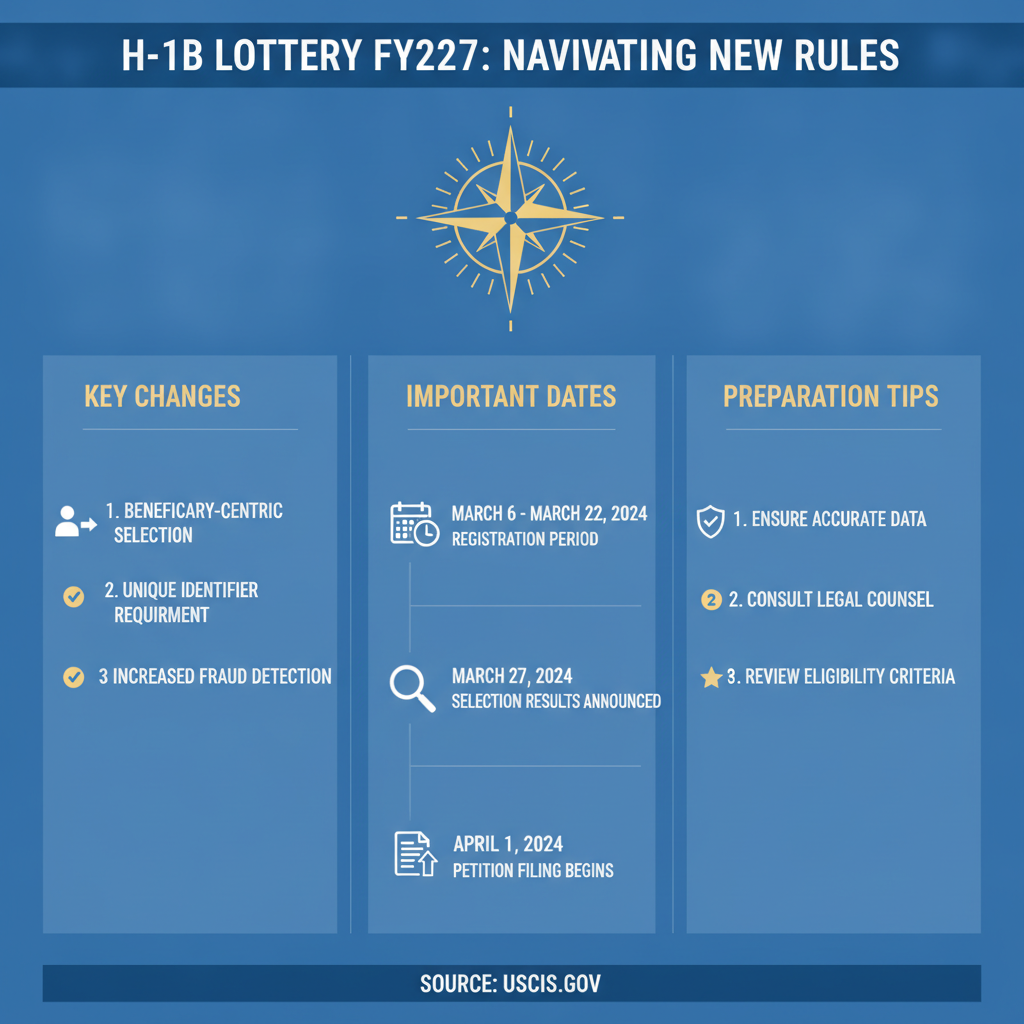
This comprehensive guide is informed by recent discussions and announcements regarding the integrity and fairness of the H-1B lottery system. While specific regulations for FY2027 are still being finalized, the U.S. Citizenship and Immigration Services (USCIS) has consistently moved towards a more beneficiary-centric selection process and enhanced measures to combat fraud. Our analysis is based on these ongoing trends and the expectation of continued vigilance in the upcoming lottery cycles.
H-1B Visa Lottery Changes for FY2027 (Legal News)
What This News Means for Immigrants in Orlando and Across Florida
The H-1B visa program is vital for many industries in Florida, bringing specialized talent to our growing economy. As an immigration law firm deeply rooted in Orlando, Imigrar understands the unique impact these changes can have on our local community and clients nationwide.
Why this news is showing up now
As of 2026-07-08, discussions and anticipated changes for the FY2027 H-1B lottery are highly relevant because the registration period typically opens in March of the calendar year preceding the fiscal year for which the visa is sought. This means the FY2027 lottery registration will likely commence in March 2027. USCIS often announces or implements changes well in advance to allow petitioners and beneficiaries ample time to prepare. These discussions usually stem from USCIS's ongoing efforts to enhance program integrity, reduce fraud, and ensure a more equitable selection process, building upon the significant beneficiary-centric changes introduced for FY2025 and FY2026.
How it can affect Florida residents
Florida's dynamic economy, particularly in sectors like technology, healthcare, aerospace, and tourism, heavily relies on the H-1B program to fill specialty occupation roles. Orlando, as a burgeoning tech hub and a major tourist destination, sees a significant demand for H-1B talent. The changes for FY2027, particularly those aimed at preventing fraud and ensuring a truly beneficiary-centric selection, can have several key impacts on Florida residents and businesses:
- Increased Scrutiny for Employers: Florida employers, especially those who sponsor multiple H-1B workers, will face intensified scrutiny to ensure legitimate job offers and compliance with prevailing wage requirements. This is particularly relevant in areas like the I-4 corridor where tech companies are rapidly expanding.
- Fairer Chances for Genuine Applicants: The continued emphasis on a beneficiary-centric selection process, where each unique beneficiary is entered only once regardless of how many employers register them, aims to level the playing field. This means individuals in Orlando and Central Florida seeking an H-1B visa through a legitimate employer have a fairer chance against those attempting to game the system with multiple, non-bona fide registrations.
- Preparation is Key: For H-1B hopefuls already living in Florida on other visa types (e.g., F-1 OPT, L-1), understanding these changes early allows for meticulous preparation with their prospective employers. This includes ensuring all documentation is robust and that the employer-employee relationship is clearly defined and legitimate.
- Impact on Local Industries: Industries in Orange County and across Florida that depend on highly skilled foreign workers, such as IT consulting firms, hospitals, and engineering companies, will need to adapt their recruitment strategies to align with the stricter lottery rules.
For those in Orlando and across Florida, these changes underscore the importance of working with experienced immigration counsel like Imigrar to navigate the complexities and ensure compliance.
What H-1B Visa Lottery Changes for FY2027 Is (and Why It Matters)
The H-1B visa program is a critical pathway for U.S. employers to hire foreign workers in specialty occupations. The "lottery" aspect comes into play because demand for these visas far exceeds the annual cap set by Congress. The "changes" for FY2027 represent USCIS's ongoing commitment to refining this process, primarily by enhancing integrity and fairness, building on the beneficiary-centric selection model introduced previously.
A plain-English definition
The H-1B visa is a nonimmigrant visa that allows U.S. employers to temporarily employ foreign workers in specialty occupations. These occupations generally require a bachelor's degree or higher in a specific field. Examples include IT professionals, engineers, doctors, architects, and certain types of analysts. Each year, Congress sets an annual cap on the number of H-1B visas issued: 65,000 for the regular cap and an additional 20,000 for those with a U.S. master's degree or higher (the "Master's Cap"). Because the number of eligible petitions often exceeds these caps, USCIS conducts an electronic lottery to select which registrations will be invited to file a full H-1B petition. The "changes" for FY2027 primarily focus on making this lottery selection process more equitable and less susceptible to fraud, ensuring that each unique individual has an equal chance, rather than an employer submitting multiple registrations for the same person to increase their odds.
Key terms you need to know
- H-1B Cap: The congressionally mandated annual limit on the number of H-1B visas issued. For FY2027, this remains at 65,000 regular visas and 20,000 for the Master's Cap.
- Specialty Occupation: An occupation that requires a theoretical and practical application of a body of highly specialized knowledge, and a bachelor's degree or higher in the specific specialty, or its equivalent, as a minimum for entry into the occupation.
- Labor Condition Application (LCA) (Form ETA Form 9035): A form certified by the U.S. Department of Labor (DOL) that attests that the employer will pay the H-1B worker at least the prevailing wage for the occupation in the area of employment and will provide working conditions that will not adversely affect other workers. This must be filed and certified BEFORE an H-1B petition can be filed.
- Petitioner: The U.S. employer who files the H-1B petition on behalf of the foreign worker.
- Beneficiary: The foreign worker for whom the H-1B petition is filed.
- Registration Period: The specific window, typically in March, during which prospective H-1B petitioners (employers) must electronically register beneficiaries for the lottery. This is a crucial two-to-three week window.
- Selection Process: If USCIS receives more registrations than available visas, it conducts a random selection process, first for the Master's Cap, then for the regular cap. For FY2027, this process continues to be beneficiary-centric, meaning selection is based on unique beneficiaries, not on the number of registrations submitted on their behalf.
- Master's Cap: The additional 20,000 H-1B visas reserved for beneficiaries who have earned a U.S. master's degree or higher.
- Fraud Detection and National Security (FDNS): A USCIS directorate responsible for detecting and deterring immigration fraud. Its efforts are increasingly visible in the H-1B program, especially in reviewing multiple registrations and the legitimacy of job offers.
- Beneficiary-Centric Selection: The core "change" that has been fully implemented for recent lotteries and is expected to continue for FY2027. Under this system, USCIS selects registrations based on the unique beneficiary identified in the registration, regardless of how many registrations are submitted on their behalf. If a beneficiary has multiple registrations submitted by different employers, they are still only entered into the lottery once. If selected, USCIS will notify all petitioners who registered that beneficiary that the beneficiary has been selected. This aims to prevent multiple registrations for the same individual from artificially inflating selection odds and reducing opportunities for others.
The integrity of the H-1B program is paramount. These changes are designed to ensure that the lottery serves its intended purpose: to fairly allocate a limited number of visas to qualified individuals for legitimate job offers, benefiting both U.S. employers and the global talent pool.
Confused by H-1B Terminology? Our legal team can clarify complex immigration terms and guide you through the FY2027 H-1B lottery process. Contact Imigrar in Orlando for a free consultation at +1 786-791-3106. Se Habla Español.
Current Immigration Law: The Foundation
The H-1B visa program is governed by specific provisions within the Immigration and Nationality Act (INA) and federal regulations. Understanding this legal framework is crucial, especially when navigating changes to the lottery process.
Federal requirements
The H-1B visa category is primarily defined under INA §101(a)(15)(H)(i)(b). Key federal requirements include:
- Specialty Occupation: The position must qualify as a specialty occupation, as defined by regulation at 8 CFR 214.2(h)(4)(ii). This means the job typically requires a bachelor's degree or higher in a specific field.
- Employer-Employee Relationship: A legitimate employer-employee relationship must exist between the petitioner and the beneficiary, as defined by USCIS policy guidance. This is particularly important for third-party placement models.
- Labor Condition Application (LCA): Before filing an H-1B petition, the employer must file and obtain certification of an LCA (ETA Form 9035) from the U.S. Department of Labor (DOL). The LCA attests that the employer will pay the H-1B worker at least the prevailing wage for the occupation in the area of intended employment and that working conditions will not adversely affect U.S. workers.
- Annual Cap: As stipulated by INA §214(g), the annual numerical limit (cap) for H-1B visas is 65,000, with an additional 20,000 for beneficiaries holding a U.S. master's degree or higher. Certain employers are exempt from the cap, such as institutions of higher education, non-profit organizations affiliated with higher education, and government research organizations.
- Qualifications of the Beneficiary: The beneficiary must meet the minimum educational and/or experience requirements for the specialty occupation. This typically means holding a bachelor's degree or its equivalent.
All H-1B petitions are filed using Form I-129, Petition for a Nonimmigrant Worker. If an employer wishes to expedite the processing of their petition, they may file Form I-907, Request for Premium Processing Service, which guarantees a response from USCIS within 15 calendar days.
For the most up-to-date forms, regulations, and policy guidance, always refer to the USCIS official website.
Florida-specific considerations
While immigration law is federal, its practical application has regional nuances. In Florida, particularly in Orlando and surrounding areas, several factors are noteworthy:
- Key Industries: Florida's robust technology sector, healthcare industry (especially in medical research and hospitals), and engineering firms are significant users of H-1B visas. The demand for skilled workers in these areas often drives H-1B sponsorships.
- Prevailing Wage: The prevailing wage determinations by the DOL are localized. Employers in Orlando, for instance, must ensure they are paying H-1B workers at least the prevailing wage for Orange County for their specific occupation, or the actual wage paid to similarly qualified U.S. workers, whichever is higher.
- Local Economy: The sustained growth in Central Florida's economy means a continuous need for specialized talent. Companies along the I-4 corridor, from Tampa to Daytona Beach, actively seek H-1B workers.
- USCIS Field Offices: While H-1B petitions are processed by USCIS service centers, the Orlando USCIS Field Office may be involved in certain ancillary matters, though less directly with the H-1B petition adjudication itself.
Understanding these local dynamics, combined with federal requirements, is key to a successful H-1B strategy in Florida.

How to Navigate the H-1B Lottery Changes: A Complete Step-by-Step Guide
The H-1B lottery process, especially with the FY2027 changes solidifying a beneficiary-centric approach, requires meticulous planning and execution. Here’s a detailed step-by-step guide to help you prepare.
1) Understand the FY22027 H-1B Lottery Changes and Prepare
Before any action is taken, it is paramount for both employers and prospective beneficiaries to fully grasp the implications of the beneficiary-centric selection process and USCIS’s enhanced fraud prevention measures for FY2027. This means:
- Beneficiary-Centric Selection: Confirm that you understand this rule. Each unique beneficiary can only have one chance in the lottery, regardless of how many employers register them. If selected, all registering employers are notified.
- Legitimate Job Offers: Employers must ensure they have a bona fide job offer for a specialty occupation position. USCIS is increasing scrutiny on situations where multiple registrations are filed for the same beneficiary by seemingly unrelated employers, or where the employer's business model doesn't clearly support the H-1B role.
- Early Consultation: Both employers and beneficiaries should consult with an experienced immigration attorney well in advance of the registration period.
Required Documents (Initial Assessment - Beneficiary):
- Copy of passport biographical page.
- Detailed resume/CV.
- Copies of all academic degrees (Bachelor's, Master's, Ph.D.).
- Official academic transcripts.
- Any professional licenses or certifications relevant to the specialty occupation.
- Copies of previous U.S. visa stamps and I-94 records (if applicable).
Required Documents (Initial Assessment - Employer):
- Company FEIN (Federal Employer Identification Number).
- Company legal name and address.
- Contact information for the authorized signatory.
- Job title, duties, and proposed salary for the H-1B position.
- A brief description of the company's business and why the H-1B position is a specialty occupation.
2) Employer Files Labor Condition Application (LCA)
Once the employer and beneficiary are aligned and an attorney has confirmed eligibility, the employer must file a Labor Condition Application (LCA), ETA Form 9035, with the U.S. Department of Labor (DOL). This must be certified by the DOL before the H-1B petition can be filed with USCIS.
- Wage Determination: The employer must determine the prevailing wage for the occupation in the intended area of employment (e.g., Orlando, FL) and attest that they will pay at least this amount or the actual wage paid to similarly qualified U.S. workers, whichever is higher.
- Posting Notice: The employer must provide notice of the LCA filing to its U.S. employees at the place of employment.
Required Documents (for LCA):
- Employer's FEIN.
- Details of the job position (title, duties, requirements).
- Proposed salary.
- Worksite location(s).
Timeline: LCA processing can take 7-10 business days, but can sometimes be longer if there are issues. It's crucial to start this process early.
3) H-1B Registration Submission
The employer (or their attorney) must electronically register the beneficiary for the H-1B lottery during the designated registration period, typically in March 2027 for FY2027. This is done through the USCIS online registration system.
- One Registration Per Beneficiary: Under the beneficiary-centric rule, each unique beneficiary should only have one registration submitted on their behalf. If multiple employers wish to sponsor the same beneficiary, they can each submit a registration, but the beneficiary's chances are not increased. USCIS will identify unique beneficiaries using passport information or other valid travel documents.
- Fee: A non-refundable $10.00 registration fee must be paid for each registration.
Required Information (for Registration):
- Employer's legal name, FEIN, and mailing address.
- Employer's authorized signatory's name, title, and contact information.
- Beneficiary's full name, date of birth, country of birth, country of citizenship.
- Beneficiary's gender.
- Beneficiary's passport number.
- Beneficiary's highest level of education and U.S. master's degree information (if applicable).
Important: Ensure all information is accurate. Errors can lead to disqualification if selected.
4) Lottery Selection and Petition Filing
If the number of registrations exceeds the annual cap, USCIS conducts the lottery. Results are typically announced in late March or early April (e.g., late March/early April 2027 for FY2027). If selected, the employer receives a selection notice and a window to file the full H-1B petition.
- Selection Notification: Selected registrants will have their online accounts updated with a "Selected" status. All employers who registered a selected beneficiary will be notified.
- Petition Filing Window: USCIS will provide a specific filing window, usually 90 days, during which the employer must submit the complete Form I-129, Petition for a Nonimmigrant Worker, along with all supporting documentation and the certified LCA.
- Choosing an Employer: If a beneficiary is selected through multiple registrations, they must choose one employer to proceed with the full petition. The other employers cannot file a petition based on that selection.
Required Documents (for Form I-129 Petition):
- Form I-129, Petition for a Nonimmigrant Worker (signed and completed).
- Certified LCA (ETA Form 9035).
- Beneficiary's academic credentials (degrees, transcripts, evaluations if foreign degrees).
- Beneficiary's resume/CV.
- Employer letter describing the job, why it's a specialty occupation, and the beneficiary's qualifications.
- Evidence of employer's ability to pay the proffered wage.
- Copies of any previous immigration documents (I-20, OPT EAD, I-797s, I-94s, visas).
- Itinerary of services (if the beneficiary will work at multiple locations or for third-party clients).
- Client letters/contracts (for third-party placements, showing work details and employer control).
- Organizational charts, project descriptions.
- Required filing fees.
Warning: The petition must be filed within the designated window. Missing this deadline will result in the forfeiture of the selection.
5) Premium Processing or Regular Adjudication
Employers have the option to request premium processing for their H-1B petition, expediting USCIS's review.
- Premium Processing: Filing Form I-907, Request for Premium Processing Service, with an additional fee, guarantees USCIS will take action on the petition (approval, denial, RFE, or NOID) within 15 calendar days.
- Regular Processing: Without premium processing, adjudication times can vary significantly, often taking 6-12 months or longer, depending on the service center and USCIS workload. Check USCIS Processing Times for current estimates.
Required Document (for Premium Processing):
- Form I-907, Request for Premium Processing Service.
- Additional premium processing fee.
6) Visa Interview (for those outside U.S.) or Change of Status (within U.S.)
Once the H-1B petition is approved, the next step depends on the beneficiary's current location and immigration status.
- Consular Processing (Outside U.S.): Beneficiaries outside the U.S. will typically attend a visa interview at a U.S. embassy or consulate in their home country. They will need their passport, approval notice (Form I-797), and other supporting documents. The U.S. Department of State provides country-specific guidelines.
- Change of Status (Within U.S.): If the beneficiary is already in the U.S. in a valid nonimmigrant status (e.g., F-1 OPT, L-1, H-4), and the H-1B petition was filed with a "change of status" request, their status will automatically change to H-1B on October 1st (the start of the fiscal year), provided the petition is approved. They do not need to leave the U.S. for a visa interview.
Required Documents (for Visa Interview/Change of Status):
- Valid passport.
- Form I-797 Approval Notice.
- DS-160 Confirmation Page (for consular processing).
- Photographs.
- Original academic documents, resume.
- Employment verification letter, job offer letter.
- Proof


