


The landscape of U.S. work visas is constantly evolving, and for those pursuing professional opportunities, staying informed is paramount. The H-1B visa, a cornerstone for skilled foreign workers, recently underwent significant changes to its lottery system, impacting the Fiscal Year 2027 (FY2027) cycle and setting a new precedent for future applications.
At Imigrar, an immigration law firm based in Orlando, Florida, we understand the anxieties and complexities these changes can bring. Our mission is to "Keep Families Together" by providing expert legal guidance and support through every step of your immigration journey. This comprehensive guide breaks down the new H-1B lottery rules, explains their impact, and offers actionable advice for navigating this critical process.
The reporting that sparked this guide
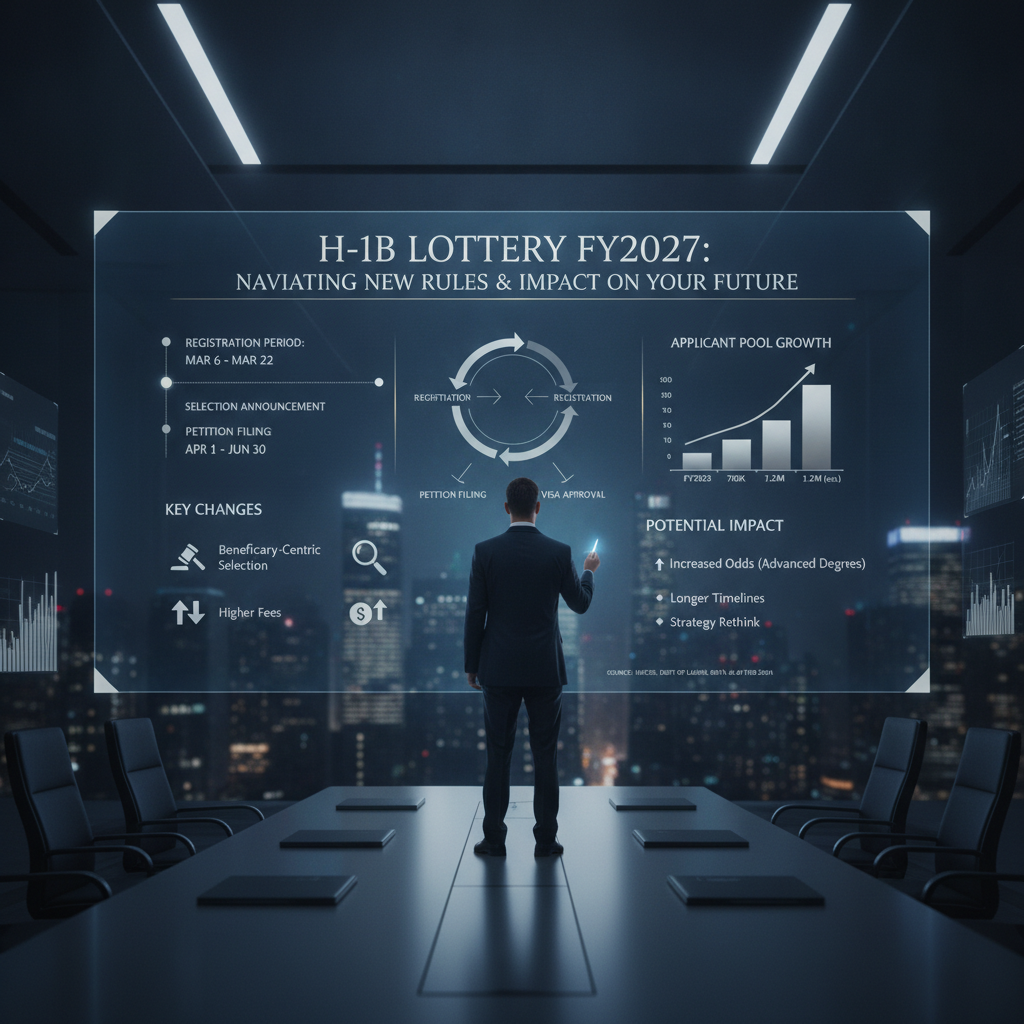
H-1B Visa Lottery Changes for FY2027 (Legal News)
What This News Means for Immigrants in Orlando and Across Florida
Why this news is showing up now
While the H-1B visa lottery for Fiscal Year 2027 (FY2027) concluded its registration and selection phases earlier this year (typically March-April 2026), the full implications and operational nuances of the new rules are only now becoming clear. The U.S. Citizenship and Immigration Services (USCIS) implemented a significant shift from a "per registration" to a "per unique beneficiary" selection process for the FY2027 lottery, aimed at reducing fraud and ensuring a fairer chance for all eligible individuals. This change, along with updated fee structures and integrity measures, has been a subject of ongoing analysis by legal professionals, government agencies, and the tech industry. As we approach the end of the current fiscal year and look towards the commencement of FY2027 on October 1, 2026, and the planning for the FY2028 lottery (registration in March 2027), the trending news reflects a heightened awareness of these established changes, their practical outcomes, and the continued need for vigilance and strategic preparation.
This news is timely because the H-1B program is a vital pathway for many skilled professionals, and any substantial change generates considerable interest and requires careful interpretation. Businesses and foreign nationals are now assessing the impact of the FY2027 changes on their current and future immigration strategies, making expert guidance more crucial than ever.
How it can affect Florida residents
Florida, particularly the Orlando metropolitan area, is a vibrant hub for technology, aerospace, tourism, healthcare, and advanced manufacturing. These industries heavily rely on skilled foreign talent, often through the H-1B visa program. The new lottery rules can significantly affect Florida residents in several ways:
- Increased Fairness for Beneficiaries: For individuals currently residing in Florida on other nonimmigrant visas (like F-1 OPT/STEM OPT, L-1, TN) or those abroad seeking opportunities in the Sunshine State, the beneficiary-centric selection process levels the playing field. It means that if multiple employers in Orlando or elsewhere register you for the H-1B lottery, your chances are no longer multiplied by those duplicate registrations. Instead, each unique individual has one single, fair chance of selection. This reduces the advantage previously held by those who could secure multiple registrations, often through fraudulent means.
- Employer Strategy Adjustments: Florida-based companies, especially those in the I-4 corridor's burgeoning tech and simulation industries, must adjust their recruitment and sponsorship strategies. They can no longer rely on submitting multiple registrations for the same candidate to boost selection odds. This necessitates a more focused approach on identifying truly qualified candidates and ensuring robust petition preparation from the outset.
- Reduced Fraud and Enhanced Integrity: The Orlando USCIS Field Office, like others across the nation, benefits from the enhanced integrity of the H-1B program. While direct interaction with the lottery is minimal at the field office level, the overall reduction in fraudulent registrations helps streamline the system and ensures that legitimate petitions receive due consideration.
- Planning for Future Cycles: For those in Central Florida aspiring to an H-1B visa, understanding these changes is critical for planning for the FY2028 lottery and beyond. It underscores the importance of working with reputable employers and ensuring all documentation is impeccable.
Navigating the New H-1B Landscape? Don't face the complexities alone. Our Orlando immigration team is ready to assist you and your employer in understanding the new H-1B rules and preparing a strong application. Call +1 786-791-3106 for a free consultation, or message us online. Se Habla Español.
What H-1B Visa Lottery Changes for FY2027 Is (and Why It Matters)
A plain-English definition
The H-1B visa is a nonimmigrant visa that allows U.S. employers to temporarily employ foreign workers in specialty occupations. A "specialty occupation" generally requires a bachelor's degree or higher in a specific field. Due to high demand and an annual cap set by Congress, USCIS conducts a lottery to select eligible registrations when the number of registrations exceeds the available visas. The "H-1B Visa Lottery Changes for FY2027" refers to the new rules that USCIS implemented for the lottery process that determined who could apply for an H-1B visa for the fiscal year beginning October 1, 2026. The most significant change is the shift to a beneficiary-centric selection process, meaning that each individual foreign national (beneficiary) gets one chance in the lottery, regardless of how many employers register them. This is a fundamental change designed to prevent fraud and create a fairer system for everyone.
Key terms you need to know
Understanding these terms is crucial when navigating the H-1B process, especially with the new changes:
- H-1B Visa: A nonimmigrant visa that permits U.S. employers to temporarily employ foreign workers in specialty occupations.
- Specialty Occupation: An occupation that requires theoretical and practical application of a body of highly specialized knowledge, and a bachelor's or higher degree in the specific specialty (or its equivalent) as a minimum for entry into the occupation in the United States.
- Annual Cap: The statutory limit on the number of H-1B visas issued each fiscal year. Currently, Congress sets the annual regular cap at 65,000, with an additional 20,000 visas reserved for those with a U.S. master's degree or higher (the "master's cap").
- H-1B Lottery (or Selection Process): When the number of eligible registrations submitted during the initial registration period exceeds the annual cap, USCIS conducts a random selection process to choose which registrations can proceed to file a full H-1B petition.
- Beneficiary: The foreign national who is seeking the H-1B visa.
- Petitioner: The U.S. employer who is sponsoring the foreign national for the H-1B visa.
- Registration Period: The designated window (typically in March) during which prospective H-1B petitioners (employers) must electronically register their beneficiaries with USCIS for the lottery. For FY2027, this period was in March 2026.
- Selection Period: The time after the registration period when USCIS conducts the lottery and announces the selected registrations. For FY2027, results were typically announced by the end of March 2026.
- Cap-Subject: Refers to H-1B petitions that are subject to the annual numerical limits.
- Cap-Exempt: Certain H-1B petitions are exempt from the annual cap, such as those filed by institutions of higher education, non-profit organizations affiliated with higher education, or governmental research organizations.
- USCIS (U.S. Citizenship and Immigration Services): The government agency responsible for administering immigration and naturalization benefits. USCIS official website
- DHS (Department of Homeland Security): The federal department that oversees USCIS, U.S. Customs and Border Protection (CBP), and U.S. Immigration and Customs Enforcement (ICE).
- DOL (Department of Labor): The government agency responsible for issuing Labor Condition Applications (LCAs), a required component of H-1B petitions.
- Form I-129, Petition for a Nonimmigrant Worker: The primary form filed by the employer on behalf of the beneficiary once a registration is selected in the lottery.
- Form I-797, Notice of Action: A receipt or approval notice issued by USCIS for various filings, including H-1B petitions.
- Labor Condition Application (LCA): Form ETA-9035, certified by the DOL, which ensures that employing an H-1B worker will not adversely affect the wages and working conditions of U.S. workers.
Current Immigration Law: The Foundation of the H-1B Visa
The H-1B visa program is rooted in federal immigration law, primarily the Immigration and Nationality Act (INA). Specifically, Section 101(a)(15)(H)(i)(b) of the INA (8 U.S.C. § 1101(a)(15)(H)(i)(b)) defines the H-1B nonimmigrant classification. Further regulations governing the H-1B program are found in Title 8 of the Code of Federal Regulations (8 CFR Part 214.2(h)). These statutes and regulations outline the eligibility criteria for both employers and beneficiaries, the annual cap limitations, and the processes for application and selection, including the lottery system.
The recent changes for FY2027 were implemented through a final rule published by DHS, amending 8 CFR Part 214.2(h) and 8 CFR Part 103. This new rule introduced the "beneficiary-centric" lottery selection process and strengthened integrity measures to prevent fraud. It also updated the H-1B cap registration fee.
Federal requirements
To qualify for an H-1B visa, both the employer (petitioner) and the foreign worker (beneficiary) must meet specific federal requirements:
For the Employer (Petitioner):
- Must offer a job in a specialty occupation.
- Must file a Labor Condition Application (LCA), Form ETA-9035, with the U.S. Department of Labor, attesting that it will pay the H-1B worker at least the prevailing wage for the occupation in the area of intended employment or the actual wage paid to other employees with similar experience and qualifications, whichever is higher.
- Must attest that employment of the H-1B worker will not adversely affect the working conditions of U.S. workers similarly employed.
- Must have an Employer Identification Number (EIN).
- Must have a legitimate job offer for the beneficiary.
For the Employee (Beneficiary):
- Must hold a bachelor's degree or its equivalent, or a license in a specialty occupation field, or have work experience equivalent to a bachelor's degree.
- The degree must be in a field related to the specialty occupation.
- Must be qualified to perform services in the specialty occupation.
- Must meet the minimum educational requirements for the specific specialty occupation.
Important: The H-1B visa is employer-specific. If an H-1B worker changes employers, the new employer must file a new H-1B petition.
Florida-specific considerations
While immigration law is federal, its impact is felt locally. For Florida residents and employers, understanding the nuances of the H-1B program within the state's economic context is key:
- High Demand in Key Sectors: Florida's growing sectors such as information technology, aerospace engineering (especially around Cape Canaveral and Orlando), healthcare, finance, and tourism management often seek H-1B talent. This means competition for H-1B visas remains high for positions within these industries in Florida.
- Prevailing Wage Levels: The prevailing wage requirements set by the DOL vary by geographic area. Employers in Orlando, Tampa, Miami, or other Florida cities must ensure their LCA accurately reflects the prevailing wage for their specific location and occupation. This is a critical component of the Form I-129 petition.
- Academic Institutions: Florida is home to numerous universities and research institutions (e.g., University of Central Florida in Orlando, University of Florida, Florida State University) that are cap-exempt. This means they can file H-1B petitions at any time of the year, outside of the lottery system, for employees working in qualifying positions. This provides an alternative pathway for some highly skilled individuals.
- Local USCIS Office: While H-1B petitions are centrally processed, the Orlando USCIS Field Office may handle certain follow-up actions or provide specific local information, though direct interaction for H-1B petitions is rare unless there's an interview for a related status adjustment.
For more detailed information on H-1B regulations and forms, you can always refer to the USCIS official website and the USCIS Forms page.
Considering an H-1B Visa in Florida? The new rules require meticulous preparation. Imigrar offers comprehensive legal support for employers and beneficiaries across Orlando and nationwide. Get your questions answered. Call +1 786-791-3106 for a free consultation. Se Habla Español.

How to Navigate the H-1B Visa Lottery Changes for FY2027: A Complete Step-by-Step Guide
The H-1B lottery process, particularly with the new FY2027 changes, demands careful planning and execution. This step-by-step guide outlines the typical process for cap-subject H-1B petitions, incorporating the new beneficiary-centric selection method.
1) Understand the New Lottery Rules and Prepare Strategically
Before any action is taken, both the employer and beneficiary must fully grasp the implications of the FY2027 changes, particularly the beneficiary-centric selection process. This means that each unique beneficiary is entered into the lottery only once, regardless of how many employers register them. This change aims to curb fraud and ensure fairness. Employers should focus on robust job offers and clear specialty occupation duties. Beneficiaries should ensure they are working with legitimate employers.
- Required Documents for Preparation:
- Beneficiary's passport biographical page.
- Beneficiary's educational degrees and transcripts (evaluated if from foreign institutions).
- Beneficiary's resume/CV.
- Employer's EIN.
- Detailed job description outlining specialty occupation duties.
- Company information (industry, size, services, etc.).
- Timeline Expectation: This preparatory phase should ideally begin months before the registration period (e.g., by late Fall 2026 for the FY2028 lottery registration in March 2027).
2) Employer Registration with USCIS
The H-1B cap-subject process begins with electronic registration. Employers must register each prospective H-1B beneficiary electronically with USCIS during a designated registration period, typically in March. For the FY2027 lottery, this period was in March 2026. Under the new rules, employers must provide the beneficiary's valid passport information, and each unique passport number identifies a unique beneficiary. The registration fee also increased for FY2027.
- Required Documents/Information for Registration:
- Employer's legal name, address, and EIN.
- Authorized signatory's name, title, and contact information.
- Beneficiary's full legal name, date of birth, country of birth, country of citizenship, gender.
- Beneficiary's valid passport number.
- Beneficiary's highest degree obtained.
- Indication of whether the beneficiary holds a U.S. master's degree or higher.
- Designated office of employment.
- Timeline Expectation: The registration period typically lasts 2-3 weeks in March. Late registrations are not accepted.
- Official Reference: USCIS H-1B Cap Season page
3) Await Lottery Results and Prepare for Petition Filing
After the registration period closes, USCIS conducts the lottery if the number of registrations exceeds the available visas. Under the new rules, this selection is based on unique beneficiaries. USCIS then notifies petitioners with selected registrations through their online accounts. If selected, the petitioner receives a selection notice allowing them to file a full H-1B petition (Form I-129) on behalf of the beneficiary.
- Required Documents: No new documents required at this stage, but selected petitioners should immediately begin compiling all necessary documents for the Form I-129.
- Timeline Expectation: Selection notifications are typically sent by the end of March for the prior month's registration. Petition filing typically opens on April 1 and usually extends for 90 days (e.g., April 1 to June 30 for FY2027).
4) File the H-1B Petition (Form I-129)
Upon selection, the employer must file the complete H-1B petition, Form I-129, Petition for a Nonimmigrant Worker, with USCIS within the designated filing window. This petition must include the certified Labor Condition Application (LCA), Form ETA-9035, and extensive supporting documentation proving the specialty occupation, the beneficiary's qualifications, and the employer-employee relationship. This step requires meticulous attention to detail.
- Required Documents for Form I-129:
- Certified LCA (Form ETA-9035).
- Employer's letter of support outlining the job offer, specialty occupation duties, and beneficiary's qualifications.
- Beneficiary's educational documents (degrees, transcripts, evaluations).
- Beneficiary's resume/CV.
- Beneficiary's passport, visa, and I-94 records (if already in the U.S.).
- Employer's business documents (e.g., articles of incorporation, business licenses, tax returns, financial statements, organizational charts).
- Evidence of employer-employee relationship (e.g., offer letter, employment contract).
- Any required fees (e.g., base filing fee, ACWIA fee, fraud prevention and detection fee, public law 114-113 fee if applicable, premium processing fee if requested).
- Important: All documents must be accurate and consistent with the registration information.
- Timeline Expectation: The filing period is usually 90 days from April 1. USCIS processing times can vary significantly. Check USCIS Processing Times for current estimates.
5) Respond to Requests for Evidence (RFEs)
It is common for USCIS to issue a Request for Evidence (RFE) if they require more information or clarification regarding the petition. RFEs often relate to specialty occupation issues, employer-employee relationship, beneficiary qualifications, or wage compliance. A timely and thorough response is critical for approval.
- Required Documents: Varies greatly depending on the RFE. May include additional evidence of specialized knowledge, client letters, detailed project plans, organizational charts, payroll records, expert opinion letters, or academic evaluations.
- Timeline Expectation: RFE response deadlines are typically 60-90 days from the RFE issue date.
6) Attend Visa Interview (for consular processing) or Await Change of Status
If the H-1B petition is approved, the next step depends on the beneficiary's current location:
- For beneficiaries outside the U.S.: They will undergo consular processing. This involves scheduling and attending a visa interview at a U.S. embassy or consulate in their home country. Upon successful interview, the H-1B visa stamp will be affixed to their passport, allowing them to enter the U.S.
- For beneficiaries inside the U.S.: If they are eligible and USCIS granted a Change of Status (COS) (e.g., from F-1 to H-1B), their status will automatically change to H-1B on October 1 of the fiscal year. They will receive an updated Form I-797, Notice of Action, indicating the approval and change of status.
- Required Documents for Consular Interview:
- Valid passport.
- DS-160 confirmation page.
- Visa interview appointment confirmation.
- Original Form I-797, Notice of Action (H-1B approval


