


The landscape of U.S. immigration is constantly evolving, and for those seeking to work in specialty occupations, the H-1B visa program is often the most direct path. As we approach the registration period for Fiscal Year 2027 (FY2027), significant changes to the H-1B lottery process are set to reshape how employers and prospective employees approach this highly competitive visa category. At Imigrar, based in Orlando, Florida, we are committed to keeping you informed and prepared for these crucial updates.
Today, June 22, 2026, the discussion around the H-1B visa lottery changes for FY2027 is paramount. These new rules, particularly the shift to a beneficiary-centric selection process, aim to enhance fairness and reduce the potential for fraud, but they also introduce new complexities that require careful understanding and strategic planning.
Feeling Overwhelmed by H-1B Changes? Don't navigate the new FY2027 rules alone. Our experienced Orlando immigration team at Imigrar is ready to assist. Call +1 786-791-3106 for a free consultation, or message us online. Se Habla Español.
This comprehensive guide will break down the latest H-1B visa lottery changes, explain what they mean for you, provide a step-by-step application process, and offer practical advice to increase your chances of success. We serve clients nationwide from our Orlando office, and our mission is to Keep Families Together by providing expert legal guidance.
NEWS SOURCE REFERENCE SECTION

The reporting that sparked this guide: H-1B Visa Lottery Changes for FY2027 (Legal News)
What This News Means for Immigrants in Orlando and Across Florida
For many highly skilled foreign nationals and the U.S. companies that seek to employ them, the H-1B visa is a lifeline. This news about changes for the FY2027 lottery is not just another procedural update; it represents a fundamental shift in how the lottery is conducted, with significant implications for all stakeholders.
Why this news is showing up now
The U.S. Citizenship and Immigration Services (USCIS) has been continually evaluating and refining the H-1B cap registration process to address persistent concerns about fairness and integrity. For years, the system has been criticized for allowing multiple employers to register the same beneficiary, thereby artificially inflating that individual's chances of selection and reducing the overall odds for others. This practice, while not illegal under previous rules, led to a perception of unfairness and potential for abuse, particularly by some petitioners who might register individuals without a genuine job offer.
The changes for FY2027 are a direct response to these concerns, building on modifications first introduced for the FY2025 lottery. USCIS announced these changes to take effect with the next registration period, which typically occurs in March of the calendar year preceding the start of the fiscal year. Given that today is June 22, 2026, the FY2027 lottery registration period (which will likely occur in March 2027) is on the horizon, making these updates critically important for planning now. The goal is to ensure that each eligible beneficiary has an equal chance of selection, regardless of the number of job offers they receive or the number of employers who register on their behalf.
These proactive measures by USCIS are designed to combat fraud, improve the integrity of the H-1B cap selection process, and ultimately ensure that the limited number of H-1B visas are allocated fairly among all eligible beneficiaries. The agency has been increasingly vocal about its intent to prosecute individuals and companies found to be engaging in fraudulent practices, reinforcing the necessity of these new rules.
How it can affect Florida residents
Florida is a dynamic state with a diverse economy, including thriving sectors like technology, tourism, healthcare, aerospace, and education. Many companies in Orlando, Tampa, Miami, and other major Florida cities rely on the H-1B program to fill critical talent gaps, especially in specialty occupations that require highly skilled professionals. The changes to the H-1B lottery will have a direct impact on both Florida employers and foreign nationals residing or seeking employment in the state.
- For Foreign Nationals in Florida: If you are an international student graduating from a Florida university (e.g., UCF, UF, USF) or a skilled professional working in Florida on an Optional Practical Training (OPT) visa, these changes are particularly relevant. The new beneficiary-centric selection process means that if you have multiple job offers from Florida companies, your individual chance of being selected in the lottery remains the same, regardless of how many employers register for you. This levels the playing field, ensuring that your skills and qualifications, rather than the number of registrations, are the primary factor in your selection odds. It emphasizes the importance of having genuine job offers and working with reputable employers.
- For Florida Employers: Companies across the I-4 corridor and throughout the state, from startups to large corporations, will need to adjust their H-1B recruitment and sponsorship strategies. The new rules underscore the importance of submitting legitimate registrations for actual job openings. Employers should be wary of third-party vendors or consultants who promise to "boost" selection chances by submitting multiple registrations for the same individual, as this practice no longer provides an advantage and could lead to investigations or penalties. For Central Florida residents, particularly those in the Orlando tech hub, understanding these changes is crucial for securing and retaining top talent. The Orlando USCIS Field Office and local legal resources will be vital points of contact for navigating the updated process.
- Increased Scrutiny: USCIS has indicated increased scrutiny on H-1B petitions following lottery selection. This means that even after selection, the petition itself must be robust, well-documented, and demonstrate a clear employer-employee relationship and a genuine specialty occupation position. Florida businesses, especially those new to H-1B sponsorship, must ensure compliance from the outset.
The bottom line for Florida residents and businesses is that integrity and genuine intent are now more critical than ever in the H-1B process. While the competition for H-1B visas remains intense due to the annual cap, these changes aim to make the process fairer and more transparent for everyone involved.
What H-1B Visa Lottery Is (and Why It Matters)
The H-1B visa is a nonimmigrant visa that allows U.S. employers to temporarily employ foreign workers in specialty occupations. These occupations generally require a bachelor's degree or higher in a specific field, such as IT, engineering, medicine, education, and many others. It's a vital tool for U.S. companies to access global talent and for skilled foreign professionals to contribute to the U.S. economy.
A plain-English definition
Think of the H-1B visa as a special work permit for highly skilled people. If a company in the U.S. needs someone with a specific university degree (like an engineer, a software developer, or a financial analyst), and they can't find a U.S. worker for the job, they can sponsor a foreign national for an H-1B visa. This visa allows that person to work in the U.S. for that specific company for up to three years, often extendable to six years, and sometimes even longer if they're pursuing a Green Card.
The problem is, the U.S. government sets an annual limit, or "cap," on how many new H-1B visas can be issued each fiscal year. This limit is currently 85,000, with 65,000 for the regular cap and an additional 20,000 for those who have earned a U.S. master's degree or higher. Because the demand for these visas far exceeds the supply, USCIS conducts an electronic lottery, officially called the H-1B Cap Registration, to randomly select which individuals will be allowed to submit a full H-1B petition.
The H-1B lottery is crucial because without being selected, an employer cannot file an H-1B petition for a cap-subject worker. It's the gateway to securing an H-1B visa for most new applicants. The changes for FY2027 are designed to make this lottery process more equitable by focusing on the individual worker, rather than how many applications they might have.
Key terms you need to know
Navigating the H-1B process requires understanding specific terminology. Here are some key terms:
- H-1B Visa: A nonimmigrant visa that permits U.S. employers to temporarily employ foreign workers in specialty occupations.
- Specialty Occupation: An occupation that requires theoretical and practical application of a body of highly specialized knowledge and a bachelor's or higher degree in the specific specialty (or its equivalent) as a minimum for entry into the occupation in the United States.
- Cap-Subject H-1B: Refers to H-1B petitions that are subject to the annual numerical limit (cap). Most new H-1B petitions are cap-subject.
- H-1B Cap: The annual numerical limit on the number of H-1B visas issued. Currently set at 65,000 for the regular cap and an additional 20,000 for those with a U.S. master's degree or higher (the "master's cap").
- H-1B Cap Registration: The electronic registration process employers must complete to enter a beneficiary into the H-1B lottery. This is what you "win" to then file the full petition.
- Beneficiary: The foreign national worker for whom the H-1B visa is sought.
- Petitioner: The U.S. employer filing the H-1B petition on behalf of the beneficiary.
- USCIS: U.S. Citizenship and Immigration Services, the government agency that administers immigration benefits. USCIS official website
- FY2027: Fiscal Year 2027, which begins on October 1, 2026, and ends on September 30, 2027. H-1B visas selected in the 2027 lottery will have an earliest start date of October 1, 2026.
- Labor Condition Application (LCA): Form ETA-9035, certified by the U.S. Department of Labor, which must be filed and certified before an H-1B petition can be submitted to USCIS. It attests that the employer will pay the H-1B worker at least the prevailing wage for the occupation in that area.
- Consular Processing: The process of applying for a visa stamp at a U.S. embassy or consulate abroad, typically for beneficiaries who are outside the U.S. when their H-1B petition is approved. U.S. Department of State
- Adjustment of Status: The process of applying for lawful permanent resident status (a Green Card) while remaining in the U.S. This is distinct from H-1B but often follows it.
Have Questions About H-1B Terminology? Imigrar's team is here to clarify. Get a free consultation by calling +1 786-791-3106 or contact us online. Se Habla Español.
Current Immigration Law: The Foundation
The H-1B visa program is governed primarily by the Immigration and Nationality Act (INA). Specifically, Section 101(a)(15)(H)(i)(b) of the INA defines the H-1B nonimmigrant category, while Section 214(g) establishes the annual numerical cap on H-1B visas. The regulations implementing these statutory provisions are found in the Code of Federal Regulations (CFR), particularly at 8 CFR Part 214.2(h).
These laws and regulations outline the eligibility criteria for both the employer and the foreign worker, the duration of the visa, the requirements for filing a petition, and the procedures for the annual cap and lottery.
Federal requirements
To be eligible for an H-1B visa, both the petitioning employer and the beneficiary must meet stringent federal requirements:
-
For the Employer (Petitioner):
- Must offer a job in a specialty occupation.
- Must have an Employer Identification Number (EIN).
- Must pay the H-1B worker at least the "prevailing wage" for that occupation in the geographic area of employment, or the actual wage paid to other employees with similar experience and qualifications, whichever is higher. This is attested to in the Labor Condition Application (LCA), Form ETA-9035, certified by the U.S. Department of Labor (DOL).
- Must demonstrate the ability to pay the offered wage.
- Must maintain an employer-employee relationship with the beneficiary.
-
For the Employee (Beneficiary):
- Must possess a bachelor's degree or its equivalent, or a higher degree required by the specialty occupation, from an accredited college or university.
- Alternatively, must hold an unrestricted state license, be in a specialty occupation, and be engaged in that specialty, or have work experience equivalent to a bachelor's degree.
- Must have an employer willing to sponsor them for an H-1B visa.
- Must meet any specific state licensing requirements for the occupation (e.g., for doctors, nurses, engineers).
The primary form used for filing an H-1B petition is Form I-129, Petition for a Nonimmigrant Worker. This form is filed with USCIS and must be accompanied by all supporting documentation, including the certified LCA, educational credentials, and evidence of the employer's business and the job offer.
Important: USCIS regularly updates its forms and filing instructions. Always refer to the USCIS Forms page for the most current versions and guidance.
Florida-specific considerations
While H-1B visa requirements are federal, the practical application and impact vary regionally. Florida's unique economic landscape means certain considerations are more pronounced:
- Demand in Key Sectors: Florida's growing tech industry (especially in Orlando, Tampa, and Miami), robust healthcare sector, and large tourism and hospitality management industries frequently utilize H-1B visas. Employers in these fields must be particularly aware of the annual cap and the lottery process.
- Educational Institutions: Florida is home to numerous universities, producing a large pool of international graduates who often seek H-1B sponsorship after completing their studies and Optional Practical Training (OPT). For students graduating from institutions like the University of Central Florida (UCF), University of Florida (UF), or Florida International University (FIU), understanding the H-1B process is critical for their post-graduation plans.
- Prevailing Wage Determinations: The prevailing wage for a specific occupation can vary significantly even within Florida. For instance, the prevailing wage for a software developer in Orlando's tech hub might differ from that in a less urbanized part of the state. Employers must ensure their LCA accurately reflects the correct wage level for their specific geographic area and job duties.
- Local USCIS Engagement: While H-1B petitions are processed at designated USCIS service centers, local USCIS field offices (like the Orlando USCIS Field Office) handle other immigration matters and can sometimes provide limited local support for inquiries, though they do not process H-1B petitions directly. It is essential to work with an attorney who understands both federal regulations and local economic nuances.
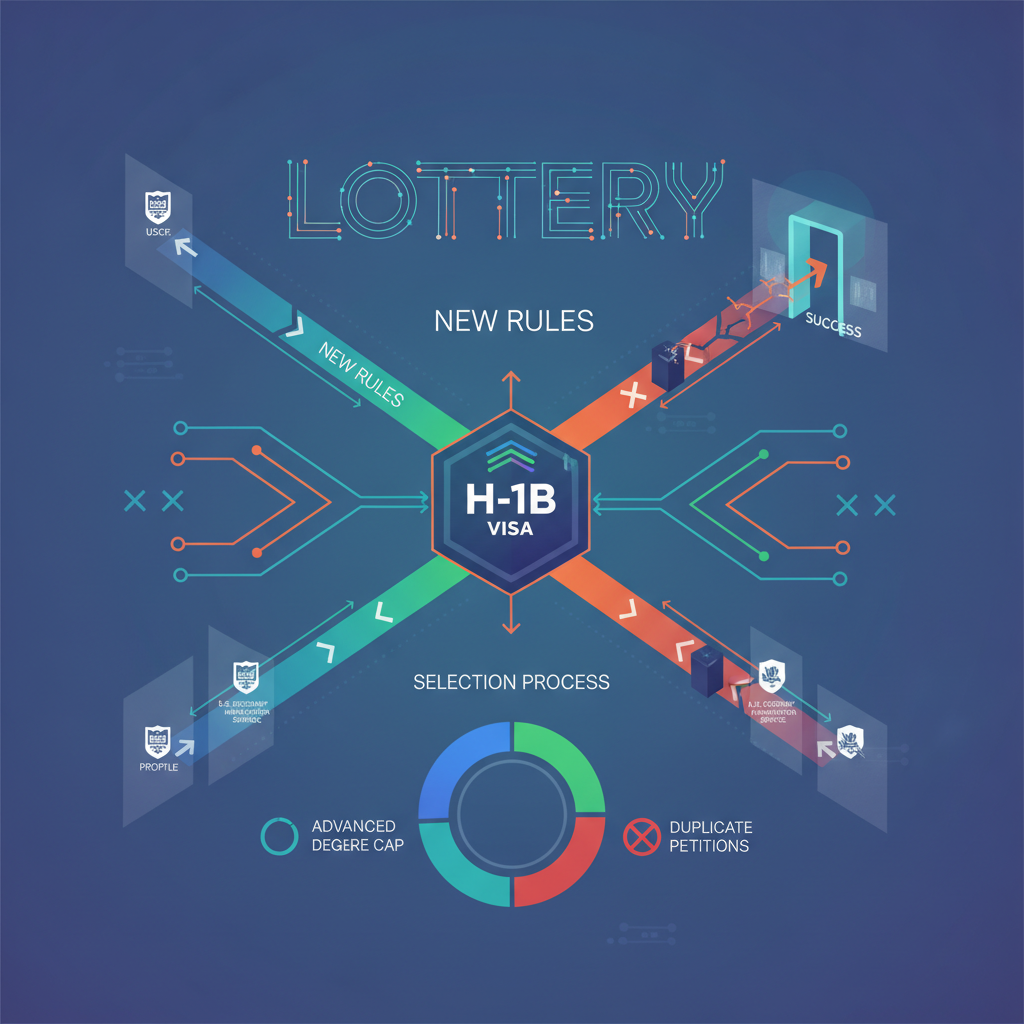
How to Navigate the H-1B Lottery Changes for FY2027: A Complete Step-by-Step Guide
The H-1B cap registration and petition process is intricate. With the new beneficiary-centric selection process for FY2027, strategic planning and meticulous execution are more critical than ever. Here’s a detailed step-by-step guide:
1) Employer Assessment & Preparation (Ongoing)
Before any registration can occur, the prospective employer must assess their need for an H-1B worker and understand the associated responsibilities.
- Identify Specialty Occupation: The employer must confirm that the job offered meets the definition of a specialty occupation. This means the job typically requires a bachelor's degree or higher in a specific field.
- Determine Prevailing Wage: The employer must determine the appropriate prevailing wage for the position based on the occupation, industry, geographic location (e.g., Orlando, Orange County), and required experience/education. This information is typically obtained from the Department of Labor's Foreign Labor Certification Data Center.
- Internal Review: The employer should ensure they have the financial ability to pay the required wage and that the job offer is genuine and full-time (or part-time meeting specific requirements).
- Gather Employer Documents: Prepare documentation proving the employer's existence, financial stability, and need for the position. This includes articles of incorporation, business licenses, tax returns, and organizational charts.
- Beneficiary Qualification: Ensure the foreign national worker (beneficiary) meets the educational and experiential requirements for the specialty occupation.
- Consult Legal Counsel: Engage an experienced immigration attorney, like Imigrar, early in this stage to ensure compliance and strategic planning.
2) Labor Condition Application (LCA) Filing and Certification (Early February - March)
The LCA (Form ETA-9035) is a prerequisite for filing an H-1B petition. It's filed with the U.S. Department of Labor (DOL), not USCIS.
- Employer Attestations: The employer attests to several conditions, including paying the prevailing wage, providing working conditions that do not adversely affect other workers, and that there is no strike or lockout at the workplace.
- Public Access File: Employers must maintain a public access file containing documents related to the LCA, which must be available for public inspection.
- Certification Process: The DOL typically certifies an LCA within 7 business days. It is crucial to have a certified LCA before the H-1B cap registration period opens, as the LCA details are needed for the registration.
- Required Documents for LCA: Employer's FEIN, job title, duties, educational requirements, wage offered, worksite location, start/end dates, prevailing wage source.
Reminder: The LCA must be certified before you can proceed to the H-1B cap registration.
3) H-1B Cap Registration (Usually March) - Critical for FY2027 Changes
This is the stage where the new beneficiary-centric selection process comes into play. The registration period typically lasts for a few weeks in March.
- Online Registration: The employer (or their authorized representative/attorney) must electronically register the beneficiary through the USCIS online H-1B registrant account.
- New Beneficiary-Centric Selection: For FY2027, USCIS will select registrations based on each unique beneficiary. This means if multiple employers submit registrations for the same individual, that individual will only be entered into the lottery ONCE. If selected, the beneficiary will be eligible to have a petition filed on their behalf, and any of the employers who registered them can file the petition. This eliminates the advantage of multiple registrations for one person.
- Registration Fee: A non-refundable fee of $10.00 (as of FY2024, subject to change for FY2027) must be paid for each registration.
-
Required Information for Registration:
- Employer's legal name, FEIN, mailing address, and authorized signatory information.
- Beneficiary's full legal name, date of birth, country of birth, country of citizenship, passport number.
- Beneficiary's gender.
- Whether the beneficiary has a U.S. master's or higher degree (for master's cap eligibility).
- Fraud Prevention: USCIS will be cross-referencing registrations to identify and potentially reject or investigate instances where multiple employers might have colluded to register the same beneficiary without a genuine job offer, which is now considered a violation.
4) H-1B Lottery Selection and Petition Filing (Late March - June)
If your registration is selected, you move to the full petition filing stage.
- Selection Notification: USCIS typically announces selections in late March. Employers whose registrations are selected will receive a notification in their online USCIS account.
- Petition Filing Window: Selected registrants are given a specific 90-day window to file the complete Form I-129, Petition for a Nonimmigrant Worker, along with all supporting documentation and filing fees.
-
Required Documents for Form I-129:
- Certified LCA (Form ETA-9035).
- Employer's letter of support, detailing the job offer, specialty occupation duties, and beneficiary's qualifications.
- Beneficiary's educational documents (degrees, transcripts, evaluation of foreign degrees).
- Beneficiary's resume/CV.


