


The landscape of U.S. immigration law is constantly evolving, and staying informed is paramount for individuals and families pursuing their American dreams. At Imigrar, an immigration law firm based in Orlando, Florida, we are committed to providing the most current and accurate information to help you navigate these complex changes. Today, we focus on significant updates to the H-1B visa lottery process for Fiscal Year 2027 (FY2027), changes that directly impact temporary skilled workers and their prospective employers across the nation, including our vibrant community in Central Florida.
The H-1B visa program is a lifeline for many seeking to contribute their specialized skills to the U.S. economy, and the annual lottery is a high-stakes event. With new rules now in effect, understanding these modifications is not just beneficial, it’s absolutely essential for a successful application.
Need Help? Our Orlando immigration team is ready to assist. Call +1 786-791-3106 for a free consultation, or message us online. Se Habla Español.
NEWS SOURCE REFERENCE SECTION
The reporting that sparked this guide: H-1B Visa Lottery Changes for FY2027 (Legal News)
What This News Means for Immigrants in Orlando and Across Florida
The U.S. Citizenship and Immigration Services (USCIS) has implemented crucial changes to the H-1B cap registration process, which officially took effect for the FY2027 lottery. These modifications are designed to enhance the integrity of the H-1B program, reduce the potential for fraud, and ensure a fairer selection process for all eligible beneficiaries.
Why this news is showing up now
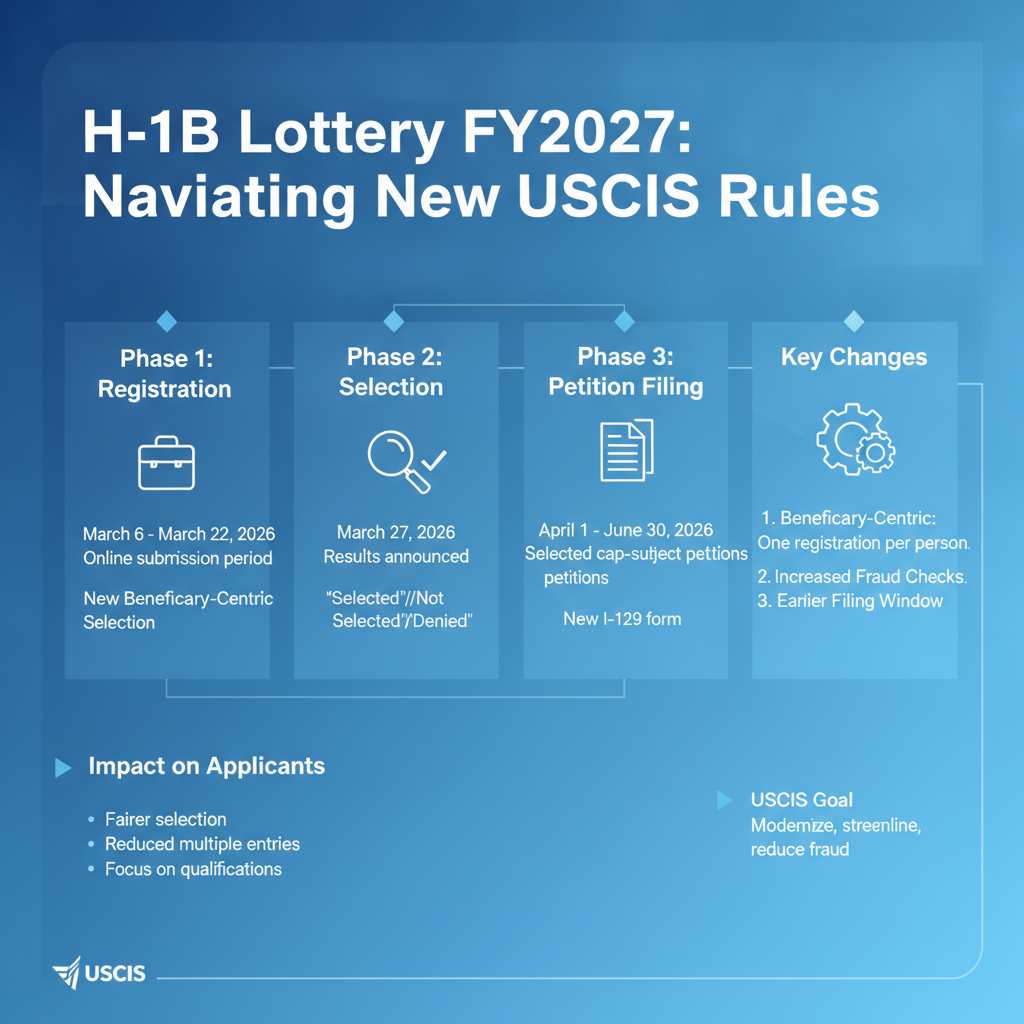
This news is highly relevant right now because the H-1B cap registration period for FY2027 concluded in March 2026, and lottery selections were announced in late March/early April 2026. The filing window for selected petitions (Form I-129) is currently open, typically running from April 1st to June 30th, 2026. This means that employers and beneficiaries who were selected in the lottery are actively engaged in preparing and submitting their detailed H-1B petitions under these new rules. For those not selected, understanding these changes is vital for strategizing future applications, potentially for FY2028.
The impetus for these changes stems from concerns over widespread fraud and abuse observed in previous H-1B lottery cycles. Specifically, USCIS identified instances where multiple employers, often related entities or shell companies, were submitting registrations for the same beneficiary, artificially inflating their chances of selection. To combat this, the Department of Homeland Security (DHS) finalized a rule, published in January 2025, introducing a beneficiary-centric selection process for the H-1B cap lottery, beginning with the FY2027 cycle. This significant shift aims to level the playing field and ensure that each unique beneficiary has an equal chance.
How it can affect Florida residents
Florida, particularly the Orlando metropolitan area, is a hub for innovation, tourism, healthcare, and technology. Many Florida-based companies rely on the H-1B program to attract and retain highly skilled foreign talent to fill specialty occupation roles that are critical to their growth and competitiveness. From tech startups along the I-4 corridor to hospitality management roles requiring unique international expertise, the demand for H-1B visas in Florida remains high.
- For Employers in Florida: If your company, whether in Orange County or elsewhere in the state, registered beneficiaries for FY2027, you must now ensure your subsequent Form I-129 petition adheres strictly to the new rules. This includes verifying the beneficiary's unique identity and ensuring all documentation aligns with the integrity measures. The new rule may also simplify the process for legitimate employers by reducing competition from fraudulent registrations.
- For Immigrants in Florida: If you are an international student graduating from a Florida university (like UCF, UF, FIU, or USF) on an F-1 visa and wish to transition to H-1B status, or if you are a professional already working in Florida on another nonimmigrant visa (e.g., L-1, TN, E-3) and seeking H-1B, these changes are directly relevant. Your chances of selection are now truly based on your individual merit, not how many employers registered for you. This means a more transparent and equitable lottery, but it also places a greater emphasis on having a strong, legitimate job offer and meticulously prepared documents.
The shift to a beneficiary-centric model fundamentally alters the strategy for both employers and potential H-1B workers. It underscores the importance of legitimate job offers and proper adherence to USCIS regulations. For Central Florida residents and businesses, understanding these nuances is key to success in the highly competitive H-1B landscape.
What H-1B Visa Lottery Changes for FY2027 Is (and Why It Matters)
The H-1B visa program allows U.S. employers to temporarily employ foreign workers in specialty occupations. These occupations generally require a bachelor's degree or higher in a specific field, such as IT, engineering, medicine, education, and more. Because the demand for H-1B visas far exceeds the annual cap set by Congress, USCIS typically conducts a lottery to select eligible registrations.
A plain-English definition
The "H-1B Visa Lottery Changes for FY2027" refers to the new rules implemented by USCIS for the H-1B cap selection process, which started with the FY2027 registration period in March 2026. The most significant change is the move to a beneficiary-centric selection process. In simple terms, this means that USCIS now selects registrations based on the unique individual (the beneficiary) rather than on each registration submitted. Previously, if five different employers registered the same person, that person effectively had five chances in the lottery. Under the new rule, that person still only gets one chance, regardless of how many employers register them. If that unique beneficiary is selected, any one of the employers who registered them can then proceed to file the H-1B petition.
This change is a direct response to concerns about fraud where multiple registrations for the same individual were being used to game the system, reducing the chances for other legitimate applicants. The new rule aims to create a fairer and more equitable lottery for all.
Key terms you need to know
- H-1B Visa: A nonimmigrant visa that allows U.S. employers to temporarily employ foreign workers in specialty occupations.
- Specialty Occupation: An occupation that requires theoretical and practical application of a body of highly specialized knowledge, and a bachelor's degree or higher in the specific specialty (or its equivalent) as a minimum for entry into the occupation in the United States.
- H-1B Cap: The annual numerical limit on H-1B visas. Congress currently sets the regular cap at 65,000, with an additional 20,000 visas reserved for those with a U.S. master's degree or higher (the "Master's Cap").
- H-1B Lottery/Cap Registration: Due to overwhelming demand, USCIS conducts an electronic registration process where prospective employers submit basic information about the company and the beneficiary. If more registrations are received than available visas, a random lottery is conducted.
- Beneficiary-Centric Selection: The *new* rule for FY2027 and onwards. USCIS conducts the lottery based on unique beneficiaries identified by their valid passport or travel document number, ensuring each individual has only one chance of selection, regardless of how many employers registered them.
- Registrant: The prospective employer who submits an electronic registration on behalf of an H-1B beneficiary.
- Petitioning Employer: The employer who files the actual Form I-129, Petition for a Nonimmigrant Worker, after a beneficiary has been selected in the lottery.
- LCA (Labor Condition Application): Form ETA 9035. This form must be certified by the U.S. Department of Labor (DOL) before an H-1B petition can be filed with USCIS. It attests to prevailing wages and working conditions.
- FY2027 (Fiscal Year 2027): The U.S. government's fiscal year that begins on October 1, 2026, and ends on September 30, 2027. H-1B cap petitions selected in the FY2027 lottery would typically have an employment start date of October 1, 2026.
- DHS Final Rule: The regulatory change published by the Department of Homeland Security that officially implemented the beneficiary-centric selection process.
These changes matter immensely because they aim to restore integrity to a system that was increasingly seen as vulnerable to manipulation. For legitimate employers and highly skilled individuals, this means a more level playing field and potentially a greater chance of success if their applications are properly prepared and submitted. For everyone involved, it means increased scrutiny and a need for absolute accuracy in all submitted information.
Concerned about the H-1B changes? Imigrar provides expert guidance to navigate these new rules. Contact us at +1 786-791-3106 for a free consultation. We serve clients nationwide, and Se Habla Español.
Current Immigration Law: The Foundation
The H-1B visa program is rooted in federal immigration law, primarily the Immigration and Nationality Act (INA). The legal framework for H-1B visas is found in INA § 101(a)(15)(H)(i)(b), which defines the H-1B nonimmigrant classification, and INA § 214(g), which establishes the annual numerical cap. USCIS regulations further detail the requirements and procedures at 8 CFR § 214.2(h).
The recent changes for FY2027 are implemented through a final rule published by the Department of Homeland Security, amending these regulations to specifically address the lottery selection process. This rule is designed to ensure that the H-1B cap is allocated fairly and lawfully.
Federal requirements
To qualify for an H-1B visa, both the employer and the beneficiary must meet specific federal requirements:
- Employer Requirements:
- Must offer a job in a specialty occupation.
- Must file and receive certification for a Labor Condition Application (LCA), Form ETA 9035, from the U.S. Department of Labor (DOL) before filing the H-1B petition. This form attests to paying the H-1B worker at least the prevailing wage for the occupation in the area of employment or the actual wage paid to other employees with similar experience and qualifications, whichever is higher.
- Must have an Employer Identification Number (EIN).
- Must show the ability to pay the offered wage.
- Must provide a bona fide job offer.
- Employee (Beneficiary) Requirements:
- Must hold a bachelor's degree or its equivalent, or possess a license in a specialty occupation field, or have work experience equivalent to a bachelor's degree.
- Must be qualified to perform services in the specialty occupation.
- Must possess a valid passport or travel document, which is now crucial for the beneficiary-centric registration.
- H-1B Cap and Lottery:
- The annual cap of 65,000 for regular H-1B visas and 20,000 for the Master's cap means that demand almost always necessitates a lottery.
- The *new* beneficiary-centric selection process ensures that each unique beneficiary is entered into the lottery only once, regardless of the number of registrations submitted on their behalf. This is a fundamental federal requirement for the FY2027 lottery and subsequent cycles.
For detailed information and official forms, always refer to the USCIS official website.
Florida-specific considerations
While there are no unique Florida state laws governing the H-1B visa program, the economic landscape of Florida heavily influences H-1B demand. Industries such as information technology, aerospace, engineering, healthcare, and tourism in Orlando, Tampa, Miami, and other metropolitan areas frequently seek H-1B workers. This means that competition for the limited number of H-1B visas remains fierce for those seeking to work in the Sunshine State.
If your case is in Orlando, the processing is handled by USCIS service centers, but local support and understanding of the regional job market can be invaluable. The Orlando USCIS Field Office primarily handles interviews for family-based petitions and naturalization, but local counsel can assist with any in-person needs or inquiries relevant to your overall immigration journey while working on an H-1B.
For Central Florida residents and employers, staying updated on national immigration trends and having an attorney familiar with both federal regulations and local economic needs is a significant advantage.

How to Navigate the H-1B Visa Lottery Changes for FY2027: A Complete Step-by-Step Guide
The process of obtaining an H-1B visa, especially under the new FY2027 rules, is multi-faceted and requires meticulous attention to detail. Here’s a step-by-step guide focusing on the current landscape:
1) Understand the New Beneficiary-Centric Selection Rule
This is the most critical first step. For FY2027, USCIS selects registrations based on the unique beneficiary, identified by a valid passport or travel document number. This means if multiple employers registered you, you still only get one chance in the lottery. If selected, *any* of the employers who registered you can file the petition. This rule aims to curb fraud and ensure fairness. Employers should focus on quality, not quantity, of registrations.
- Key Action: Employers should ensure they have the beneficiary's correct and unique passport information for registration. Beneficiaries should communicate clearly with all potential employers to avoid confusion, knowing that multiple registrations no longer multiply their lottery chances.
- Required Documents (for registration):
- Beneficiary's full legal name, date of birth, country of birth, country of citizenship, and valid passport number.
- Employer's legal name, FEIN (Federal Employer Identification Number), and mailing address.
- Confirmation of Master's degree from a U.S. institution (if applicable for the Master's cap).
2) Employer Registration Period (March 2026 for FY2027)
The electronic registration period for FY2027 took place in March 2026. Employers, or their authorized representatives (like Imigrar), submitted registrations online via the USCIS online account. A $10 fee per registration was required. This step determined who would be eligible to file a full H-1B petition.
- Key Action: Ensure registration information is 100% accurate. Any discrepancies between registration data and the subsequent Form I-129 petition could lead to denial.
- Required Documents (for registration – already covered in step 1, but reinforcing):
- Employer's company details.
- Beneficiary's passport information and other biographic data.
3) Await Lottery Results (Late March/Early April 2026)
USCIS announced the results of the FY2027 H-1B lottery in late March/early April 2026. Employers and their legal representatives were notified through their USCIS online accounts. Only those beneficiaries whose registrations were selected are eligible to have an H-1B petition filed on their behalf.
- Key Action: Regularly check your USCIS online account for updates. If selected, immediately begin preparing for the next steps.
- Required Documents:
- Access to the USCIS online account where the registration was submitted.
- Selection Notice (Form I-797C, Notice of Action), which indicates the beneficiary was selected and provides the filing window.
4) File the H-1B Petition (Form I-129) for Selected Beneficiaries
If your beneficiary’s registration was selected, the employer has a 90-day window (typically April 1 to June 30, 2026, for FY2027) to file a complete H-1B petition with USCIS. This involves submitting Form I-129, Petition for a Nonimmigrant Worker, along with extensive supporting documentation and fees. This is where the bulk of the work and detailed evidence comes into play.


