What This News Means for Immigrants in Orlando and Across Florida
The landscape of U.S. immigration law is constantly evolving, and few areas see as much dynamic change as the H-1B visa program. For professionals seeking to work in specialty occupations in the United States, and for employers across Florida eager to hire top global talent, the annual H-1B cap lottery is a pivotal event. Recent announcements from U.S. Citizenship and Immigration Services (USCIS) regarding the H-1B visa lottery for Fiscal Year 2027 (FY2027) introduce significant rule changes designed to enhance integrity and fairness in the selection process. These updates are not just minor adjustments; they represent a fundamental shift in how the lottery operates, directly impacting thousands of aspiring immigrants and their sponsoring employers, especially here in a vibrant economic hub like Orlando.Why this news is showing up now
The H-1B visa program, which allows U.S. employers to temporarily employ foreign workers in specialty occupations, is highly competitive due to an annual cap. Demand consistently far outstrips the available visas. In recent years, USCIS identified a concerning trend of widespread fraud, where multiple registrations were submitted on behalf of the same beneficiary by various employers, artificially inflating selection chances. To combat this abuse and ensure a more equitable distribution of H-1B visas, USCIS finalized a rule change that significantly alters the lottery selection process. While this rule was technically implemented for the FY2025 lottery, its implications and full impact continue to unfold and will govern the upcoming FY2027 lottery, making it a critical topic for anyone involved in the H-1B process. The agency's commitment to program integrity means these changes are now the standard, and understanding them is paramount for a successful application.How it can affect Florida residents
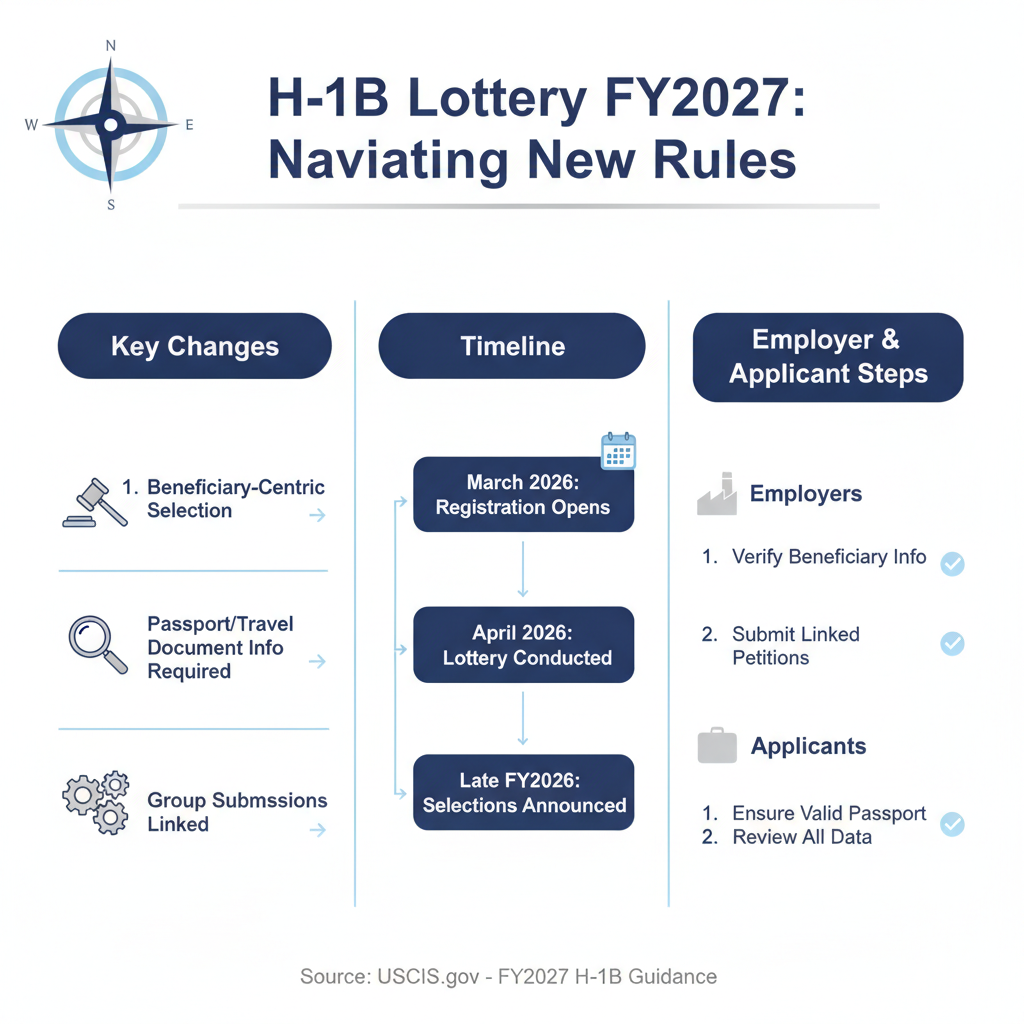
Florida, particularly Central Florida with its booming tech, tourism, healthcare, and aerospace industries, is a magnet for skilled professionals. Orlando, Tampa, and Miami are home to numerous companies that rely on the H-1B program to fill critical talent gaps. For international students graduating from Florida universities like the University of Central Florida (UCF), the University of Florida (UF), or Florida International University (FIU), securing an H-1B visa is often the next step toward a professional career in the U.S. The new H-1B lottery system, which prioritizes a **beneficiary-centric selection** process, means that each unique individual beneficiary will have an equal chance of selection, regardless of how many employers register them. This change aims to level the playing field, making it fairer for all applicants. For Florida residents, this could mean: * **Increased Fairness:** Legitimate candidates sponsored by a single employer now face less competition from fraudulent, multiple registrations. * **Employer Strategy Shift:** Employers in Orlando and across Florida must now focus on submitting a single, strong registration for a candidate, rather than relying on multiple filings. * **Reduced Fraud Impact:** The elimination of widespread multiple registrations could lead to a more predictable and transparent lottery process, benefiting both employers and potential employees in the state. * **Focus on Genuine Offers:** This change reinforces the importance of a genuine job offer and a legitimate employer-employee relationship, which is crucial for the integrity of the program and for securing top talent for Florida's growing economy. Navigating these changes requires meticulous attention to detail and a thorough understanding of the updated regulations. Imigrar is here to provide that clarity and guidance for individuals and businesses throughout Florida.Need Help? Our Orlando immigration team is ready to assist. Call +1 786-791-3106 for a free consultation, or message us online. Se Habla Español.
What H-1B Visa Lottery Changes for FY2027 Is (and Why It Matters)
The H-1B visa is a nonimmigrant visa that allows U.S. employers to temporarily employ foreign workers in specialty occupations. A specialty occupation generally requires a bachelor's degree or higher in a specific specialty, or its equivalent. Examples include IT professionals, engineers, scientists, architects, accountants, and certain medical professionals. The "lottery changes" for FY2027 refer to USCIS's updated regulations on how they conduct the annual selection process when the number of H-1B registrations exceeds the congressionally mandated annual cap. These changes are crucial because they fundamentally alter the strategy for both employers and beneficiaries participating in the highly competitive H-1B program.A plain-English definition
Imagine a coveted job where only a limited number of positions are available each year. Thousands of people apply, far exceeding the number of spots. To decide who gets those spots, a "lottery" is held. The H-1B visa program works similarly. Each year, Congress sets a limit (the "cap") on the number of new H-1B visas that can be issued – typically 65,000 for the regular cap and an additional 20,000 for those with a U.S. master's degree or higher (the "Master's Cap"). Since the demand for H-1B visas is usually much higher than these caps, USCIS conducts an electronic lottery to select which registrations will be eligible to file a full H-1B petition. The "changes" for FY2027 mean that this lottery process will now focus on the **beneficiary** (the foreign worker) rather than the **petitioner** (the employer). Previously, if multiple employers registered the same individual, that individual would have multiple entries in the lottery, effectively increasing their chances. The new rule ensures that each unique individual beneficiary is entered into the lottery only *once*, regardless of how many employers register them. If a beneficiary is selected, all employers who registered them for that lottery are notified, and any one of those employers can then proceed to file an H-1B petition on their behalf. This change aims to eliminate the unfair advantage gained through multiple registrations and to ensure that every eligible individual has an equal and fair shot at selection.Key terms you need to know
Understanding the following terms is essential for navigating the H-1B process: * **H-1B Visa:** A nonimmigrant visa that permits U.S. employers to temporarily employ foreign workers in specialty occupations. * **Specialty Occupation:** An occupation that requires theoretical and practical application of a body of highly specialized knowledge, and a bachelor's or higher degree in the specific specialty (or its equivalent) as a minimum for entry into the occupation in the United States. * **Cap-Subject H-1B:** Refers to H-1B visas that are subject to the annual numerical limitations set by Congress. * **Annual Cap:** The congressionally mandated limit on the number of H-1B visas issued each fiscal year. Currently, 65,000 for the regular cap and an additional 20,000 for the Master's Cap. * **Master's Cap (U.S. Master's Degree Exemption):** An additional 20,000 H-1B visas reserved for beneficiaries who have earned a U.S. master's degree or higher. These are typically selected first. * **Fiscal Year (FY):** The U.S. government's accounting year, which runs from October 1 to September 30. The H-1B cap for a given FY (e.g., FY2027) opens for filing on April 1 of the calendar year preceding the FY (e.g., April 1, 2026, for FY2027). * **Beneficiary:** The foreign national employee for whom the H-1B visa is sought. * **Petitioner:** The U.S. employer seeking to hire the foreign national on an H-1B visa. * **H-1B Registration:** The initial electronic submission by a prospective employer to USCIS, on behalf of a beneficiary, during a specified registration period. This is required to enter the lottery. * **Lottery Selection:** The process by which USCIS randomly selects registrations when the number of eligible registrations exceeds the annual cap. * **Beneficiary-Centric Selection:** The new method where each unique beneficiary is entered into the lottery only once, regardless of how many registrations are submitted on their behalf. * **Selection Notice:** Notification from USCIS indicating that a registration has been selected in the lottery, allowing the petitioner to file an H-1B petition. * **Labor Condition Application (LCA):** Form ETA-9035. An application filed by the employer with the U.S. Department of Labor (DOL) attesting that they will pay the H-1B worker at least the prevailing wage or the actual wage, whichever is higher, and will provide working conditions that will not adversely affect other workers. This must be certified before filing the H-1B petition. * **Form I-129:** The "Petition for a Nonimmigrant Worker." This is the primary form filed with USCIS by the employer after a registration has been selected in the lottery. * **Premium Processing:** An optional service offered by USCIS that guarantees processing of certain petitions (including H-1B) within a specified timeframe (typically 15 calendar days) for an additional fee. * **Change of Status:** The process by which an individual already in the U.S. in one nonimmigrant status (e.g., F-1 student) can switch to another nonimmigrant status (e.g., H-1B) without leaving the country. * **Consular Processing:** The process by which an individual outside the U.S. applies for an H-1B visa stamp at a U.S. consulate or embassy in their home country after their H-1B petition has been approved by USCIS.Current Immigration Law: The Foundation of the H-1B Program
The H-1B visa program is authorized under the Immigration and Nationality Act (INA), specifically Section 101(a)(15)(H)(i)(b), which defines the H-1B nonimmigrant classification, and Section 214(g), which sets the annual numerical limitations (the cap). These statutes are implemented through regulations found in the Code of Federal Regulations (CFR), primarily at 8 CFR Part 214.2(h). The recent changes to the H-1B lottery process, specifically the beneficiary-centric selection, were enacted through a final rule published by USCIS, amending 8 CFR 214.2(h). This rule aims to strengthen the integrity of the H-1B program, reduce the potential for fraud, and ensure that the selection process is fair and equitable for all beneficiaries.Federal requirements
To qualify for an H-1B visa, both the employer (petitioner) and the foreign worker (beneficiary) must meet specific federal requirements: * **For the Beneficiary:** * Must be coming to the U.S. to perform services in a specialty occupation. * Must hold a U.S. bachelor's or higher degree, or its equivalent, in the specific specialty occupation field, or hold an unrestricted state license, or have work experience equivalent to a bachelor's degree. * If applying for the Master's Cap, must possess a U.S. master's degree or higher from an accredited U.S. academic institution. * **For the Petitioner (Employer):** * Must offer employment in a specialty occupation. * Must demonstrate that it will pay the H-1B worker at least the actual wage paid to similarly qualified workers, or the prevailing wage for the occupation in the area of employment, whichever is higher. * Must file a certified **Labor Condition Application (LCA)** (Form ETA-9035) with the U.S. Department of Labor before filing the H-1B petition with USCIS. * Must agree to specific attestations on the LCA regarding wages, working conditions, and absence of strikes or lockouts. * Must file **Form I-129, Petition for a Nonimmigrant Worker**, on behalf of the beneficiary, along with all supporting documentation and fees, within the designated filing window after a registration is selected. **Important:** The H-1B cap for FY2027 will be 85,000 (65,000 regular cap + 20,000 Master's cap). The registration period for FY2027 is expected to occur in March 2027, with selected petitions eligible for filing starting April 1, 2027, for employment starting on October 1, 2027.Florida-specific considerations
While H-1B requirements are federal, the program's impact is deeply felt at the state level. Florida's economy is diverse and rapidly expanding, leading to a strong demand for H-1B talent. * **High Demand Industries:** Tech companies in Orlando's "Medical City," aerospace firms on the Space Coast, financial institutions in South Florida, and hospitality management groups across the state frequently sponsor H-1B visas. This means a higher concentration of employers and applicants, increasing the overall competition for the limited visas. * **Educational Institutions:** Florida is home to many reputable universities. Graduates from programs in STEM (Science, Technology, Engineering, Mathematics) fields often seek H-1B sponsorship after completing their Optional Practical Training (OPT). The Master's Cap is particularly relevant for these highly educated individuals. * **Orlando USCIS Field Office:** While H-1B petitions are processed at service centers, the Orlando USCIS Field Office may be involved in certain aspects of an immigrant's journey, especially if there are related applications for family members or if an individual needs local assistance with other immigration matters. * **Legal Expertise:** Given the complexity and competitiveness of the H-1B process, especially with the new rules, securing experienced legal counsel from firms like Imigrar, based in Orlando, is paramount for employers and beneficiaries in Central Florida and beyond. For the most up-to-date forms and guidance, always refer to the USCIS official website.Navigating H-1B changes can be complex. Don't risk your future. Imigrar offers expert guidance for the FY2027 H-1B lottery. Call us at +1 786-791-3106 for a free consultation. Se Habla Español.
How to Navigate the H-1B Visa Lottery Changes: A Complete Step-by-Step Guide for FY2027
The H-1B lottery process for FY2027, incorporating the new beneficiary-centric selection, requires careful planning and execution. This step-by-step guide outlines the typical timeline and requirements.1) Understanding the New Lottery System and Eligibility
Before anything else, both the prospective employer and the beneficiary must understand the new rules and confirm eligibility. The **beneficiary-centric selection** means that each unique beneficiary can only be counted once in the lottery, even if multiple employers submit registrations on their behalf. This significantly impacts strategy. * **Beneficiary Eligibility:** * Confirm you meet the educational requirements for a specialty occupation (bachelor's degree or higher, or equivalent work experience). * If applicable, ensure your U.S. master's degree is from a qualifying institution for the Master's Cap. * **Employer Eligibility:** * Confirm the job offered is a **specialty occupation**. * Verify the company's ability to pay the required wage and comply with H-1B program requirements. * **Actionable Advice:** Start early! Identify potential employers and discuss their willingness to sponsor an H-1B. For employers, identify qualified candidates and understand your responsibilities.2) Employer Registration and Fee Payment
This is the critical entry point to the H-1B lottery. USCIS conducts an electronic registration process annually. * **Timeline (Expected for FY2027):** * **Early March 2027:** The H-1B electronic registration period is expected to open, typically lasting for about two to three weeks. * **Late March 2027:** Registration period closes. * **Required Documents/Information for Registration:** * Employer's IRS Tax ID Number (EIN). * Employer's legal name, doing business as name (if any), and mailing address. * Employer's authorized signatory information. * Beneficiary's full legal name, gender, date of birth, country of birth, country of citizenship. * Beneficiary's passport number. * Beneficiary's highest level of education (e.g., U.S. Master's or higher degree). * Payment of the registration fee (currently $10 per registration, though USCIS has proposed increasing this in the future; always check the latest fee schedule). * **Process:** The employer (or their authorized legal representative, like Imigrar) creates a USCIS online account, enters the required information for each beneficiary, and pays the registration fee. **Warning:** Under the new rules, any attempt to submit multiple registrations for the *same beneficiary* by related entities or individuals could be flagged as fraud and lead to denial or revocation of petitions, and even criminal penalties. Each unique beneficiary should only have one eligible registration in the lottery system.3) Lottery Selection and Notification
After the registration period closes, USCIS conducts the lottery. * **Selection Process:** USCIS first selects registrations under the Master's Cap. If the number of Master's Cap registrations exceeds the available visas, a lottery is conducted for that group. Unselected Master's Cap registrations are then added to the regular cap pool, and a second lottery is conducted for the remaining regular cap visas. * **Timeline (Expected for FY2027):** * **Late March/Early April 2027:** USCIS announces the results of the lottery. * **Notification:** Employers (and their legal representatives) who submitted selected registrations will receive a "Selection Notice" in their USCIS online account. This notice confirms that they can now proceed to file a full H-1B petition on behalf of the selected beneficiary.4) Preparing and Filing the H-1B Petition (Form I-129)
If a registration is selected, the employer has a specific window to file the complete H-1B petition. This is the most extensive and document-intensive step. * **Timeline (Expected for FY2027):** * **April 1, 2027, through June 30, 2027 (approx.):** The filing window for selected FY2027 H-1B petitions. * **Required Documents for Form I-129 Petition:** * Certified **Labor Condition Application (LCA)** (Form ETA-9035) from the U.S. Department of Labor. This must be filed and certified *before* the H-1B petition. * Completed **Form I-129, Petition for a Nonimmigrant Worker**. * H-1B Data Collection and Filing Fee Exemption Supplement. * Employer's letter of support describing the job, specialty occupation nature, beneficiary's qualifications, and terms of employment. * Beneficiary's educational documents (degrees, transcripts, evaluations of foreign degrees). * Beneficiary's resume/CV. * Evidence of beneficiary's qualifications for the specialty occupation (e.g., licenses, certifications, experience letters). * Employer's financial documents (e.g., tax returns, annual reports) to prove ability to pay. * Copies of beneficiary's passport, visa, I-94 record, and previous U.S. immigration documents (if applicable). * Organizational chart and details about the employer's business. * Client letters/Master Service Agreements (if the H-1B worker will be placed at a third-party client site). * Applicable filing fees (currently: **Base Filing Fee**, **ACWIA Fee**, **Fraud Prevention and Detection Fee**, and potentially the **Public Law 114-113 Fee** for certain employers). * **Filing:** The complete petition package is mailed to the appropriate USCIS Service Center. * **Premium Processing:** Employers can opt for premium processing (additional fee, currently $2,805, subject to change) to receive a decision within 15 calendar days. This is highly recommended if a quick decision is needed, but it does not increase the chances of approval.5) Responding to RFEs and Approval
After filing, USCIS may issue a Request for Evidence (RFE) if they need more information or clarification. * **Request for Evidence (RFE):** USCIS issues an RFE if the initial petition lacks sufficient evidence or if there are questions about eligibility. Responding to an RFE requires careful attention and often additional documentation. * **Notice of Action (Form I-797):** If the petition is approved, USCIS will issue an **I-797 Approval Notice**. For beneficiaries seeking a change of status, this notice will indicate the new H-1B status and validity period. For those outside the U.S., it serves as the basis for a visa interview. * **Important:** Respond to RFEs promptly and comprehensively. An experienced immigration attorney from Imigrar can be invaluable in preparing a robust RFE response.6) Visa Interview (for those outside the U.S.) or Change of Status (for those in the U.S.)
The final step depends on the beneficiary's location. * **Change of Status (within U.S.):** If the beneficiary is already in the U.S. in a valid nonimmigrant status (e.g., F-1 OPT), and the H-1B petition requested a change of status, their status will automatically change to H-1B on October 1, 2027 (the start of FY2027), assuming the petition was approved. * **Consular Processing (outside U.S.):** If the beneficiary is outside the U.S. or opted for consular processing, they must schedule and attend a visa interview at a U.S. embassy or consulate in their home country. * **Required Documents for Visa Interview:** * Valid passport. * DS-160 confirmation page. * Appointment confirmation page. * **Form I-797 Approval Notice**. * LCA (Form ETA-9035). * Employer letter, job offer letter. * Educational documents (original degrees, transcripts). * Resume/CV. * Evidence of ties to home country (if applicable). * **Post-Interview:** If approved, the visa stamp will be placed in the passport, allowing entry to the U.S. in H-1B status.Practical Steps You Can Take Today for the FY2027 H-1B Lottery
Preparing for the H-1B lottery is a marathon, not a sprint. With the new beneficiary-centric rules in place, early and diligent preparation is more important than ever. Here's an actionable checklist: * **Verify Eligibility (Beneficiary):** * Ensure your degree and work experience align with a specialty occupation. Gather all academic transcripts, diplomas, and professional certifications. * If you have a foreign degree, consider obtaining a professional credential evaluation to determine its U.S. equivalency. * Update your resume to clearly highlight your skills and qualifications relevant to specialty occupations. * **Secure Employer Sponsorship (Beneficiary):** * Actively network and apply for positions with employers known to sponsor H-1B visas. * Clearly communicate your H-1B sponsorship needs during job interviews. * **Important:** Under the new rules, while multiple employers *can* register you, it does not increase your individual chances. Focus on securing one genuine job offer from a committed sponsor. * **Assess Needs and Plan (Employer):** * For employers in Orlando and beyond, identify your talent needs for FY2027 now. * Review potential candidates and determine who you wish to sponsor. * Budget for H-1B filing fees and potential legal costs. * **Gather Essential Documents:** * **For Beneficiary:** Passport copy, birth certificate, marriage certificate (if applicable), all academic documents (transcripts, diplomas, degree evaluations), professional licenses/certifications, updated CV. * **For Employer:** Company's IRS EIN, business registration documents, financial statements, office lease, detailed job description for the specialty occupation. * **Consult with an Experienced Immigration Attorney:** * This is perhaps the most crucial step. An attorney can assess eligibility, advise on strategy under the new rules, ensure all documents are correctly prepared, and manage the entire registration and petition filing process. Imigrar specializes in H-1B visas and can provide invaluable assistance. * **Understand Key Timelines:** * **Late 2026/Early 2027:** Begin attorney consultation and document gathering. * **Expected March 2027:** H-1B electronic registration period. **Do not miss this window!** * **Late March/Early April 2027:** Lottery results announced. * **April 1, 2027 - June 30, 2027 (approx.):** Filing period for selected petitions. * **October 1, 2027:** Earliest start date for approved H-1B employment for FY2027. **Reminder:** The H-1B process is highly competitive. Proactive preparation and adherence to all requirements are vital for success. Utilize official government resources like USCIS Forms and USCIS Processing Times, but always consult with legal counsel.