What This News Means for Immigrants in Orlando and Across Florida
The H-1B visa program is a cornerstone of the U.S. economy, enabling American employers to temporarily employ foreign workers in specialty occupations. For years, the demand for H-1B visas has far outstripped the available supply, leading to a highly competitive lottery system. The news of significant changes to the H-1B visa lottery for Fiscal Year 2027 (FY2027) is not just a technical update; it represents a fundamental shift designed to ensure fairness and integrity in the process. At Imigrar, we understand that these changes bring both hope and uncertainty to countless individuals and businesses in Orlando, throughout Florida, and across the nation.Why this news is showing up now
The changes to the H-1B lottery system for FY2027, spearheaded by U.S. Citizenship and Immigration Services (USCIS), are a direct response to persistent concerns about fraud and gaming of the system. In previous years, some employers and third-party companies engaged in practices that artificially inflated the number of registrations for individual beneficiaries, thereby reducing the chances for legitimate applicants. USCIS has been actively investigating these fraudulent activities and has taken decisive action to reform the lottery. These new rules, officially announced well in advance of the FY2027 registration period (which typically occurs in March), fundamentally alter *how* registrations are selected. While the FY2027 registration period has already concluded, the implications of these changes are still very much unfolding as petitions are being filed and adjudicated. This news continues to be relevant as it shapes the current filing process for selected individuals and sets the precedent for all future H-1B lottery cycles (FY2028 and beyond). The goal is to ensure that each eligible beneficiary has an equal chance, regardless of how many employers register them.How it can affect Florida residents
Florida is a vibrant hub for many industries that rely on H-1B talent, including technology, healthcare, tourism, and aerospace. Cities like Orlando, Tampa, Miami, and Jacksonville attract highly skilled professionals and innovative companies. The I-4 corridor, in particular, is a hotbed for tech startups and established corporations that frequently sponsor H-1B visas. For Florida residents who are foreign nationals hoping to secure an H-1B visa, these changes are critical: * **Increased Fairness:** If you are an F-1 student on Optional Practical Training (OPT) in Orlando, a researcher at a university in Gainesville, or a skilled professional working for a tech company near the Space Coast, the new beneficiary-centric selection process means your chances are no longer diluted by fraudulent multiple registrations. Each unique individual now has one chance in the lottery, which levels the playing field significantly. * **Employer Responsibilities:** Florida-based employers, from large corporations in Miami to growing tech firms in Orange County, must adapt their H-1B sponsorship strategies. They need to ensure their internal processes comply with the new rules, particularly regarding the truthful attestation of job offers and the understanding that multiple registrations for the *same beneficiary* from different employers will no longer improve selection odds. * **Focus on Merit:** The changes reinforce the program's original intent: to bring highly skilled foreign workers to fill critical gaps in the U.S. workforce. For those in specialty occupations in Florida, this shift emphasizes genuine job offers and qualified candidates. * **Reduced Fraud:** The crackdown on fraud protects the integrity of the H-1B program, ensuring that legitimate applications from Florida employers and beneficiaries are given due consideration. Understanding these implications is the first step toward successfully navigating the H-1B process under the new regime. Imigrar is here to provide the clarity and guidance you need.Need Help Navigating the New H-1B Rules? Our Orlando immigration team is ready to assist. Call +1 786-791-3106 for a free consultation, or message us online. Se Habla Español.
What H-1B Visa Lottery Changes for FY2027 Is (and Why It Matters)
The H-1B visa lottery changes for FY2027 represent one of the most significant overhauls in recent memory, primarily targeting the H-1B electronic registration process. These reforms are critical because they directly address long-standing issues of fairness and integrity, aiming to ensure that the lottery genuinely provides an equal opportunity for every eligible beneficiary.A plain-English definition
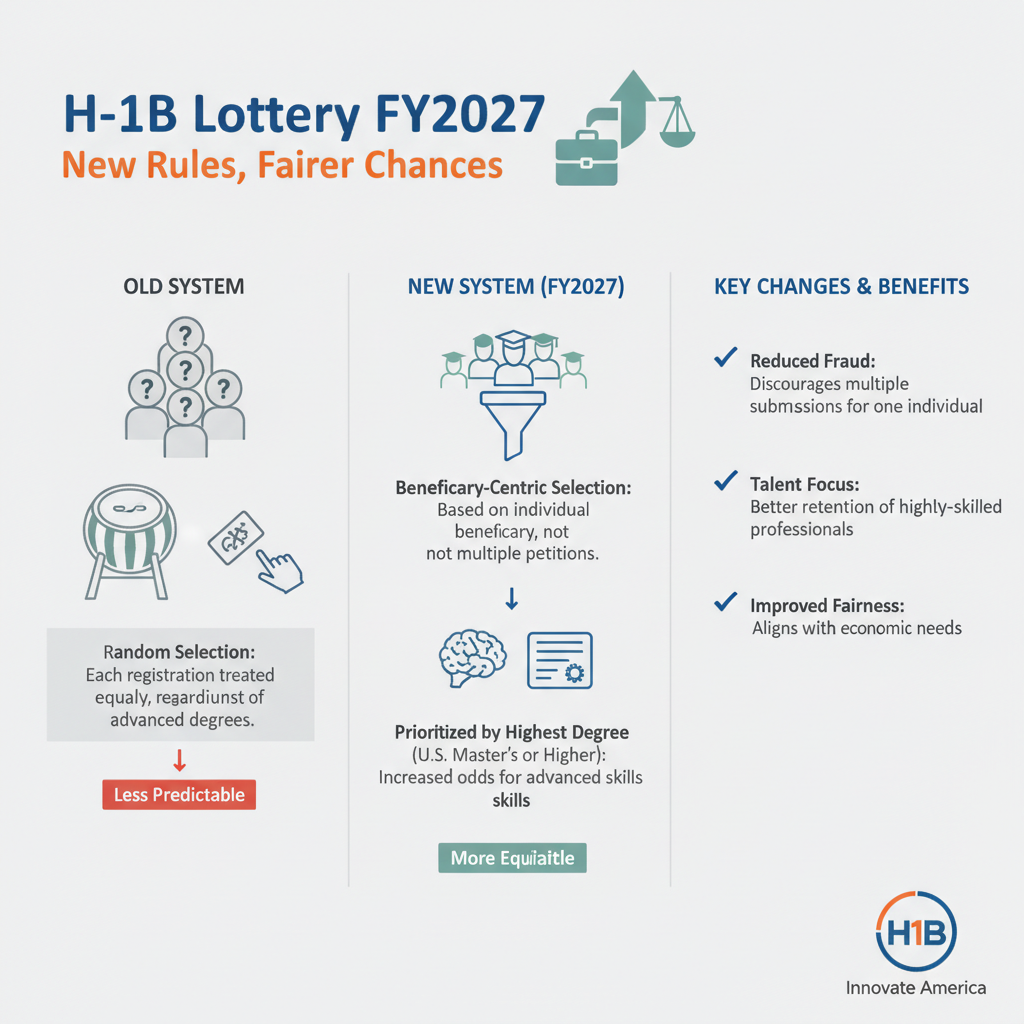
The H-1B visa allows U.S. employers to temporarily hire foreign workers in "specialty occupations," which generally require a bachelor's degree or higher in a specific field. Because the number of H-1B visas available each year is capped by Congress, USCIS uses a lottery system to select eligible registrations when demand exceeds supply. The "H-1B Visa Lottery Changes for FY2027" refers to new regulations implemented by USCIS that fundamentally alter how beneficiaries are selected in the annual lottery. Previously, an individual could have multiple employers submit registrations on their behalf, effectively increasing their chances of selection. The new rule, often called the **beneficiary-centric selection process**, changes this. Now, selections are made based on the *unique beneficiary*, not the number of registrations submitted for them. If a beneficiary has multiple registrations submitted by different employers, they still only have one chance in the lottery. If selected, USCIS will then notify *all* employers who registered that beneficiary that they have been selected, and *any* of those employers can then file a petition on behalf of the selected individual. This change is designed to combat fraud where individuals or companies would submit numerous frivolous registrations for the same person to game the system.Key terms you need to know
Navigating the H-1B landscape requires understanding specific terminology. Here are the key terms relevant to the FY2027 changes: * **H-1B Visa:** A nonimmigrant visa that allows U.S. employers to temporarily employ foreign workers in specialty occupations. * **Specialty Occupation:** An occupation that requires theoretical and practical application of a body of highly specialized knowledge and a bachelor's degree or higher in the specific specialty (or its equivalent) as a minimum for entry into the occupation in the United States. * **Cap-Subject H-1B:** H-1B petitions that are subject to the annual numerical limit (cap) set by Congress. This includes most private-sector employers. * **Cap-Exempt H-1B:** Certain H-1B petitions are exempt from the annual cap. This typically includes petitions filed by institutions of higher education, non-profit organizations affiliated with higher education, non-profit research organizations, or governmental research organizations. * **Beneficiary:** The foreign worker who will be employed in the H-1B specialty occupation. * **Petitioner:** The U.S. employer who files the H-1B petition on behalf of the beneficiary. * **H-1B Electronic Registration Process:** The online system where prospective petitioners (employers) submit basic information about the company and the beneficiary during a specified registration period. This is the first step before the lottery. * **Unique Beneficiary Identifier:** A specific identifier (often passport number or travel document number) that USCIS uses to identify each unique beneficiary in the electronic registration system. This is central to the new beneficiary-centric selection. * **Lottery Selection:** The random selection process conducted by USCIS when the number of eligible registrations exceeds the annual cap. * **Fiscal Year (FY):** The U.S. government's fiscal year runs from October 1 to September 30. H-1B visas are issued for a specific fiscal year (e.g., FY2027 visas become available starting October 1, 2026). * **Labor Condition Application (LCA):** Form ETA-9035. An application filed by the employer with the U.S. Department of Labor (DOL) attesting to certain conditions of employment, including prevailing wage and working conditions, before filing an H-1B petition. * **Form I-129:** Petition for a Nonimmigrant Worker. The primary form filed with USCIS by the employer after a beneficiary's registration has been selected in the lottery. * **Request for Evidence (RFE):** A letter from USCIS requesting additional information or documentation to support an H-1B petition. * **Premium Processing:** An optional service offered by USCIS for certain petitions, including H-1B, which guarantees processing within a shorter timeframe (typically 15 calendar days) for an additional fee. Understanding these terms is crucial as we delve deeper into the current law and the step-by-step guide.Current Immigration Law: The Foundation
The H-1B visa program operates under the authority of the Immigration and Nationality Act (INA), specifically Section 101(a)(15)(H)(i)(b), codified at 8 U.S.C. § 1101(a)(15)(H)(i)(b), and further detailed in regulations found at 8 CFR Part 214.2(h). These laws and regulations establish the framework for who is eligible, how petitions are processed, and the annual numerical limits.Federal requirements
The core federal requirements for an H-1B visa remain largely unchanged, even with the new lottery rules. These include: * **Specialty Occupation:** The job offered must qualify as a specialty occupation. This means it typically requires a bachelor's degree or its equivalent in a specific field, and the beneficiary must hold such a degree or its equivalent. USCIS evaluates the nature of the duties, the industry practice, and the employer's usual requirements for the position. * **Employer-Employee Relationship:** There must be a valid employer-employee relationship between the petitioning U.S. employer and the H-1B beneficiary. This means the employer must have the right to control the beneficiary's work. * **Prevailing Wage:** The employer must pay the H-1B beneficiary at least the actual wage paid to other employees with similar experience and qualifications, or the prevailing wage for the occupational classification in the area of employment, whichever is higher. This is attested to in the **Labor Condition Application (LCA)**, Form ETA-9035, which must be certified by the Department of Labor before the H-1B petition can be filed. * **Educational Requirements:** The beneficiary must possess a bachelor's degree or its equivalent, or a license in a specialty occupation field, or have work experience equivalent to a bachelor's degree. Foreign degrees must be evaluated to determine their U.S. equivalency. * **Annual Cap:** Congress sets an annual cap of 65,000 H-1B visas, with an additional 20,000 visas reserved for those holding a U.S. master's degree or higher (the "Master's Cap"). Certain organizations, such as universities and non-profit research institutions, are exempt from this cap. * **Fraud Prevention and Detection Fee:** Employers must pay a fee to fund USCIS fraud detection and prevention activities. * **Public Law 114-113 (ACWIA Fee):** Depending on the employer's size and number of H-1B employees, an additional fee (ACWIA fee) may apply. All these requirements are meticulously reviewed by USCIS when adjudicating the primary form, Form I-129, Petition for a Nonimmigrant Worker. For the most up-to-date information on forms, fees, and filing instructions, always refer to the USCIS official website.Florida-specific considerations
While there are no specific Florida state laws governing H-1B visas – immigration law is federal – the economic landscape and demand for skilled labor in Florida significantly impact H-1B applications. * **High Demand in Tech and Healthcare:** Florida's booming tech sector, particularly in the Orlando and Tampa areas, and its robust healthcare industry consistently generate a high demand for H-1B workers. This means competition for visas can be intense, making adherence to every detail of the new lottery rules even more critical. * **Universities and Research Institutions:** Florida is home to numerous cap-exempt institutions, such as the University of Central Florida in Orlando, the University of Florida in Gainesville, and Florida International University in Miami. These institutions frequently sponsor H-1B visas for researchers, professors, and other essential personnel, and their petitions are not subject to the lottery. * **Local Office Processing:** While H-1B petitions are typically processed by USCIS service centers, individuals seeking to change their status while in the U.S. might interact with local USCIS field offices, such as the Orlando USCIS Field Office, for certain related matters, though not for the initial H-1B petition adjudication itself. For Central Florida residents and employers, understanding the national H-1B framework and how the new lottery changes interact with Florida's unique economic environment is key to a successful application.How to Navigate the New H-1B Lottery System: A Complete Step-by-Step Guide
The H-1B lottery changes for FY2027 introduce a beneficiary-centric selection process, which significantly impacts the initial registration phase. This guide outlines the steps an employer and beneficiary should follow, incorporating these new rules.1) Employer Assessment and LCA Filing
Before any lottery registration can occur, the employer must determine if the position qualifies as a specialty occupation and if they meet the requirements to sponsor an H-1B worker. * **Employer's Actions:** * **Assess Job Requirements:** Confirm the position requires a bachelor's degree or higher in a specific field. * **Determine Prevailing Wage:** Research the appropriate prevailing wage for the occupation in the specific geographic area using resources from the Department of Labor (DOL). * **File Labor Condition Application (LCA) - Form ETA-9035:** The employer must file an LCA with the DOL. This form attests that the employer will pay the H-1B worker at least the prevailing wage or the actual wage, whichever is higher, and provide working conditions that will not adversely affect other employees. The LCA must be certified by the DOL before the H-1B petition can be filed with USCIS. * **Required Documents (for LCA):** * Employer's Federal Employer Identification Number (FEIN) * Employer's legal name and address * Beneficiary's job title and duties * Worksite location(s) * Prevailing wage determination (if obtained from a third party) * Documentation of notice to employees (e.g., posting notices at the worksite) * Reminder: The LCA process can take several days to weeks, so employers should start this well in advance of the H-1B registration period.2) H-1B Electronic Registration
This is the phase most impacted by the FY2027 changes. The H-1B electronic registration is where the lottery selection occurs. * **Employer's Actions:** * **Create/Access USCIS Online Account:** The employer (or their authorized representative, like Imigrar) must have a registrant account with USCIS. * **Submit Electronic Registration:** During the designated registration period (typically in March for the following fiscal year), the employer submits an electronic registration for each beneficiary they intend to sponsor. * **Provide Unique Beneficiary Information:** This is the crucial part of the new rule. For each beneficiary, the employer must provide their legal name, date of birth, country of birth, country of citizenship, passport number or travel document number, and importantly, attest that the job offer is *bona fide*. The system will use this information to identify unique beneficiaries. * **Pay Registration Fee:** A non-refundable fee (currently $10) is required for each registration. * **Required Information (for Registration):** * Employer's name, address, and FEIN * Employer's authorized signatory information * Beneficiary's full legal name * Beneficiary's date of birth * Beneficiary's country of birth * Beneficiary's country of citizenship * Beneficiary's valid passport number (or other travel document number if no passport) * Educational level of the beneficiary * Confirmation of a bona fide job offer * **Important:** Under the new beneficiary-centric selection, if multiple employers register the *same beneficiary*, USCIS will consider only one registration for that beneficiary in the lottery. If selected, all registrants for that beneficiary will be notified. This significantly reduces the incentive for fraudulent multiple registrations.3) Lottery Selection and Notification
After the registration period closes, USCIS conducts the lottery. * **USCIS Actions:** * **Conduct Lottery:** USCIS conducts a random selection process, first for the Master's Cap (if applicable), then for the Regular Cap. * **Notify Registrants:** USCIS notifies selected registrants through their online accounts. The notification will indicate that the beneficiary's registration has been selected and that the petitioner is eligible to file an H-1B petition on their behalf. * **Expected Timeline (approximate for FY2027, though registration is past):** * **Registration Period:** Typically early March. * **Selection Notifications:** Typically by late March. * **Petition Filing Window:** Typically April 1 to June 30. * **What Happens Next:** If selected, the employer can proceed to file the full H-1B petition. If not selected, the employer and beneficiary must await the next fiscal year's lottery or consider alternative visa options.4) Petition Filing (Form I-129)
If a beneficiary's registration is selected, the employer can then proceed to file the full H-1B petition. * **Employer's Actions:** * **Prepare Form I-129:** Complete the Petition for a Nonimmigrant Worker. This form is extensive and requires detailed information about the employer, the beneficiary, and the proposed employment. * **Gather Supporting Documentation:** Compile all necessary evidence to support the petition, proving the specialty occupation, beneficiary's qualifications, and employer's ability to pay. * **File with USCIS:** Mail the complete petition package, including all forms, supporting documents, and required fees, to the correct USCIS service center. * **Required Documents (for Form I-129 petition):** * Certified **Labor Condition Application (LCA)** (Form ETA-9035) * Copy of the H-1B selection notice * Beneficiary's educational documents (diplomas, transcripts, foreign degree evaluations) * Beneficiary's resume/CV * Copies of beneficiary's passport, visa, I-94 record, and previous U.S. visa documents (if applicable) * Employer's financial statements, tax returns, and business license * Detailed job description and organizational chart * Letters from previous employers (if experience is used to qualify) * Copy of any relevant professional licenses * **Important:** The filing window for selected petitions is limited (e.g., April 1 to June 30 for FY2027). Missing this deadline will result in denial.5) Adjudication and Approval
Once the petition is filed, USCIS reviews it. * **USCIS Actions:** * **Initial Review:** USCIS reviews the petition for completeness. * **RFE Issuance (if applicable):** If USCIS needs more information, they will issue a **Request for Evidence (RFE)**, requiring the employer to submit additional documents or clarifications within a specified timeframe. * **Approval/Denial:** USCIS will either approve the petition (sending an I-797 Approval Notice) or deny it. * **Employer's/Beneficiary's Actions:** * **Respond to RFE:** If an RFE is received, work with legal counsel (like Imigrar) to provide a comprehensive and timely response. * **Prepare for Start Date:** If approved, the H-1B status becomes effective on October 1 of the fiscal year (e.g., October 1, 2026, for FY2027).6) Status Change or Consular Processing
The final step depends on whether the beneficiary is already in the U.S. or abroad. * **If Beneficiary is in the U.S. (Change of Status):** * If the beneficiary is maintaining a valid nonimmigrant status (e.g., F-1 OPT) and the H-1B petition included a request for **Change of Status**, their status automatically changes to H-1B on October 1 (if approved). They can then begin working for the H-1B employer. * **If Beneficiary is Outside the U.S. (Consular Processing):** * The beneficiary will need to attend an H-1B visa interview at a U.S. Embassy or Consulate in their home country. They will need the approved Form I-797 approval notice from USCIS. * **Required Documents (for Consular Interview):** * Valid passport * Approved Form I-797 (Petition Approval Notice) * DS-160 confirmation page * Appointment confirmation page * Passport-style photos * Original LCA (Form ETA-9035) * Copies of educational documents, resume, job offer letter * Employer's support letter * Evidence of ties to home country (to overcome immigrant intent presumption) * Upon successful interview, the H-1B visa stamp will be placed in their passport, allowing them to enter the U.S. to begin H-1B employment.Don't navigate these complex steps alone! Imigrar provides expert guidance for H-1B petitions. Call +1 786-791-3106 for a free consultation. Se Habla Español.