

The landscape of U.S. immigration is constantly evolving, and for those pursuing high-skilled employment visas, staying informed is paramount. As your trusted immigration law firm in Orlando, Imigrar is dedicated to providing clarity on the latest developments. Today, we delve into the significant adjustments impacting the H-1B visa lottery for Fiscal Year 2027.
Need Help Navigating H-1B Changes? Our Orlando immigration team is ready to assist. Call +1 786-791-3106 for a free consultation, or message us online. Se Habla Español.
The reporting that sparked this guide:
H-1B Visa Lottery Changes for FY2027 (Legal News)
What This News Means for Immigrants in Orlando and Across Florida
Why this news is showing up now
As of July 2026, the discussions and implementation surrounding the H-1B visa lottery changes for Fiscal Year 2027 (FY2027) are at the forefront of immigration news. While the H-1B lottery registration period for FY2027 typically concludes in March of the prior calendar year (meaning March 2026 for FY2027), the implications of these new rules extend far beyond the initial registration. These changes, often finalized and clarified through official guidance, impact the ongoing filing and adjudication of petitions selected in the lottery, as well as set the precedent for future cycles. The U.S. Citizenship and Immigration Services (USCIS) regularly issues policy updates, fee adjustments, and integrity measures designed to refine the H-1B program. The recent focus has been on strengthening the integrity of the lottery process and ensuring fairness, directly addressing concerns about fraud and abuse that have plagued previous cycles. Therefore, even though the lottery itself might have concluded, understanding these rules is crucial for beneficiaries whose petitions are currently being processed, and for employers and prospective H-1B workers preparing for the next cycle, FY2028.
How it can affect Florida residents
Florida, particularly the Orlando metropolitan area, is a hub for innovation, tourism, healthcare, and technology. Companies across the state, from startups along the I-4 corridor to established corporations in Miami and Tampa, heavily rely on the H-1B program to fill critical high-skilled positions. For international students graduating from Florida universities like the University of Central Florida (UCF), University of Florida (UF), and Florida International University (FIU), the H-1B visa is often the primary pathway to long-term employment in the U.S.
- Increased Scrutiny: Florida employers sponsoring H-1B workers will face heightened scrutiny regarding the validity of job offers and the qualifications of beneficiaries. This means a more rigorous documentation process and a greater need for legal precision.
- Fairer Chances (Potentially): For genuine beneficiaries and employers, the beneficiary-centric selection model (which we'll explain in detail) aims to reduce the advantage held by those who previously submitted multiple registrations through various employers. This could lead to a more equitable distribution of the limited H-1B visas among qualified individuals working for legitimate companies, including those in Orlando and across Central Florida.
- Impact on Tech and Healthcare: Florida's booming tech sector and robust healthcare industry are major consumers of H-1B visas. Any changes to the lottery process directly affect their ability to attract and retain top global talent. Employers will need to adapt their recruitment and sponsorship strategies.
- Planning for the Future: Florida residents, whether employers or prospective H-1B workers, must meticulously plan their immigration strategy, understanding the revised timelines, increased costs, and enhanced requirements. Early preparation and expert legal guidance are more critical than ever.
What H-1B Visa Lottery Changes for FY2027 Is (and Why It Matters)
A plain-English definition
The H-1B visa is a nonimmigrant visa that allows U.S. employers to temporarily employ foreign workers in specialty occupations. These occupations generally require a bachelor's degree or higher in a specific field. Examples include IT professionals, engineers, doctors, architects, and scientists. Because demand for H-1B visas far exceeds the annual supply, USCIS conducts a lottery to select eligible registrations. The "changes for FY2027" refer to updated regulations and policies that govern how this lottery is conducted and how H-1B petitions are processed for the fiscal year that began on October 1, 2026, and will conclude on September 30, 2027.
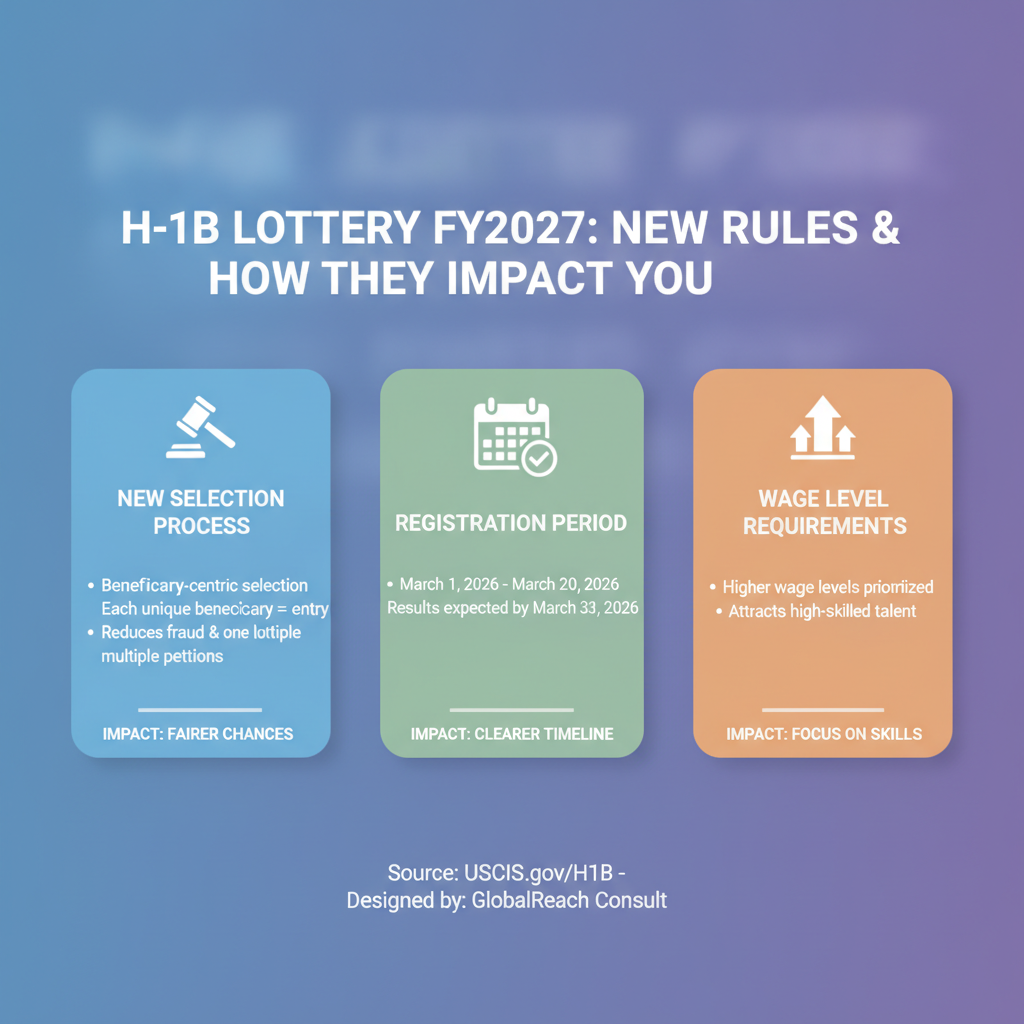
The most significant of these changes, implemented to strengthen program integrity, is the shift to a beneficiary-centric selection process. In simple terms, instead of allowing multiple employers to register the same individual multiple times, the lottery now selects individuals (beneficiaries) directly. This means that each unique beneficiary is entered into the lottery only once, regardless of how many employers register them. If a beneficiary is selected, any employer who registered that beneficiary can then file a petition on their behalf.
Key terms you need to know
- H-1B Cap: The annual limit on the number of H-1B visas issued. The statutory cap is 65,000 visas, plus an additional 20,000 for those with a U.S. master's degree or higher (the "master's cap").
- Cap-Subject: Refers to H-1B petitions that are subject to the annual numerical limits. Certain employers (e.g., universities, non-profit research organizations) are "cap-exempt."
- Beneficiary: The foreign national who will be employed in the specialty occupation.
- Petitioner: The U.S. employer who files the H-1B petition on behalf of the beneficiary.
- H-1B Registration Period: The specific window (typically in March) during which prospective petitioners electronically register beneficiaries for the lottery. For FY2027, this period was in March 2026.
- Selection Notice: The notification from USCIS indicating that a beneficiary’s registration has been selected in the lottery, allowing an employer to proceed with filing a full H-1B petition.
- Form I-129: The Petition for a Nonimmigrant Worker, which is the primary form filed by the employer after a beneficiary is selected in the lottery.
- LCA (Labor Condition Application): Form ETA-9035, certified by the U.S. Department of Labor, which attests that the employer will pay the H-1B worker at least the prevailing wage or the actual wage, whichever is higher, and provide working conditions that will not adversely affect other workers. This must be certified before filing Form I-129.
- FY2027: Fiscal Year 2027, which runs from October 1, 2026, to September 30, 2027. H-1B petitions approved under this cap generally have an employment start date of October 1, 2026, or later.
- Beneficiary-Centric Selection: The new lottery process where selections are based on unique beneficiaries, not on registrations. This aims to prevent fraud where multiple employers might register the same individual to increase their chances.
Understanding these terms is crucial for anyone involved in the H-1B process, especially with the recent changes designed to enhance program integrity and guard against fraud. These changes matter immensely because they directly impact the fairness and accessibility of one of the most sought-after nonimmigrant visas, shaping the careers of countless skilled workers and the workforce strategies of U.S. companies.
Current Immigration Law: The Foundation
The H-1B visa program is rooted in the Immigration and Nationality Act (INA). Specifically, Section 101(a)(15)(H)(i)(b) of the INA defines the H-1B nonimmigrant classification, while Section 214(g) establishes the annual numerical cap. The most recent regulations, which introduce the beneficiary-centric selection process and other integrity measures, were finalized by USCIS to amend Title 8 of the Code of Federal Regulations, specifically 8 CFR parts 214 and 299.
For detailed information on the H-1B program and its governing regulations, always refer to the USCIS official website.
Federal requirements
To qualify for an H-1B visa, both the employer (petitioner) and the foreign worker (beneficiary) must meet specific federal criteria:
For the Employer (Petitioner):
- Bona Fide Job Offer: Must offer a genuine job in a specialty occupation.
- Employer-Employee Relationship: Must establish a valid employer-employee relationship with the beneficiary.
- Wage Requirements: Must pay the H-1B worker at least the prevailing wage for the occupation in the area of employment or the actual wage paid to other employees with similar experience and qualifications, whichever is higher. This is attested to on the Labor Condition Application (Form ETA-9035).
- Compliance with LCA: Must comply with all terms and conditions of the certified LCA.
For the Foreign Worker (Beneficiary):
- Specialty Occupation Qualification: Must hold a bachelor's degree or its equivalent, or possess a license, or have work experience equivalent to a bachelor's degree in the specialty occupation field.
- Professional License: If required for the occupation in the state of intended employment (e.g., doctors, nurses, architects), the beneficiary must hold the appropriate license.
- Employer Sponsorship: Must be sponsored by a U.S. employer.
Florida-specific considerations
While H-1B is a federal program, its implementation has regional nuances. For Florida residents and businesses:
- Industry Demand: Florida's diverse economy, particularly the technology sector in areas like Orlando and Tampa, and the healthcare industry across the state, drives significant demand for H-1B workers. This means a competitive landscape for both employers and beneficiaries.
- Prevailing Wage Levels: The prevailing wage for a specific occupation can vary significantly by geographic location. Employers in Orlando, for example, must adhere to the prevailing wage rates specific to the Orlando-Kissimmee-Sanford metropolitan statistical area, as determined by the Department of Labor.
- Educational Institutions: Florida is home to many universities that produce highly qualified international graduates, making it a source of potential H-1B beneficiaries. These graduates are often eligible for the master's cap, which has slightly better odds in the lottery.
- Local USCIS Office: While H-1B petitions are processed centrally, the Orlando USCIS Field Office (located at 5449 South Semoran Boulevard, Orlando, FL 32812) handles certain local immigration matters. However, H-1B petitions themselves are not processed at field offices.
How to Navigate the FY2027 H-1B Lottery Changes: A Complete Step-by-Step Guide
The H-1B lottery process, especially with the FY2027 changes, requires meticulous attention to detail and adherence to strict timelines. Here’s a comprehensive guide:
1) Understand the New Beneficiary-Centric Selection Process
The Core Change for FY2027: For the FY2027 H-1B cap season, USCIS implemented the "H-1B Final Rule: Strengthening the H-1B Program and Guarding Against Fraud," which took effect for the FY2025 cap season and continues for FY2027. The most significant aspect is the shift from a registration-centric selection to a beneficiary-centric selection process. This means:
- One Selection Per Beneficiary: Each unique beneficiary is entered into the lottery only once, regardless of how many employers submit registrations on their behalf.
- No Multiple Entries: This change aims to eliminate the practice where individuals would have multiple registrations submitted by different employers, artificially inflating their chances of selection and creating an unfair advantage.
- Employer Responsibility: Employers must still submit individual registrations for each beneficiary they wish to sponsor. However, if a beneficiary is selected, *any* employer who submitted a valid registration for that beneficiary can then file a petition.
- Increased Fees: Be aware of potential fee increases for the H-1B program, which USCIS adjusts periodically. These new fees are effective for petitions filed on or after April 1, 2024 (for FY2025 and subsequent years, including FY2027). For example, the H-1B cap registration fee increased from $10 to $215.
Action: Educate yourself and your employer thoroughly on these changes. This is the foundation of a compliant application for FY2027 and beyond.
2) Employer Sponsorship and Labor Condition Application (LCA)
Before any lottery registration can occur, an employer must genuinely intend to hire the foreign worker in a specialty occupation. This initial stage involves the employer determining the appropriate wage level and filing a Labor Condition Application (LCA) with the U.S. Department of Labor (DOL).
- Job Offer: The employer must have a firm job offer for the beneficiary in a specialty occupation.
- Wage Determination: The employer must determine the appropriate prevailing wage for the position based on the occupation, industry, and geographic location (e.g., Orlando, Florida).
- File LCA (Form ETA-9035): The employer files the LCA with the DOL. This form attests to the employer’s commitment to pay the prevailing wage or actual wage, whichever is higher, and provide suitable working conditions.
- DOL Certification: The DOL typically processes and certifies LCAs within 7-10 business days. A certified LCA is mandatory before an H-1B petition can be filed with USCIS.
Required Documents (for LCA preparation): Job description, proposed salary, work location, beneficiary's qualifications (to determine appropriate wage level).
3) H-1B Registration Period (March 2026 for FY2027)
This step is critical and occurs annually. For the FY2027 cap, the registration period was in March 2026. Employers must electronically register each desired beneficiary with USCIS.
- Create a USCIS Online Account: Prospective petitioners (employers) must create a USCIS online account.
- Submit Electronic Registration: During the designated registration period, the employer submits an electronic registration for each beneficiary, providing basic information about the company and the beneficiary.
- Pay Registration Fee: A non-refundable registration fee (which increased to $215 for FY2027) must be paid for each submission.
- Unique Beneficiary ID: USCIS assigns a unique identification number to each beneficiary, which is crucial for the beneficiary-centric selection process.
Important: The registration period is typically short (around two weeks) and strict. Missing this window means missing the opportunity for the entire fiscal year.
4) Lottery Selection and Notification (March/April 2026 for FY2027)
After the registration period closes, USCIS conducts the lottery if the number of registrations exceeds the annual cap. For FY2027, the selections were made in March/April 2026.
- Lottery Conducted: USCIS randomly selects the required number of registrations to meet the annual H-1B cap, prioritizing the master's cap first. Under the new rules, this selection is based on unique beneficiaries.
- Notification: USCIS notifies selected petitioners (employers) of their selection through their online accounts. Beneficiaries are usually informed by their sponsoring employer.
- Filing Window: A specific filing window is provided (typically 90 days from the selection date) during which selected petitions must be submitted to USCIS.
Warning: Only selected registrations can proceed to the petition filing stage. Unselected registrations are simply "not selected" and cannot be filed.
5) Prepare and File Form I-129 Petition
If a beneficiary is selected, the employer proceeds with filing the full H-1B petition. This is the most complex and document-intensive stage.
- Compile Documents: Gather all necessary supporting documentation (see list below).
- Prepare Form I-129: Complete Form I-129, Petition for a Nonimmigrant Worker, and its appropriate supplements.
- Prepare G-28 (if applicable): If represented by an attorney (highly recommended), file Form G-28, Notice of Entry of Appearance as Attorney or Accredited Representative.
- Pay Filing Fees: Submit all required USCIS filing fees, which can include:
- Form I-129 fee (increased to $780 for FY2027 for employers with 26+ employees, $460 for small employers)
- American Competitiveness and Workforce Improvement Act (ACWIA) fee ($1,500 for employers with 26+ employees, $750 for small employers)
- Fraud Prevention and Detection Fee ($500)
- Public Law 114-113 Fee ($4,000 for employers with 50+ employees, where 50% or more are H-1B or L-1 workers)
- Asylum Program Fee (newly introduced, $600 for employers with 26+ employees, $300 for small employers)
- Mail Petition: File the complete petition package to the correct USCIS service center within the designated filing window.
Required Documents for Form I-129 (example list, not exhaustive):
- Certified Form ETA-9035 (LCA)
- Beneficiary's educational degrees, transcripts, and evaluations (if foreign degree)
- Beneficiary's resume/CV
- Letters of experience from previous employers
- Beneficiary's passport, visa, and I-94 records
- Employer's support letter detailing the job offer, specialty occupation duties, and beneficiary's qualifications
- Employer's business documents (e.g., articles of incorporation, financial statements, tax returns, office lease)
- Organizational chart showing the H-1B position
- Evidence of employer-employee relationship (e.g., contracts, pay stubs for current employees)
- Client letters/contracts (if working at a third-party site)
- Any previous USCIS approval notices (e.g., F-1 OPT EAD, previous H-1B)
Reminder: All foreign language documents must be accompanied by a certified English translation.
6) Premium Processing (Optional)
Employers can elect for Premium Processing Service for an additional fee to expedite the adjudication of Form I-129. This ensures a response (approval, denial, or Request for Evidence - RFE) within 15 calendar days.
- File Form I-907, Request for Premium Processing Service: Submit this form along with the required fee (increased to $2,805 for FY2027) either concurrently with the H-1B petition or after filing.
Consideration: While helpful for urgent cases, it does not guarantee approval and does not affect the lottery selection process itself.
7) Adjudication and Approval
After filing, USCIS reviews the petition. This can result in an approval, a denial, or a Request for Evidence (RFE).
- Processing: USCIS adjudicates the petition. Check USCIS Processing Times for current estimates.
- RFE Response: If an RFE is issued, it means USCIS requires more information or clarification. A timely and comprehensive response is crucial.
- Approval: If approved, USCIS issues an I-797 Approval Notice. This notice includes an attached Form I-94 if the beneficiary is changing status within the U.S.
8) Visa Stamping or Change of Status
The final step depends on the beneficiary's current location and immigration status.
- Change of Status (in U.S.): If the beneficiary is already in the U.S. in a valid nonimmigrant status (e.g., F-1 OPT) and the H-1B petition included a request for change of status, the I-797 Approval Notice with the new I-94 indicates the change to H-1B status. The new H-1B employment typically begins on October 1st of the fiscal year.
- Consular Processing (outside U.S. or for travel): If the beneficiary is outside the U.S. or needs to travel internationally, they will need to attend a visa interview at a U.S. embassy or consulate abroad to obtain an H-1B visa stamp in their passport. This process involves filling out Form DS-160, Online Nonimmigrant Visa Application, and paying the visa application fee. The U.S. Department of State website provides information on consular processing.
Confused by the H-1B Process? Imigrar provides clear guidance. Contact us at +1 786-791-3106 for a free consultation. We serve clients nationwide from our Orlando office. Se Habla Español.


