

The landscape of U.S. immigration is constantly evolving, and for skilled foreign workers and their employers, few updates carry more weight than those concerning the H-1B visa program. As we approach the registration period for the Fiscal Year 2027 (FY2027) H-1B lottery, significant changes are impacting how individuals and companies in Orlando, across Florida, and nationwide must strategize their applications. At Imigrar, we believe in empowering our clients with timely, accurate, and actionable information to help them navigate these complex processes successfully.
This comprehensive guide dives deep into the latest H-1B visa lottery changes for FY2027, explaining what they mean for you, outlining the new procedures, and offering practical advice to maximize your chances of success. Whether you are a prospective H-1B beneficiary, an employer seeking to sponsor talent, or simply trying to understand the current immigration climate, this resource is designed to keep you informed and prepared.
Need Help Navigating the H-1B Changes? Don't face the complexities of the H-1B lottery alone. Our Orlando immigration team is ready to assist you. Call +1 786-791-3106 for a free consultation, or message us online. Se Habla Español.
The reporting that sparked this guide
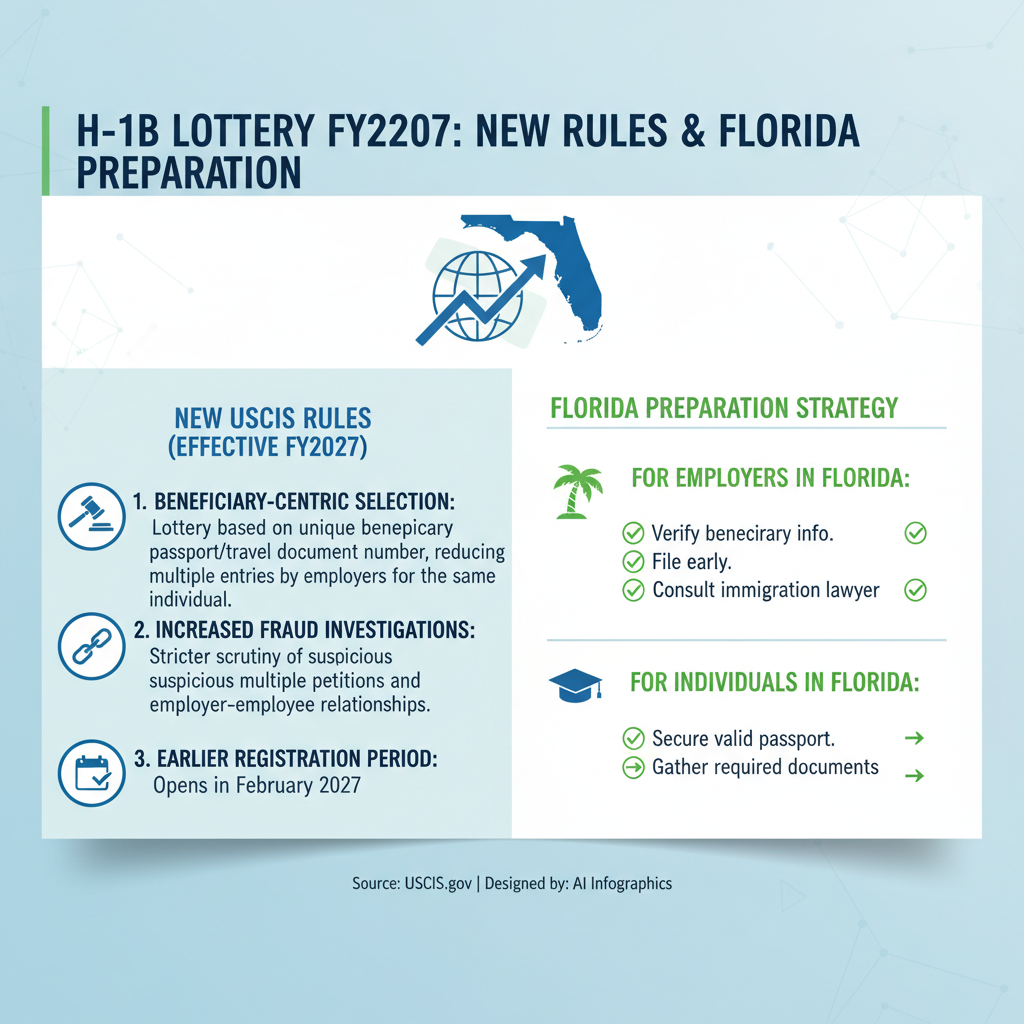
This crucial information is based on recent developments and announcements regarding the H-1B visa program:
H-1B Visa Lottery Changes for FY2027 (Legal News)
What This News Means for Immigrants in Orlando and Across Florida
The H-1B visa program is a cornerstone for many skilled professionals seeking to live and work in the United States, particularly in high-demand fields like technology, engineering, medicine, and education. For individuals and businesses in Florida, these changes are not just federal policy adjustments; they have direct, tangible impacts on career paths, economic growth, and the ability to retain top talent.
Why this news is showing up now
Immigration processes operate on a fiscal year cycle (FY) that runs from October 1st to September 30th. The H-1B visa cap-subject lottery for a given fiscal year typically opens for registration in March of the preceding calendar year. For FY2027, this means the registration window is expected to open in March 2026. USCIS generally announces any significant rule changes, fee adjustments, or procedural modifications well in advance of this critical registration period. The recent news reflects the finalization or imminent implementation of these changes, providing stakeholders with necessary lead time to prepare.
The most impactful recent change, the beneficiary-centric selection process, was finalized and implemented for FY2025 but continues to be a critical aspect of the FY2027 lottery, fundamentally altering how selections are made and aiming to curb fraud. Additionally, USCIS has recently updated its fee structure and enhanced integrity measures, all of which contribute to the "new rules" for the upcoming lottery.
How it can affect Florida residents
Florida is a rapidly growing state with diverse industries, including a burgeoning tech sector, world-class healthcare systems, and numerous universities and research institutions. Cities like Orlando, Tampa, Miami, and Jacksonville are hubs for innovation and specialized talent. The H-1B visa is vital for many Floridian companies to hire international graduates from local universities (like the University of Central Florida, University of Florida, or Florida International University) or bring in experienced professionals from abroad.
-
For H-1B Beneficiaries (Prospective Employees):
- Increased Fairness (Beneficiary-Centric Selection): The new beneficiary-centric selection process aims to prevent multiple registrations for the same individual, which previously inflated lottery numbers and reduced genuine chances. This means each eligible beneficiary, regardless of how many employers register them, will only have one chance in the lottery. This could lead to a statistically higher chance of selection for legitimate candidates by reducing fraudulent or speculative entries.
- Higher Costs: USCIS fee increases, which became effective in April 2024, will impact the overall cost of filing an H-1B petition, making it more expensive for both employers and, indirectly, employees (though the employer is generally responsible for filing fees).
- Enhanced Scrutiny: With increased integrity measures, applicants can expect closer examination of their qualifications, job duties, and the employer-employee relationship.
- Strategic Planning: It becomes even more crucial to secure a strong, legitimate job offer from an employer willing to navigate the process diligently.
-
For Florida Employers (Petitioners):
- Reduced Fraud, More Predictability: Employers can be more confident that if their prospective employee is selected, it's a genuine slot, not one taken by a fraudulent multiple entry. This could lead to a more stable talent acquisition pipeline.
- Increased Costs: Higher filing fees mean employers must budget more for each H-1B petition. This might particularly affect smaller businesses or startups in Orlando's tech corridor or the I-4 corridor.
- Compliance Focus: The emphasis on integrity means employers must ensure full compliance with all H-1B requirements, including job offer legitimacy, wage requirements, and specialty occupation criteria. The Orlando USCIS Field Office and local Department of Labor offices are vigilant in enforcing these rules.
- Recruitment Strategies: Employers might need to adjust their recruitment strategies, focusing on early identification of talent and preparing registrations well in advance.
Understanding these changes is paramount for anyone involved in the H-1B process in Florida. Imigrar is here to help you navigate these new waters with confidence.
What H-1B Visa Lottery Changes for FY2027 Is (and Why It Matters)
The H-1B visa program allows U.S. employers to temporarily employ foreign workers in specialty occupations. These occupations generally require a bachelor's degree or higher in a specific field. Due to high demand, the number of H-1B petitions often exceeds the annual cap set by Congress, necessitating a lottery system.
A plain-English definition
Imagine a highly sought-after job that many qualified people want. The U.S. government sets a limit on how many people can get this job each year through a specific visa (the H-1B). Because more people want it than there are spots available, they hold a "lottery" to pick who gets to apply. The "H-1B Visa Lottery Changes for FY2027" refers to new rules that USCIS has put in place for how this lottery will be run for the fiscal year starting October 1, 2026. The most significant change is how individuals are entered into the lottery – now, each person gets one entry, no matter how many companies want to sponsor them, to make the process fairer and reduce fraud.
Key terms you need to know
- H-1B Visa: A nonimmigrant visa that allows U.S. employers to temporarily employ foreign workers in specialty occupations.
- Specialty Occupation: An occupation that requires theoretical and practical application of a body of highly specialized knowledge, and a bachelor's or higher degree in the specific specialty (or its equivalent) as a minimum for entry into the occupation in the United States.
- Cap-Subject H-1B: An H-1B petition that is subject to the annual numerical limit (cap) set by Congress. The current annual cap is 65,000 visas, plus an additional 20,000 visas for those with a U.S. master's degree or higher (the "master's cap").
- Cap-Exempt H-1B: Certain organizations are exempt from the annual cap, including institutions of higher education, non-profit organizations affiliated with institutions of higher education, and non-profit research organizations or governmental research organizations.
- Beneficiary: The foreign national who will be employed in the H-1B specialty occupation.
- Petitioner: The U.S. employer who files the H-1B petition on behalf of the beneficiary.
- H-1B Registration Period: A specific window, typically in March, during which prospective H-1B petitioners (employers) electronically register beneficiaries for the lottery. This is not the full petition, but an initial entry.
- Selection Notification: If a beneficiary's registration is selected in the lottery, USCIS notifies the petitioner that they can proceed with filing a full H-1B petition.
- Beneficiary-Centric Selection: The new rule implemented for FY2025 and continuing for FY2027, where selection is based on unique beneficiaries rather than unique registrations. This means if one beneficiary has multiple registrations submitted by different employers, they only get one chance in the lottery. This aims to prevent fraud and increase fairness.
- Form I-129: The "Petition for a Nonimmigrant Worker" used by employers to petition for H-1B status on behalf of a foreign worker.
- LCA (Labor Condition Application): Form ETA-9035, filed with the Department of Labor by the employer, attesting to wage and working conditions before an H-1B petition can be filed.
The changes primarily matter because they aim to streamline the lottery process, reduce the incidence of fraud (where multiple employers would register the same individual to increase their chances), and potentially offer a more equitable chance for genuinely interested beneficiaries and employers. For Orlando's growing tech and healthcare sectors, understanding these shifts is crucial for talent acquisition and career planning.
Current Immigration Law: The Foundation of the H-1B Program
The H-1B visa program is governed by the Immigration and Nationality Act (INA), specifically Section 101(a)(15)(H)(i)(b), which defines the H-1B nonimmigrant classification, and Section 214(g), which establishes the annual numerical cap. These statutory provisions are supplemented by regulations issued by the Department of Homeland Security (DHS) and Department of Labor (DOL), as well as policy guidance from U.S. Citizenship and Immigration Services (USCIS).
Federal requirements
To qualify for an H-1B visa, both the employer and the prospective employee must meet specific federal criteria:
- Specialty Occupation: The job must qualify as a specialty occupation, meaning it requires a theoretical and practical application of highly specialized knowledge and a bachelor's degree or higher in a specific field.
- Educational Requirements: The beneficiary must hold at least a U.S. bachelor's degree (or foreign equivalent), or possess a license in a specialty occupation field, or have work experience equivalent to a bachelor's degree.
- Employer-Employee Relationship: A valid employer-employee relationship must exist between the petitioner and the beneficiary, as defined by USCIS.
- Wage Requirements: The employer must pay the H-1B employee at least the actual wage paid to other employees with similar experience and qualifications, or the prevailing wage for the occupational classification in the area of intended employment, whichever is higher. This is certified through the Labor Condition Application (LCA).
- Numerical Cap: Most H-1B petitions are subject to the annual cap of 85,000 (65,000 regular cap + 20,000 U.S. master's cap). This cap is why the lottery is necessary.
- Registration Requirement: For cap-subject H-1B petitions, employers must first register the beneficiary electronically with USCIS during a designated period. Only selected registrations can proceed to file a full petition.
The recent changes, particularly the beneficiary-centric selection process, are regulatory adjustments aimed at ensuring the integrity of this core statutory framework. They do not alter the fundamental eligibility criteria for the H-1B visa itself but rather the mechanism by which cap-subject petitions are selected.
For more details on federal requirements, always refer to the USCIS official website and the U.S. Department of State.
Florida-specific considerations
While H-1B is a federal program, local factors in Florida can influence the process and experience:
- High Demand in Tech and Healthcare: Florida's growing tech industry, particularly in Orlando, Tampa, and Miami, generates significant demand for H-1B workers in IT, software development, data science, and engineering. Similarly, the state's large healthcare sector requires medical professionals. This means competition for H-1B visas remains fierce for Florida-based employers and job seekers.
- University Talent Pool: Florida boasts a robust university system, including UCF in Orlando, UF in Gainesville, USF in Tampa, and FIU in Miami. Many international students graduating from these institutions on F-1 (Optional Practical Training - OPT and STEM OPT) visas seek H-1B sponsorship from Florida employers. The H-1B changes directly impact their post-graduation career prospects.
- Local USCIS Offices: While H-1B petitions are generally processed by USCIS service centers, local field offices like the Orlando USCIS Field Office may handle certain follow-up actions or interviews in specific circumstances (e.g., Change of Status interviews, though less common for initial H-1B).
- Prevailing Wage Areas: Prevailing wage determinations for Florida vary significantly by metropolitan area. Employers in the Orlando-Kissimmee-Sanford MSA must ensure they meet the prevailing wage for their specific occupation and location, which is a key component of the Labor Condition Application (LCA).
Important: Ensuring full compliance with both federal and local prevailing wage requirements is critical to avoid issues during the H-1B petition process. USCIS uses Form I-129 for the H-1B petition.
Don't Risk Your H-1B Future! The new rules demand precision. Let Imigrar guide you. Contact our experienced Orlando immigration lawyers today for a free consultation at +1 786-791-3106. Se Habla Español.
How to Navigate the H-1B Visa Lottery Changes for FY2027: A Complete Step-by-Step Guide
Successfully securing an H-1B visa, especially under the new FY2027 lottery rules, requires meticulous planning and execution. Here’s a detailed step-by-step guide:
1) Understand the New Rules and Confirm Eligibility
Before any action, both the prospective beneficiary and the employer must fully grasp the FY2027 H-1B lottery changes, particularly the beneficiary-centric selection process and any updated fee structures. Confirm that both the job and the beneficiary meet the fundamental H-1B eligibility criteria.
- For Beneficiaries:
- Ensure your education (bachelor's degree or higher, or equivalent experience) aligns with a specialty occupation.
- Verify your current visa status (e.g., F-1 OPT/STEM OPT, J-1, L-1, TN) and its expiration date.
- Understand that you will only have one chance in the lottery, regardless of how many employers register you.
- For Employers:
- Confirm the position qualifies as a specialty occupation.
- Verify the ability to pay the required prevailing wage for the position in the intended area of employment (e.g., Orlando, FL).
- Understand the increased registration and filing fees.
- Be prepared for enhanced scrutiny from USCIS regarding the legitimacy of the job offer and employer-employee relationship.
Reminder: The new beneficiary-centric rule means that if multiple registrations are submitted for the same individual, USCIS will select based on the unique passport or travel document number provided for the beneficiary. Any duplicate selections for the same beneficiary will be considered invalid, preventing a single individual from having multiple chances.
2) Secure a Job Offer and Initiate Labor Condition Application (LCA)
The H-1B process begins with a bona fide job offer from a U.S. employer. Once an offer is extended and accepted, the employer must take the first legal step: filing a Labor Condition Application (LCA) with the U.S. Department of Labor (DOL).
- Job Offer: Must clearly state the specialty occupation, salary, work location, and terms of employment.
- LCA Filing (Form ETA-9035):
- The employer must electronically file Form ETA-9035, the LCA, with the DOL.
- This form attests that the employer will pay the H-1B worker at least the prevailing wage or the actual wage, whichever is higher, and provide working conditions that will not adversely affect other employees.
- The LCA typically takes 7-10 calendar days for certification by the DOL. It must be certified before the H-1B petition (Form I-129) can be filed.
Required Documents for LCA: Job description, prevailing wage determination (if pre-determined), employer's FEIN.
3) H-1B Lottery Registration
Once the LCA is certified (or while awaiting certification, if the registration window is open), the employer must register the beneficiary for the H-1B lottery. This is the critical step that determines if you get a chance to file a full petition.
- Registration Period: Typically opens in early March (e.g., for FY2027, likely March 2026) and lasts for approximately two weeks.
- Online Registration: Employers (or their authorized legal representatives) must create a USCIS online account and submit a separate registration for each beneficiary.
- Information Required:
- Employer's legal name, FEIN, and contact information.
- Beneficiary's full legal name, date of birth, country of birth, country of citizenship, passport number or other valid travel document number, and gender.
- Beneficiary's highest level of education.
- Indication of whether the beneficiary is eligible for the master's cap.
- Registration Fee: The fee has increased. For FY2027, it is $10 per registration, as per the new fee schedule. This fee is non-refundable.
Important: Under the new rules, each beneficiary should have only one registration submitted using their unique passport/travel document number. While multiple employers *can* still register the same beneficiary, the beneficiary-centric selection process ensures only one selection notice will be issued per beneficiary, even if multiple registrations were submitted. Any additional selections for that beneficiary will be deemed invalid.
4) If Selected: Petition Preparation and Filing (Form I-129)
If your registration is selected in the lottery (notifications typically occur by late March or early April), the employer receives a selection notice. This notice authorizes the employer to file the full H-1B petition within a specified filing window (usually 90 days).
- Gather Documents: Collect all necessary supporting documentation.
- Prepare Form I-129: Complete Form I-129, Petition for a Nonimmigrant Worker, and its relevant supplements (H-1B Data Collection and Filing Fee Exemption Supplement).
- Required Documents for I-129 Petition:
- Certified LCA (Form ETA-9035).
- Copy of the H-1B registration selection notice.
- Beneficiary's educational documents (diplomas, transcripts, foreign degree evaluations).
- Beneficiary's passport, visa, I-94 record, and previous U.S. immigration documents (EAD, I-20, DS-2019, I-797).
- Employer's documentation (business license, tax ID, financial statements, organizational charts, marketing materials).
- Detailed job description, employer support letter, and employment contract.
- Evidence of employer-employee relationship (e.g., client letters for consulting firms).
- Any required affidavits or expert opinions supporting specialty occupation claims.
- Checks for filing fees.
- File with USCIS: Submit the complete petition package to the correct USCIS service center. The filing window will be clearly stated on the selection notice.
Warning: Missing the filing deadline or submitting an incomplete petition will result in rejection, even if selected in the lottery.
5) Premium Processing & Follow-up
After filing, you can choose to expedite the processing of your petition.
- Premium Processing: Employers can opt for Premium Processing by filing Form I-907 and paying an additional fee (currently $2,805 for H-1B petitions, subject to change). This guarantees USCIS will take action on the petition (approval, denial, Request for Evidence (RFE), or Notice of Intent to Deny (NOID)) within 15 calendar days.
- Responding to RFEs: It's common for USCIS to issue a Request for Evidence (RFE) if they need more information. A prompt and thorough response, often with legal guidance, is crucial.
- Status Monitoring: Regularly check the status of your petition online using the receipt number provided by USCIS (USCIS Processing Times).
6) Visa Interview or Change of Status
Upon approval, the beneficiary will either undergo a visa interview abroad or change their status within the U.S.
- Change of Status (if in U.S.): If the beneficiary is already in the U.S. in a valid nonimmigrant status (e.g., F-1 OPT) and the H-1B petition requests a change of status, they will automatically transition to H-1B status on October 1st (the start of FY2027), provided the petition is approved.
- Consular Processing (if outside U.S. or opting for it): If the beneficiary is outside the U.S. or chooses to leave the U.S., they will attend a visa interview at a U.S. consulate or embassy in their home country.
- Required Documents for Interview: Passport, DS-160 confirmation page, visa interview appointment confirmation, Form I-797 (H-1B approval notice), LCA, employer support letter, educational documents, resume, photos, financial documents.
7) Post-Approval Considerations
Once the H-1B visa is secured, there are ongoing compliance requirements.
- Start Date: H-1B employment for cap-subject petitions typically begins on October 1st of the fiscal year for which it was approved (e.g., October 1, 2026, for FY2027).
- Employer Compliance: Employers must adhere to the terms of the certified LCA, including wage and working conditions, throughout the H-1B employee's tenure.
- Maintaining Status: Beneficiaries must maintain their H-1B status, including working only for the petitioning employer in the approved specialty occupation. Any significant changes (e.g., job duties, work location, employer) may require an amended petition.
For official forms and detailed instructions, visit USCIS Forms.

Practical Steps You Can Take Today to Prepare for the FY2027 H-1B Lottery
Preparation is key, especially with the updated rules and increased scrutiny. Here’s an actionable checklist:
- Educate Yourself and Your Employer: Thoroughly review the USCIS announcements regarding the beneficiary-centric selection process, new fee schedule, and integrity measures. Ensure your prospective employer (or current employer if you're on OPT) is fully aware and prepared.
- Secure a Strong Job Offer: Focus on obtaining a legitimate job offer from an employer committed to sponsoring your H-1B visa. Ensure the job truly qualifies as a specialty occupation and the employer can meet prevailing wage requirements in your intended work location (e.g., Orlando, FL).
- Gather Your Personal Documents:
- Valid passport (ensure it’s current and has sufficient validity).
- Educational degrees, diplomas, and official transcripts. If your degree is foreign, consider getting a U.S. equivalency evaluation now.
- All previous U.S. visa documents (I-20s, DS-2019s, EAD cards, previous I-797 approval notices).
- Updated resume/CV.
- Birth certificate and marriage certificate (if applicable).
- Budget for Increased Costs: Be aware that USCIS registration and filing fees have increased. Discuss with your employer who will cover which costs, though certain fees (like attorney fees and anti-fraud fees) are generally the employer's responsibility.
- Consult with an Experienced Immigration Attorney: This is perhaps the most crucial step. An attorney can assess your eligibility, advise your employer on compliance, prepare the LCA and registration, and if selected, expertly file your Form I-129 petition. They can also help strategize for potential RFEs.
- Maintain Current Immigration Status: If you are currently in the U.S. (e.g., on F-1 OPT), ensure you meticulously maintain your nonimmigrant status. Any lapse could jeopardize your ability to change status to H-1B.
- Understand Timeline Expectations:
- Early March 2026: H-1B FY2027 Lottery Registration Window opens.
- Late March/Early April 2026: Lottery selections announced.
- April 1 to June 30, 2026 (approx.): Filing window for selected H-1B petitions.
- October 1, 2026: Earliest possible start date for approved H-1B petitions.
Reminder: For Central Florida residents, local expertise can be invaluable. Imigrar understands the specific needs and challenges faced by immigrants and employers in the Orlando area.
Overwhelmed by H-1B Changes? Imigrar's Orlando team offers clear, strategic advice. Get a free consultation by calling +1 786-791-3106 or contacting us online.


Have Questions About Your Case?
Schedule a free consultation with our attorney-reviewed team today