What This News Means for Immigrants in Orlando and Across Florida
The H-1B visa program is a cornerstone of the U.S. economy, enabling American employers to temporarily employ foreign workers in specialty occupations. These are roles requiring a bachelor's degree or higher in a specific field, such as technology, engineering, medicine, and education. For many skilled professionals and the businesses that rely on their talent, the H-1B visa represents a critical pathway to opportunity and growth. However, the demand for H-1B visas far outstrips the annual supply, leading to a highly competitive lottery system each year. The recent announcements regarding significant changes to the H-1B visa lottery process for Fiscal Year 2027 (FY2027) have sent ripples through the immigrant community and among U.S. employers. These aren't minor tweaks; they represent a substantial overhaul designed to address long-standing issues, particularly concerning fraud and fairness in the selection process. For anyone considering an H-1B visa, or for employers seeking to sponsor talent, understanding these new rules is not just beneficial—it's essential for successful navigation.Why this news is showing up now
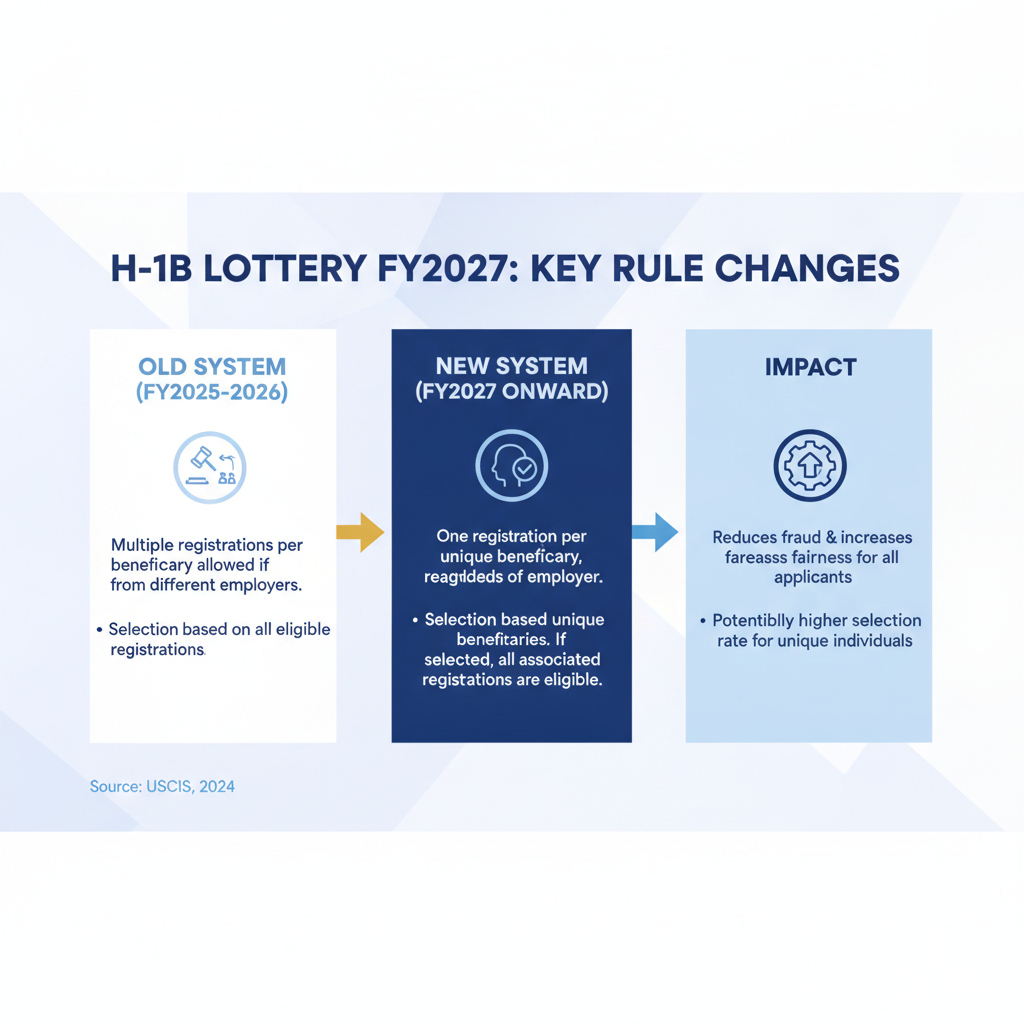
As of today, June 23, 2026, the H-1B visa lottery for FY2027 has concluded its registration and selection phases, which typically occur in March. News outlets and legal journals are now extensively covering the impact and implications of the new rules that were implemented for this cycle. The U.S. Citizenship and Immigration Services (USCIS) announced these changes well in advance of the FY2027 registration period, giving petitioners and beneficiaries time to prepare, but the full scope of their effect is only now becoming clear as the lottery results are processed and petitions are filed. The changes were a direct response to concerns about widespread abuse of the previous lottery system, where multiple registrations for the same beneficiary by different employers artificially inflated selection odds, disadvantaging legitimate applicants. The government's objective is clear: to ensure the H-1B program operates as intended, allowing U.S. employers to hire highly skilled foreign workers while protecting the integrity of the immigration system. This means a shift towards a more transparent and equitable process, aiming to give every eligible beneficiary a fair chance.How it can affect Florida residents
Florida, particularly Central Florida and the Orlando metropolitan area, is a vibrant hub for technology, aerospace, healthcare, and tourism. Companies along the I-4 corridor, from Tampa to Orlando and beyond, regularly seek highly skilled professionals in fields that qualify for H-1B visas. The impact of these H-1B lottery changes for FY2027 on Florida residents and businesses is multifaceted: * **For Skilled Immigrants in Florida:** If you are currently on an F-1 OPT visa, a J-1 visa, or another nonimmigrant status in Florida and aspire to obtain an H-1B, these changes directly affect your chances. The new beneficiary-centric selection process aims to level the playing field, potentially increasing your odds if you previously competed against multiple registrations from other individuals. However, it also means that employers can no longer "stack the deck" by submitting multiple registrations for you, placing greater emphasis on securing a single, legitimate job offer. * **For Florida Employers:** Businesses in Orlando, Kissimmee, Tampa, and Jacksonville that rely on H-1B talent will find the process more streamlined in terms of registration strategy. Instead of coordinating multiple registrations, they can focus on submitting one strong registration per candidate. This reduces administrative burden but also means they can't rely on multiple entries to improve selection chances. The increased fees associated with the H-1B process will also be a factor in their hiring budgets. * **Increased Scrutiny:** USCIS has indicated enhanced anti-fraud measures. This means that both employers and beneficiaries in Florida can expect greater scrutiny of their applications, including site visits and requests for evidence (RFEs) to verify the legitimacy of job offers and the qualifications of beneficiaries. * **Economic Impact:** A more equitable H-1B system could lead to a fairer distribution of skilled talent, potentially benefiting smaller, legitimate Florida businesses that previously struggled to compete against larger firms or those engaged in questionable registration practices. This could foster innovation and growth in Central Florida's burgeoning tech and healthcare sectors.Need Help? Navigating the new H-1B lottery rules can be complex. Our Orlando immigration team is ready to assist. Call +1 786-791-3106 for a free consultation, or message us online. Se Habla Español.
What H-1B Visa Lottery Changes for FY2027 Is (and Why It Matters)
The H-1B visa program is a nonimmigrant visa that allows U.S. employers to temporarily employ foreign workers in specialty occupations. These occupations generally require a bachelor's degree or higher in a specific specialty. Examples include IT professionals, engineers, doctors, architects, and certain types of educators. The program is crucial for U.S. companies to fill critical skill gaps and remain competitive in the global market. The "lottery" aspect comes into play because Congress sets an annual cap on the number of H-1B visas issued each fiscal year. This cap is currently 65,000 for the regular cap and an additional 20,000 for those with a U.S. master's degree or higher (the "master's cap"). With demand consistently exceeding supply, USCIS conducts an electronic lottery to select which registrations will be eligible to file a full H-1B petition. For FY2027, USCIS has implemented significant regulatory changes aimed at reforming the H-1B cap lottery process. These changes, outlined in the "Improving the H-1B Registration Process and Promoting Program Integrity" final rule, are designed to combat fraud, improve fairness, and modernize the H-1B program.A plain-English definition
Simply put, the **H-1B Visa Lottery Changes for FY2027** refer to the new rules USCIS introduced to how they select who gets a chance to apply for an H-1B visa. Before these changes, some individuals had multiple companies register them in the lottery, significantly increasing their chances of being selected over someone with only one registration. This was widely seen as unfair and a source of fraud. The core of the new system is **beneficiary-centric selection**. This means that instead of selecting registrations based on the employer (petitioner), USCIS now selects registrations based on the individual foreign worker (beneficiary). Each unique beneficiary will only be entered into the lottery once, regardless of how many employers register them. If a beneficiary is selected, all employers who registered them will be notified, and any one of those employers can then proceed to file an H-1B petition on behalf of that beneficiary. This change dramatically levels the playing field, ensuring that every individual has an equal chance of selection. Additionally, these changes involve increased filing fees for certain aspects of the H-1B process and enhanced fraud detection and prevention measures. The goal is to make the H-1B system more robust, fair, and less susceptible to manipulation.Key terms you need to know
Understanding these terms is vital when navigating the H-1B process, especially with the new FY2027 changes: * **H-1B Visa:** A nonimmigrant visa allowing U.S. employers to temporarily employ foreign workers in specialty occupations. * **Specialty Occupation:** An occupation that requires theoretical and practical application of a body of highly specialized knowledge, and a bachelor's degree or higher in the specific specialty (or its equivalent) as a minimum for entry into the occupation. * **Cap-Subject H-1B:** H-1B visas subject to the annual numerical limit set by Congress. * **Cap-Exempt H-1B:** H-1B visas not subject to the annual cap, typically for employment at institutions of higher education, non-profit organizations affiliated with higher education, or non-profit research organizations or government research organizations. * **Beneficiary:** The foreign worker who is the subject of the H-1B petition. Under the new rules, this is the central figure in the lottery selection. * **Petitioner:** The U.S. employer filing the H-1B petition on behalf of the beneficiary. * **H-1B Registration:** The initial electronic process where employers (or their attorneys) submit basic information about the company and the beneficiary to USCIS during a specific window, before the lottery. There is a registration fee (e.g., $10 for FY2027, though this fee is subject to change in future years). * **Lottery Selection:** The random process conducted by USCIS if the number of registrations exceeds the annual cap. For FY2027, this selection is now **beneficiary-centric**. * **Petition Filing Period:** The window of time during which selected petitioners can submit the full **Form I-129**, Petition for a Nonimmigrant Worker. * **Labor Condition Application (LCA):** **Form ETA-9035**. An application filed with the Department of Labor (DOL) by the employer, attesting that they will pay the H-1B worker at least the prevailing wage or the actual wage paid to other employees with similar experience and qualifications, whichever is higher, and that employment of the H-1B worker will not adversely affect the working conditions of U.S. workers. This must be certified before filing **Form I-129**. * **Prevailing Wage:** The average wage paid to similarly employed workers in a specific occupation in the geographic area of intended employment. * **Premium Processing:** An optional service that allows petitioners to expedite the processing of certain immigration forms, including **Form I-129**, for an additional fee. USCIS guarantees a 15-calendar day processing time for petitions filed with premium processing. * **Request for Evidence (RFE):** A notice from USCIS asking for additional documentation or information to support a petition. * **Notice of Intent to Deny (NOID):** A notice from USCIS indicating their intent to deny a petition, giving the petitioner an opportunity to respond. * **Effective Date:** The date the H-1B petition, if approved, becomes effective, typically October 1st for cap-subject petitions.Current Immigration Law: The Foundation
The H-1B visa program is governed by the Immigration and Nationality Act (INA), specifically Section 101(a)(15)(H)(i)(b), which defines the H-1B nonimmigrant classification, and Section 214(g), which establishes the annual numerical cap. These statutory provisions form the bedrock of the H-1B program, with regulations published by USCIS and the Department of Labor (DOL) providing the operational details. The **Immigration and Nationality Act (INA)** is the primary federal law governing immigration in the United States. Its various sections dictate who can enter, how they can stay, and what rights they have. For H-1B visas, the relevant sections ensure that the program serves its intended purpose: to bring skilled foreign workers to fill specific needs in the U.S. workforce without displacing U.S. workers.Federal requirements
To qualify for an H-1B visa, both the employer (petitioner) and the foreign worker (beneficiary) must meet specific federal requirements: * **For the Employer (Petitioner):** * **Bona Fide Job Offer:** The employer must have a legitimate offer of employment in a specialty occupation. * **Employer-Employee Relationship:** There must be a valid employer-employee relationship as defined by USCIS. This is particularly scrutinized for third-party placements. * **Labor Condition Application (LCA):** The employer must file and obtain certification for a **Form ETA-9035** with the Department of Labor (DOL) before filing the H-1B petition. The LCA attests that the employer will pay the H-1B worker at least the prevailing wage for the occupation in the area of employment or the actual wage paid to similarly qualified workers, whichever is higher. It also attests to working conditions that will not adversely affect U.S. workers. * **FEIN:** The employer must have a valid Federal Employer Identification Number (FEIN). * **For the Employee (Beneficiary):** * **Specialty Occupation Qualification:** The beneficiary must hold a bachelor's degree or its equivalent, or a higher degree in a specialty field directly related to the position, or possess a state license, or have work experience equivalent to a bachelor's degree. * **Licensure:** If the occupation requires a state license (e.g., for doctors, nurses, architects), the beneficiary must possess the appropriate license. * **Qualifications Match Job:** The beneficiary's qualifications must match the requirements of the specialty occupation offered. The H-1B cap is set by Congress at 65,000 visas annually, with an additional 20,000 visas reserved for those with a U.S. master's degree or higher. Certain organizations are exempt from the cap, including institutions of higher education, non-profit organizations related to or affiliated with institutions of higher education, and non-profit research organizations or government research organizations.Florida-specific considerations
While there are no H-1B laws specific to Florida, the state's economic landscape and job market dynamics play a significant role. Florida is a rapidly growing state with a diverse economy. Major industries in Florida that frequently sponsor H-1B visas include: * **Technology:** Orlando and Tampa are emerging tech hubs with companies in software development, cybersecurity, modeling, simulation, and aerospace. * **Healthcare:** Hospitals and healthcare systems across Florida, including those in Orlando, Miami, and Jacksonville, sponsor H-1B visas for doctors, physical therapists, and other medical professionals. * **Finance and Business Services:** Large corporations and financial institutions throughout the state require skilled analysts, accountants, and IT specialists. * **Engineering:** Aerospace, civil, and environmental engineering firms have a strong presence, especially in areas like the Space Coast and along the I-4 corridor. For Central Florida residents, understanding the local job market and the types of companies that typically sponsor H-1B visas can be crucial for a successful application. The Orlando USCIS Field Office primarily handles adjustment of status applications and interviews, but the overall H-1B petition processing is handled by USCIS service centers (California and Vermont).Warning: The H-1B process is highly technical. Incorrect filings or missed deadlines can lead to denials. Don't risk your future; consult with the experienced immigration attorneys at Imigrar. Call +1 786-791-3106 today. Se Habla Español.
How to Navigate the New H-1B Lottery System: A Complete Step-by-Step Guide
The H-1B lottery process, especially with the FY2027 changes, requires meticulous planning and execution. This guide outlines the key steps for petitioners and beneficiaries.1) Understand Eligibility & New Rules
Before anything else, ensure both the employer and the prospective employee meet the fundamental H-1B eligibility criteria. For FY2027, this also means thoroughly understanding the beneficiary-centric selection process and updated fee structures. * **Employer's Role:** Confirm the job offered is a **specialty occupation** requiring at least a bachelor's degree. Verify the employer has a legitimate need for the position and can pay the **prevailing wage**. * **Beneficiary's Role:** Ensure you possess the required degree or its equivalent in a field related to the specialty occupation. If currently on another visa (e.g., F-1 OPT), ensure your status is maintained. * **New Rules Impact:** Recognize that your unique identifier (passport number or travel document number) will be central to the lottery. Only one selection per beneficiary, regardless of multiple registrations. **Required Documents (for initial assessment):** * Beneficiary's resume/CV and academic transcripts/degrees. * Copies of beneficiary's passport, visa, and I-94 record. * Job description and employer details.2) Employer Attestation & LCA Filing (DOL)
Once eligibility is confirmed, the employer must initiate the **Labor Condition Application (LCA)** process with the U.S. Department of Labor (DOL). This is a critical prerequisite to filing the **Form I-129**. * **Prepare LCA (Form ETA-9035):** The employer, or their representative, prepares the LCA, detailing the occupation, wage, work location, and attestations regarding working conditions and wages for U.S. workers. * **Determine Prevailing Wage:** This involves researching the appropriate prevailing wage for the specific occupation in the geographic area of employment. The DOL's Online Wage Library or private wage surveys can be used. * **Internal Notice:** The employer must provide notice of filing the LCA to their employees either through physical posting at the worksite or electronic notification. * **Submit to DOL:** The LCA is electronically submitted to the DOL. Certification typically takes 7-10 business days. **Warning:** An H-1B petition cannot be filed without a certified LCA. **Required Documents (for LCA):** * Employer's FEIN. * Detailed job description and requirements. * Prevailing wage determination documentation. * Employer's internal notice posting/email records.3) H-1B Registration (USCIS)
This step is where the new beneficiary-centric selection process primarily takes effect. * **Create USCIS Online Account:** Both employers and their attorneys must have a registrant account on the USCIS official website. * **Submit Registration:** During the designated registration period (typically in March preceding the October 1st start date of the fiscal year), the employer (or their attorney) submits an electronic registration for each beneficiary. This includes basic information about the employer and the beneficiary (name, date of birth, country of birth, passport number, highest degree). * **Pay Registration Fee:** A non-refundable fee (e.g., $10 per registration for FY2027) must be paid at the time of submission. * **Beneficiary-Centric Data:** Crucially, the beneficiary's unique identifying number (passport or travel document number) is now the primary identifier. If multiple registrations are submitted for the same beneficiary, USCIS will consolidate them into a single entry for the lottery. **Required Information (for Registration):** * Employer's legal name, FEIN, and mailing address. * Beneficiary's full legal name, date of birth, country of birth, country of citizenship, gender, and **valid passport number** (or other travel document number if no passport). * Beneficiary's highest level of education.4) Lottery Selection & Notification
After the registration period closes, USCIS conducts the lottery. * **Electronic Selection:** If the number of eligible registrations exceeds the annual cap, USCIS conducts a random selection process, prioritizing the master's cap first, then the regular cap. For FY2027, this is **beneficiary-centric**. * **Notification:** USCIS notifies selected registrants through their online accounts. The notification will indicate that the registration has been selected and that the petitioner is eligible to file an H-1B cap-subject petition on behalf of the named beneficiary. * **Petition Filing Period:** The notification will also specify the window during which the full H-1B petition (**Form I-129**) must be filed. This period is typically 90 days. **Important:** Only selected registrations can proceed to the next step. If a beneficiary has multiple selected registrations, any one of the employers who submitted a registration for that selected beneficiary can proceed to file the petition.5) Petition Filing (Form I-129)
If your registration is selected, the employer must then prepare and file the full H-1B petition. * **Assemble Petition Package:** This includes the **Form I-129**, the certified LCA, supporting documentation for the employer and beneficiary, and all required fees. * **Employer Documentation:** Articles of incorporation, business licenses, financial statements, tax returns, and other evidence proving the employer's legitimacy and ability to pay the wage. * **Beneficiary Documentation:** Educational degrees, transcripts, evaluations of foreign degrees, professional licenses, previous employment verification letters, copies of all immigration documents (I-20, EAD, I-94, visa stamps). * **Specialty Occupation Evidence:** Expert opinion letters, detailed job duties, organizational charts, and other evidence demonstrating the position is a specialty occupation and the beneficiary is qualified. * **File with USCIS:** The complete petition package is mailed to the correct USCIS Service Center (typically California or Vermont, depending on the employer's location). Include a copy of the selection notice. * **Premium Processing (Optional):** If elected, **Form I-907** and the additional fee are included to expedite processing. **Required Documents (for Form I-129):** * Certified **Form ETA-9035** (LCA). * **Form I-129** and H-1B Data Collection and Filing Fee Exemption Supplement. * Copy of H-1B selection notice. * Employer's federal tax ID (FEIN) and business registration documents. * Beneficiary's passport, visa, I-94, I-20 (if applicable), EAD (if applicable). * Beneficiary's educational degrees, transcripts, and foreign degree evaluations. * Letters of experience from previous employers. * Detailed job description and organizational chart. * Employer's federal tax returns and financial statements.6) Responding to RFE/NOID or Approval
After filing, USCIS will review the petition. * **Receipt Notice:** USCIS will issue a **Form I-797C, Notice of Action**, confirming receipt of the petition. * **Request for Evidence (RFE):** USCIS may issue an RFE if they need more information or clarification. A timely and comprehensive response is crucial. * **Notice of Intent to Deny (NOID):** In some cases, USCIS may issue a NOID, indicating their intention to deny the petition. This is a serious notice requiring a robust response. * **Approval:** If the petition is approved, USCIS will issue a **Form I-797, Approval Notice**. If the beneficiary is already in the U.S. and an **Adjustment of Status** was requested, the I-94 attached to the approval notice will reflect the new H-1B status and validity dates (typically starting October 1st). * **Consular Processing:** If the beneficiary is outside the U.S. or opted for consular processing, the approval notice will be sent to the National Visa Center, which will then coordinate with the appropriate U.S. consulate or embassy for a visa interview. **Required Documents (for RFE/NOID response):** * All documents requested in the RFE/NOID. * Cover letter explaining the response. * Additional supporting evidence as needed. USCIS Processing Times can vary significantly, so it’s essential to monitor them.Practical Steps You Can Take Today
Even though the FY2027 lottery registration and selection phases have passed, the implications of the new rules are ongoing. For those planning for FY2028 or those whose petitions are still being processed, these steps are vital. **Actionable Checklist:** 1. **Educate Yourself on the New Rules:** Thoroughly understand the beneficiary-centric selection process, increased fees, and enhanced fraud measures. Don't rely on outdated information. 2. **Verify Your Employer's Legitimacy:** For beneficiaries, ensure your sponsoring employer is bona fide and has a genuine need for your skills. Be wary of "body shop" companies that appear to exist solely to file H-1B petitions. 3. **Gather All Personal & Professional Documents:** Proactively collect your passport, birth certificate, academic degrees, transcripts (and get foreign degrees evaluated), previous employment letters, and any professional licenses. Keep them organized. 4. **Maintain Your Current Immigration Status:** If you are in the U.S. on another nonimmigrant visa (e.g., F-1 OPT, L-1, TN), ensure you maintain compliance with its terms and conditions. Any lapse could jeopardize your H-1B application. 5. **Start Early with LCA Preparation:** Employers should begin the LCA process well in advance of the H-1B registration period. This ensures sufficient time for DOL certification and reduces last-minute stress. 6. **Budget for Increased Costs:** Be aware of the increased USCIS filing fees for H-1B petitions for FY2027. Discuss these with your employer. 7. **Consult an Experienced Immigration Attorney:** This is perhaps the most critical step. The H-1B process is complex, and the new rules add another layer of intricacy. An attorney can ensure compliance, advise on strategy, and represent you effectively. **Document Preparation Guidance:** * **Originals vs. Copies:** Generally, USCIS requires copies of documents unless specifically requested otherwise. Keep your originals safe. * **Translations:** Any document not in English must be accompanied by a certified English translation. The translator must attest that they are competent to translate and that the translation is accurate. * **Organization:** Present documents clearly, logically, and in the order requested by USCIS or your attorney. Use tabs and labels. * **Digital Copies:** Keep digital copies of all submitted documents for your records. **Timeline Expectations:** * **Registration Period (Typically March):** A multi-week window for electronic registration. * **Selection Notification (Late March/Early April):** USCIS announces lottery results. * **Petition Filing Period (April 1 - June 30):** The 90-day window for selected petitioners to file **Form I-129**. * **Premium Processing (Optional):** 15-calendar day processing for an additional fee. * **Regular Processing (Varies):** Can take several months (e.g., 6-12+ months). Check USCIS Processing Times for current estimates. * **H-1B Start Date (October 1):** Approved cap-subject petitions typically become effective on October 1st of the fiscal year.