


The landscape of U.S. immigration is constantly evolving, and for those aspiring to work in the United States, staying informed about changes to key visa programs is paramount. Today, we delve into significant updates impacting the H-1B visa lottery for Fiscal Year 2027 (FY2027). These changes, recently finalized by U.S. Citizenship and Immigration Services (USCIS), are designed to enhance the integrity of the H-1B cap registration process and ensure a fairer selection system.
At Imigrar, an immigration law firm based in Orlando, Florida, we understand the anxieties and complexities that come with navigating these changes. Our mission is to "Keep Families Together" by providing expert legal guidance and support to immigrants nationwide, including those right here in Central Florida. With this comprehensive guide, we aim to shed light on the new H-1B rules, helping you understand what they mean for your future.
The reporting that sparked this guide
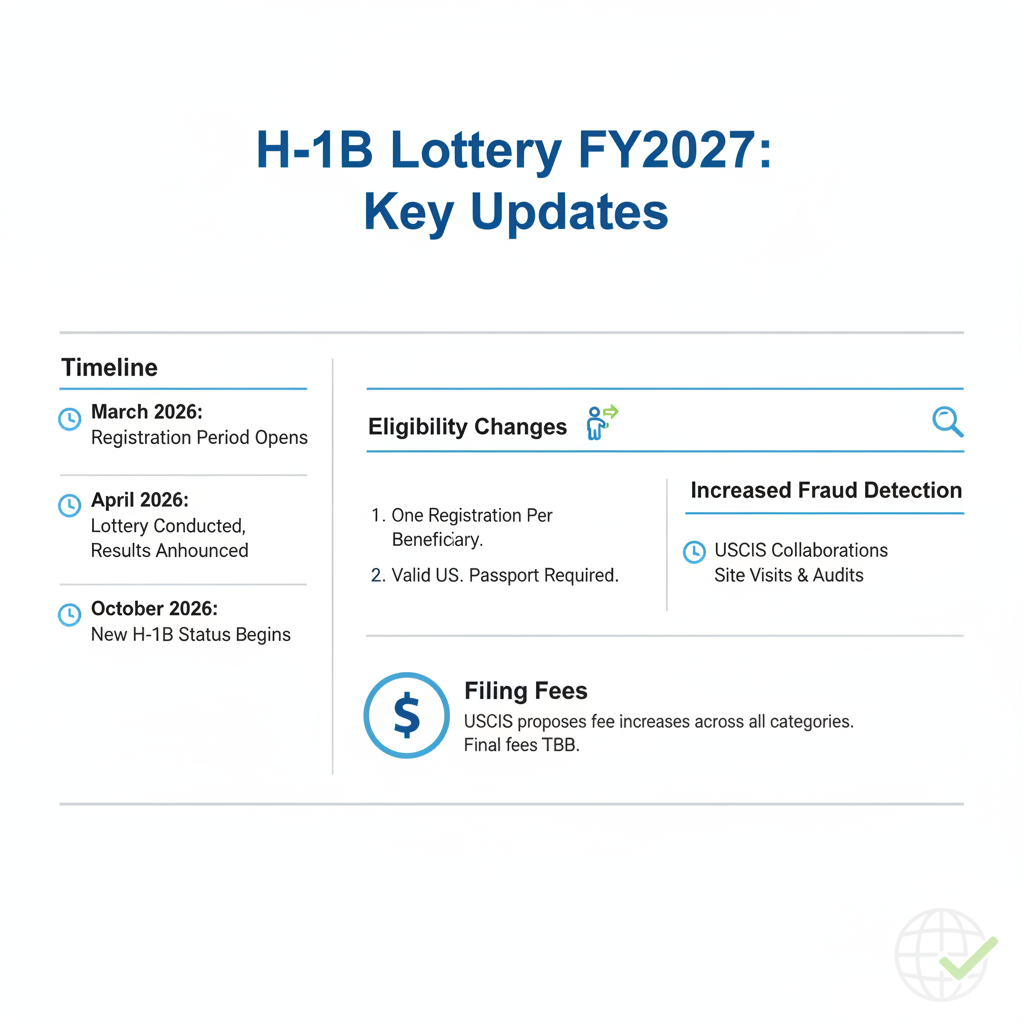
Our insights are informed by recent developments reported in legal news outlets concerning the H-1B Visa Lottery Changes for FY2027 (Legal News). These reports highlight the final rule published by USCIS, which introduces a beneficiary-centric selection process and strengthens measures against fraud.
What This News Means for Immigrants in Orlando and Across Florida
For skilled foreign workers and employers in Orlando, across Florida, and indeed nationwide, the H-1B visa is a critical pathway. The H-1B program allows U.S. employers to temporarily employ foreign workers in specialty occupations. With a statutory annual cap, demand consistently outstrips supply, making the annual lottery a high-stakes event. The new changes directly impact how this lottery will operate for the upcoming FY2027 cycle.
Why this news is showing up now
This news is prominent now because USCIS recently published a final rule, officially titled "Improving the H-1B Registration Program and Strengthening Program Integrity" (89 FR 19524), which became effective on March 4, 2024. This rule codifies a significant shift in the H-1B lottery selection process, moving from a registration-centric model to a beneficiary-centric one. While the rule was finalized in early 2024, its full impact will be felt during the upcoming FY2027 H-1B cap registration period, which is anticipated to open in March 2026. This timing allows employers and beneficiaries ample time to prepare for the new procedures.
The changes were prompted by USCIS's observations of widespread abuse in previous lottery cycles, where multiple companies registered the same individuals, artificially inflating their chances of selection. The agency aims to close these loopholes and ensure that each unique beneficiary has an equal chance of selection, regardless of how many employers register them.
How it can affect Florida residents
Florida, particularly the Orlando and Tampa Bay areas, is a growing hub for technology, healthcare, tourism, and aerospace industries—sectors that heavily rely on H-1B visas to fill specialized roles. For Florida residents, both those currently on other nonimmigrant visas (like F-1 OPT) hoping to transition to H-1B, and the employers seeking to sponsor them, these changes have several key implications:
- Fairer Chances: For legitimate beneficiaries, the new system offers a fairer chance of selection. Instead of a single beneficiary being registered multiple times by different employers, thereby increasing their odds, each unique individual will now be entered into the lottery only once, regardless of the number of registrations submitted on their behalf.
- Employer Compliance: Florida employers sponsoring H-1B candidates must now be even more diligent in understanding and complying with the new rules. They need to ensure they are submitting registrations only for genuine job offers and are not involved in any fraudulent multi-employer schemes. USCIS has explicitly stated it will investigate and deny petitions where fraud is suspected.
- Increased Scrutiny: USCIS will be scrutinizing registrations more closely. This means that if you are an H-1B candidate in Orlando or anywhere in Florida, your employer's compliance with the rules is more critical than ever. Ensure your potential employer is reputable and understands the new beneficiary-centric approach.
- Planning is Key: For students graduating from Florida universities like UCF, UF, or FIU, who are on F-1 OPT and looking to secure an H-1B, advanced planning with potential employers is crucial. Understanding the timeline and requirements will be vital to a successful application.
Need Help? Our Orlando immigration team is ready to assist. Call +1 786-791-3106 for a free consultation, or message us online. Se Habla Español.
What H-1B Visa Lottery Changes Are (and Why They Matter)
The H-1B visa program is a cornerstone of U.S. immigration for skilled workers. Understanding the recent changes, particularly for the FY2027 lottery, is crucial for anyone involved in this process.
A plain-English definition
The H-1B visa is a nonimmigrant visa that allows U.S. employers to temporarily employ foreign workers in specialty occupations. These occupations generally require a bachelor's degree or higher in a specific specialty, such as IT professionals, engineers, doctors, or architects. Due to high demand and a limited number of available visas (known as the "cap"), USCIS conducts an annual "lottery" or random selection process if the number of registrations exceeds the cap.
The core change for FY2027 is simple yet profound: **the lottery will now be "beneficiary-centric."** Previously, if multiple employers registered the same foreign worker (beneficiary), each registration was entered into the lottery, effectively giving that individual multiple chances of selection. Under the new rule, even if multiple employers register the same beneficiary, that individual will only be entered into the lottery **once**. USCIS will conduct the selection based on each unique beneficiary, not each unique registration. If a beneficiary is selected, all employers who registered that individual will be notified and can then proceed to file an H-1B petition on their behalf.
This change matters because it aims to eliminate the unfair advantage created by multiple registrations for a single individual, making the selection process more equitable for all eligible beneficiaries. It directly addresses concerns about fraud and manipulation of the lottery system.
Key terms you need to know
Navigating the H-1B process requires familiarity with specific terminology. Here are some essential terms:
- H-1B Visa: A nonimmigrant visa that permits U.S. employers to temporarily employ foreign workers in specialty occupations.
- Specialty Occupation: An occupation that requires theoretical and practical application of a body of highly specialized knowledge, and a bachelor's or higher degree in the specific specialty (or its equivalent) as a minimum for entry into the occupation in the United States.
- H-1B Cap: The statutory limit on the number of H-1B visas issued each fiscal year. The regular cap is 65,000, plus an additional 20,000 for those with a U.S. master's degree or higher (the "master's cap").
- H-1B Lottery (or Selection Process): The random selection process conducted by USCIS when the number of eligible H-1B registrations exceeds the annual cap.
- Beneficiary: The foreign worker for whom an H-1B visa petition is filed.
- Registrant: The prospective employer who submits an H-1B registration on behalf of a beneficiary.
- H-1B Registration: An electronic process where prospective petitioners (employers) submit basic information about the company and the prospective H-1B worker to USCIS during a designated registration period. This is the first step before a lottery is conducted.
- H-1B Petition: The formal application (Form I-129) submitted to USCIS by a selected employer after a successful lottery registration, requesting H-1B classification for a beneficiary.
- Fiscal Year (FY): The U.S. government's fiscal year runs from October 1st to September 30th. H-1B visas become available on October 1st of the fiscal year for which they are approved (e.g., FY2027 starts October 1, 2026).
- LCA (Labor Condition Application): Form ETA-9035, certified by the Department of Labor, which attests that the employer will pay the H-1B worker at least the prevailing wage or the actual wage, whichever is higher, and will provide working conditions that will not adversely affect other workers. This must be certified before filing the H-1B petition.
- Premium Processing: An optional service offered by USCIS that guarantees processing of certain petitions (including H-1B) within 15 calendar days for an additional fee.
- Change of Status (COS): An application to change from one nonimmigrant status to another (e.g., F-1 student to H-1B worker) while remaining in the U.S.
- Consular Processing: The process of applying for an H-1B visa stamp at a U.S. embassy or consulate abroad if the beneficiary is outside the U.S. or chooses to depart and re-enter.
Current Immigration Law: The Foundation of H-1B Visas
The H-1B visa program is governed by specific U.S. immigration laws and regulations. Understanding this legal framework is crucial for both employers and beneficiaries.
Federal requirements
The authority for the H-1B visa program originates from the **Immigration and Nationality Act (INA)**, specifically Section 101(a)(15)(H)(i)(b), which defines the H-1B nonimmigrant classification. Further regulations governing the H-1B program are found in 8 Code of Federal Regulations (CFR) Part 214.2(h).
Key federal requirements for an H-1B visa include:
- Specialty Occupation: The job must qualify as a specialty occupation, meaning it requires a bachelor's degree or higher in a specific field.
- Beneficiary Qualifications: The beneficiary must hold the required bachelor's or higher degree (or its equivalent) or possess a license that authorizes them to practice the specialty occupation, or have work experience equivalent to a bachelor's degree.
- Employer-Employee Relationship: A valid employer-employee relationship must exist between the petitioning U.S. employer and the beneficiary.
- LCA Certification: Before filing an H-1B petition, the employer must obtain a certified Labor Condition Application (Form ETA-9035) from the U.S. Department of Labor (DOL). This form attests to the employer's compliance with wage and working condition requirements.
- Cap-Subject vs. Cap-Exempt: Most H-1B petitions are subject to the annual cap. However, certain employers, such as institutions of higher education, non-profit organizations affiliated with higher education, or non-profit research organizations, are "cap-exempt" and can file H-1B petitions at any time, without being subject to the lottery.
- Prevailing Wage: Employers must pay the H-1B worker at least the prevailing wage for the occupation in the area of intended employment or the actual wage paid to other employees with similar experience and qualifications, whichever is higher.
- Duration: An H-1B visa is initially granted for up to three years and can be extended for a maximum total of six years. In some cases, extensions beyond six years are possible, particularly if the beneficiary is pursuing lawful permanent residency.
The primary form used for filing an H-1B petition is Form I-129, Petition for a Nonimmigrant Worker. This form, along with supporting documentation, is submitted to USCIS after a successful lottery selection.
For official information and forms, always refer to the USCIS official website.
Florida-specific considerations
While H-1B laws are federal, their application can have specific nuances depending on the state and local economy. In Florida, particularly in the Orlando area, certain industries are prominent and frequently utilize H-1B visas:
- Tech Sector: Orlando's "Silicon Swamp" and the I-4 corridor are home to numerous tech companies, from startups to established firms, actively seeking software developers, data scientists, and IT specialists.
- Tourism & Hospitality: While less common for the H-1B (which focuses on specialty occupations), certain roles in large hospitality corporations or theme park design/engineering might qualify.
- Healthcare: Hospitals and medical research facilities across Florida, including those in Orlando's Medical City, frequently sponsor H-1B visas for medical professionals, researchers, and specialized technicians.
- Aerospace & Defense: Central Florida has a strong presence in these sectors, with companies often needing engineers and scientists.
- Universities: Florida's robust university system, including the University of Central Florida (UCF) in Orlando, the University of Florida (UF), and Florida International University (FIU), are major employers of H-1B professionals as researchers, professors, and post-doctoral fellows. As cap-exempt institutions, they offer a direct pathway for many academics.
For individuals currently on F-1 OPT (Optional Practical Training) after graduating from a Florida university, the H-1B is often the next step. The new beneficiary-centric lottery means that if you have multiple job offers, each employer can register you, but your personal chance of selection remains the same as if only one employer registered you. This emphasizes the importance of securing a strong, legitimate job offer.
How to Navigate the New H-1B Lottery System: A Complete Step-by-Step Guide for FY2027
The H-1B process, especially with the new FY2027 changes, can be intricate. This step-by-step guide will walk you through the essential stages, focusing on the updated lottery mechanism.
1) Employer Assessment & LCA Filing Preparation
The journey begins with a U.S. employer identifying a need for a foreign worker in a specialty occupation. This is the bedrock of any H-1B petition.
- Job Qualification: The employer must first determine if the position qualifies as a specialty occupation. This typically means the role requires at least a bachelor's degree in a specific field for entry.
- Beneficiary Qualification: The employer must assess if the prospective employee (beneficiary) meets the educational and experiential requirements for the specialty occupation. This includes reviewing degrees, transcripts, and work experience.
- Wage Determination: The employer must determine the appropriate wage for the position, ensuring it meets or exceeds the prevailing wage for that occupation in the specific geographic area (e.g., Orlando, FL). This is a critical component of the subsequent LCA.
- Internal Review: For employers in Central Florida, an internal legal or HR review should confirm all requirements are met before proceeding.
- LCA Preparation: The employer, often with legal counsel, prepares and files a Labor Condition Application (Form ETA-9035) with the Department of Labor (DOL). This form outlines the wage, working conditions, and attests to no adverse impact on U.S. workers. The LCA must be certified by the DOL before an H-1B petition can be filed with USCIS.
Required Documents (Employer):
- Job description and requirements
- Wage data (e.g., from DOL's FLCDataCenter)
- Company financial statements (to demonstrate ability to pay)
- Employer's Federal Employer Identification Number (EIN)
Required Documents (Beneficiary, for employer review):
- Resume/CV
- Copies of all academic degrees, diplomas, and transcripts (foreign degrees may require an educational equivalency evaluation)
- Letters of experience from previous employers
- Professional licenses, if applicable
Timeline Expectation: LCA processing by the DOL typically takes 7-10 business days. This must be completed *before* the H-1B petition can be filed, but not necessarily before registration.
2) H-1B Registration Process
This is the critical stage where the new beneficiary-centric rules come into play for the FY2027 lottery.
- Registration Window: USCIS announces an annual registration period, typically in early March. For FY2027, expect this window around March 2026.
- Employer Account: The prospective employer (registrant) creates or uses an existing USCIS online account to submit the H-1B registration.
- Beneficiary Information: For each prospective H-1B worker, the employer provides essential information:
- Beneficiary's full legal name
- Date of birth
- Country of birth
- Country of citizenship
- Passport number
- Whether the beneficiary has a U.S. master's or higher degree
- Employer Information: The employer also provides their legal name, address, and EIN.
- Registration Fee: A non-refundable fee (currently $10 per registration, though this fee is subject to change) must be paid for each registration submitted.
- Beneficiary-Centric Selection: Important: Under the new rule, if multiple employers register the same beneficiary, USCIS will consolidate these into a single entry for that unique beneficiary in the lottery. Each unique beneficiary will only have one chance of selection.
Required Documents:
- No physical documents are submitted at this stage. Only data entry is required.
- Ensure accurate beneficiary passport information is available.
Timeline Expectation: The registration window is typically open for 2-3 weeks. Registrations must be submitted electronically within this period.
3) Lottery Selection and Petition Filing
After the registration period closes, USCIS conducts the lottery, if necessary.
- Selection Process: USCIS first selects enough registrations to meet the master's cap (20,000), then conducts a second lottery for the regular cap (65,000) from the remaining master's degree holders and all other registrants.
- Notification: USCIS notifies selected registrants (employers) through their online accounts. If a beneficiary is selected, all employers who submitted a registration for that beneficiary will be notified that the beneficiary has been selected. This means any of the registering employers can then file a petition.
- Petition Filing Window: Selected employers are given a specific window (typically 90 days from the selection date) to file the complete H-1B petition with USCIS.
- Form I-129 Filing: The employer files Form I-129, Petition for a Nonimmigrant Worker, along with the certified LCA, supporting documentation, and all applicable fees.
Required Documents (for Form I-129 filing):
- Certified Form ETA-9035 (LCA)
- Form I-129 and H-1B Supplement
- Educational documents (degrees, transcripts, evaluations)
- Experience letters
- Copy of beneficiary's passport, visa, I-94 record
- Employer's letter of support describing the job, specialty occupation nexus, and beneficiary's qualifications
- Company brochures, financial statements, and other evidence of employer's legitimacy and ability to pay
- Evidence of a valid employer-employee relationship (e.g., organizational charts, client letters for third-party placements)
- G-28 (Notice of Entry of Appearance as Attorney or Accredited Representative), if applicable.
Timeline Expectation: Lottery results are typically announced by the end of March. The filing window usually extends until June.
4) USCIS Processing & RFE Response
Once the H-1B petition is filed, USCIS begins its review.
- Receipt Notice: USCIS issues a receipt notice (Form I-797C) acknowledging receipt of the petition.
- Normal Processing: Processing times can vary significantly (from a few months to over a year) depending on the service center and USCIS workload. You can check current processing times on the USCIS Processing Times page.
- Premium Processing: Employers can opt for Premium Processing by filing Form I-907 and paying an additional fee, guaranteeing a decision within 15 calendar days.
- Request for Evidence (RFE): USCIS may issue an RFE if they require additional documentation or clarification on any aspect of the petition (e.g., specialty occupation, employer-employee relationship, beneficiary qualifications). Responding to an RFE accurately and promptly is crucial.
- Approval/Denial: USCIS will issue an approval (Form I-797A or I-797B) or denial notice.
Required Documents (for RFE response):
- Specific documents requested in the RFE
- A cover letter explaining the submitted evidence
- Any additional supporting documentation to strengthen the case
Timeline Expectation: Standard processing can be 6-12+ months. RFE responses typically have a deadline of 60-90 days.
5) Visa Interview (Consular Processing) or Change of Status
Upon approval, the beneficiary either changes status within the U.S. or obtains a visa abroad.
- Change of Status (COS): If the beneficiary is already in the U.S. in a valid nonimmigrant status (e.g., F-1 OPT) and their H-1B petition was approved with a COS, their status automatically changes on October 1st of the fiscal year. They can begin working for the H-1B employer on this date.
- Consular Processing: If the beneficiary is outside the U.S., or if their petition was approved for consular processing (Form I-797B), they must attend an interview at a U.S. embassy or consulate in their home country.
- Schedule an interview appointment through the U.S. Department of State website.
- Complete Form DS-160, Online Nonimmigrant Visa Application.
- Pay the visa application fee.
- Gather required documents for the interview.
Required Documents (for Consular Interview):
- Valid passport
- Form DS-160 confirmation page
- Appointment confirmation page
- MRV fee receipt
- Original Form I-797B (H-1B Approval Notice)
- Original LCA
- Employer's support letter
- Educational documents, resume, experience letters
- Financial documents (pay stubs if previously employed in the U.S.)
- Photographs (as per embassy specifications)
- Marriage certificate and birth certificates for dependents (H-4 visa applicants)
Timeline Expectation: Consular interview wait times vary by country and can be checked on the Department of State website. The visa stamping process itself typically takes a few days to a few weeks.
6) H-1B Approval & Commencement of Employment
The final step is the official start of H-1B employment.
- Start Date: For cap-subject H-1B petitions, the earliest start date is always October 1st of the fiscal year for which the petition was approved.
- Entry to U.S.: If consular processed, the beneficiary can enter the U.S. up to 10 days before the October 1st start date.
- I-9 Verification: Upon commencing employment, the employer must complete Form I-9, Employment Eligibility Verification, verifying the H-1B worker's authorization to work.
Required Documents:
- Passport with H-1B visa stamp (if consular processed)
- Form I-797A (Approval Notice with I-94) or Form I-797B and new I-94 card (if change of status)
Reminder: H-1B status is tied to the specific employer and job. Any significant changes (e.g., new employer, different job duties, change in work location for Orlando residents) may require a new or amended H-1B petition.
Navigating these complex steps requires precision. Our Orlando immigration team provides expert guidance through every stage of the H-1B process, from registration to final approval. Call +1 786-791-3106 for a free consultation. Se Habla Español.

Practical Steps You Can Take Today
Even though the FY2027 H-1B registration period is still some months away, proactive preparation is key to success under the new rules.
Actionable checklist
- Understand the New Rule: Ensure both you (the beneficiary) and your prospective employer fully grasp the beneficiary-centric selection process. One unique beneficiary, one chance.
- Secure a Legitimate Job Offer: Focus on securing a genuine job offer from a reputable employer. The new rules emphasize the importance of a true employer-employee relationship and genuine job offers.
- Gather Personal Documents: Start compiling all your personal documents:
- Valid passport (ensure it's not expiring soon)
- Birth certificate
- Marriage certificate (if applicable for H-4)
- Previous U.S. visa stamps and I-94 records
- Academic Credential Evaluation: If your degree is from a foreign institution, obtain an educational equivalency evaluation from a reputable U.S. agency. This is a critical step that takes time.
- Transcripts & Diplomas: Gather all original academic transcripts and diplomas.
- Letters of Experience: Collect detailed letters from previous employers outlining your job duties, dates of employment, and skills utilized. These are crucial for demonstrating your qualifications for a specialty occupation.
- Employer Due Diligence: If you are an employer in Orlando or elsewhere, ensure your internal processes are updated to reflect the new H-1B registration requirements. Verify that all H-1B registrations are for bona fide job offers and that you are not engaging in practices that could be construed as fraudulent.
- Consult an Immigration Attorney: Engage with an experienced immigration law firm like Im


