


The landscape of U.S. skilled worker immigration is continually evolving, and few changes impact employers and foreign nationals as profoundly as updates to the H-1B visa lottery. Today, we delve into the significant new rules for the Fiscal Year 2027 (FY2027) H-1B cap season, which introduce a beneficiary-centric selection process. These changes aim to enhance fairness and reduce fraud, but they also introduce new complexities that require careful navigation.
At Imigrar, an immigration law firm based in Orlando, Florida, we understand the critical importance of staying ahead of these developments. Our mission is to "Keep Families Together," and that includes helping skilled professionals secure their future in the U.S. This comprehensive guide will break down the new H-1B lottery rules, explain their implications for you and your family, and provide actionable steps to prepare for the upcoming FY2027 cap season. Whether you're an employer in Central Florida or a skilled professional seeking to work in the U.S., understanding these changes is paramount.
Navigating new H-1B rules can be complex. Our Orlando immigration team is ready to assist. Call +1 786-791-3106 for a free consultation, or message us online. Se Habla Español.
NEWS SOURCE REFERENCE SECTION
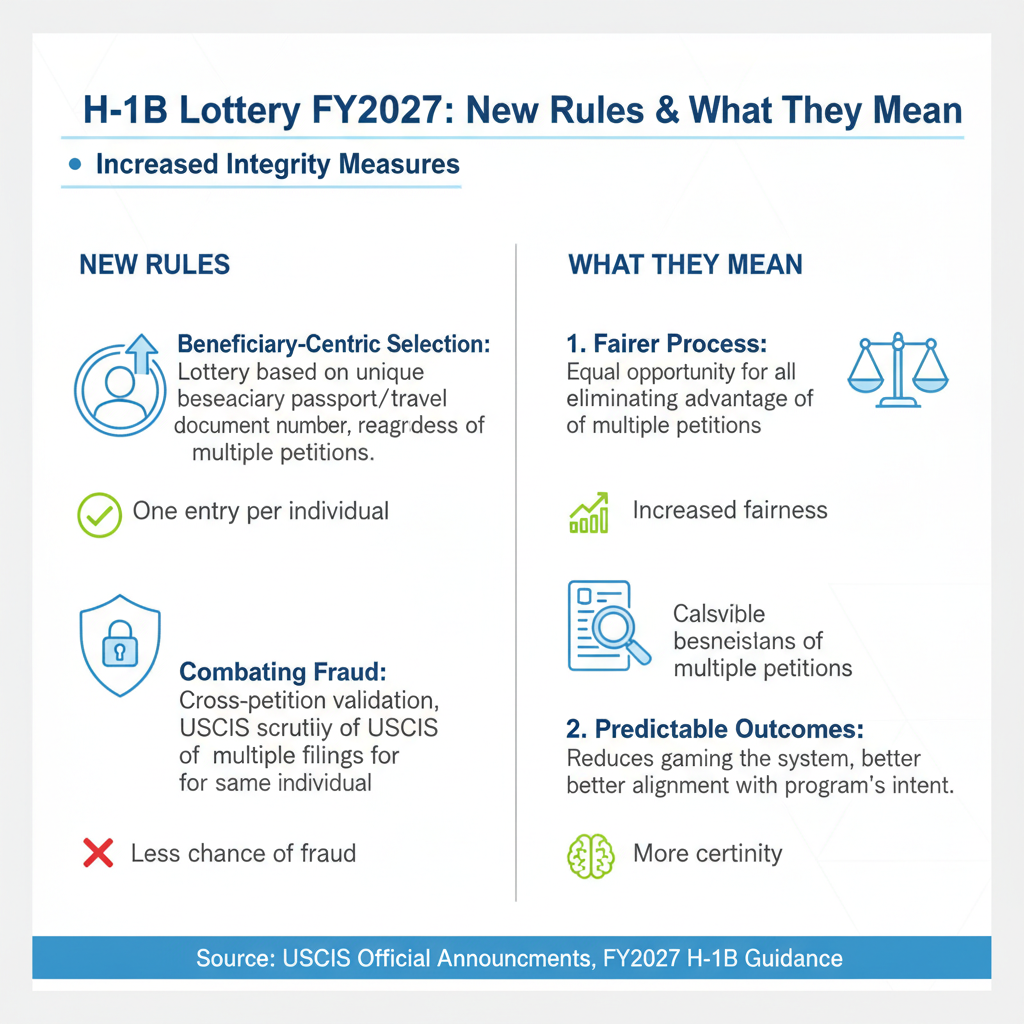
The reporting that sparked this guide: H-1B Visa Lottery Changes for FY2027 (Legal News)
What This News Means for Immigrants in Orlando and Across Florida
The recent announcement of changes to the H-1B visa lottery for FY2027 marks a pivotal moment for skilled foreign workers and the U.S. companies that seek to employ them. These aren't minor tweaks; they represent a fundamental shift in how the lottery is conducted, designed to combat fraud and ensure a fairer selection process. For individuals and businesses throughout Florida, particularly in innovation hubs like Orlando, Tampa, and Miami, understanding these updates is crucial for strategic planning.
Why this news is showing up now
The United States Citizenship and Immigration Services (USCIS) has been grappling with persistent issues surrounding the H-1B lottery for years, primarily concerns about fraud and the submission of multiple registrations by petitioners for the same beneficiary to increase their chances of selection. This practice, while not explicitly illegal under previous rules, led to a significantly inflated number of registrations and a distorted picture of demand, ultimately reducing the genuine odds for legitimate candidates.
After observing these patterns and conducting internal reviews, USCIS decided that a fundamental change was necessary. The new rules, effective for the FY2027 cap season, are a direct response to these concerns. They aim to shift the focus from the employer (petitioner) to the individual (beneficiary) as the primary unit of selection in the lottery. This change was finalized and announced to give employers and prospective H-1B beneficiaries ample time to understand and adapt before the next registration period, typically in March of the preceding fiscal year (i.e., March 2026 for FY2027).
How it can affect Florida residents
Florida, with its rapidly growing tech sector, thriving tourism and hospitality industries, and numerous educational institutions, is a significant player in the H-1B landscape. Cities like Orlando, known for its simulation and entertainment technology, and Tampa, a burgeoning hub for cybersecurity and finance, rely on H-1B visas to attract top talent. The impact of these changes on Florida residents, both employers and employees, will be substantial:
- For Employers in Central Florida: Companies along the I-4 corridor and beyond, from major theme parks to innovative startups, will need to re-evaluate their H-1B strategies. The new beneficiary-centric approach means they can no longer submit multiple registrations for the same individual through related entities to boost lottery odds. This levels the playing field, but also means employers must focus on ensuring their single registration for each beneficiary is impeccable.
- For Prospective H-1B Beneficiaries Living in Florida: If you are a foreign national currently on an F-1 OPT or another non-immigrant visa and aspire to an H-1B, these rules are largely beneficial. They dramatically reduce the chances of your spot being taken by someone whose employer submitted numerous fraudulent registrations. You now have a fairer shot, regardless of how many employers are interested in sponsoring you. However, it also means you must ensure that any employer sponsoring you adheres strictly to the new rules, as violations could jeopardize your eligibility.
- For Graduates of Florida Universities: Graduates from institutions like the University of Central Florida (UCF), University of Florida (UF), and Florida International University (FIU) who are seeking H-1B sponsorship will find a more transparent and equitable lottery process. This could potentially increase their chances of selection if they find a legitimate sponsoring employer.
- Increased Scrutiny: USCIS has indicated increased enforcement against fraudulent practices. This means that both employers and beneficiaries in Florida should expect greater scrutiny of their applications and ensure full compliance with all regulations.
Understanding these shifts is not just about compliance; it's about strategic positioning. Imigrar is here to guide you through every nuance of these new regulations, ensuring your H-1B journey in Florida is successful.
What H-1B Visa Lottery Changes for FY2027 Is (and Why It Matters)
The H-1B visa program is a cornerstone of U.S. immigration for skilled foreign workers. It allows U.S. employers to temporarily employ foreign workers in specialty occupations, which generally require a bachelor's degree or higher in a specific field. Due to high demand, the number of H-1B visas issued annually is capped by Congress, leading to a lottery system when demand exceeds supply. The changes for FY2027 fundamentally alter this lottery process.
A plain-English definition
Historically, the H-1B lottery operated on a "per-registration" basis. This meant that if an employer wanted to sponsor a foreign worker, they would submit a registration for that worker. If multiple employers wanted to sponsor the *same* foreign worker, each employer could submit a separate registration for that individual. This led to a situation where some individuals had multiple registrations entered on their behalf, significantly inflating their odds of selection compared to individuals with only one registration. This also made it appear as though demand for H-1B visas was even higher than it genuinely was, as duplicate registrations for the same person were counted individually.
The new H-1B lottery changes for FY2027 introduce a **beneficiary-centric selection process**. In plain English, this means that for the lottery, USCIS will now select registrations based on the *unique beneficiary* (the foreign worker), not on the individual registrations submitted. Regardless of how many employers submit a registration on behalf of a single foreign worker, that worker will only be entered into the lottery *once*. If that unique beneficiary is selected, then *any* of the employers who submitted a valid registration for them can proceed to file the H-1B petition.
This change is designed to:
- Increase Fairness: Every eligible beneficiary now has an equal chance of selection, eliminating the advantage previously held by those with multiple employer registrations.
- Reduce Fraud: It directly targets the practice of submitting multiple registrations for the same beneficiary by related entities or shell companies simply to game the system.
- Improve Integrity: The lottery results will more accurately reflect the true demand for H-1B visas among unique individuals.
Key terms you need to know
To fully grasp the H-1B process and these new changes, it’s essential to understand the following terms:
- H-1B Visa: A non-immigrant visa that allows U.S. employers to temporarily employ foreign workers in specialty occupations.
- Specialty Occupation: An occupation that requires a theoretical and practical application of a body of highly specialized knowledge, and a bachelor's or higher degree in the specific specialty (or its equivalent) as a minimum for entry into the occupation in the United States.
- Beneficiary: The foreign national (the employee) for whom the H-1B visa is sought.
- Petitioner: The U.S. employer filing the H-1B petition on behalf of the foreign national.
- H-1B Cap: The annual statutory limit on the number of H-1B visas issued. The current annual cap is 65,000 visas, plus an additional 20,000 for those with a U.S. master's degree or higher (the "master's cap").
- Lottery/Cap Lottery: The random selection process conducted by USCIS when the number of eligible registrations exceeds the annual H-1B cap.
- Registration Period: The designated window during which employers must electronically register prospective H-1B beneficiaries with USCIS. For FY2027, this is expected to be in March 2026.
- Selection Notice: A notification from USCIS informing a petitioner that their beneficiary's registration has been selected in the lottery, allowing them to proceed with filing the full H-1B petition.
- LCA (Labor Condition Application): Form ETA-9035, certified by the U.S. Department of Labor (DOL), which must be filed by an employer before filing an H-1B petition. It attests that the employer will pay the H-1B worker at least the prevailing wage or the actual wage, whichever is higher, and will provide working conditions that do not adversely affect other workers.
- Form I-129, Petition for a Nonimmigrant Worker: The primary form filed by the employer with USCIS to request H-1B classification for a foreign national.
- Prevailing Wage: The average wage paid to similarly employed workers in a specific occupation in the area of intended employment.
- Designated Representative: An attorney or accredited representative who can submit registrations on behalf of a petitioner.
These changes are not merely administrative; they reflect a significant policy shift. For employers in Orlando and across the country, it means a renewed focus on genuine need and compliance. For beneficiaries, it means a fairer, albeit still highly competitive, path to an H-1B visa. Understanding these terms and the new beneficiary-centric approach is the first step toward successful navigation of the FY2027 H-1B season.
Need expert guidance on the H-1B lottery? Imigrar offers free consultations to discuss your specific situation. Call +1 786-791-3106 or contact us online. Se Habla Español.
Current Immigration Law: The Foundation
The H-1B visa program operates under specific sections of the Immigration and Nationality Act (INA), which establish the framework for specialty occupation visas. While the lottery process has changed, the underlying legal requirements for an H-1B petition remain largely the same. Understanding this foundation is crucial for any employer or beneficiary.
Federal requirements
The H-1B visa is governed primarily by Section 101(a)(15)(H)(i)(b) of the Immigration and Nationality Act (INA). Key federal requirements include:
- Specialty Occupation: The position must qualify as a specialty occupation. This means it generally requires a bachelor's degree or higher in a specific field, and the beneficiary must possess that degree or its equivalent. USCIS assesses whether the job duties are sufficiently complex and specialized to meet this definition.
- Beneficiary Qualifications: The foreign national must hold a bachelor's degree or its equivalent, or possess a license in a specialty occupation field, or have work experience equivalent to a bachelor's degree.
- Employer-Employee Relationship: A valid employer-employee relationship must exist between the petitioner and the beneficiary, as defined by USCIS regulations. This is often a point of scrutiny, especially for third-party placements.
- Labor Condition Application (LCA): Before filing an H-1B petition with USCIS, the employer must file and obtain certification of a Form ETA-9035, Labor Condition Application, from the U.S. Department of Labor (DOL). This form attests to compliance with wage and working condition requirements to protect both U.S. and foreign workers. Employers must pay the H-1B worker at least the prevailing wage for the occupation in the area of employment or the actual wage paid to similarly qualified workers, whichever is higher.
- H-1B Cap: The statutory annual limit (currently 65,000 for the regular cap and 20,000 for the master's cap) is a federal mandate. Once these numbers are reached, a lottery is triggered.
- Non-immigrant Intent: Although the H-1B is a "dual intent" visa, meaning H-1B holders can pursue permanent residency, the initial application still requires an understanding of non-immigrant status.
All H-1B petitions are filed with USCIS using Form I-129, Petition for a Nonimmigrant Worker, along with extensive supporting documentation. USCIS processes these petitions and issues approvals, often in the form of an Form I-797, Notice of Action. You can find detailed information and all official forms on the USCIS official website.
For more details on H-1B eligibility criteria, refer to the USCIS H-1B Specialty Occupations page.
Florida-specific considerations
While immigration law is federal, the practical application and impact of H-1B visas have distinct regional characteristics. For those in Florida, several factors come into play:
- Industry Demand: Florida's economy is diverse. Orlando, for instance, has a strong demand for H-1B workers in technology (modeling, simulation, gaming), aerospace, hospitality management, and healthcare. Tampa and Miami see demand in finance, IT, and international trade. Understanding the prevailing wages and typical roles in these sectors is crucial for LCA compliance.
- Educational Institutions: Florida is home to many large universities, producing a significant pool of international graduates (F-1 visa holders) who often seek H-1B sponsorship after completing their Optional Practical Training (OPT). This creates a competitive environment for employers seeking to hire new graduates.
- Orlando USCIS Field Office: While H-1B petitions are centrally processed, beneficiaries who eventually need to adjust status or address other immigration matters may interact with the Orlando USCIS Field Office (located at 5449 Forbes Pl, Orlando, FL 32812). Understanding local office procedures, even if indirectly related to the H-1B, can be beneficial.
- State-Level Economic Development: Florida's pro-business environment and efforts to attract tech companies along the I-4 corridor mean there's a strong incentive for businesses to utilize programs like the H-1B to bring in specialized talent, contributing to local economic growth.
Reminder: While federal law is uniform, the specific nuances of your employer's industry, location within Florida, and the local labor market can influence aspects like prevailing wage determinations and the availability of suitable H-1B positions.
How to Navigate the New H-1B Lottery System: A Complete Step-by-Step Guide
The new beneficiary-centric H-1B lottery system for FY2027 requires meticulous attention to detail from both employers and prospective employees. Here's a step-by-step guide to navigating this updated process:
1) Understand the New Beneficiary-Centric Registration
This is the most critical change. Instead of multiple registrations for one person, USCIS will now select unique beneficiaries. This means an individual foreign national will only be entered into the lottery once, regardless of how many employers register for them. If selected, any employer who submitted a valid registration for that beneficiary can file the H-1B petition. This significantly reduces the impact of fraud and levels the playing field for all legitimate candidates.
- Action: If you are a beneficiary, ensure that all employers interested in sponsoring you are aware of this new rule and understand that only one selection notice will be issued per unique individual. If you are an employer, focus on submitting one accurate registration per beneficiary.
- Important: USCIS has stated that it will deny or revoke petitions where multiple registrations were submitted by related entities to "unfairly increase the chance of selection," even under the old rules. The new system is a direct response to this.
2) Employer Pre-Registration and Account Setup
Before the H-1B registration period opens, the petitioning employer (or their authorized legal representative) must have an active registrant account with USCIS. This account is used to submit the electronic registrations.
- Action: Employers should ensure their USCIS online account is active and updated. If you don't have one, create an "H-1B Registrant" account well in advance of the registration period. Attorneys will use a "Legal Representative" account.
- Required Documents (for account setup):
- Employer Identification Number (EIN)
- Company legal name and address
- Contact information for authorized signatory
3) Submit H-1B Registration for Each Beneficiary
During the designated registration period (typically in March, e.g., March 2026 for FY2027), the employer or their legal representative must electronically submit a registration for each prospective H-1B beneficiary. This involves providing basic information about the employer and the beneficiary, and paying a registration fee (currently $10 for FY2027, but subject to change).
- Action: For each unique beneficiary you wish to sponsor, submit one complete and accurate electronic registration. Double-check all information.
- Required Information (per registration):
- Employer's legal name, EIN, and mailing address.
- Employer's authorized signatory's name, title, and contact information.
- Beneficiary's full legal name, gender, date of birth, country of birth, country of citizenship.
- Beneficiary's passport number.
- Whether the beneficiary has a U.S. master's or higher degree (for master's cap eligibility).
- Attorney or representative information (if applicable).
- Payment of the non-refundable registration fee.
- Warning: Submitting multiple registrations for the same beneficiary by the same employer (or related entities) is strictly prohibited and can lead to denial or revocation of all petitions.
4) Await Lottery Results and Selection
After the registration period closes, USCIS conducts the lottery. Under the new rules, selections will be made based on unique beneficiaries. USCIS will first select enough beneficiaries to meet the master's cap, then the regular cap. Notifications are typically sent out by the end of March.
- Action: Monitor your USCIS online account for selection notifications. If your beneficiary is selected, USCIS will issue a selection notice that includes a receipt number and instructions on where and when to file the H-1B petition.
- Important: A selection notice does not guarantee H-1B approval; it only grants permission to file the full petition.
- Check USCIS Processing Times for general timelines, though lottery results are typically announced within a specific window.
5) File the H-1B Petition (Form I-129)
If your beneficiary's registration is selected, the employer has a specific filing window (typically 90 days, starting April 1st) to submit the complete H-1B petition packet to USCIS. This involves preparing and filing Form I-129, Petition for a Nonimmigrant Worker, along with the certified LCA (Form ETA-9035) and extensive supporting documentation.
- Action: Work with an experienced immigration attorney to prepare a robust H-1B petition. Ensure all required documentation is included and accurately completed.
- Required Documents (example list, not exhaustive):
- Certified Form ETA-9035 (LCA)
- Form I-129 and H-1B Data Collection and Filing Fee Exemption Supplement
- Employer's letter of support describing the specialty occupation and beneficiary's role
- Beneficiary's educational credentials (degrees, transcripts, evaluations)
- Beneficiary's resume and professional licenses (if applicable)
- Evidence of employer's business operations (e.g., articles of incorporation, business licenses, tax returns)
- Evidence of employer-employee relationship (e.g., offer letter, employment agreement)
- Photos of the workplace (if applicable)
- Client letters for third-party placements (if applicable)
- Filing fees (check USCIS Filing Fees for current amounts)
- Reminder: The petition must be filed at the correct USCIS service center as indicated on the selection notice.
6) Respond to RFEs and Await Adjudication
After filing, USCIS will review the petition. It's common for USCIS to issue a Request for Evidence (RFE) if they require additional information or clarification. Prompt and thorough responses are crucial.
- Action: If an RFE is issued, work immediately with your attorney to gather the requested evidence and submit a comprehensive response within the given deadline.
- Important: An RFE is not a denial but indicates USCIS needs more information to make a decision. A well-prepared RFE response significantly increases the chances of approval.
7) Visa Interview (if applicable) and Entry
If the petition is approved and the beneficiary is outside the U.S., they will need to attend an H-1B visa interview at a U.S. embassy or consulate in their home country. If the beneficiary is already in the U.S. (e.g., on F-1 OPT) and the change of status is approved, they can generally begin working on the H-1B start date (usually October 1st).
- Action: Prepare for the visa interview by reviewing your petition and understanding the purpose of your H-1B employment. Gather all necessary documents for the interview.
- External Link: For information on visa interviews and U.S. embassies/consulates, visit the U.S. Department of State website.
This process is intricate, and even minor errors can lead to significant delays or denials. Engaging an experienced immigration attorney, like those at Imigrar, is highly recommended to navigate these complexities effectively, especially with the new lottery rules in place.
Practical Steps You Can Take Today
The H-1B lottery is highly competitive, and the new rules mean preparation is more critical than ever. Here's what you can do now to get ready for the FY2027 cap season:
Actionable Checklist:
- Review Eligibility: Both employers and beneficiaries should re-confirm their eligibility. For beneficiaries, ensure your degree or work experience aligns with a "specialty occupation." For employers, verify the job truly requires a bachelor's degree or higher in a specific field.
- Identify Potential Employers/Beneficiaries: If you are a beneficiary, actively network and secure job offers from potential H-1B sponsoring employers. If you are an employer in Orlando, start identifying your talent needs early.
- Gather Beneficiary Documents: Proactively collect all necessary personal and educational documents (see guidance below).
- Establish Employer-Employee Relationship: Ensure a clear, bona fide employer-employee relationship is established, especially for consulting companies or third-party placements. USCIS scrutinizes this heavily.
- Secure Legal Counsel: Engage an experienced immigration attorney well in advance. They can advise on eligibility, prepare registrations, and handle the full petition if selected. This is particularly vital with the new rules.
- Understand Key Dates: While official dates for FY2027 are pending, anticipate the registration period to be in March 2026, with petition filing for selected cases starting April 1, 2026, for an October 1, 2026 start date.
- Budget for Costs: Be aware of the various fees involved: registration fee, filing fees (Form I-129), ACWIA fee, fraud prevention and detection fee, public law fee (if applicable), and attorney fees.
Document Preparation Guidance:
Starting early on document collection can save valuable time and reduce stress during the frantic H-1B season. Here’s a general list of documents to prepare:
- For the Beneficiary:
- Copy of passport (all pages, including blank ones)
- Birth certificate
- All U.S. visas and I-94 records
- Educational documents: degrees, diplomas, academic transcripts (from all colleges/universities attended)
- Foreign degree evaluations (if applicable)
- Resumes/CVs outlining work experience
- Professional licenses or certifications (if applicable)
- Marriage certificate (if applicable)
- Copies of previous H-1B approval notices (Form I-797) and LCA (if applicable)
- For the Employer (Petitioner):
- Company's Employer Identification Number (EIN)
- Business license(s)
- Articles of incorporation/organization
- Federal tax ID number and recent tax returns
- Company brochures, website printouts, and marketing materials
- Lease agreement for office space (especially important for new or small businesses in Central Florida)
- Job description for the H-1B position
- Organizational charts
- Wage information (to determine prevailing wage)
- Evidence of financial viability to pay the required wage
Timeline Expectations:
While USCIS releases official dates annually, the H-1B cap season generally follows a predictable pattern:
- March 2026: H-1B electronic registration period for FY2027 opens (typically for about two to three weeks).
- Late March 2026: Lottery results announced, and selection notices are issued.
- April 1, 2026 – June 30, 2026 (approx.): 90-day window for selected petitioners to file their H-1B petitions.
- April 2026 – September 2026: USCIS processes petitions, issues RFEs, and adjudicates cases.
- October 1, 2026: The earliest date H-1B approved beneficiaries can begin working under H-1B status.
Warning: Missing any deadline, particularly the registration window or the 90-day filing period, means waiting another year for the next H-1B cap season. This is where an experienced attorney can provide critical support and reminders.
How Imigrar Helps Immigrants in Orlando Navigate H-1B Changes
The new H-1B lottery rules for FY2027 introduce a layer of complexity that demands specialized legal expertise. At Imigrar, we are dedicated


