What This News Means for Immigrants in Orlando and Across Florida
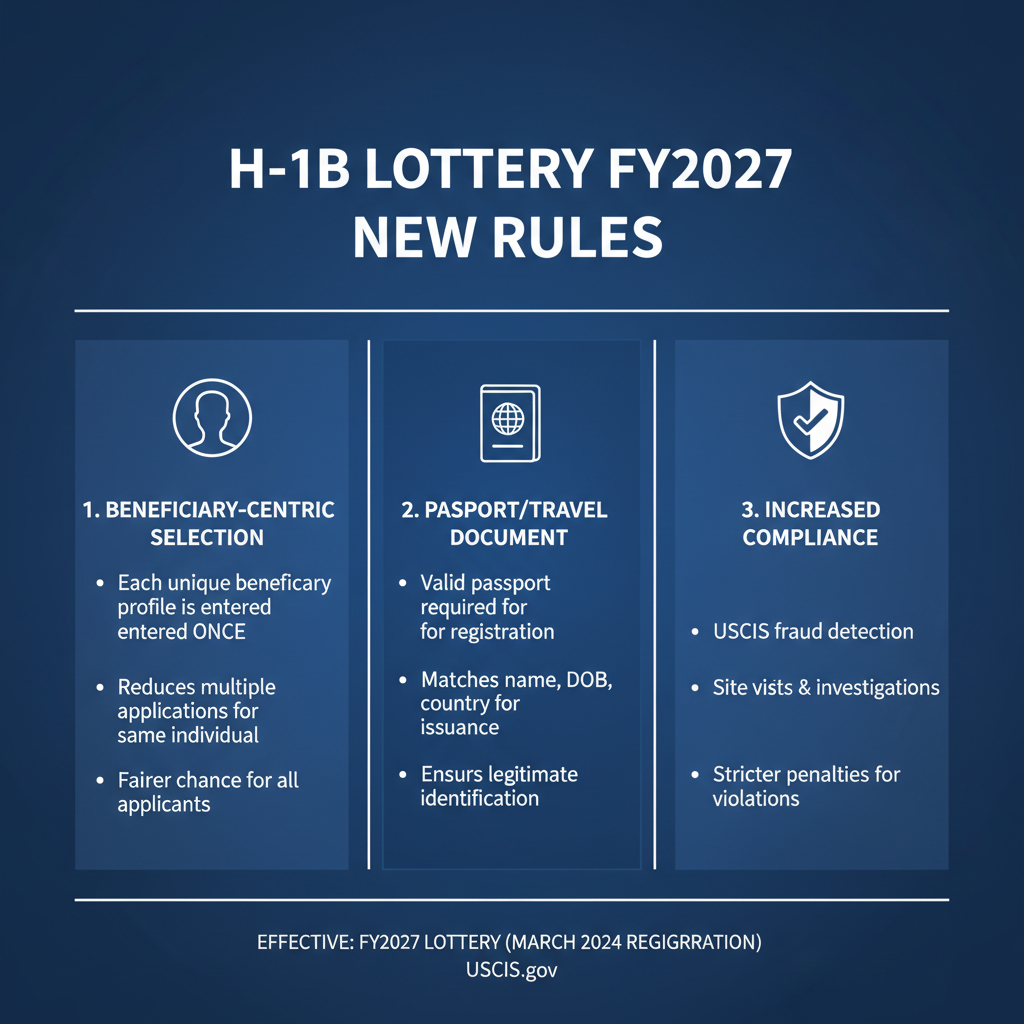
The H-1B visa program is a cornerstone for many skilled foreign professionals seeking to live and work in the United States, particularly in high-demand fields like technology, engineering, medicine, and education. Each year, due to the statutory cap on the number of H-1B visas available, demand far outstrips supply, necessitating a lottery system. For **Fiscal Year 2027 (FY2027)**, which begins on October 1, 2026, the U.S. Citizenship and Immigration Services (USCIS) has implemented significant changes to the H-1B lottery process. These aren't just minor tweaks; they represent a fundamental shift designed to enhance fairness, combat fraud, and streamline the selection process. For individuals and employers in Orlando, across Florida, and nationwide, understanding these new rules is not just beneficial—it's essential for a successful application.Why this news is showing up now
The **H-1B visa cap lottery** for **FY2207** concluded its registration phase in March 2026. USCIS typically announces selection results shortly after the registration period closes, with the official filing period for selected petitions beginning on April 1st. The new rules, formally outlined by USCIS, were introduced well in advance of the **FY2027** registration period to give prospective petitioners and beneficiaries time to understand and adapt. Legal news outlets are now extensively covering the implications of these changes as the results are out and the petition filing period is ongoing. This timing ensures that everyone involved is aware of the updated requirements and procedures as they move forward with their H-1B petitions. The shift to a **beneficiary-centric selection process** and enhanced measures to detect and deter fraud are the most prominent aspects of these new regulations, directly impacting how employers register and how USCIS makes its selections.How it can affect Florida residents
Florida, with its booming tech sector, diverse economy, and numerous universities, is a significant hub for H-1B visa holders and aspiring professionals. Cities like Orlando, Tampa, Miami, and Jacksonville attract talent in IT, aerospace, healthcare, and tourism. The new H-1B lottery changes will have a direct impact on: * **Individuals in Orlando and Central Florida:** Many international students graduating from local institutions like the University of Central Florida (UCF), Rollins College, and Florida A&M University, as well as professionals working for companies along the **I-4 corridor**, rely on the H-1B visa to continue their careers in the U.S. The new beneficiary-centric selection means that each individual, regardless of how many employers register for them, has only one chance in the lottery, potentially leveling the playing field against those with multiple job offers. * **Florida Employers:** Companies, from startups to large corporations in Orlando's Lake Nona Medical City or the growing tech parks, will need to adapt their H-1B sponsorship strategies. The focus on reducing fraud through stricter attestation requirements during registration means employers must be more diligent than ever in verifying their intent to employ the beneficiary. * **Increased Scrutiny:** With enhanced fraud detection, Florida employers who previously engaged in questionable practices, such as filing multiple registrations for the same individual through related entities without a genuine job offer, will face significant risks, including denial and potential legal penalties. * **Fairer Chances:** For legitimate job seekers and employers, the new rules aim to create a fairer lottery system, reducing the advantage previously held by those who could submit numerous registrations for the same individual. This could lead to a more equitable distribution of the limited H-1B visas. The changes underscore the importance of working with experienced legal counsel, especially for those navigating the complexities of the H-1B process in a competitive state like Florida.Need Help? Our Orlando immigration team is ready to assist. Call +1 786-791-3106 for a free consultation, or message us online. Se Habla Español.
What H-1B Visa Lottery Changes for FY2027 Is (and Why It Matters)
The **H-1B visa** program allows U.S. employers to temporarily employ foreign workers in **specialty occupations**. These occupations generally require a bachelor's degree or higher in a specific field. The program is vital for U.S. companies that need to fill highly skilled positions when qualified American workers are unavailable. The recent "H-1B Visa Lottery Changes for FY2027" refer specifically to the new rules implemented by **USCIS** for the electronic registration process and selection lottery for the **H-1B cap** for the fiscal year starting October 1, 2026. These changes were codified in a final rule, "Improving the H-1B Registration Program and Strengthening Program Integrity," published by the Department of Homeland Security (DHS).A plain-English definition
Think of the H-1B visa as a special work permit for highly skilled jobs. Because there are more people who want these permits than there are available each year (the **H-1B cap**), the government uses a lottery system to decide who gets to apply. For **FY2027**, the big change is that this lottery now focuses on the *individual worker* (the **beneficiary**) rather than the *employer*. Previously, an employer could submit multiple lottery entries for the same person if they had different job offers. Now, no matter how many employers want to hire you, you only get one chance in the lottery. This aims to make the system fairer and reduce fraud where companies might have submitted many entries to inflate a person's chances, sometimes without a real job offer.Key terms you need to know
To fully understand the H-1B process and the new changes, it’s crucial to be familiar with these key terms: * **H-1B Visa:** A nonimmigrant visa that allows U.S. employers to temporarily employ foreign workers in specialty occupations. * **Specialty Occupation:** An occupation that requires the theoretical and practical application of a body of highly specialized knowledge, and a bachelor's or higher degree in the specific specialty (or its equivalent) as a minimum for entry into the occupation in the United States. * **H-1B Cap:** The statutory limit on the number of H-1B visas issued each fiscal year. Currently, it's 65,000 general category visas and an additional 20,000 for those with a U.S. master's degree or higher (the **Master's Cap**). * **USCIS (U.S. Citizenship and Immigration Services):** The government agency responsible for administering immigration and naturalization benefits, including the H-1B program. USCIS official website. * **Beneficiary:** The foreign worker who is the subject of the H-1B petition. * **Petitioner:** The U.S. employer who files the H-1B petition on behalf of the foreign worker. * **LCA (Labor Condition Application):** A form (ETA Form 9035) filed with the Department of Labor (DOL) by the employer, attesting that they will pay the H-1B worker at least the prevailing wage or the actual wage paid to similarly situated workers, whichever is higher, and provide working conditions that will not adversely affect other workers. * **H-1B Registration Period:** The window, typically in March, during which prospective petitioners electronically submit registrations for the H-1B lottery. For **FY2027**, this was March 6 to March 22, 2026. * **Selection Notice:** Notification from USCIS indicating that a registration has been selected in the H-1B lottery. * **Cap-Exempt:** Certain employers (e.g., institutions of higher education, non-profit research organizations) are exempt from the annual H-1B cap and do not need to go through the lottery. * **Premium Processing:** An optional service offered by USCIS that guarantees processing of certain petitions (including H-1B) within 15 calendar days for an additional fee. * **Change of Status (COS):** Applying to change from one nonimmigrant status (e.g., F-1 student) to another (e.g., H-1B) while remaining in the U.S. * **Consular Processing:** Applying for an H-1B visa stamp at a U.S. embassy or consulate abroad. * **Duplicate Registrations:** Under the *new rules*, multiple registrations for the *same beneficiary* by *different employers* are still allowed, but the beneficiary is only entered into the lottery *once*. Any petitioner found to have submitted multiple registrations for the *same beneficiary* will have *all* their registrations for that beneficiary invalidated. This is a critical change to prevent fraud. * **Beneficiary-Centric Selection:** The core of the new rule. Instead of selecting registrations, USCIS now selects unique beneficiaries. Each unique beneficiary has one chance of selection, regardless of the number of registrations submitted on their behalf. * **Fraud Detection:** USCIS has enhanced its capabilities and intent to detect and investigate fraudulent registrations, including those where no bona fide job offer exists or multiple employers are related entities attempting to gain an unfair advantage. These changes are significant because they aim to restore integrity to a system that was increasingly plagued by widespread fraud, particularly the submission of multiple registrations for the same beneficiary by related companies or shell corporations to unfairly increase selection odds. For **FY2027**, this means a fairer lottery for all legitimate participants.Current Immigration Law: The Foundation
The H-1B visa program is governed primarily by the **Immigration and Nationality Act (INA)**, specifically **Section 101(a)(15)(H)(i)(b)** and **Section 214(g)**, along with corresponding regulations found in **8 Code of Federal Regulations (CFR) 214.2(h)**. These legal frameworks establish the requirements for both the employer (petitioner) and the foreign worker (beneficiary). The recent changes for **FY2027** are regulatory amendments designed to enforce the existing statutory intent more effectively and combat program abuse.Federal requirements
The fundamental federal requirements for an H-1B visa remain largely unchanged, though the *process* of getting selected in the lottery has evolved. 1. **Specialty Occupation:** The job must qualify as a **specialty occupation**, meaning it requires a theoretical and practical application of a body of highly specialized knowledge, and a bachelor's degree or higher in the specific specialty (or its equivalent) as a minimum for entry into the occupation in the U.S. This is a critical threshold. 2. **Beneficiary Qualifications:** The foreign worker must possess at least a bachelor's degree or its equivalent, or hold an unrestricted state license, or have work experience equivalent to a bachelor's degree in a specialty occupation field. 3. **Employer Sponsorship:** A U.S. employer must sponsor the H-1B worker. The employer must demonstrate a legitimate need for the **specialty occupation** worker and that they will pay the required wage. 4. **Labor Condition Application (LCA):** Before filing an H-1B petition, the employer must file and have certified a **Form ETA 9035**, Labor Condition Application, with the U.S. Department of Labor (DOL). This attests to prevailing wage compliance and working conditions. 5. **Numerical Cap:** The annual **H-1B cap** is 65,000, with an additional 20,000 visas reserved for those with a U.S. master's degree or higher (the **Master's Cap**). Once these numbers are reached, a lottery is triggered for cap-subject petitions. 6. **Period of Stay:** H-1B status is generally granted for an initial period of up to three years, with extensions possible up to a maximum of six years.Florida-specific considerations
While immigration law is federal, its impact is felt locally. In Florida: * **Diverse Industries:** Florida's economy is robust and diverse, with significant demand for H-1B workers in sectors like: * **Technology:** Orlando and Tampa are growing tech hubs, attracting software developers, IT professionals, and engineers. * **Healthcare:** With a large and aging population, Florida's healthcare system, including facilities in Orlando's Medical City, relies on foreign medical professionals. * **Tourism & Hospitality:** While less common for H-1B, certain specialized roles in large resort management or international marketing may qualify. * **Education:** Universities across Florida, including the University of Florida, Florida State University, and the University of Central Florida, employ foreign researchers and faculty, often under **cap-exempt** H-1B status. * **Prevailing Wage Data:** Employers in Florida must adhere to the prevailing wage requirements for their specific occupation and geographic area. Wage data varies significantly by region (e.g., Orlando vs. Miami) and can impact an employer's ability to meet the **LCA** requirements. * **Local USCIS Field Offices:** While H-1B petitions are processed by USCIS service centers, local field offices like the **Orlando USCIS Field Office** handle certain interviews related to **Adjustment of Status** (if applicable) or other immigration matters for H-1B holders. * **State Regulations:** While Florida doesn't have its own H-1B visa laws, state-level professional licensing requirements (e.g., for doctors, nurses, engineers) must be met by H-1B beneficiaries seeking to work in regulated professions within the state. **Important Forms:** The primary form for an H-1B petition is **Form I-129, Petition for a Nonimmigrant Worker**. This form is filed by the employer on behalf of the beneficiary. Other relevant forms may include: * **Form I-907, Request for Premium Processing Service** (if opting for faster processing) * **Form I-539, Application to Extend/Change Nonimmigrant Status** (if changing status within the U.S.) You can find all official forms and detailed instructions on the USCIS Forms page.Navigating the new H-1B rules can be challenging. Imigrar has the expertise to guide you. Contact us today for a free consultation at +1 786-791-3106. Se Habla Español.
How to Navigate the H-1B Visa Process Under New Rules: A Complete Step-by-Step Guide
The H-1B process is complex, even more so with the new **FY2027** changes. This guide outlines the typical steps, emphasizing how the new beneficiary-centric lottery and anti-fraud measures play a role.1) Employer Assessment, Wage Determination, and LCA Filing
Before any lottery registration, the employer must determine if the position qualifies as a **specialty occupation** and if the potential **beneficiary** meets the educational requirements. * **Employer Action:** The U.S. employer identifies a need for a foreign worker in a **specialty occupation**. They must gather information about the job duties, required qualifications, and proposed salary. * **Wage Determination:** The employer must research and obtain a prevailing wage determination for the specific occupation in the geographic area of employment. This is crucial for the **LCA**. * **LCA Filing:** The employer (or their attorney) files **Form ETA 9035, Labor Condition Application (LCA)**, with the U.S. Department of Labor (DOL). The LCA attests that the employer will pay the H-1B worker at least the prevailing wage or the actual wage paid to similarly qualified employees, whichever is higher, and that working conditions will not adversely affect other workers. The LCA must be certified by the DOL before an H-1B petition can be filed. * **New Rule Impact:** While the LCA process itself hasn't changed, the employer's genuine intent to employ the beneficiary, as attested in the LCA, will be scrutinized more heavily by USCIS during petition adjudication, especially if there are concerns about fraud or multiple registrations. **Required Documents/Information (for LCA):** * Employer's FEIN (Federal Employer Identification Number) * Employer's legal name and address * Occupational title and SOC (Standard Occupational Classification) code * Proposed wage rate and wage source * Worksite location(s) * Duration of employment * Beneficiary's educational qualifications (for internal assessment)2) H-1B Lottery Registration (The Beneficiary-Centric Shift)
This is where the **FY2027** changes are most pronounced. * **Employer Action:** During the designated registration period (typically in March), the employer electronically submits a registration for each prospective H-1B **beneficiary** through the **USCIS** online system. Each registration must include information about the employer and the beneficiary. * **New Rule Impact - Beneficiary-Centric Selection:** * **One Entry Per Beneficiary:** Each unique **beneficiary** will only be entered into the lottery ONCE, regardless of how many employers submit registrations on their behalf. If a beneficiary has multiple registrations from different employers, USCIS will consolidate them and enter the beneficiary only once into the lottery. * **Petitioner Attestation:** Each registering petitioner (employer) must sign an attestation that the registration is based on a bona fide job offer for the named beneficiary and that the petitioner intends to employ the beneficiary if selected. * **Fraud Prevention:** USCIS explicitly states that any petitioner (or related entities) found to have submitted more than one registration for the *same beneficiary* will have ALL registrations for that beneficiary invalidated. This targets schemes where multiple related companies filed for the same individual to increase their odds. USCIS will use various methods to identify such attempts. * **Important:** While a beneficiary gets only one lottery entry, it is still permissible for *multiple unrelated employers* to submit registrations for the *same beneficiary* if each has a genuine job offer. This is crucial for individuals with several job prospects. **Required Documents/Information (for Registration):** * Employer's legal name, FEIN, and address * Employer's authorized signatory information * Beneficiary's full legal name, date of birth, country of birth, country of citizenship, passport number * Beneficiary's highest level of education * Whether the beneficiary holds a U.S. master's or higher degree (for **Master's Cap**)3) Petition Filing (If Selected)
If a registration is selected in the lottery, the employer receives a **Selection Notice**. * **Employer Action:** Upon selection, the employer has a specific filing window (usually 90 days, starting April 1st) to prepare and file the complete **Form I-129, Petition for a Nonimmigrant Worker**, along with all supporting documentation, to USCIS. The filing location is typically a USCIS Service Center, not a local field office like the **Orlando USCIS Field Office**. * **New Rule Impact:** The information provided in the registration must match the information in the **Form I-129**. Discrepancies could lead to **Requests for Evidence (RFEs)** or denial. The petition must clearly demonstrate the **specialty occupation** nature of the job and the beneficiary's qualifications. USCIS will also scrutinize the bona fides of the job offer and the employer's intent, especially if there were multiple registrations for the beneficiary. **Required Documents (for I-129 Petition):** * Certified **LCA** (ETA Form 9035) * Copy of the **H-1B Registration Selection Notice** * **Form I-129** and H-1B Data Collection and Filing Fee Exemption Supplement * Employer's support letter detailing the job, beneficiary’s qualifications, and why the position is a **specialty occupation** * Beneficiary's academic credentials (degrees, transcripts, evaluations of foreign degrees) * Beneficiary's resume/CV * Evidence of beneficiary’s experience (e.g., previous employment letters) * Beneficiary's passport and visa copies * Employer's financial statements, tax returns, and business licenses to prove ability to pay and legitimate operations * Organizational charts, client contracts (if applicable for consulting firms) * **Form I-907** and fee (if requesting **Premium Processing**)4) USCIS Processing & RFE Responses
USCIS reviews the filed petition. * **USCIS Action:** USCIS adjudicates the petition. This can involve background checks, review of submitted evidence, and potentially issuing a **Request for Evidence (RFE)** if more information is needed. * **Employer/Beneficiary Action:** If an **RFE** is issued, the employer and attorney must gather and submit the requested additional documentation or clarification within the specified deadline. * **New Rule Impact:** Expect increased scrutiny, especially regarding the **specialty occupation** criteria and the bona fides of the employment relationship, particularly for consulting models or newly established businesses. The new rules empower USCIS to investigate potential fraud more aggressively. **Required Documents (for RFE response):** (Varies based on RFE, but common requests include) * Additional evidence of **specialty occupation** (expert opinion letters, detailed job descriptions) * Further proof of employer-employee relationship (for third-party placements) * Proof of beneficiary's qualifications (more detailed evaluations) * Evidence of employer's financial viability and ability to pay the proffered wage5) Visa Interview (Consular Processing) or Change of Status
Once the **Form I-129** is approved (indicated by **Form I-797, Approval Notice**), the beneficiary proceeds to obtain the H-1B status. * **Change of Status (COS):** If the beneficiary is already in the U.S. in another valid nonimmigrant status (e.g., F-1 OPT) and requested a **COS** with their **Form I-129**, their status automatically changes to H-1B on October 1st (or the petition’s validity start date). * **Consular Processing:** If the beneficiary is outside the U.S. or opted for consular processing, they will schedule an interview at a U.S. embassy or consulate in their home country. They will need the **Form I-797 Approval Notice** and other supporting documents. * **New Rule Impact:** No direct change to this step, but a strong, fraud-free petition will facilitate a smoother interview process. **Required Documents (for Consular Interview):** * Valid passport (at least 6 months beyond intended stay) * DS-160 confirmation page * Visa interview appointment confirmation * **Form I-797 Approval Notice** * Original **LCA** * Letter from employer confirming employment * Educational documents, work experience letters, resume * Marriage certificate and children's birth certificates (if applying for H-4 dependents) * Proof of ties to home country (though H-1B is dual intent, it can be helpful)6) Starting Employment
The beneficiary can begin working for the petitioning employer. * **Action:** For **COS** cases, employment can begin on October 1st. For consular processed cases, employment can begin after entering the U.S. with the H-1B visa stamp. * **Employer Compliance:** The employer must continue to comply with all **LCA** attestations, including wage requirements and working conditions. **Warning:** Any fraudulent activity discovered at any stage, including misrepresentation during registration, can lead to petition denial, visa revocation, and even criminal penalties for petitioners and beneficiaries. USCIS explicitly stated its intent to refer cases of suspected fraud to law enforcement.Practical Steps You Can Take Today
Even with the new rules, proactive preparation is key for a successful H-1B application. * **Understand the New Rules Fully:** Both employers and beneficiaries must grasp the shift to **beneficiary-centric selection** and the implications for fraud prevention. If you were considering multiple registrations from related entities, be aware that this strategy is now highly risky and likely to result in invalidation. * **Verify Employer Legitimacy:** Beneficiaries, especially those working with third-party vendors or smaller consulting firms, should thoroughly vet their potential employers. Ensure they have a bona fide need for your services and a legitimate business operation in the U.S. * **Gather Your Documents Early:** Start collecting all personal and educational documents NOW. This includes degrees, transcripts, academic evaluations of foreign degrees, employment letters, passport copies, and any professional licenses. Having these ready will save valuable time if your registration is selected. * **Ensure Your Resume and Job Duties Align:** Work closely with your prospective employer to ensure the job description and your qualifications clearly align with the definition of a **specialty occupation**. This is a major point of **RFE** and denial. * **Consult with an Experienced Immigration Attorney:** The complexities of the H-1B program, coupled with the new rules and increased fraud scrutiny, make legal counsel indispensable. An attorney can help determine eligibility, prepare accurate registrations, advise on ethical practices, and respond effectively to **RFEs**. This is especially important for companies in **Orlando** and across **Central Florida** who are new to sponsoring H-1B visas. * **Monitor USCIS Updates:** Immigration policies can change. Regularly check the USCIS official website for the latest news and announcements, particularly regarding processing times (USCIS Processing Times). * **Prepare for RFEs:** Assume you might receive an **RFE**. Begin thinking about what additional evidence you might need to prove **specialty occupation**, employer-employee relationship, or your qualifications. **Timeline Expectations (General for FY2027):** * **March 2026:** H-1B electronic registration period (concluded) * **Late March 2026:** Lottery selection notices issued (concluded) * **April 1, 2026 - June 30, 2026:** Petition filing period for selected registrations (ongoing) * **April 2026 - September 2026:** USCIS processing of petitions, potential RFEs. * **October 1, 2026:** Start date for approved H-1B petitions.