H-1B Visa Lottery Changes for FY2027 (Legal News)
## What This News Means for Immigrants in Orlando and Across Florida
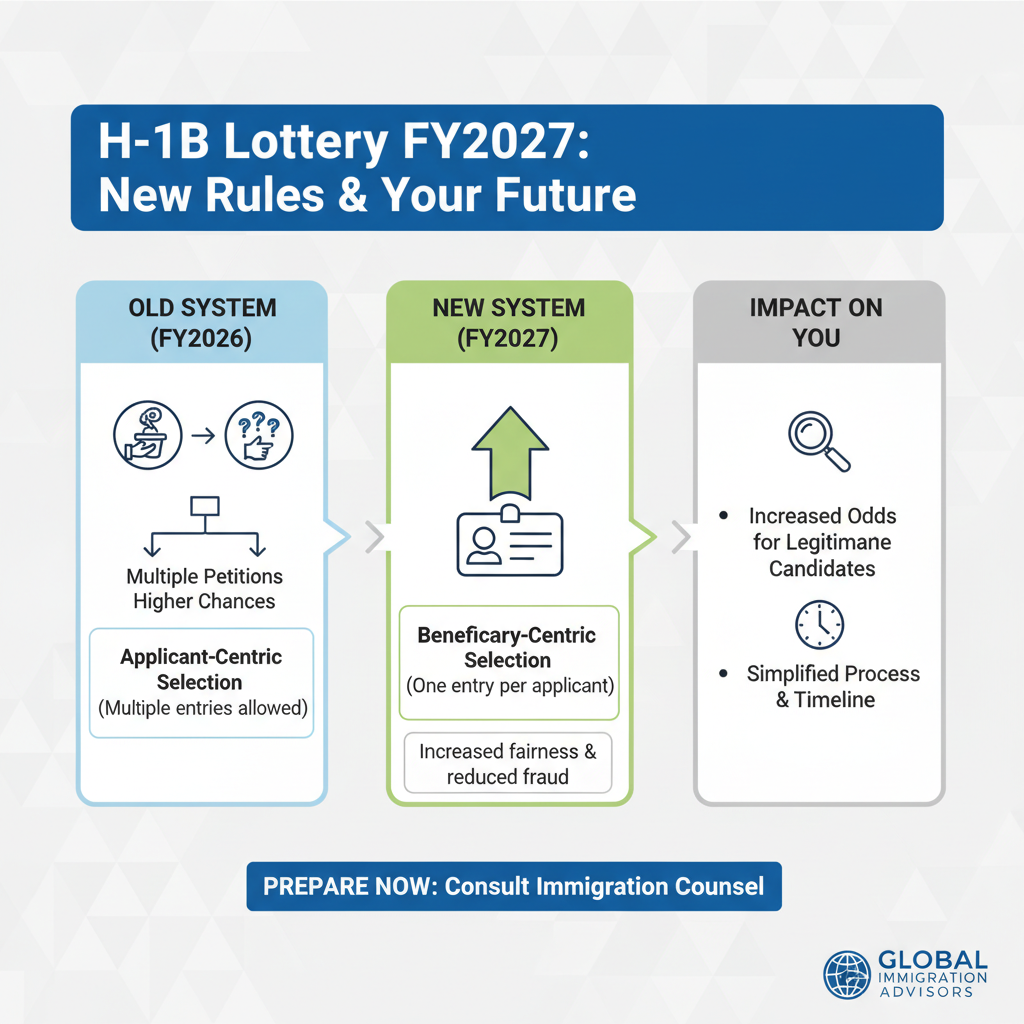
The H-1B visa program is a lifeline for many skilled foreign workers seeking opportunities in the United States and for U.S. employers looking to fill critical talent gaps. As an Orlando-based immigration law firm serving clients nationwide, Imigrar understands the immense importance of this visa category. Recent announcements regarding changes to the H-1B visa lottery for Fiscal Year 2027 (FY2027) mark a significant shift in how these coveted visas will be allocated. These updates, aimed at increasing fairness and reducing fraud, directly impact individuals and businesses across Florida, especially those in our vibrant tech, healthcare, and tourism sectors.
### Why this news is showing up now
Immigration policy is dynamic, and the U.S. Citizenship and Immigration Services (USCIS) regularly reviews and updates its processes to adapt to evolving circumstances and address program vulnerabilities. The H-1B visa program, particularly its lottery system, has faced scrutiny over the years due to its high demand and the challenges associated with managing a cap-limited visa category. The changes for FY2027 stem from USCIS's efforts to combat widespread fraud and abuse observed in previous lottery seasons, where multiple registrations were submitted for the same beneficiary by different employers, often without a legitimate job offer.
USCIS announced these rule changes well in advance of the FY22027 H-1B cap season to give employers, prospective H-1B beneficiaries, and legal representatives ample time to understand and prepare for the new requirements. The goal is to ensure a more equitable and transparent lottery process, prioritizing genuine job opportunities and reducing the incentive for fraudulent registrations. This proactive disclosure allows for proper planning, which is crucial given the intense competition for H-1B visas.
### How it can affect Florida residents
Florida's economy is diverse and growing, with strong demand for skilled professionals in various fields. Cities like Orlando, Tampa, and Miami are hubs for technology, engineering, healthcare, and advanced manufacturing, all industries that heavily rely on H-1B visa holders. The H-1B visa lottery changes for FY2027 will have several key impacts on Florida residents:
* **For Prospective H-1B Beneficiaries in Florida:** If you are a foreign national living in Florida on an F-1 OPT/CPT, L-1, or other nonimmigrant visa and aspire to secure an H-1B visa, these changes are highly relevant. The new beneficiary-centric selection process means that each unique beneficiary will only be entered into the lottery once, regardless of how many employers register on their behalf. This significantly reduces the chances of fraudulent registrations diluting the pool for legitimate candidates. While it doesn't increase the overall number of visas, it levels the playing field, potentially improving the odds for individuals with a single, bona fide job offer. For those working in Central Florida's growing tech parks or healthcare facilities, understanding these rules is paramount to a successful application.
* **For Florida Employers:** Businesses across the I-4 corridor, from theme parks needing specialized engineers to tech startups in Orlando and research institutions, often rely on H-1B visas to attract top international talent. Employers must now ensure that their H-1B registrations are made with the understanding that multiple registrations for the same individual will no longer provide a strategic advantage. Instead, the focus shifts entirely to the beneficiary's unique identifying information. This change mandates stricter internal controls for employers to avoid duplicate registrations for the same individual, which could lead to disqualification. Employers in Orange County and beyond must ensure they are partnering with reputable immigration counsel to navigate these new requirements.
* **Combating Fraud in Florida:** The previous system saw instances where "visa mills" or unscrupulous consulting firms would submit multiple registrations for individuals without actual job offers, merely to increase their chances of selection, then "sell" these selections. The new rules aim to curtail such practices, which ultimately harm legitimate Florida businesses and deserving foreign workers. This creates a more ethical environment for H-1B sponsorship within the state.
## What H-1B Visa Lottery Changes for FY2027 Is (and Why It Matters)
The H-1B visa program allows U.S. employers to temporarily employ foreign workers in specialty occupations. A specialty occupation generally requires a bachelor's degree or higher in a specific field. Due to overwhelming demand, USCIS typically receives more H-1B petitions than the annual cap allows, necessitating a lottery system to select eligible registrations. The H-1B visa lottery changes for FY2027 are significant reforms to this selection process, primarily aimed at curbing fraud and enhancing the integrity of the lottery.
### A plain-English definition
In simple terms, the H-1B visa is for skilled workers in jobs that require at least a bachelor's degree. Because there are more applicants than available visas each year, USCIS holds an electronic lottery. The big change for FY2027 is *how* that lottery works. Previously, each employer could register a candidate, and if multiple employers registered the same person, that person had multiple entries in the lottery. Now, for FY2027, the lottery will be "beneficiary-centric." This means that **each individual person (beneficiary) will only get one entry into the lottery, no matter how many employers want to sponsor them.** If a person is selected, USCIS will then verify that a legitimate employer submitted the winning registration. This change aims to stop companies from submitting many registrations for the same person without a real job offer, which was making it harder for truly deserving candidates to get selected.
### Key terms you need to know
Understanding the following terms is crucial when discussing the H-1B visa and its recent changes:
* **H-1B Visa:** A nonimmigrant visa that allows U.S. employers to temporarily employ foreign workers in specialty occupations.
* **Specialty Occupation:** An occupation that requires theoretical and practical application of a body of highly specialized knowledge and a bachelor's or higher degree in the specific specialty (or its equivalent) as a minimum for entry into the occupation in the United States.
* **Annual Cap:** The congressionally mandated limit on the number of H-1B visas issued each fiscal year. Currently, this cap is **65,000** for the regular quota, plus an additional **20,000** for beneficiaries who hold a U.S. master's degree or higher (the "master's cap").
* **Cap-Subject:** Refers to H-1B petitions that are subject to the annual cap. Most H-1B petitions fall into this category.
* **Cap-Exempt:** Certain employers are exempt from the annual cap, such as institutions of higher education, non-profit organizations affiliated with higher education, and government research organizations. Petitions filed by these entities do not go through the lottery.
* **Beneficiary:** The foreign national worker who will be employed under the H-1B visa.
* **Petitioner:** The U.S. employer who files the H-1B petition on behalf of the beneficiary.
* **H-1B Registration Process:** An electronic pre-registration system introduced by USCIS, where prospective petitioners (employers) submit basic information about themselves and the beneficiary during a designated period. Only selected registrations can then file a full H-1B petition.
* **Lottery (Selection Process):** If the number of registrations exceeds the annual cap, USCIS conducts a random lottery to select registrations eligible to file an H-1B petition.
* **Beneficiary-Centric Selection:** The core of the FY2027 change. Instead of selecting registrations based on the employer, selections will now be based on the unique beneficiary. Each beneficiary will be entered into the lottery only once, regardless of how many eligible registrations are submitted on their behalf.
* **Labor Condition Application (LCA):** **Form ETA-9035**. An application filed with the U.S. Department of Labor (DOL) by the employer, attesting that they will pay the H-1B worker at least the prevailing wage or the actual wage paid to similarly qualified workers, whichever is higher, and that employment will not adversely affect working conditions of U.S. workers. An approved LCA is required before filing **Form I-129**.
* **Form I-129:** **Petition for a Nonimmigrant Worker**. The primary form filed by a U.S. employer with USCIS to request H-1B classification for a foreign worker.
* **Request for Evidence (RFE):** A letter from USCIS requesting additional information or documentation to support a petition.
* **Fraud Detection and National Security (FDNS):** A USCIS unit responsible for detecting, deterring, and combating immigration benefit fraud and threats to national security. The new H-1B rules are a direct result of FDNS findings.
## Current Immigration Law: The Foundation
The H-1B visa program is governed by the Immigration and Nationality Act (INA), specifically Sections 101(a)(15)(H)(i)(b) and 214(g). These statutes establish the framework for nonimmigrant specialty occupation workers, including the annual cap and general eligibility criteria. The regulations further elaborate on these provisions, outlining the detailed requirements for employers and beneficiaries.
### Federal requirements
The H-1B program is subject to stringent federal regulations designed to protect both U.S. workers and H-1B beneficiaries. Key federal requirements include:
* **Specialty Occupation Requirement:** The job offered must qualify as a specialty occupation, meaning it typically requires a bachelor's degree or higher in a specific field. The beneficiary must possess at least that degree or its equivalent through a combination of education and experience.
* **Employer-Employee Relationship:** There must be a legitimate employer-employee relationship, as defined by USCIS. This means the employer must have the right to control the H-1B worker's employment.
* **Prevailing Wage:** Employers must pay the H-1B worker at least the prevailing wage for their occupation in the geographic area of employment, or the actual wage paid to other employees with similar experience and qualifications, whichever is higher. This is attested to in the **Labor Condition Application (LCA)**, **Form ETA-9035**, filed with the Department of Labor.
* **No Adverse Effect on U.S. Workers:** The employment of H-1B workers must not adversely affect the working conditions of U.S. workers similarly employed.
* **Annual Cap Adherence:** Unless cap-exempt, all H-1B petitions must fall within the annual cap limits. The **H-1B registration process** is now the gatekeeper for cap-subject petitions.
* **Period of Stay:** H-1B status is generally granted for an initial period of up to three years, with extensions possible up to a maximum of six years. Some exceptions allow for extensions beyond six years, particularly for those with approved permanent residency petitions.
**Important:** The new **beneficiary-centric selection process** for FY2027 is a regulatory change implemented by USCIS, falling under its authority to manage immigration benefit programs. This change is codified in the final rule titled "Improving the H-1B Registration Selection Process and Program Integrity."
For more detailed information, always refer to the USCIS official website.
### Florida-specific considerations
While H-1B laws are federal, their impact is felt locally. Florida's economy benefits significantly from H-1B workers, particularly in:
* **Tech and Innovation:** Orlando's "Silicon Swamp" and research parks, Tampa's growing cybersecurity sector, and Miami's burgeoning tech scene attract H-1B talent in software development, engineering, data science, and IT.
* **Healthcare:** Hospitals and healthcare systems throughout Florida rely on H-1B physicians, nurses, and medical researchers to meet the demands of a growing and aging population.
* **Education:** Florida's universities often sponsor H-1B professors and researchers, who are typically cap-exempt.
* **Tourism and Hospitality:** While less common for the H-1B, certain specialized roles in the large theme park and hospitality industries might qualify, especially those requiring advanced degrees in engineering, finance, or specialized management.
For businesses and individuals in Central Florida, understanding the H-1B process means knowing how to effectively leverage this visa category within the local job market. Working with an experienced immigration attorney in Orlando, like Imigrar, ensures that your application is tailored to meet both federal requirements and local industry expectations. While H-1B petitions are processed centrally by USCIS service centers, the initial job offer and employer requirements are rooted in the Florida economic landscape.
## How to Navigate the H-1B Visa Lottery Changes for FY2027: A Complete Step-by-Step Guide
Navigating the H-1B lottery, especially with new rules, requires careful planning and precise execution. Here’s a step-by-step guide for the FY2027 season:
### 1) Understand the New Lottery Rules and Eligibility
Before anything else, grasp the core changes. For FY2027, the primary shift is the **beneficiary-centric selection**. This means:
* **One Entry Per Beneficiary:** Each unique beneficiary (foreign national) can only be selected once in the lottery, regardless of how many employers register them.
* **Identification:** USCIS will use the beneficiary’s valid passport or travel document information to identify unique individuals.
* **Bona Fide Job Offer:** USCIS emphasizes that each registration must be based on a legitimate job offer. They have enhanced their ability to detect and investigate fraudulent multiple registrations.
**Action Items:**
* Review the latest USCIS guidance on H-1B registrations for FY22027.
* Ensure your passport or travel document is valid and will remain so throughout the process.
* If multiple employers are interested in sponsoring you, inform them of the new rules and ensure they understand that only one registration for you will be selected.
### 2) Secure a Bona Fide Job Offer from a U.S. Employer
The foundation of any H-1B petition is a genuine job offer from a U.S. employer. This job must qualify as a **specialty occupation**.
**Required Documents (Employer & Beneficiary Preparation):**
* **Job Offer Letter:** Detailed letter from the prospective employer outlining the position, duties, salary, start date, and location (e.g., Orlando, FL).
* **Employer Information:** Employer's Federal Employer Identification Number (FEIN), company name, address, and contact person.
* **Beneficiary's Resume/CV:** Up-to-date document detailing education, work experience, and skills.
* **Educational Documents:**
* Copies of all academic degrees (Bachelor's, Master's, Ph.D.).
* Official transcripts.
* **Foreign Degree Evaluation:** If your degree is from outside the U.S., you will need a credential evaluation report from a USCIS-recognized service determining its U.S. equivalency.
* **Professional Licenses/Certifications:** Any required for the occupation (e.g., engineering, medical licenses in Florida).
* **Passport:** Copy of the beneficiary's valid passport biographical page.
* **I-94 Arrival/Departure Record:** If currently in the U.S.
* **Previous Visa Documents:** Copies of prior visa stamps, I-797 approval notices, EAD cards, etc. (if applicable).
### 3) H-1B Registration Submission (Typically March)
This is the initial electronic step for cap-subject H-1B petitions. The registration period usually opens in early March.
**Key Dates (Approximate for FY2027, based on past patterns):**
* **Early March 2026:** Registration window opens.
* **Mid-March 2026:** Registration window closes.
* **Late March 2026:** Lottery results announced.
**Action Items:**
* The sponsoring employer (or their attorney) will create a USCIS online account.
* Submit the required registration information for each beneficiary, including:
* Employer's name, FEIN, and address.
* Beneficiary's full name, date of birth, country of birth, country of citizenship.
* Beneficiary's passport number.
* Whether the beneficiary holds a U.S. master's degree or higher (for the master's cap).
* Pay the **$10 H-1B registration fee** for each submission.
* **Warning:** Double-check all beneficiary information (especially passport number) for accuracy. Errors can lead to disqualification.
### 4) Lottery Selection and Petition Filing (If Selected)
If your registration is selected in the lottery, USCIS will notify the registrant (employer/attorney). You will then have a specific window to file the full H-1B petition.
**Action Items (Upon Selection):**
* **LCA Filing:** The employer must file a **Labor Condition Application (Form ETA-9035)** with the Department of Labor. This must be certified before the H-1B petition can be filed with USCIS.
* **Prepare Form I-129:** Complete **Form I-129, Petition for a Nonimmigrant Worker**, and the H-1B classification supplement.
* **Gather Supporting Documents:** Compile all necessary documents to prove eligibility.
* **Approved LCA.**
* **Employer Support Letter:** Explaining the company, the job, and why the beneficiary is qualified.
* **Beneficiary's Academic Credentials:** Degrees, transcripts, evaluations.
* **Evidence of Specialty Occupation:** Job description, industry standards, company organization charts.
* **Evidence of Employer-Employee Relationship:** Employment contract, offer letter.
* **Beneficiary's Immigration Documents:** I-94, visa stamps, prior I-797s, EAD (if applicable).
* **Beneficiary's Passport Copy.**
* **Company Financials:** Annual reports, tax returns, bank statements (for smaller companies).
* **Photos:** Passport-style photos of the beneficiary.
* **Pay Filing Fees:**
* **Form I-129 Filing Fee:** **$460** (as of current regulations, subject to change).
* **ACWIA Fee:** **$750** (for employers with 1-25 FTE employees) or **$1,500** (for employers with 26+ FTE employees).
* **Fraud Prevention and Detection Fee:** **$500**.
* **Public Law 114-113 Fee:** **$4,000** (for employers with 50 or more employees, where more than 50% of employees are in H-1B or L-1 status).
* **Premium Processing Fee:** **$2,805** (optional, for expedited processing).
* **Mail Petition:** Submit the complete petition package to the designated USCIS Service Center within the filing window specified in the selection notice.
### 5) USCIS Processing and Adjudication
After filing, USCIS will process the petition. This can take several months, unless premium processing is used.
**Action Items:**
* **Track Status:** Monitor your case status online using the receipt number provided by USCIS.
* **Respond to RFEs:** If USCIS issues a **Request for Evidence (RFE)**, respond promptly and thoroughly with the requested documentation. This is a critical step, and an experienced attorney can be invaluable here.
* **Await Decision:** USCIS will either approve or deny the petition. An approval will result in an **I-797 Approval Notice**.
### 6) Visa Interview (for those outside the U.S.)
If the beneficiary is outside the U.S., they will need to attend a visa interview at a U.S. embassy or consulate in their home country.
**Action Items:**
* **DS-160 Form:** Complete the online Nonimmigrant Visa Application, **Form DS-160**.
* **Schedule Interview:** Schedule an appointment at the embassy/consulate.
* **Gather Documents:** Bring all original supporting documents, including the **I-797 Approval Notice**, passport, educational documents, job offer letter, and financial evidence.
* **Attend Interview:** Be prepared to answer questions about your qualifications, the job, and your intent to return to your home country after your H-1B status concludes.
### 7) Maintaining H-1B Status
Once approved and admitted to the U.S. (or status changed), it's crucial to maintain your H-1B status.
**Action Items:**
* **Start Work:** Begin work only on or after the start date specified on your **I-797 Approval Notice**.
* **Adhere to Petition:** Work only for the sponsoring employer in the approved position and location.
* **Amendments:** If there are significant changes to your employment (e.g., job duties, location within Florida, salary reduction), an H-1B amendment may be required.
* **Extensions:** Plan for extensions of stay before your current H-1B status expires.
Don't navigate the H-1B process alone. Imigrar's experienced Orlando attorneys can guide you through every step. Call +1 786-791-3106 for a free consultation, or message us online. Se Habla Español.
Call Us Now: +1 786-791-3106
## Practical Steps You Can Take Today
The H-1B lottery is highly competitive, and the new rules demand even greater diligence. Here are practical steps you can take now to prepare for the FY2027 season:
* **Verify Eligibility:**
* Confirm your job offer truly meets the **specialty occupation** criteria.
* Ensure your educational background (U.S. bachelor's or foreign equivalent) aligns with the job requirements.
* Check your passport validity – it should be valid for at least six months beyond your intended H-1B stay.
* **Gather and Organize All Documents:**
* Request official transcripts and degree certificates from all educational institutions.
* If you have a foreign degree, initiate a credential evaluation now. This can take time.
* Update your resume to accurately reflect your skills and experience.
* Collect all previous immigration documents (I-20s, EADs, I-797s, I-94s).
* **Communicate Clearly with Your Sponsoring Employer(s):**
* Discuss the new **beneficiary-centric selection** rule.
* Ensure your employer understands the importance of accurate registration information, especially your passport number.
* Clarify who will be responsible for filing the H-1B registration and subsequent petition.
* **Consult with an Experienced Immigration Attorney:**
* An attorney can assess your eligibility, review your job offer, and advise on the best strategy under the new rules.
* They can prepare and submit accurate registrations and, if selected, prepare a robust H-1B petition, minimizing the risk of RFEs or denials.
* For Central Florida residents, Imigrar offers localized expertise combined with nationwide reach.
* **Understand the Timelines (Estimated for FY2027):**
* **March 2026:** H-1B electronic registration period.
* **Late March 2026:** Lottery results announced.
* **April 1, 2026 – June 30, 2026 (approx.):** Petition filing window for selected registrations.
* **October 1, 2026:** Earliest start date for approved H-1B petitions.
* **Reminder:** These are crucial deadlines. Missing any can jeopardize your entire application.
## How Imigrar Helps Immigrants in Orlando
At Imigrar, our mission is to "Keep Families Together" and empower individuals to achieve their American dreams. With the H-1B visa changes for FY2027, the stakes are higher, and the need for expert legal guidance is more critical than ever.
**Our Experience and Expertise:**
Our team of dedicated immigration attorneys has extensive experience navigating the complexities of U.S. immigration law, including the H-1B visa program. We stay abreast of the latest regulatory updates and policy changes, ensuring that our clients receive accurate, up-to-date advice. We understand the nuances of the new **beneficiary-centric selection process** and can help both employers and beneficiaries prepare meticulously. Whether you're a recent graduate from a Florida university, an experienced professional seeking opportunities in Orlando's burgeoning tech scene, or a company looking to attract global talent, we have the knowledge to guide you.
**Comprehensive Support:**
From the initial eligibility assessment and document gathering to the H-1B registration process, petition filing, and responding to RFEs, Imigrar provides end-to-end support. We meticulously review all documentation, ensure compliance with federal requirements, and craft compelling petitions that highlight your qualifications and the specialty nature of the occupation. Our goal is to maximize your chances of success in this highly competitive environment.
**Free Consultation Offer:**
We believe that everyone deserves access to quality legal advice. That's why we offer a **free initial consultation** to discuss your specific H-1B visa situation. During this consultation, we can evaluate your case, explain the new rules in detail, and outline a clear strategy tailored to your needs. This is your opportunity to ask questions and understand how the FY2027 changes impact you directly.
**Se Habla Español:**
We are proud to serve Florida's diverse immigrant community. Our team is fluent in both English and Spanish, ensuring that language is never a barrier to receiving the legal assistance you need. **Se Habla Español** is more than just a phrase; it's a commitment to clear, empathetic communication with our Spanish-speaking clients.
If you are an employer in Central Florida or a skilled professional aiming for an H-1B visa, contact Imigrar today. Let us put our expertise to work for you.
## Frequently Asked Questions
### Q: What are the main changes to the H-1B lottery for FY2027?
A: The primary change for FY2027 is the shift to a **beneficiary-centric selection process**. This means that each individual beneficiary will only be entered into the lottery once, regardless of how many employers submit registrations on their behalf. USCIS will use the beneficiary's valid passport or travel document information to identify unique individuals. This aims to prevent fraud and ensure a fairer lottery.
### Q: How does the new beneficiary-centric selection process work?
A: Instead of selecting registrations based on the employer, USCIS will now select based on the unique beneficiary. If a beneficiary has multiple registrations submitted by different employers, they will still only have one chance of being selected in the lottery. If that beneficiary's unique identification is selected, then any employer who registered for them can proceed to file an H-1B petition. USCIS will then verify that the selected registration was submitted by a legitimate petitioner with a bona fide job offer.
### Q: Can I still have multiple employers register for me?
A: Yes, multiple employers can still register you for the H-1B lottery. However, under the new **beneficiary-centric** rules, having multiple employers register you will *not* increase your chances of selection, as you will only receive one entry in the lottery as a unique individual. The benefit of multiple registrations now lies in having more potential employers ready to file a petition if your single entry is selected.
### Q: What happens if I am selected but my employer withdraws the petition or the job offer?
A: If your unique beneficiary ID is
Related Articles
You may also be interested in: