


The landscape of U.S. immigration law is constantly evolving, and for those aspiring to work in specialty occupations, few changes are as impactful as those affecting the H-1B visa program. As we approach the FY2027 H-1B Cap season, significant updates to the lottery system are set to redefine how employers and prospective employees navigate this highly competitive process. At Imigrar, your trusted immigration law firm in Orlando, Florida, we are dedicated to keeping you informed and prepared.
Our mission is simple: "Keep Families Together." We understand the dreams and aspirations tied to securing an H-1B visa, not just for the individual but for their loved ones. This comprehensive guide will break down the latest H-1B visa lottery changes, providing clear, actionable advice for immigrants and their families in Orlando, across Florida, and nationwide.
Navigating the H-1B changes can be complex. Don't face it alone. Our Orlando immigration team is ready to assist. Call +1 786-791-3106 for a free consultation, or message us online. Se Habla Español.
NEWS SOURCE REFERENCE SECTION
The reporting that sparked this guide: H-1B Visa Lottery Changes for FY2027 (Legal News)
What This News Means for Immigrants in Orlando and Across Florida
The H-1B visa program is a cornerstone for U.S. employers seeking to hire foreign workers in specialty occupations, and for skilled individuals worldwide aiming to contribute their talents to the American economy. The recent changes announced by U.S. Citizenship and Immigration Services (USCIS) for the H-1B lottery process are more than just procedural tweaks; they represent a fundamental shift designed to enhance fairness and integrity.
Why this news is showing up now
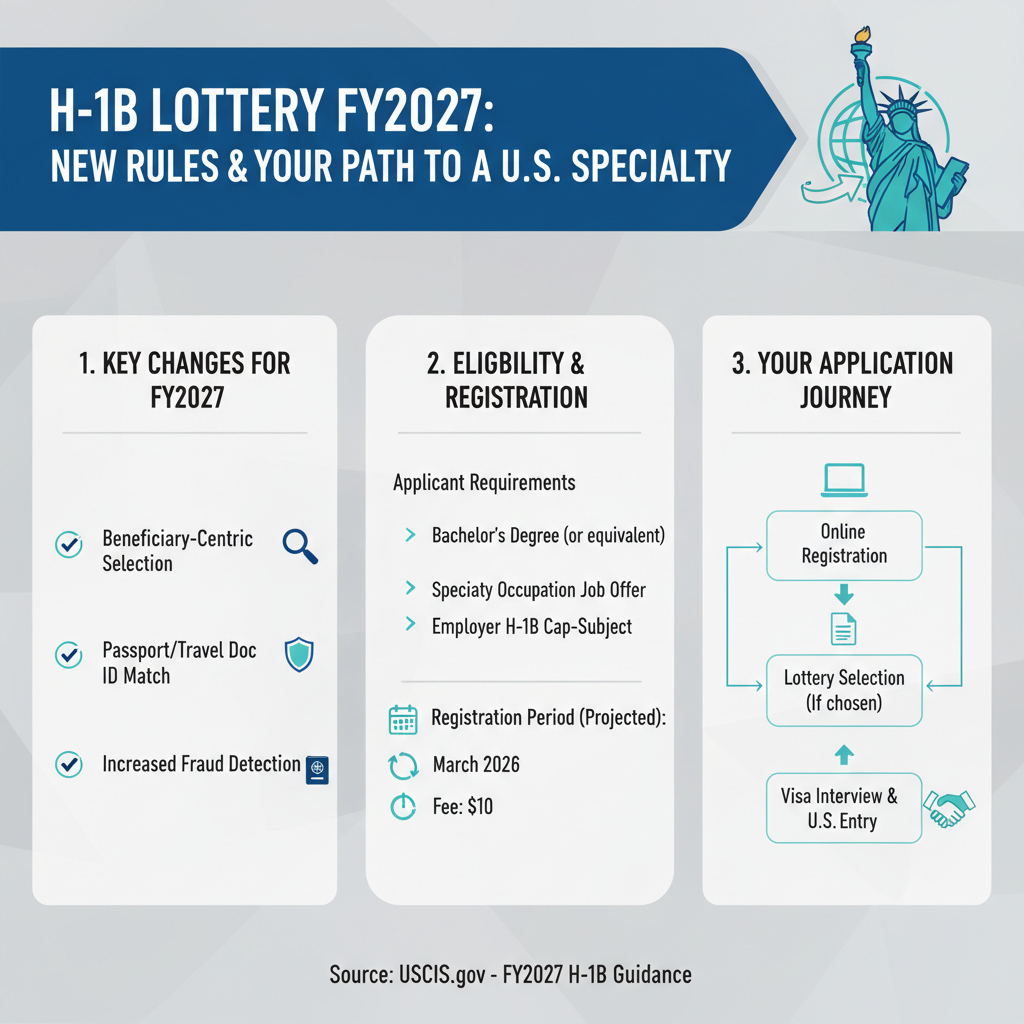
These changes are not entirely new but are the culmination of a final rule published by USCIS on January 30, 2024, titled "Improving the H-1B Registration Program and Strengthening Program Integrity." While the rule technically became effective for the FY2025 cap season (meaning the registration period in March 2024), its impact continues for all subsequent cap seasons, including the upcoming FY2027 H-1B cap season, for which registration is anticipated in March 2026. USCIS implemented these updates to address concerns about fraud and to ensure that the lottery system genuinely provides an equal chance to all eligible beneficiaries.
The core of these changes revolves around a "beneficiary-centric" selection process. This means that instead of selecting registrations based on each submission, USCIS will now select based on each unique beneficiary. This directly targets the practice of submitting multiple registrations for the same individual by various employers to artificially inflate selection odds. The news is trending now because as we draw closer to the FY2027 registration period, employers and potential beneficiaries are actively seeking clarity on how these rules will affect their strategies and chances.
How it can affect Florida residents
Florida, particularly Central Florida and the I-4 corridor, is a hub for various industries that rely heavily on H-1B talent. Technology companies in Orlando, Tampa, and Miami, aerospace firms on the Space Coast, and major tourism and hospitality corporations all seek skilled workers in fields like IT, engineering, finance, and specialized management. Universities across the state, including the University of Central Florida (UCF), University of Florida (UF), and University of South Florida (USF), also often sponsor H-1B visas for researchers and faculty, as well as for their international graduates.
For individuals currently living and working in Florida on other nonimmigrant visas (such as F-1 OPT/STEM OPT, J-1, or L-1) who aspire to transition to H-1B status, these changes are critical. The beneficiary-centric approach aims to level the playing field, ensuring that a highly qualified candidate sponsored by a legitimate employer in Orlando has the same chance of selection as a candidate sponsored in Silicon Valley. This could potentially reduce the perceived advantage of having multiple employers register for one individual, fostering a more equitable and transparent process for Florida's diverse workforce.
Employers in Orlando and other Florida cities must also adapt their strategies. They need to understand that while they can still register multiple eligible beneficiaries, the focus is now squarely on the qualifications and uniqueness of the individual worker, rather than the volume of registrations submitted on their behalf. This emphasizes the importance of a strong, legitimate job offer and a clear understanding of the new rules to ensure compliance and maximize chances of success for their sponsored employees.
What H-1B Visa Lottery Changes for FY2027 Is (and Why It Matters)
The H-1B visa program is one of the most sought-after avenues for skilled foreign workers to live and work legally in the United States. Its annual cap, combined with overwhelming demand, necessitates a lottery system. Understanding the H-1B visa itself and the recent lottery changes for FY2027 is crucial for anyone involved in this process.
A plain-English definition
The H-1B visa is a nonimmigrant visa that allows U.S. employers to temporarily employ foreign workers in specialty occupations. A specialty occupation generally requires a bachelor's degree or higher in a specific field. Examples include IT professionals, engineers, scientists, architects, accountants, and certain medical professionals.
The "lottery changes" for FY2027 refer to a significant modification in how USCIS selects registrations for the H-1B cap. Previously, if an individual had multiple employers register for them, each registration was treated as a separate entry in the lottery, potentially increasing the odds of selection for that individual. The new rule, effective for FY2025 and continuing for FY2027, shifts to a "beneficiary-centric" selection model. This means that each unique beneficiary (the foreign worker) is entered into the lottery only once, regardless of how many employers register on their behalf. If a beneficiary is selected, all employers who registered for that beneficiary will be notified, and any one of them can then proceed to file an H-1B petition.
This change matters immensely because it aims to eliminate the unfair advantage gained by filing multiple registrations for a single individual, thereby reducing fraud and ensuring that all eligible beneficiaries have an equal chance at selection. It promotes fairness and integrity in a highly competitive system, which is good news for genuinely qualified candidates and their sponsoring employers.
Key terms you need to know
Navigating the H-1B process requires familiarity with specific terminology:
- H-1B Visa: A nonimmigrant visa that permits U.S. employers to temporarily employ foreign workers in specialty occupations.
- Specialty Occupation: A theoretical and practical application of a body of highly specialized knowledge, and requires a bachelor's degree or higher in a specific specialty (or its equivalent) as a minimum for entry into the occupation in the U.S.
- Annual Cap: The statutory limit on the number of H-1B visas issued each fiscal year. Currently, it is 65,000 visas, plus an additional 20,000 for those with a U.S. master's degree or higher (the "U.S. Master's Cap").
- H-1B Lottery: The random selection process conducted by USCIS when the number of eligible registrations exceeds the annual cap.
- Beneficiary: The foreign national who will be employed in the specialty occupation.
- Petitioner: The U.S. employer who files the H-1B petition on behalf of the beneficiary.
- Fiscal Year (FY): The U.S. government's fiscal year runs from October 1 to September 30. H-1B visas for a given FY (e.g., FY2027) typically become available on October 1 of the preceding calendar year (e.g., October 1, 2026, for FY2027).
- Registration Period: The specific window (usually in March) during which employers must electronically register prospective H-1B beneficiaries with USCIS for the upcoming fiscal year's cap. For FY2027, this is anticipated in March 2026.
- Cap-Exempt: Certain H-1B petitions are not subject to the annual cap. This includes those filed by institutions of higher education, non-profit organizations affiliated with higher education, non-profit research organizations, and governmental research organizations. Beneficiaries who already hold H-1B status and are seeking to change employers or amend their existing petition are also generally cap-exempt.
- Labor Condition Application (LCA): Form ETA-9035. An application filed by the employer with the U.S. Department of Labor (DOL) attesting that they will pay the H-1B worker at least the prevailing wage for the occupation in the area of employment, and that the employment will not adversely affect the working conditions of U.S. workers. This must be certified before filing the H-1B petition.
- Form I-129: Petition for a Nonimmigrant Worker. The primary form filed by the employer with USCIS to request H-1B classification for a foreign national.
- Premium Processing: An optional service offered by USCIS for an additional fee, guaranteeing processing of certain petitions (including H-1B) within 15 calendar days.
Confused by the new H-1B rules? Imigrar provides clarity and expert guidance. Contact our Orlando office for a free consultation at +1 786-791-3106. Se Habla Español.
Current Immigration Law: The Foundation for H-1B Visas
The H-1B visa program is governed by specific provisions within the Immigration and Nationality Act (INA) and federal regulations. Understanding these foundational laws is essential, especially with the recent changes aiming to enforce their spirit more effectively.
Federal requirements
The legal basis for the H-1B visa is primarily found in Section 101(a)(15)(H)(i)(b) and Section 214(g)(1)(A) of the Immigration and Nationality Act (INA). These sections establish the H-1B as a nonimmigrant visa for specialty occupations and define the annual cap. Regulations found in 8 CFR 214.2(h) further detail the eligibility criteria, petitioning process, and conditions for H-1B status.
Key federal requirements for an H-1B petition include:
- Specialty Occupation: The job offered must meet the definition of a specialty occupation, typically requiring a bachelor's degree or higher in a specific field.
- Beneficiary Qualifications: The foreign national must possess the required degree or its equivalent, or hold an unrestricted state license, or have work experience equivalent to a bachelor's degree in the specialty occupation field.
- Employer-Employee Relationship: A legitimate employer-employee relationship must exist, where the employer has the right to control the beneficiary's work.
- Labor Condition Application (LCA): The employer must obtain a certified Form ETA-9035 from the Department of Labor, attesting to wage and working condition requirements.
- Annual Cap & Lottery: Unless cap-exempt, the petition is subject to the annual H-1B cap (65,000 regular cap, 20,000 U.S. Master's Cap). If demand exceeds supply, a lottery is conducted. The FY2027 lottery will use the new beneficiary-centric selection process.
- Petition Filing: If selected in the lottery, the employer files Form I-129, Petition for a Nonimmigrant Worker, with USCIS along with supporting documentation.
For official information, always refer to the USCIS official website.
Florida-specific considerations
While the H-1B visa is a federal program, certain state-level factors can influence its applicability and success, particularly in Florida:
- Industry Demand: Florida's growing tech, aerospace, healthcare, and tourism sectors create a high demand for specialty occupation workers. Employers in Orlando, for example, often seek H-1B candidates for roles in software development, engineering, finance, and specialized management.
- Prevailing Wage: The Department of Labor's prevailing wage determination is localized. Employers in different regions of Florida (e.g., Orlando vs. Miami vs. Tallahassee) may have different prevailing wage requirements for the same occupation, which must be met to comply with LCA regulations.
- Educational Institutions: Florida is home to numerous universities and colleges that offer degrees in specialty occupation fields. Graduates from these institutions, especially those with U.S. master's degrees, are often sponsored by Florida employers or are eligible for the U.S. Master's Cap.
- Local USCIS Offices: While H-1B petitions are processed at USCIS service centers, the Orlando USCIS Field Office may handle certain ancillary processes, such as biometric appointments or interviews for beneficiaries seeking an adjustment of status if they have other petitions pending. However, the H-1B petition itself is centrally processed.
Reminder: The H-1B program is federal. Florida cannot create its own H-1B rules, but the economic and educational landscape of the state directly impacts the prevalence and types of H-1B opportunities available.

How to Navigate the H-1B Lottery Changes: A Complete Step-by-Step Guide
The H-1B cap lottery process for FY2027 requires careful planning and strict adherence to new rules. This guide outlines the critical steps for both employers and beneficiaries.
1) Understanding the New Beneficiary-Centric Selection Process
This is the most crucial change for FY2027. Effective for the FY2025 cap season and continuing, USCIS now selects registrations based on each unique beneficiary. This means:
- One Entry Per Beneficiary: Regardless of how many employers submit a registration on behalf of the same beneficiary, that beneficiary will only be entered into the lottery draw once.
- Combating Fraud: This change aims to eliminate the practice of multiple, non-substantive registrations from related entities, or even unrelated entities, solely to boost a beneficiary's chances.
- Selection Notification: If a unique beneficiary is selected, USCIS will notify *all* registrants who submitted a registration for that beneficiary. Any one of those selected registrants (employers) can then proceed to file an H-1B petition on behalf of the selected beneficiary.
Action: Both employers and beneficiaries must understand that submitting multiple registrations no longer increases the individual's odds. The focus shifts to legitimate job offers and highly qualified candidates.
2) Employer and Beneficiary Eligibility Assessment
Before the registration period, both parties must confirm their eligibility.
- Employer Eligibility:
- Must be a U.S. employer.
- Must offer a legitimate job in a specialty occupation.
- Must have an Employer Identification Number (EIN).
- Must be able to pay the required wage (prevailing wage or actual wage, whichever is higher).
- Beneficiary Eligibility:
- Must possess a bachelor's degree or its equivalent (e.g., three years of progressive work experience for every one year of college education).
- The degree must be in a field related to the specialty occupation.
- For the U.S. Master's Cap, the beneficiary must have earned a U.S. master's or higher degree from a qualifying institution.
Required Documents (for assessment):
- Beneficiary's academic credentials (transcripts, diplomas, evaluations for foreign degrees).
- Beneficiary's resume and work experience letters.
- Employer's job description for the specialty occupation.
- Employer's business documentation (e.g., articles of incorporation, financial statements).
Ensure your eligibility is airtight. Imigrar can review your qualifications and employer's offer. Call +1 786-791-3106 for a free consultation. Se Habla Español.
3) H-1B Registration Period and Submission
The annual electronic registration period is typically in March for the fiscal year beginning October 1. For FY2027, the registration period is anticipated to be in March 2026.
- Create/Access USCIS Online Account: Employers must use a registrant account on the USCIS official website.
- Submit Registration: For each prospective beneficiary, the employer submits an electronic registration providing basic information about the company and the beneficiary.
- Beneficiary Information Required:
- Beneficiary's full legal name.
- Beneficiary's date of birth.
- Beneficiary's country of birth.
- Beneficiary's country of citizenship.
- Beneficiary's gender.
- Beneficiary's passport number (Important: This is a new requirement for FY2025 and beyond. Each beneficiary must have a valid passport and provide their most recent valid passport information at the time of registration).
- Whether the beneficiary has a U.S. master's degree or higher.
- Employer Information Required:
- Legal name of the petitioning employer.
- Employer's EIN.
- Employer's mailing address.
- Employer's authorized signatory information.
- Registration Fee: As of the FY2025 cap season, the registration fee increased from $10 to $215. This fee must be paid for each registration.
Warning: Ensure all information is accurate. Errors can lead to disqualification.
4) Lottery Selection and Notification
After the registration period closes, USCIS conducts the lottery.
- Random Selection: USCIS first selects enough registrations to meet the 20,000 U.S. Master's Cap, then selects from the remaining pool (including unselected U.S. master's degree holders) for the 65,000 regular cap. The selection is now based on unique beneficiaries.
- Notification Date: USCIS typically announces selection results by the end of March. Employers (registrants) will be notified through their online USCIS accounts.
- Status Update: The status for selected registrations will show "Selected." For those not selected, it will show "Not Selected" or "Denied" (if duplicate registrations from related entities were identified).
Timeline Expectation:
- Early March 2026: H-1B registration period opens.
- Mid-March 2026: H-1B registration period closes.
- Late March 2026: USCIS announces lottery results.
5) Filing the H-1B Petition (Form I-129)
Only if a registration is selected can the employer proceed to file the full H-1B petition.
- Petition Filing Window: USCIS provides a specific window (usually 90 days) during which selected petitions must be filed. For FY2027, this would typically be from April 1, 2026, to June 30, 2026.
- Labor Condition Application (LCA): Before filing Form I-129, the employer must submit and receive certification for Form ETA-9035 from the U.S. Department of Labor. This process can take 7-10 business days.
- Prepare Form I-129 and Supporting Documents:
- Certified LCA.
- Educational documents for the beneficiary (degrees, transcripts, evaluations).
- Beneficiary's resume and letters of experience.
- Copy of beneficiary's passport, visa, and I-94 record.
- Employer's letter of support outlining the job offer, specialty occupation duties, and beneficiary's qualifications.
- Employer's company documents (e.g., articles of incorporation, business licenses, financial statements, organizational charts).
- Evidence of employer-employee relationship (e.g., employment contract, pay stubs, W-2s if applicable).
- Any required affidavits or certifications.
- Filing Fees:
- Form I-129 filing fee: $460 (as of 2/23/2026, subject to change)
- American Competitiveness and Workforce Improvement Act (ACWIA) fee: $750 (for employers with 1-25 FTE employees) or $1,500 (for employers with 26+ FTE employees).
- Fraud Prevention and Detection Fee: $500.
- Public Law 114-113 fee: $4,000 (for employers with 50 or more employees, where more than 50% are in H-1B or L-1 status).
Important: All documents must be accurate and consistent with the registration information. The H-1B petition must be filed by one of the employers who submitted a selected registration for that beneficiary.
6) Premium Processing and USCIS Decision
Once the petition is filed, USCIS reviews it.
- Standard Processing: Processing times vary widely and can be lengthy (several months to over a year). Check USCIS Processing Times for current estimates.
- Premium Processing: For an additional fee ($2,805 as of 2/23/2026, subject to change), USCIS guarantees a decision within 15 calendar days. This option is highly recommended for those with urgent needs.
- Request for Evidence (RFE): USCIS may issue an RFE if they require additional information or clarification. A strong, timely response is critical.
- Approval/Denial: If approved, USCIS issues an I-797 Approval Notice. If denied, the employer and beneficiary will receive a denial letter explaining the reasons.
7) Visa Interview and Entry to U.S. (if applicable)
For beneficiaries outside the U.S. or those changing status.
- Change of Status (within U.S.): If the beneficiary is already in the U.S. in valid nonimmigrant status (e.g., F-1 OPT) and the H-1B petition includes a request for change of status, they may begin working on October 1 (or the petition approval date, whichever is later) without leaving the country.
- Consular Processing (outside U.S.): If the beneficiary is outside the U.S. or needs to leave and re-enter, they must attend a


