


The landscape of U.S. immigration is constantly evolving, and for skilled foreign workers and their prospective employers, few changes are as impactful as those affecting the H-1B visa program. As we approach the registration period for Fiscal Year 2027 (FY2027), significant new rules are now firmly in place, fundamentally altering how the H-1B lottery operates. These changes aim to enhance fairness and reduce fraud, but they also introduce new complexities that require careful navigation.
At Imigrar, an immigration law firm based in Orlando, Florida, we understand that these updates can be daunting. Our mission is to "Keep Families Together" by providing clear, actionable guidance and expert legal representation to immigrants nationwide. This comprehensive guide will break down the H-1B visa lottery changes for FY2027, explain what they mean for you, and outline the steps you need to take to maximize your chances of success.
The reporting that sparked this guide:
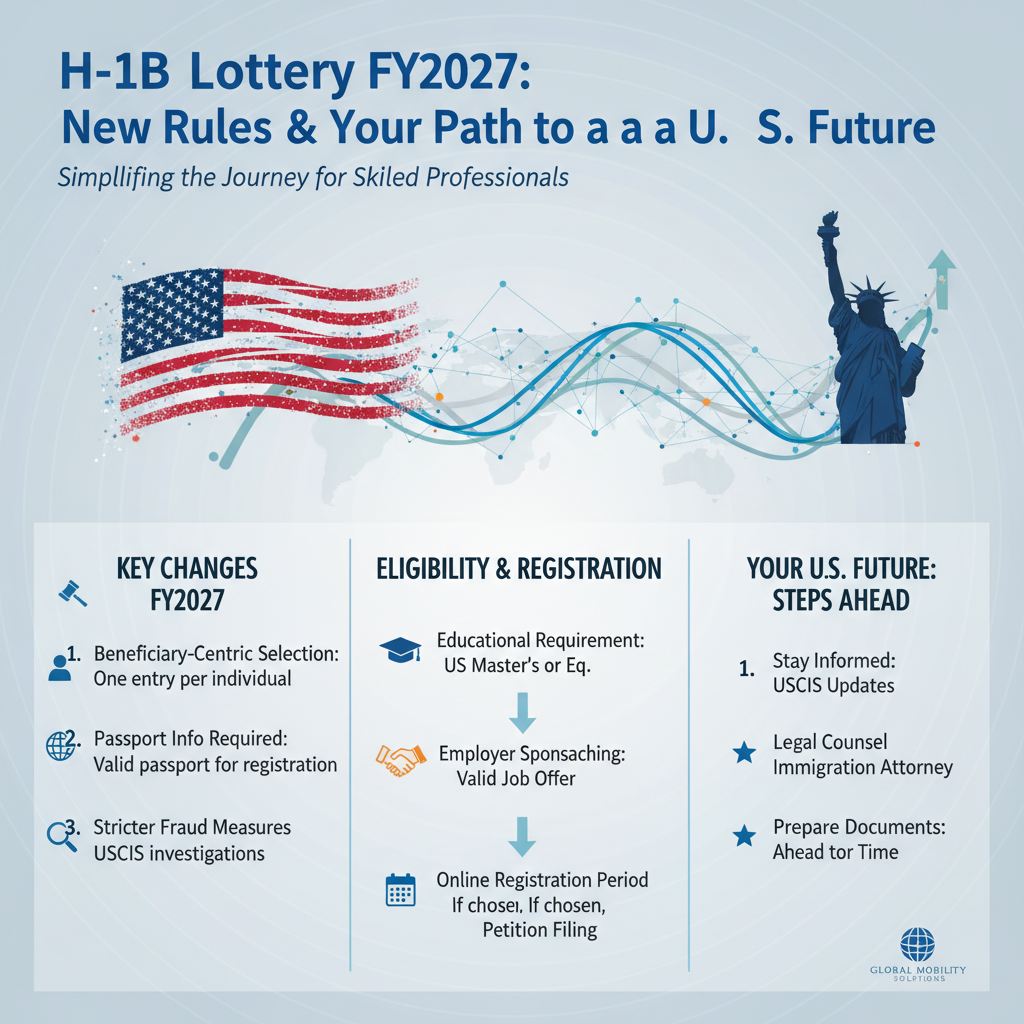
H-1B Visa Lottery Changes for FY2027 (Legal News)
What This News Means for Immigrants in Orlando and Across Florida
For individuals aspiring to work in the U.S. in specialty occupations, especially those in the tech, engineering, healthcare, and finance sectors prevalent in Central Florida, the H-1B visa is often the primary pathway. The recent changes to the H-1B lottery system for FY2027 are not just bureaucratic adjustments; they are foundational shifts that directly impact who gets selected and how applications are processed. Understanding these changes is paramount for anyone considering this visa.
Why this news is showing up now
The U.S. Citizenship and Immigration Services (USCIS) typically announces changes to major visa programs well in advance of their implementation. The most significant H-1B lottery overhaul, the "beneficiary-centric" selection process, was finalized and implemented for the FY2025 lottery, which concluded in March 2024. As we move into 2026, these rules are now the established framework for the upcoming FY2027 lottery cycle. USCIS’s proactive communication ensures that petitioners (employers) and beneficiaries (prospective employees) have ample time to prepare for the annual registration period, which usually opens in early March each year. This news is relevant now because the FY2027 registration window will soon open, and preparation for it should be underway.
How it can affect Florida residents
Florida, particularly the Orlando metropolitan area and the I-4 corridor, is a hub for growing industries that heavily rely on skilled foreign talent. Sectors like simulation and training, aviation and aerospace, medical technology, and hospitality management frequently sponsor H-1B visas. The new lottery rules have several implications for Florida residents and those hoping to move here:
- Increased Fairness for Beneficiaries: The primary goal of the new rules is to deter fraud and ensure that each unique beneficiary has an equal chance of selection, regardless of how many employers register them. This is particularly beneficial for highly sought-after candidates who might have previously been disadvantaged by a system prone to multiple registrations by unscrupulous employers.
- Employer Strategy Adjustments: Florida employers, especially those in fast-growing tech parks around Orlando and Tampa, must now adjust their H-1B sponsorship strategies. The focus shifts from simply registering as many times as possible to ensuring a legitimate job offer and a strong, compliant registration for each candidate.
- Reduced "Noise" in the System: With fraudulent multiple registrations curbed, the lottery might become more predictable, potentially leading to clearer communication from USCIS.
- Enhanced Scrutiny: While the aim is fairness, USCIS will likely increase scrutiny on petitions that are selected, ensuring compliance with the new rules and verifying the legitimacy of job offers and employer-employee relationships. This means Florida-based companies and their sponsored employees need to be exceptionally diligent.
Need Help? Our Orlando immigration team is ready to assist. Call +1 786-791-3106 for a free consultation, or message us online. Se Habla Español.
What H-1B Visa Lottery Changes for FY2027 Is (and Why It Matters)
The H-1B visa program is a cornerstone of U.S. immigration for skilled workers. It allows U.S. employers to temporarily employ foreign workers in specialty occupations that require theoretical or technical expertise in specialized fields such as IT, engineering, medicine, science, and education. Due to high demand, the number of H-1B petitions far exceeds the annual cap set by Congress, necessitating a lottery system.
A plain-English definition
The H-1B visa lottery changes for FY2027 refer to the updated rules governing how USCIS selects H-1B registrations when the number of eligible registrations exceeds the annual cap. For FY2027, the most critical change is the shift to a **beneficiary-centric selection process**. Previously, if multiple employers registered the same foreign worker, each registration was entered into the lottery. This created an unfair advantage for individuals with multiple job offers and allowed some employers to flood the system, reducing the odds for others. Under the new rules, each unique foreign worker (beneficiary) is entered into the lottery only **once**, regardless of how many employers submit registrations on their behalf. If a beneficiary is selected, all employers who registered for them will be notified, and any one of those employers can then proceed to file an H-1B petition on their behalf.
This change matters immensely because it aims to level the playing field, making the lottery fairer for all eligible beneficiaries and reducing opportunities for fraud. It means that the selection rate is now truly based on the number of unique individuals seeking an H-1B visa, rather than the number of registrations.
Key terms you need to know
Navigating the H-1B process requires understanding specific terminology. Here are some key terms:
- H-1B Visa: A non-immigrant visa that allows U.S. employers to temporarily employ foreign workers in specialty occupations.
- Specialty Occupation: An occupation that requires a bachelor's degree or higher in a specific specialty or its equivalent.
- Cap-Subject H-1B: H-1B visas subject to the annual numerical limits set by Congress.
- Annual Cap: The statutory limit on the number of H-1B visas issued each fiscal year. Currently, it's 65,000 for the regular cap and an additional 20,000 for the **Master's Cap**.
- Master's Cap (or Advanced Degree Exemption): The additional 20,000 visas reserved for those who have earned a U.S. master's degree or higher.
- Beneficiary: The foreign national (prospective employee) for whom the H-1B visa is sought.
- Petitioner: The U.S. employer filing the H-1B petition on behalf of the beneficiary.
- H-1B Registration: The mandatory electronic process where prospective petitioners (employers) submit basic information about the company and the beneficiary to USCIS during a designated period. This is required before an H-1B petition can be filed.
- Lottery Selection: When the number of registrations exceeds the annual cap, USCIS conducts a random lottery to select registrations that are eligible to file an H-1B petition.
- Beneficiary-Centric Selection: The new process for FY2027 where selection in the lottery is based on each unique beneficiary, not on the number of registrations submitted on their behalf.
- Form I-129, Petition for a Nonimmigrant Worker: The primary form filed by the employer once an H-1B registration is selected.
- LCA (Labor Condition Application): **Form ETA-9035** filed with the U.S. Department of Labor (DOL) by the employer before filing **Form I-129**. It attests to wages and working conditions.
- Premium Processing: An expedited service offered by USCIS for certain petitions, including H-1B, guaranteeing a 15-calendar day processing time for an additional fee.
- Change of Status (COS): Applying to change from one nonimmigrant status to another (e.g., F-1 student to H-1B worker) while remaining in the U.S.
- Consular Processing: Applying for an H-1B visa stamp at a U.S. embassy or consulate abroad, typically required if the beneficiary is outside the U.S. or chooses to leave and re-enter.
Current Immigration Law: The Foundation
The H-1B visa program operates under the authority of the Immigration and Nationality Act (INA), specifically Section 101(a)(15)(H)(i)(b) and Section 214(g). These sections outline the eligibility criteria, the annual numerical limitations (caps), and the general framework for the program. The recent changes to the lottery process were implemented by USCIS through regulatory amendments to 8 CFR Part 214, specifically focusing on the H-1B cap and lottery procedures.
Federal requirements
To be eligible for an H-1B visa, both the employer (petitioner) and the foreign worker (beneficiary) must meet specific federal requirements:
For the Employer (Petitioner):
- Must offer a job in a **specialty occupation**.
- Must attest that they will pay the H-1B worker at least the actual wage paid to other employees with similar experience and qualifications, or the prevailing wage for the occupation in the area of intended employment, whichever is higher. This is verified through the **LCA (Form ETA-9035)**.
- Must attest that employing the H-1B worker will not adversely affect the working conditions of similarly employed U.S. workers.
- Must file the necessary forms, primarily **Form I-129, Petition for a Nonimmigrant Worker**, with USCIS.
For the Employee (Beneficiary):
- Must hold a bachelor's degree or its equivalent, or a higher degree, or possess a license that authorizes him or her to practice a specialty occupation, or have work experience equivalent to a bachelor's degree.
- The degree or equivalent must be in a field related to the specialty occupation.
- Must meet any state licensing requirements for the occupation, if applicable.
The annual cap for H-1B visas is 65,000, with an additional 20,000 for beneficiaries holding a U.S. master's degree or higher. Certain organizations are exempt from the cap, including institutions of higher education, non-profit organizations affiliated with higher education, and government research organizations.
Florida-specific considerations
While H-1B laws are federal, their application often has state-specific nuances, particularly concerning licensing and prevailing wage determinations. For Central Florida residents and employers:
- Prevailing Wages: The prevailing wage for an occupation can vary significantly by geographic location. Employers in Orlando, Tampa, or Miami will need to ensure their LCA reflects the correct prevailing wage for their specific metropolitan statistical area.
- Licensing Requirements: Many specialty occupations, especially in healthcare (doctors, nurses, physical therapists) and engineering, require state-specific licenses. A beneficiary must either possess the required Florida license or be actively pursuing it, demonstrating that they can obtain it within a reasonable timeframe.
- Industry Demand: Florida's diverse economy means high demand for H-1B workers in various fields. Orlando, for instance, has a thriving tech scene, aerospace industry, and a massive tourism and hospitality sector that often requires specialized IT, engineering, and management professionals.
For official information and forms, always refer to the USCIS official website.
Navigating these new rules requires precision. Don't leave your H-1B application to chance. Our Orlando immigration team provides expert guidance. Call +1 786-791-3106 for a free consultation, or message us online. Se Habla Español.
How to Navigate the New H-1B Lottery Rules: A Complete Step-by-Step Guide
The H-1B lottery process, especially with the FY2027 changes, is multi-faceted. Here's a detailed guide to help you and your employer prepare and proceed.
1) Understand the New Rules and Eligibility (Beneficiary-Centric Selection)
Before anything else, both the employer and the beneficiary must grasp the core change: **beneficiary-centric selection**. This means that for the FY2027 lottery, each unique beneficiary will only be counted once in the lottery pool, regardless of how many employers submit a registration on their behalf. If a beneficiary is selected, all employers who properly registered for that beneficiary will receive a selection notice and will be eligible to file a petition. This is a significant shift from previous years.
Actionable Steps:
- For Beneficiaries: Ensure all potential employers are aware of this rule. If multiple employers register for you, confirm they are legitimate job offers.
- For Employers: Focus on submitting one accurate, complete, and legitimate registration per beneficiary. Understand that if your candidate is selected, other employers who registered for them will also be notified.
- Verify Eligibility: Both the specialty occupation requirements and the beneficiary's educational qualifications must be firmly established. Ensure the job truly requires a bachelor's degree or higher in a specific field and that the beneficiary possesses that degree or its equivalent.
Required Documents (for initial assessment):
- Beneficiary's academic transcripts and diplomas (translated and evaluated if from outside the U.S.).
- Beneficiary's resume/CV.
- Detailed job description from the employer.
- Employer's Federal Employer Identification Number (EIN).
2) Employer-Sponsor Identification and LCA Filing
The H-1B process begins with a U.S. employer. Once a legitimate job offer is extended and accepted, and the eligibility criteria are met, the employer must take the first official step: filing the Labor Condition Application (LCA) with the U.S. Department of Labor (DOL).
Actionable Steps:
- Determine Prevailing Wage: The employer must research and determine the prevailing wage for the specific occupation in the geographic area of employment (e.g., Orlando, FL). This is a critical step to ensure compliance.
- File LCA (Form ETA-9035): The employer, or their authorized representative (like Imigrar), files the LCA electronically with the DOL. This form attests to the employer's commitment to pay the required wage and provide suitable working conditions.
- Post Notice: The employer must provide notice of the LCA filing to U.S. workers either through internal posting or notification to the bargaining representative, if one exists.
Required Documents (for LCA):
- Employer's EIN.
- Employer's contact information and address.
- Beneficiary's job title, duties, and proposed salary.
- Worksite address (e.g., Orlando, FL).
- Prevailing wage determination source and wage level.
Reminder: The LCA must be certified by the DOL before an H-1B petition can be filed. This process typically takes 7-10 business days.
3) H-1B Electronic Registration
This is the gateway to the H-1B lottery. The electronic registration period typically occurs in early March for about 2-3 weeks. For FY2027, this would likely be in March 2026. Both the employer and the beneficiary must have a USCIS online account.
Actionable Steps:
- Create/Access USCIS Online Account: Both the prospective petitioner (U.S. employer) and the prospective beneficiary (foreign worker) must have a USCIS online account.
- Gather Required Information: The employer will input basic information about their company and the beneficiary.
- Submit Registration: The employer submits the electronic registration for each beneficiary they wish to sponsor, paying the non-refundable H-1B registration fee (currently $10, but subject to change).
- **Important:** Under the new rules, ensure the beneficiary's passport or travel document information is accurate and consistent across all registrations if multiple employers are registering for the same individual. This is how USCIS identifies unique beneficiaries.
Required Documents/Information (for registration):
- Employer's legal name, EIN, and U.S. mailing address.
- Employer's authorized signatory information.
- Beneficiary's full legal name, date of birth, country of birth, country of citizenship.
- Beneficiary's passport number (or other valid travel document number).
- Beneficiary's gender.
- Beneficiary's highest level of education.
- Whether the beneficiary holds a U.S. master's or higher degree.
Warning: Intentional misrepresentation or fraud in the registration process can lead to severe penalties, including denial of current and future petitions.
4) Lottery Selection and Petition Filing
After the registration period closes, USCIS conducts the lottery. For FY2027, this will happen shortly after the March 2026 registration period. Notifications are typically sent out by the end of March.
Actionable Steps:
- Monitor for Selection Notices: USCIS sends electronic selection notices to the USCIS online accounts of the employers whose registrations were selected. Under the new rules, if a beneficiary is selected, all employers who registered for that beneficiary will receive a selection notice.
- File Form I-129: If selected, the employer must then prepare and file the full H-1B petition (**Form I-129, Petition for a Nonimmigrant Worker**) with all supporting documentation within the designated filing window (typically 90 days from the selection date).
- Choose One Employer (if multiple selected): If a beneficiary has multiple selection notices from different employers, they must choose one employer to proceed with the H-1B petition. Only one H-1B petition can be filed per selected beneficiary.
Required Documents (for Form I-129 petition):
- Certified LCA (**Form ETA-9035**).
- **Form I-129** and H-1B Supplement.
- Copy of the H-1B registration selection notice.
- Proof of beneficiary's educational qualifications (transcripts, diplomas, evaluations).
- Beneficiary's resume/CV.
- Employer support letter detailing the job, salary, and why it qualifies as a specialty occupation.
- Company financial documents (e.g., tax returns, annual reports) to prove ability to pay.
- Organizational chart.
- Copies of beneficiary's passport, visa, **Form I-94** (if in U.S.).
- Any prior immigration documents (e.g., EAD, OPT).
- Employer-employee agreement (if applicable).
Important: The H-1B petition must be filed at the correct USCIS Service Center, as indicated on the selection notice. Incorrect filing can lead to delays or rejection.
5) Premium Processing & Adjudication
Once the **Form I-129** petition is filed, it enters the adjudication phase. Employers have the option to pay for Premium Processing to expedite the review.
Actionable Steps:
- Consider Premium Processing: Employers can choose to file **Form I-907, Request for Premium Processing Service**, along with the **Form I-129** or at a later date. This guarantees a response (approval, denial, Request for Evidence) within 15 calendar days for an additional fee. This is often recommended for those starting work on October 1st.
- Respond to RFEs: USCIS may issue a Request for Evidence (RFE) if they need more information. A prompt and thorough response is crucial.
- Adjudication: USCIS reviews the petition and supporting documents. If approved, an **Form I-797, Approval Notice**, is issued.
Required Documents (for RFE response, if applicable):
- Specific documents requested by USCIS to address their concerns.
Timeline Expectations: Regular processing times for H-1B petitions can vary significantly, often ranging from several months to over a year without premium processing. Check USCIS Processing Times for current estimates.
6) Visa Interview (if applicable) & Status Change
Upon approval, the beneficiary's next steps depend on their current location and status.
Actionable Steps:
- Change of Status (COS): If the beneficiary is already in the U.S. in a valid nonimmigrant status (e.g., F-1 OPT) and the H-1B petition was filed as a Change of Status, their status will automatically change to H-1B on October 1st (the start of the fiscal year), provided the petition is approved.
- Consular Processing: If the beneficiary is outside the U.S., or if the petition was filed for consular processing, they will need to attend an H-1B visa interview at a U.S. embassy or consulate abroad. This involves scheduling an appointment, completing **Form DS-160**, and paying the visa application fee.
- Entry to U.S.: Once the H-1B visa is stamped in their passport, the beneficiary can enter the U.S. in H-1B status, typically starting on October 1st.
Required Documents (for Consular Processing):
- Valid passport.
- **Form DS-160** confirmation page.
- Appointment confirmation page.
- **Form I-797** Approval Notice.
- LCA.
- Letter from employer confirming employment.
- Educational documents.
- Photographs.
- Any other documents requested by the consulate.
Reminder: For those in Orlando or elsewhere in Florida undergoing a Change of Status, maintaining valid underlying nonimmigrant status until October 1st is crucial.

Practical Steps You Can Take Today
The H-1B lottery is highly competitive, and the new rules mean preparation is more critical than ever. Here's an actionable checklist:
- Verify Beneficiary Eligibility: Ensure the beneficiary's degree and the job's requirements align perfectly with the "specialty occupation" definition. Get foreign degrees evaluated if necessary.
- Secure Legitimate Job Offers: If you're a beneficiary, actively seek multiple, genuine job offers from employers willing to sponsor you. Under the new rules, having more legitimate offers doesn't increase your odds of selection, but it provides options if you are selected.
- Educate Employers on New Rules: Ensure any potential sponsoring employer understands the beneficiary-centric selection process. This prevents confusion and ensures proper registration.
- Gather All Beneficiary Information: Collect the beneficiary's passport details, educational documents, and work history well in advance. Accuracy is paramount for registration.
- Plan for LCA Filing: Employers should begin the prevailing wage determination process and prepare to file the LCA as soon as possible, especially if the registration period for FY2027 is approaching (typically early March).
- Consult an Immigration Attorney: This is arguably the most important step. An experienced attorney can guide both employers and beneficiaries through the complexities, ensure compliance with the new rules, and prevent costly mistakes. For Central Florida residents, Imigrar offers local expertise.
- Explore Alternative Visa Options: Given the high demand for H-1B visas, discuss alternative nonimmigrant (e.g., O-1, L-1, E-3, TN) or immigrant visa pathways with your attorney in case the H-1B lottery is unsuccessful.
Document Preparation Guidance:
- Accuracy is Key: Double-check all information before submission. Even minor discrepancies can lead to RFEs or denials.
- Translations and Evaluations: All foreign-language documents must be accompanied by certified English translations. Foreign degrees must often be evaluated by a credential evaluation service to determine U.S. equivalency.
- Organize Digitally: Keep all documents scanned, clearly labeled, and organized in digital folders for easy access and submission.
Timeline Expectations (Approximate for FY2027 based on past years):
- February 2026: Employers finalize job offers, begin LCA preparation and prevailing wage research.
- Early March 2026: H-1B electronic registration period opens (typically for 2-3 weeks).
- Late March 2026: H-1B lottery conducted, selection notifications issued.
- April 1, 2026 - June 30, 2026: Petition filing window for selected registrations.
- October 1, 2026: Earliest start date for approved H-1B petitions.
Important: These are approximate dates. Always refer to official USCIS announcements for precise dates and deadlines.
Don't navigate
Schedule a free consultation with our attorney-reviewed team todayHave Questions About Your Case?


