

The landscape of U.S. employment-based immigration is constantly evolving, and few changes impact skilled foreign workers and their sponsoring employers as significantly as adjustments to the H-1B visa lottery system. For Fiscal Year 2027 (FY2027), the U.S. Citizenship and Immigration Services (USCIS) implemented a pivotal modification to how H-1B cap-subject registrations are selected, moving to a "beneficiary-centric" process. This shift, designed to curb fraud and enhance fairness, has profound implications for individuals seeking to work in specialty occupations in the United States, including those vibrant professional communities here in Orlando and throughout Florida.
At Imigrar, your trusted immigration law firm in Orlando, Florida, we understand that these changes can be complex and daunting. Our mission is to "Keep Families Together" by providing clear, actionable guidance to navigate the intricacies of U.S. immigration law. This comprehensive guide will break down the FY2027 H-1B lottery changes, explain what they mean for you, and outline the essential steps to successfully secure your H-1B visa.
Navigating H-1B Changes? Don't go it alone. Our Orlando immigration team is ready to assist. Call +1 786-791-3106 for a free consultation, or message us online. Se Habla Español.
NEWS SOURCE REFERENCE SECTION
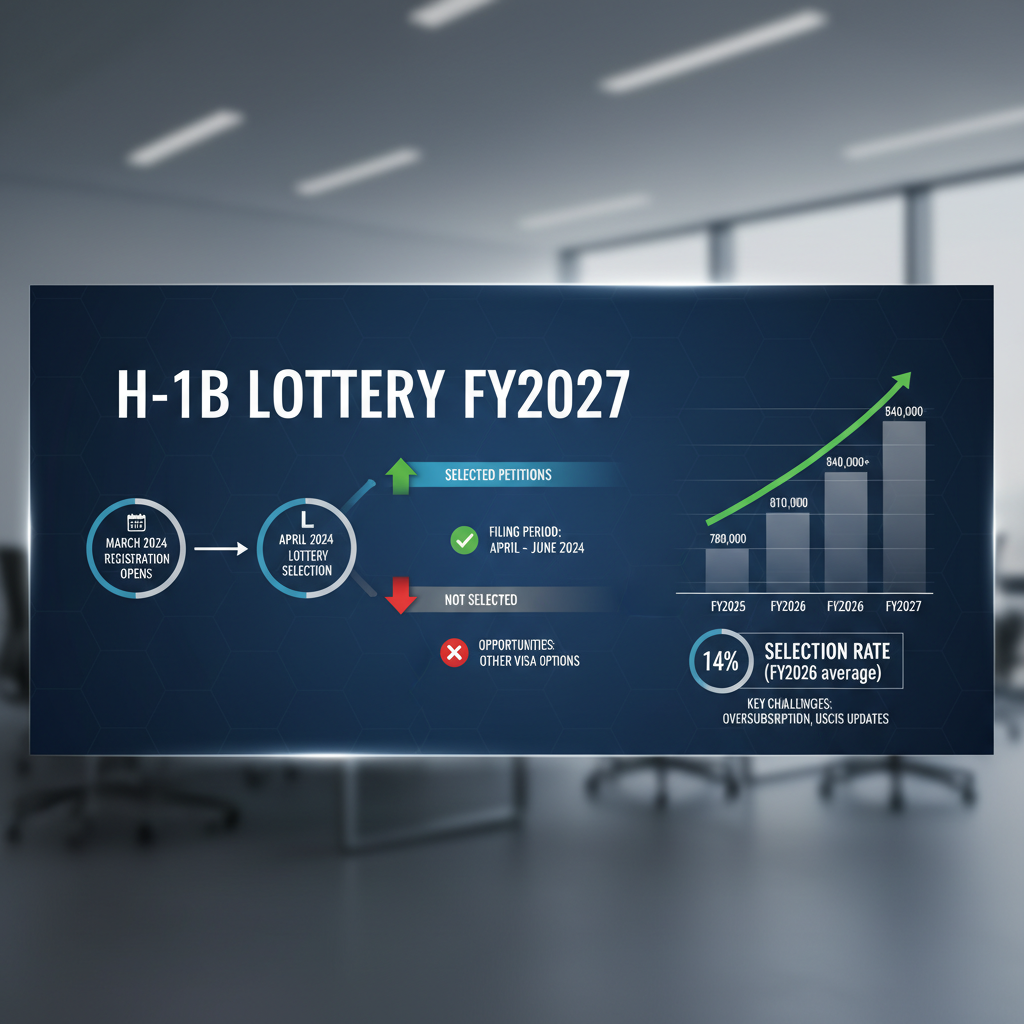
The reporting that sparked this guide: H-1B Visa Lottery Changes for FY2027 (Legal News)
What This News Means for Immigrants in Orlando and Across Florida
The recent changes to the H-1B visa lottery system represent one of the most significant procedural overhauls in years. For employers and prospective H-1B beneficiaries in Orlando, Central Florida, and indeed nationwide, understanding these modifications is not just important – it's critical for successful planning and application.
Why this news is showing up now
The H-1B visa program operates on a fiscal year basis, beginning on October 1st. For FY2027, which commences on October 1, 2026, USCIS announced and implemented new rules affecting the H-1B cap registration process. The registration period for FY2027 typically occurs in March (e.g., March 6-22, 2026), with lottery results announced by late March or early April (e.g., March 27, 2026). As of today, May 10, 2026, the FY2027 lottery has concluded, and selected registrants are currently within their 90-day window to file the full H-1B petition. This news is "showing up now" because the impact of these new rules is actively being felt by employers and beneficiaries as they prepare and submit their detailed petitions, or plan for future years based on the FY2027 experience. The changes were formally published in the Federal Register and went into effect for the FY2027 lottery, fundamentally altering how registrations were processed and selected.
The primary driver behind these changes was a concerted effort by the Department of Homeland Security (DHS) and USCIS to combat pervasive fraud in the H-1B lottery system. Under the previous "registrant-centric" model, a single beneficiary could have multiple registrations submitted on their behalf by different employers, artificially inflating their chances of selection and creating an unfair advantage. The new "beneficiary-centric" approach seeks to eliminate this loophole, ensuring that each unique individual has an equal and fair shot at being selected, regardless of how many employers register them.
How it can affect Florida residents
Florida is a dynamic state with a diverse economy, including burgeoning technology sectors in Orlando, Tampa, and Miami, a robust healthcare industry, world-class universities, and a strong aerospace presence on the Space Coast. Many companies in these sectors rely on the H-1B program to attract and retain highly skilled foreign talent.
- For Employers in Central Florida: Companies along the I-4 corridor, from Orlando's Medical City to research parks, must now ensure they understand the new rules. While they can still register prospective employees, they must be aware that multiple registrations for the same beneficiary will not increase that individual's chances. This means a focus on quality over quantity in registrations and a stronger emphasis on identifying truly qualified candidates who align with the "specialty occupation" requirements. It also means potentially less competition from fraudulent, duplicate entries.
- For Prospective H-1B Beneficiaries in Orlando: If you are a foreign national living in Orlando or planning to work here, these changes are largely beneficial for you. You no longer need to worry about other applicants gaining an unfair advantage through multiple entries. Your focus should be on ensuring your qualifications meet the "specialty occupation" criteria and that your sponsoring employer is legitimate and compliant. However, it also means that if you are approached by multiple employers, you must ensure your information is consistent across all registrations, as USCIS will deduplicate entries based on your unique passport/travel document number.
- Increased Fairness and Integrity: The new system aims to create a more level playing field, which benefits all legitimate applicants and employers. For the diverse immigrant communities in Orlando and across Florida, this means a fairer opportunity to pursue their professional goals and contribute to the state's economy.
What H-1B Visa Lottery Changes for FY2027 Is (and Why It Matters)
The H-1B visa program is a cornerstone of U.S. immigration for skilled workers, and its annual lottery is a high-stakes event. The changes introduced for FY2027 are not merely procedural; they reflect a significant policy shift aimed at restoring integrity to the system.
A plain-English definition
The H-1B visa is a nonimmigrant visa that allows U.S. employers to temporarily employ foreign workers in specialty occupations. These occupations generally require a bachelor's degree or higher in a specific field. Due to high demand and an annual cap set by Congress, USCIS conducts a lottery each year to select eligible registrations. For FY2027, the big change is this: instead of counting each employer's registration as a separate entry, USCIS now counts each unique individual (the "beneficiary") as a single entry. This means if three different companies register the same person, that person still only gets one chance in the lottery. This "beneficiary-centric" approach replaces the old "registrant-centric" system and is designed to stop fraud where individuals might have multiple employers register them to boost their chances unfairly.
Key terms you need to know
- H-1B Visa: A nonimmigrant visa that permits U.S. employers to temporarily employ foreign workers in specialty occupations.
- Specialty Occupation: An occupation that requires theoretical and practical application of a body of highly specialized knowledge, and a bachelor's degree or higher in the specific specialty (or its equivalent) as a minimum for entry into the occupation in the United States.
- H-1B Cap: The annual numerical limit on the number of H-1B visas issued. Congress currently sets the regular cap at 65,000, plus an additional 20,000 for beneficiaries who hold a U.S. master's degree or higher (the "Master's Cap").
- Cap-Exempt: Certain employers (e.g., institutions of higher education, non-profit research organizations, government research organizations) are exempt from the annual H-1B cap and can file petitions at any time.
- FY2027: Refers to Fiscal Year 2027, which begins on October 1, 2026, and ends on September 30, 2027. H-1B visas approved for this fiscal year allow work to commence on October 1, 2026.
- Beneficiary-Centric Selection: The new lottery system implemented for FY2027, where each unique beneficiary (individual) is entered into the lottery only once, regardless of how many employers submit registrations on their behalf. This is identified by a unique, valid passport or travel document number.
- Registrant-Centric Selection (old system): The previous lottery system where each unique *employer* registration was considered a separate entry, allowing a single beneficiary to have multiple entries if registered by multiple employers.
- USCIS: U.S. Citizenship and Immigration Services, the federal agency that oversees lawful immigration to the United States.
- DHS: Department of Homeland Security, the parent agency of USCIS.
- Employer Sponsorship: An H-1B visa requires a U.S. employer to sponsor the foreign worker. The employer files the necessary petitions on behalf of the beneficiary.
The shift to a beneficiary-centric system is crucial because it directly addresses the issue of multiple registrations for a single individual. Under the old system, some individuals and companies exploited this by submitting dozens, sometimes even hundreds, of registrations for the same person through various shell companies or related entities. This practice significantly skewed the lottery odds, making it harder for legitimate, single-entry applicants to be selected. The new rule aims to level the playing field, making the lottery more transparent and equitable for all qualified applicants and their sponsoring employers.
Concerned about H-1B compliance? Our Orlando immigration team provides expert guidance. Call +1 786-791-3106 for a free consultation, or message us online. Se Habla Español.

Current Immigration Law: The Foundation
The H-1B visa program is governed by specific provisions within the Immigration and Nationality Act (INA) and federal regulations. Understanding these foundational laws is essential for both employers and beneficiaries.
Federal requirements
The primary legal framework for the H-1B visa is found in Section 214(g) of the Immigration and Nationality Act (INA), which establishes the annual numerical cap. Further regulations are detailed in the Code of Federal Regulations, specifically 8 CFR 214.2(h), which outlines the eligibility criteria, petitioning process, and specific requirements for H-1B nonimmigrants.
Key federal requirements include:
- Specialty Occupation: The job offered must qualify as a specialty occupation, meaning it requires a theoretical and practical application of a body of highly specialized knowledge and a bachelor's degree or higher in a specific specialty.
- Beneficiary Qualifications: The foreign worker must possess at least a bachelor's degree or its equivalent, or hold an unrestricted state license, or have work experience equivalent to a bachelor's degree.
- Employer-Employee Relationship: A valid employer-employee relationship must exist between the petitioner and the beneficiary, as defined by USCIS.
- Labor Condition Application (LCA): Before filing an H-1B petition, the employer must file and obtain certification of a Labor Condition Application (LCA) with the U.S. Department of Labor (DOL). The LCA attests that the employer will pay the H-1B worker at least the prevailing wage for the occupation in the area of employment or the actual wage paid to other employees with similar experience and qualifications, whichever is higher. It also attests to working conditions and notification requirements.
- Annual Cap: As mentioned, the H-1B program is subject to an annual cap of 65,000 visas, with an additional 20,000 for those with a U.S. master's degree or higher. This cap is typically reached quickly, necessitating the lottery.
- New Beneficiary-Centric Lottery Rule: The rule for FY2027, published in the Federal Register, amends 8 CFR 214.2(h)(8)(ii)(C) to implement the beneficiary-centric selection process. This means that USCIS will select registrations based on unique beneficiaries, rather than unique registrants, to deter fraud and ensure fair allocation of H-1B visas.
The core form for the H-1B petition is Form I-129, Petition for a Nonimmigrant Worker. This form, along with various supplements and extensive supporting documentation, is filed *after* a registration has been selected in the lottery.
For official information and to download forms, always refer to the USCIS official website.
Florida-specific considerations
While H-1B visa requirements are federal, their impact is deeply felt at the state and local levels. Florida's economy, particularly in metropolitan areas like Orlando, benefits significantly from skilled foreign workers. The growth of sectors such as:
- Technology: Orlando's tech hub, including simulation and training, digital media, and software development, attracts engineers, IT specialists, and data scientists.
- Healthcare: Florida's aging population


