


The landscape of U.S. work visas is constantly evolving, and for those aspiring to live and work in the United States, staying informed is paramount. The H-1B visa program, a cornerstone for skilled foreign workers, is once again undergoing significant changes that will impact its annual lottery. As an immigration law firm dedicated to helping families and individuals achieve their American dreams, Imigrar is here to dissect these new rules and provide clarity for our clients in Orlando, across Florida, and nationwide.
Navigating new H-1B rules can be complex. Our experienced Orlando immigration team at Imigrar is ready to assist you and your employer. Call +1 786-791-3106 for a free consultation, or message us online. Se Habla Español.
The reporting that sparked this guide:
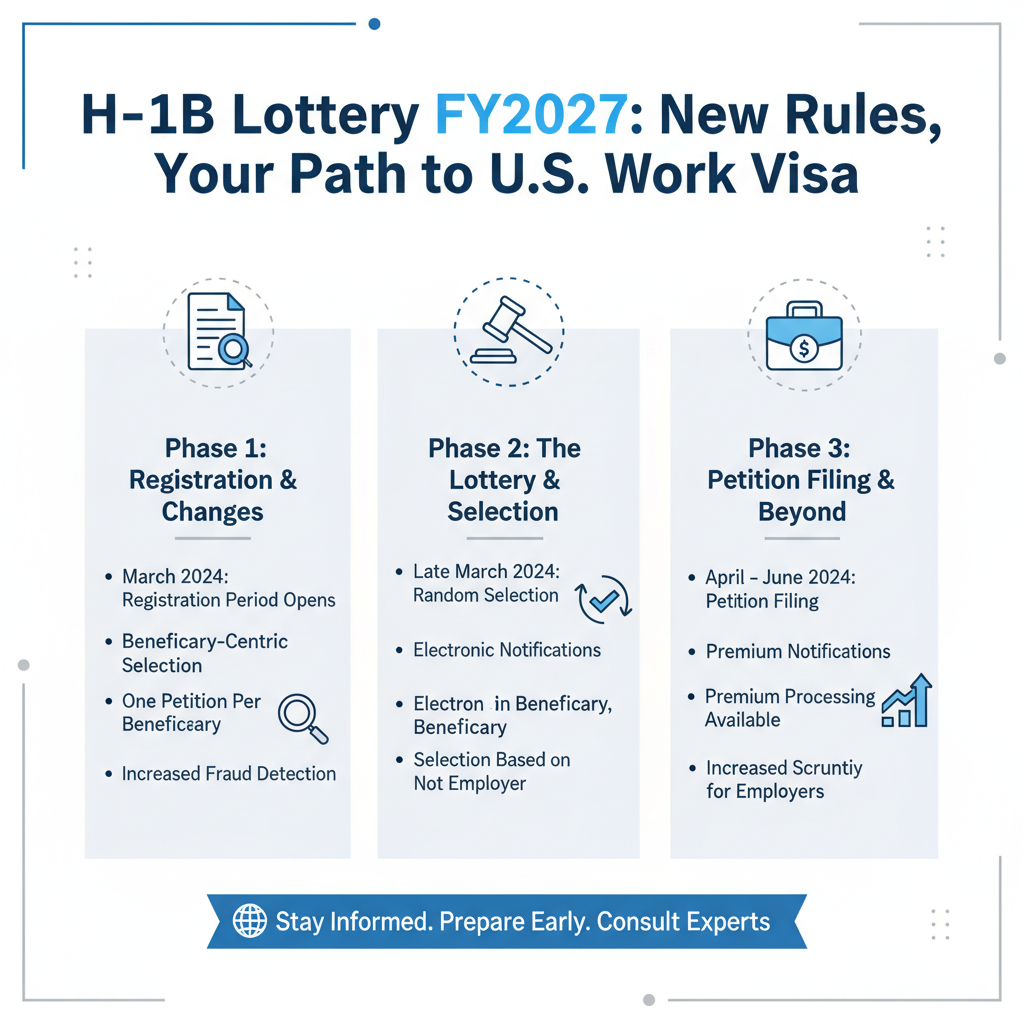
H-1B Visa Lottery Changes for FY2027 (Legal News)
What This News Means for Immigrants in Orlando and Across Florida
The H-1B visa program is a lifeline for many talented individuals seeking to contribute their skills to the U.S. economy, particularly in high-demand sectors like technology, engineering, medicine, and education. The recent changes to the H-1B lottery process, specifically for the upcoming Fiscal Year 2027 (FY2027), are designed to make the system fairer and more efficient. For immigrants and employers in Florida, understanding these shifts is crucial for successful planning and application.
Why this news is showing up now
While the H-1B lottery for FY2027 might seem far off (applications typically open in March 2026 for the fiscal year starting October 1, 2026), the United States Citizenship and Immigration Services (USCIS) has been proactive in announcing changes to the lottery selection process. These changes were finalized and implemented starting with the FY2025 lottery, meaning they are now the established protocol for subsequent lotteries, including FY2027. The legal news outlets are highlighting these ongoing impacts and reinforcing the importance of being aware of the modified system well in advance. USCIS aims to give employers and prospective H-1B beneficiaries ample time to prepare under the new rules, ensuring compliance and reducing potential fraud.
How it can affect Florida residents
Florida, with its booming tech hubs in Orlando, Tampa, and Miami, its thriving healthcare industry, and its robust tourism and hospitality sectors, is a significant destination for H-1B visa holders. Universities across the state, including the University of Central Florida (UCF) in Orlando, the University of Florida, and the University of South Florida, also attract a large number of international students who often seek H-1B sponsorship post-graduation. The new lottery rules will have several key impacts on Florida residents:
- Increased Fairness for Beneficiaries: The primary change is the shift to a "beneficiary-centric" selection process. This means that each unique individual (beneficiary) will only be entered into the lottery once, regardless of how many employers register them. This change aims to eliminate the practice of multiple employers submitting registrations for the same individual to artificially inflate their chances. For a skilled professional in Orlando, this levels the playing field, ensuring that every eligible individual has an equal, single chance at selection.
- Employer Strategy Adjustments: Florida employers, particularly those in the highly competitive tech corridor along I-4, will need to adjust their recruitment strategies. They can no longer rely on having multiple registrations for a single candidate. Instead, they must focus on robust recruitment, ensuring their sponsored candidates are truly qualified and that their H-1B registration is meticulously prepared.
- Reduced Fraud and Abuse: The new system is designed to combat fraud where individuals or "shell" companies might submit numerous registrations for the same person without a genuine job offer. This fosters greater integrity in the H-1B program, benefiting legitimate employers and beneficiaries in Florida.
- Focus on Genuine Job Offers: For prospective H-1B workers in Central Florida, this emphasizes the importance of securing a legitimate, bona fide job offer from a sponsoring employer. The quality of the job offer and the employer's commitment to the candidate will become even more critical.
- Impact on OPT Holders: Many international students from Florida universities on Optional Practical Training (OPT) or STEM OPT Extension utilize the H-1B program as their next step. These changes mean that they, like all other beneficiaries, will have one chance in the lottery. Strategic planning with their employers regarding their OPT expiration and potential H-1B cap-gap relief becomes even more important.
For those living in or planning to move to Orlando, Florida, these changes underscore the need for early preparation, comprehensive understanding, and professional legal guidance. Imigrar is here to help you navigate these complexities.
What H-1B Visa Lottery Changes for FY2027 Is (and Why It Matters)
The H-1B visa is a nonimmigrant visa that allows U.S. employers to temporarily employ foreign workers in specialty occupations. These occupations generally require a bachelor's degree or higher in a specific specialty, or its equivalent. The demand for H-1B visas consistently far outstrips the annual supply, leading to a lottery system for selection.
A plain-English definition
Imagine a highly sought-after concert where there are only a limited number of tickets. To ensure fairness, everyone who wants a ticket enters a random drawing, or "lottery." The H-1B visa works similarly. Each year, the U.S. government sets a cap (limit) on the number of new H-1B visas available. Because many more people apply than there are visas, USCIS uses a lottery to select which applications can proceed. The "changes for FY2027" mean that the rules for how you enter that lottery and how selections are made have been updated to be fairer and prevent people from trying to "game" the system by having multiple entries for the same person. Now, each person only gets one chance, no matter how many employers want to sponsor them.
Key terms you need to know
Understanding the following terms is essential for anyone involved in the H-1B process, especially with the new changes:
- H-1B Visa: A nonimmigrant visa that permits U.S. employers to temporarily employ foreign workers in specialty occupations.
- Specialty Occupation: An occupation that requires theoretical and practical application of a body of highly specialized knowledge, and a bachelor's or higher degree in the specific specialty (or its equivalent) as a minimum for entry into the occupation in the United States.
- Beneficiary: The foreign national (the individual) who is seeking the H-1B visa.
- Petitioner: The U.S. employer who is sponsoring the foreign national for the H-1B visa.
- Annual Cap: The statutory limit on the number of H-1B visas issued each fiscal year. Currently, this is 65,000 for the regular cap and an additional 20,000 for the U.S. Master's Cap.
- H-1B Lottery (or "Cap Lottery"): The computerized random selection process used by USCIS when the number of H-1B registrations exceeds the annual cap.
- H-1B Registration: An online process where employers (petitioners) submit basic information about the prospective H-1B employee (beneficiary) and the job offer to USCIS during a designated period. This is the first step before the lottery.
- Master's Cap (or "Advanced Degree Exemption"): An additional 20,000 H-1B visas reserved for beneficiaries who have earned a U.S. master's degree or higher from an accredited U.S. institution.
- Prevailing Wage: The average wage paid to similarly employed workers in a specific occupation in the area of intended employment. Employers must pay H-1B workers at least the prevailing wage or the actual wage paid to other employees with similar experience and qualifications, whichever is higher.
- Fiscal Year (FY): The U.S. government's accounting year, which runs from October 1 to September 30. H-1B visas are allocated per fiscal year. For example, FY2027 starts October 1, 2026.
- Beneficiary-Centric Selection: The new method for the H-1B lottery where selections are based on each unique beneficiary, rather than on each registration. If multiple employers register the same beneficiary, that beneficiary is still only entered once into the lottery.
These changes matter immensely because they directly influence the likelihood of securing an H-1B visa. By shifting to a beneficiary-centric model, USCIS aims to restore integrity to the lottery process, ensuring that the limited number of visas are allocated fairly based on individual merit and genuine employment opportunities, rather than on the number of registrations submitted by multiple employers for the same person. This means less speculation and a more transparent process for everyone involved.
Current Immigration Law: The Foundation for H-1B Visas
The H-1B visa program is rooted in the Immigration and Nationality Act (INA), specifically INA § 101(a)(15)(H)(i)(b), which defines the H-1B nonimmigrant classification. Further regulations, primarily found in Title 8 of the Code of Federal Regulations (8 CFR Part 214), provide the detailed framework for its implementation, including eligibility, petition requirements, and the annual cap. The changes implemented for FY2027 are administrative rule changes designed to refine the lottery process within the existing statutory framework.
Federal requirements
To qualify for an H-1B visa, both the employer (petitioner) and the foreign worker (beneficiary) must meet specific federal requirements:
- For the Beneficiary:
- Hold a bachelor's degree or its equivalent, or a higher degree, or possess a license in a specialty occupation field, or have work experience equivalent to a bachelor's degree.
- Possess the necessary qualifications for the specialty occupation position offered.
- For the Petitioner (Employer):
- Offer a job in a "specialty occupation."
- Pay the H-1B employee at least the prevailing wage for that occupation in the geographic area of employment, or the actual wage paid to other employees with similar experience and qualifications, whichever is higher. This is certified through a Labor Condition Application (LCA) filed with the U.S. Department of Labor (DOL) before the H-1B petition.
- Demonstrate that there is a genuine employer-employee relationship.
- Not displace U.S. workers.
- Annual Cap: As mentioned, there is an annual numerical cap of 65,000 H-1B visas for the regular cap, plus an additional 20,000 for beneficiaries with a U.S. master's degree or higher. Certain employers are exempt from the cap, including institutions of higher education, non-profit organizations affiliated with higher education, and non-profit research organizations or governmental research organizations.
The H-1B visa process begins with an electronic registration submitted by the employer. If selected in the lottery, the employer then files Form I-129, Petition for a Nonimmigrant Worker, with USCIS. This form is the core document for requesting H-1B classification.
For detailed information on current regulations and forms, always refer to the USCIS official website.
Florida-specific considerations
While H-1B law is federal, its impact and application have unique considerations in Florida:
- Demand in Key Industries: Florida's economy is diverse, leading to high H-1B demand in specific sectors. The tech industry, particularly around the Orlando and Tampa metropolitan areas (often dubbed "Silicon Swamp" or "Tech Coast"), consistently seeks H-1B workers in software development, IT, and engineering. The robust healthcare sector across the state, from Jacksonville to Miami, also relies on H-1B visas for doctors, nurses, and medical researchers. Tourism and hospitality, while often not directly H-1B eligible due to degree requirements, support ancillary tech and management roles that do qualify.
- Academic Institutions: Florida is home to numerous large universities that enroll a significant number of international students. Graduates from institutions like the University of Central Florida (UCF), which is one of the largest universities by enrollment in the U.S., often seek H-1B sponsorship. These universities also frequently sponsor H-1B workers for research and teaching positions, which are often cap-exempt.
- Prevailing Wage Variations: The prevailing wage for a specific occupation can vary significantly by geographic location. Employers in Orlando, for example, would need to consider the prevailing wage specific to Orange County or the Orlando-Kissimmee-Sanford metropolitan statistical area, which might differ from wages in Miami or Jacksonville.
- Local USCIS Offices: While H-1B petitions are processed centrally, individuals changing status or needing other immigration services might interact with local USCIS Field Offices, such as the one in Orlando. Understanding local procedures and potential interview requirements, though rare for initial H-1B, is helpful.
For Florida businesses and foreign nationals, understanding the interplay between federal regulations and local economic realities is crucial for a successful H-1B strategy. Imigrar, with its roots in Orlando, possesses specific insights into the Florida market and can provide tailored advice.
Confused by the H-1B process? Let Imigrar simplify it for you. Our Orlando-based legal team offers expert guidance for employers and beneficiaries. Call +1 786-791-3106 for a free consultation. Se Habla Español.
Navigating the H-1B Process with New Lottery Rules: A Complete Step-by-Step Guide
The H-1B process is multifaceted and requires meticulous attention to detail. With the new beneficiary-centric lottery rules for FY2027, strategic planning and timely action are more critical than ever. Here’s a complete step-by-step guide:
1) Employer Decision & Initial Assessment
Action: The U.S. employer identifies a need for a foreign worker in a specialty occupation and determines that the H-1B visa is the appropriate classification. This is where the employer and potential beneficiary first connect and agree to pursue H-1B sponsorship.
- Required Documents (Initial Assessment):
- Detailed job description outlining specialty occupation duties.
- Beneficiary's resume/CV and academic credentials (degrees, transcripts).
- Employer's basic company information (FEIN, industry, number of employees).
Practical Advice: Employers should thoroughly review the job requirements to ensure they genuinely qualify as a "specialty occupation" and that the beneficiary possesses the necessary qualifications. This initial assessment is critical to avoid issues later. For Central Florida employers, understanding local market needs and prevailing wage implications is key.
2) Labor Condition Application (LCA) Filing & H-1B Registration Period
Action: Before H-1B registration, the employer must file a Labor Condition Application (LCA), Form ETA-9035, with the U.S. Department of Labor (DOL). This document attests that the employer will pay the H-1B worker at least the prevailing wage and provide working conditions that will not adversely affect U.S. workers. Once certified, the employer can proceed to the H-1B electronic registration.
The H-1B electronic registration period typically occurs in March (e.g., March 2026 for FY2027). During this period, the employer (or their authorized representative) submits a simple online registration for each prospective H-1B beneficiary. Under the new beneficiary-centric rules, multiple registrations for the same individual are now prohibited and will result in disqualification. Each unique beneficiary can only be submitted once, regardless of how many employers wish to sponsor them. If a beneficiary has multiple job offers, they must choose one employer to register them, or multiple employers can register them but USCIS will only consider one of those registrations for the lottery.
- Required Documents (LCA & Registration):
- Certified LCA (Form ETA-9035).
- Beneficiary's full legal name, date of birth, country of birth, country of citizenship, passport number.
- Beneficiary's highest degree attained and the institution that granted it.
- Employer's legal name, FEIN, and mailing address.
- Employer's attorney or representative information (if applicable).
Important: The registration fee is minimal (currently $10), but failure to adhere to the single-beneficiary rule will lead to rejection of all registrations for that individual.
3) Lottery Selection & Notification
Action: After the registration period closes, USCIS conducts the H-1B lottery. This usually happens a few days after the registration window closes. First, selections are made under the U.S. Master's Cap, and then unselected Master's Cap registrations are entered into the Regular Cap lottery. USCIS then notifies employers of selected registrations through their online accounts.
- Required Documents:
- No documents are submitted at this stage, but employers should be ready to proceed immediately upon notification.
Timeline: Selections are typically announced by the end of March (e.g., late March 2026 for FY2027). Employers receive a selection notice for each selected beneficiary.
4) Petition Filing (Form I-129)
Action: If a beneficiary's registration is selected, the employer has a specific window (typically 90 days from the selection date) to file the complete H-1B petition, Form I-129, Petition for a Nonimmigrant Worker, with USCIS. This is the most extensive part of the application process and requires detailed documentation to prove eligibility for both the employer and the beneficiary.
- Required Documents (Form I-129 Petition):
- Certified LCA (Form ETA-9035).
- Copy of the H-1B registration selection notice.
- Form I-129 and all required supplements (e.g., H-1B Data Collection and Filing Fee Exemption Supplement).
- Employer's support letter detailing the job, salary, and why the position qualifies as a specialty occupation.
- Beneficiary's educational documents (degrees, transcripts, evaluations of foreign degrees).
- Beneficiary's professional licenses, certifications, and experience letters.
- Beneficiary's passport, visa, I-94 record, and previous U.S. immigration documents (if applicable).
- Evidence of the employer's ability to pay the proffered wage (e.g., financial statements, tax returns).
- Organizational charts, company brochures, and other evidence of the employer's business operations.
- Applicable filing fees (including base fee, ACWIA fee, fraud prevention and detection fee, and Public Law 114-113 fee if applicable).
Warning: Missing documents or incorrect information can lead to Requests for Evidence (RFEs) or denial. It is crucial to work with an experienced immigration attorney at this stage.
5) USCIS Processing & Approval
Action: USCIS reviews the filed Form I-129 petition. This processing can take several months. Premium Processing is available for an additional fee, guaranteeing a response within 15 calendar days (or 15 business days for certain categories). If approved, USCIS sends an I-797 Approval Notice.
- Required Documents:
- No documents submitted by the applicant during this stage, but all filed documents must be readily available for attorney review if an RFE is issued.
Timeline: Regular processing times can vary significantly. Check USCIS Processing Times for current estimates. Premium Processing is a faster option, but it comes with a substantial fee.
6) Visa Interview (Consular Processing) or Change of Status
Action (for beneficiaries outside the U.S.): Upon approval, the beneficiary will typically undergo consular processing at a U.S. embassy or consulate in their home country. This involves scheduling a visa interview, completing Form DS-160 (Online Nonimmigrant Visa Application), and attending the interview to obtain the H-1B visa stamp in their passport.
Action (for beneficiaries already in the U.S.): If the beneficiary is already in the U.S. in a valid nonimmigrant status (e.g., F-1 OPT, L-1, H-4) and the H-1B petition requested a "Change of Status," the approval notice (Form I-797) will indicate that their status has been changed to H-1B. They can then begin working on October 1st (or the petition's start date).
- Required Documents (Consular Processing):
- Valid passport.
- Printed confirmation page of Form DS-160.
- Visa interview appointment confirmation page.
- Original Form I-797 Approval Notice.
- LCA (Form ETA-9035).
- Employer's support letter and job offer letter.
- Academic credentials (original degrees, transcripts).
- Resume/CV.
- Evidence of ties to home country (though less critical for H-1B due to dual intent).
- Passport-style photographs.
- Receipts for visa fees.
Reminder: For those in Orlando or across Florida on OPT, the "cap-gap" provision allows them to continue working beyond their OPT expiration date if an H-1B petition is filed on their behalf and selected, extending their status until October 1st.
7) Beginning Employment
Action: H-1B beneficiaries can begin their approved employment on the start date specified in their petition, typically October 1st for cap-subject petitions, provided they have the necessary visa stamp (if outside the U.S.) or approved Change of Status (if inside the U.S.).
- Required Documents:
- I-94 arrival/departure record.
- H-1B visa stamp (if applicable).
- I-797 Approval Notice.
Practical Advice: Ensure all documents are in order before starting work. Keep copies of all immigration documents in a safe place. For employers in Florida, proper I-9 compliance is essential. This is where the commitment to "Keep Families Together" truly manifests, as a successful H-1B journey allows individuals to build their lives and careers in the U.S.

Practical Steps You Can Take Today for Your FY2027 H-1B Application
Even though the FY2027 H-1B lottery is still some time away, proactive preparation is key to success, especially with the new rules. Here’s an actionable checklist:
- Research Sponsoring Employers: Start identifying potential employers in Orlando, Central Florida, or nationwide who historically sponsor H-1B visas and are actively recruiting for specialty occupations that match your skills. Network diligently.
- Secure a Job Offer: The most crucial step. Focus on obtaining a genuine job offer from a U.S. employer willing to sponsor you. Remember, under the new rules, quality of offer over quantity of registrations is paramount.
- Gather and Organize Documents: Even before a job offer, compile all your academic credentials (degrees, transcripts, foreign degree evaluations), professional licenses, certifications, and a detailed resume. Ensure your passport is valid and up-to-date.
- Understand Your Eligibility: Review the requirements for a "specialty occupation" and confirm your qualifications. If you have a U.S. master's degree, understand the advantages for the Master's Cap.
- Educate Your Potential Employer: Be prepared to explain the new beneficiary-centric lottery process to potential employers. Reassure them that Imigrar can assist with the legal complexities.
- Consult with an Immigration Attorney: This is perhaps the most critical step. An attorney can assess your eligibility, advise your potential employer on the process, ensure compliance with the new lottery rules, and prepare a strong petition if selected.
- Develop a Backup Plan: Given the unpredictable nature of the lottery, consider alternative nonimmigrant visas (e.g., O-1 for extraordinary ability, L-1 for intracompany transfers, E-3 for Australians, TN for Canadians/Mexicans) or strategies if H-1B is not successful.
Document Preparation Guidance
- Academic Credentials: Ensure all foreign degrees are evaluated by a reputable credential evaluation service to determine their U.S. equivalent. Have official transcripts ready.
- Experience Letters: If relying on work experience in lieu of a degree, obtain detailed letters from previous employers outlining your duties and experience.
- Passport & Visa: Make sure your passport is valid for at least six months beyond your intended H-1B period. Keep copies of all current and past U.S. visas and I-94 records.
- Translations: Any documents not in English must be accompanied by a certified English translation.
Timeline Expectations (Approximate for FY2027)
- Late 2025 - Early 2026: Employer identifies need, assesses beneficiary, and begins LCA preparation.
- February - Early March 2026: LCA filed with DOL.
- Early March 2026: H-1B electronic registration period opens (typically 2-3 weeks). This is the crucial window for the new lottery rules.
- Late March 2026: USCIS conducts the lottery; selection notices issued.
- April - June 2026: Selected employers file complete Form I-129 petitions within the 90-day window.
- June 2026 - September 2026 (or longer): USCIS processes petitions. RFEs may be issued.
- October 1, 2026: Earliest start date for approved H-1B employment for cap-subject petitions. Consular processing (if


