


The landscape of U.S. immigration is constantly evolving, and staying informed is crucial for anyone pursuing their American dream. Today, we delve into significant updates regarding one of the most sought-after nonimmigrant visas: the H-1B. These changes for Fiscal Year 2027 (FY2027) are poised to reshape the application process, demanding careful attention from employers and prospective employees alike.
NEWS SOURCE REFERENCE SECTION
The reporting that sparked this guide: H-1B Visa Lottery Changes for FY2027 (Legal News)
What This News Means for Immigrants in Orlando and Across Florida
The H-1B visa program is a lifeline for many skilled foreign workers and the U.S. companies that rely on their talent. Given Florida's booming tech and innovation sectors, especially along the I-4 corridor connecting major hubs like Orlando, Tampa, and Miami, these changes carry particular weight for our state's residents and employers.
Why this news is showing up now
Immigration regulations are often updated to address program integrity concerns, adapt to economic shifts, or streamline administrative processes. For the H-1B visa, the annual lottery system has faced increasing scrutiny due to concerns over fraud, multiple registrations by different employers for the same beneficiary, and the sheer volume of applications far exceeding the available visa cap. USCIS, the agency responsible for administering these programs, continuously seeks to refine the process to ensure fairness and prevent abuse.
The announcement of changes for FY2027, occurring in August 2026, aligns with the typical timeline for USCIS to finalize and publish rules well in advance of the next fiscal year's registration period. This proactive approach allows employers and potential H-1B beneficiaries ample time to understand and prepare for the updated requirements, which usually kick off with the H-1B registration period in early March of the calendar year preceding the fiscal year (e.g., March 2026 for FY2027).
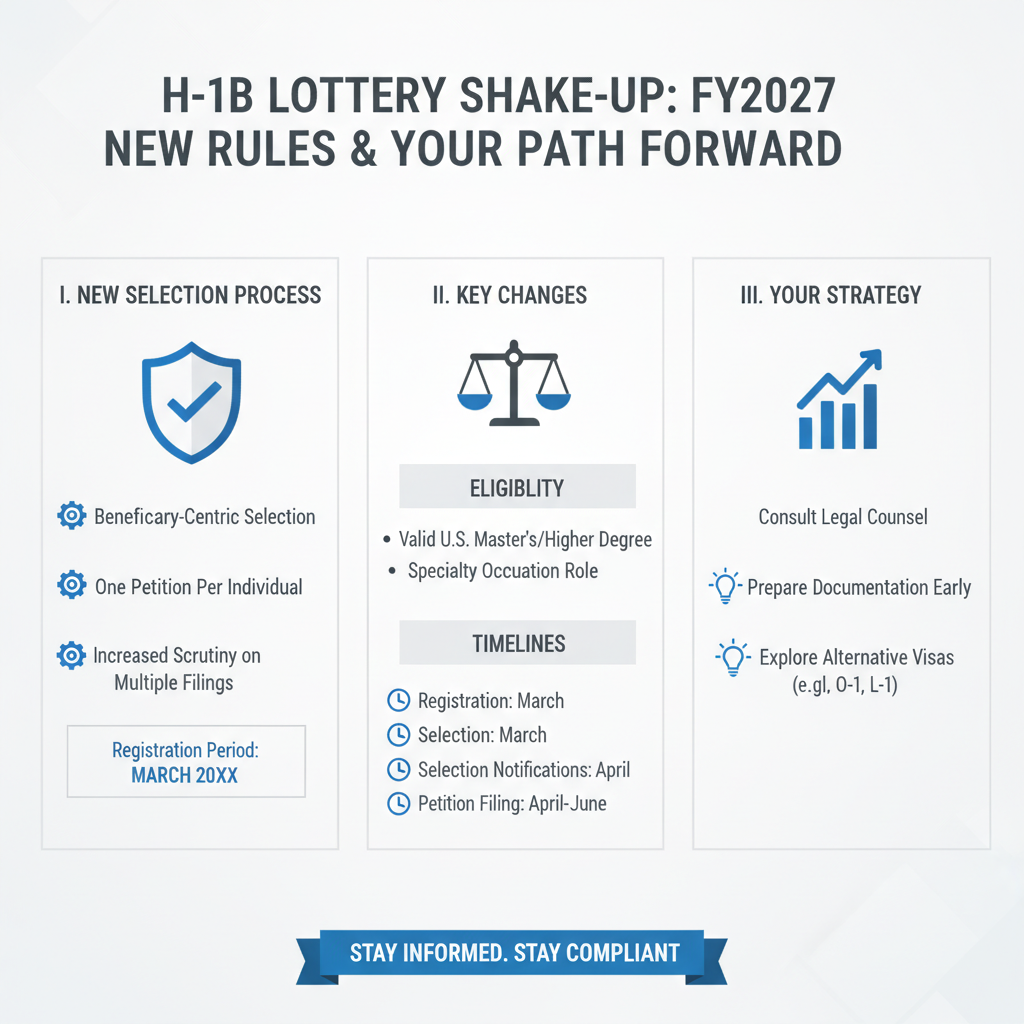
The latest revisions, building on previous integrity measures such as the beneficiary-centric selection process introduced for FY2025, aim to further strengthen the lottery system. These updates are a direct response to ongoing challenges and USCIS's commitment to prioritizing legitimate petitions and minimizing fraudulent registrations.
How it can affect Florida residents
Florida is a vibrant economic hub, attracting significant investment in technology, healthcare, aerospace, and tourism. Cities like Orlando, with its growing tech scene and major universities such as the University of Central Florida (UCF), are prime locations for companies seeking H-1B talent. The new rules for FY2027 will have several key impacts:
- Increased Scrutiny for Employers: Florida-based companies, especially those in fast-growing sectors, must now be even more diligent in their H-1B petition preparation. USCIS is emphasizing the legitimacy of job offers and the employer-employee relationship, particularly for third-party placements.
- Fairer Chances for Beneficiaries: The continued focus on a beneficiary-centric selection process means that each unique individual, regardless of how many employers register them, will have only one chance in the lottery. This levels the playing field, benefiting highly qualified candidates in Orlando and across Florida by reducing the impact of fraudulent multiple registrations.
- Enhanced Data Requirements: Employers in Central Florida and beyond will likely need to provide more detailed information during the initial registration phase, potentially including specific job duties, wage levels, and work locations. This requires more upfront preparation.
- Reduced Fraud: While beneficial overall, the stricter anti-fraud measures may lead to increased scrutiny for some Florida employers who previously engaged in practices now deemed impermissible. This ensures that the limited H-1B visas go to genuine employment opportunities.
- Demand for Legal Expertise: Navigating these changes will be more complex. For Central Florida residents and employers, the need for experienced immigration counsel, such as Imigrar, becomes even more critical to ensure compliance and maximize chances of success.
For those living in Orlando and working for companies along the I-4 corridor, understanding these nuanced changes is not just about compliance; it's about protecting your professional future and ensuring your employer can successfully sponsor your H-1B visa.
Need Help? Our Orlando immigration team is ready to assist. Call +1 786-791-3106 for a free consultation, or message us online. Se Habla Español.
What H-1B Visa Lottery Changes for FY2027 Is (and Why It Matters)
The H-1B visa program allows U.S. employers to temporarily employ foreign workers in specialty occupations. These occupations generally require a bachelor's degree or higher in a specific field. Due to high demand, the number of H-1B petitions often exceeds the annual cap set by Congress, necessitating a lottery system to select eligible registrations.
A plain-English definition
Imagine a highly competitive job where only a limited number of positions are available each year. Thousands of qualified people apply, so to decide who gets an interview, they draw names from a hat. That's essentially the H-1B visa lottery. The "H-1B Visa Lottery Changes for FY2027" refers to new rules that USCIS has put in place for how these names will be drawn and what information is required to get your name into the hat for the fiscal year starting October 1, 2026.
The most significant of these changes, building on previous reforms, is the beneficiary-centric selection process. Instead of employers being able to register the same person multiple times (which inflated the numbers), the lottery now focuses on the individual applicant (the "beneficiary"). This means that each unique beneficiary gets only one chance in the lottery, no matter how many employers want to sponsor them. This is a major step towards making the lottery fairer and reducing the chances of fraud.
Additionally, USCIS has likely implemented stricter requirements for the initial registration, potentially asking for more detailed information upfront. This helps them verify the legitimacy of both the employer and the job offer earlier in the process, aiming to filter out non-serious or fraudulent registrations before the lottery even takes place.
Key terms you need to know
Understanding the jargon is critical for navigating the H-1B process effectively:
- H-1B Visa: A nonimmigrant visa that allows U.S. employers to temporarily employ foreign workers in specialty occupations.
- Specialty Occupation: An occupation that requires a theoretical and practical application of a body of highly specialized knowledge, and a bachelor's or higher degree in the specific specialty (or its equivalent) as a minimum for entry into the occupation in the United States.
- Annual Cap: The congressionally mandated limit on the number of H-1B visas issued each fiscal year. The current annual cap is 65,000, with an additional 20,000 visas reserved for those with a U.S. master's degree or higher (the "master's cap" or "advanced degree exemption").
- Fiscal Year (FY): The U.S. government's fiscal year runs from October 1 to September 30. FY2027 begins on October 1, 2026.
- H-1B Cap-Subject: Refers to petitions filed for workers subject to the annual H-1B cap. Certain organizations (e.g., universities, non-profit research organizations) are "cap-exempt."
- Beneficiary: The foreign worker who will be employed under the H-1B visa.
- Petitioner: The U.S. employer filing the H-1B petition on behalf of the beneficiary.
- H-1B Registration: The electronic process where prospective petitioners (employers) submit basic information about themselves and each prospective H-1B beneficiary to USCIS for the lottery. This occurs before the full petition is filed.
- Lottery (Selection Process): When the number of registrations exceeds the annual cap, USCIS conducts a random selection process to determine which registrations are eligible to file an H-1B petition.
- Labor Condition Application (LCA): Form ETA-9035. An application filed with the U.S. Department of Labor (DOL) by the employer, attesting to certain conditions of employment (e.g., wages, working conditions) before an H-1B petition can be filed with USCIS.
- Beneficiary-Centric Selection: The new rule for FY2027 (building on FY2025) where each unique beneficiary is entered into the lottery only once, regardless of how many different employers submit registrations on their behalf. This prevents multiple entries for the same individual.
- Form I-129: Petition for a Nonimmigrant Worker. The primary form filed by a U.S. employer to request an H-1B nonimmigrant worker.
- Form I-797: Notice of Action. A receipt or approval notice issued by USCIS for various applications, including H-1B petitions.
Current Immigration Law: The Foundation
The H-1B visa program is governed primarily by the Immigration and Nationality Act (INA), specifically Sections 101(a)(15)(H)(i)(b) and 214(g). These statutes establish the framework for specialty occupations, annual caps, and other core requirements. The new changes for FY2027 are implemented through regulatory amendments and policy memos that interpret and enforce these underlying laws.
For the most authoritative and up-to-date information, always refer to the USCIS official website.
Federal requirements
To qualify for an H-1B visa, both the employer and the employee must meet specific federal requirements:
For the Employer (Petitioner):
- Valid U.S. Employer: Must be a legitimate U.S. entity with an Employer Identification Number (EIN).
- Bona Fide Job Offer: Must offer a real job in a specialty occupation that requires a bachelor's degree or higher.
- LCA Approval: Must obtain a certified Form ETA-9035 (Labor Condition Application) from the Department of Labor before filing the H-1B petition with USCIS. This form attests that the employer will pay the H-1B worker at least the prevailing wage or the actual wage paid to other employees with similar experience and qualifications, whichever is higher, and provide working conditions that will not adversely affect other workers.
- Ability to Pay: Must demonstrate the financial ability to pay the offered wage.
For the Employee (Beneficiary):
- Specialty Occupation Qualification: Must meet one of the following criteria:
- Hold a U.S. bachelor's degree or its equivalent required by the specialty occupation.
- Hold a foreign degree equivalent to a U.S. bachelor's degree in a specialty occupation.
- Possess an unrestricted state license, registration, or certification that authorizes them to fully practice the specialty occupation and be engaged in that specialty in the state of intended employment.
- Have work experience equivalent to a bachelor's degree through a combination of education, training, and experience. (Generally, 3 years of professional work experience is considered equivalent to 1 year of college education).
- Master's Cap Eligibility: To qualify for the advanced degree exemption, the beneficiary must hold a U.S. master's or higher degree from a "U.S. institution of higher education" as defined by federal law.
- Non-Immigrant Intent: While H-1B is a "dual intent" visa, meaning you can simultaneously pursue permanent residency, the initial application is for temporary employment.
The H-1B cap is typically reached within the first few days of the registration period. For FY2027, the registration period is expected to open in early March 2026. USCIS will then conduct the lottery and announce selections shortly thereafter, usually by the end of March.
Florida-specific considerations
While immigration law is federal, its impact is felt locally. For Florida residents and employers, several factors are particularly relevant:
- Tech & Healthcare Hubs: Orlando, Tampa, and Miami are burgeoning tech, healthcare, and finance centers. Companies in these areas frequently sponsor H-1B visas for software developers, IT analysts, engineers, medical professionals, and researchers. The Orlando USCIS Field Office may handle certain local inquiries, though most H-1B processing is centralized.
- University Graduates: Florida boasts a robust higher education system, including major institutions like the University of Central Florida (UCF), University of Florida (UF), and University of Miami. Many international students graduating from these universities with STEM (Science, Technology, Engineering, Mathematics) degrees will seek H-1B sponsorship. These graduates often qualify for the master's cap if they earned their advanced degree from a U.S. institution.
- Economic Growth: Florida's strong economic growth means a continuous demand for skilled labor, making the H-1B program vital for businesses looking to expand and innovate.
- Prevailing Wage Determinations: The Department of Labor’s prevailing wage data for specific occupations can vary significantly by geographic area. Employers in Orlando, for example, must ensure they are meeting the prevailing wage requirements for Orange County or the specific metropolitan area where the H-1B worker will be employed.
The new beneficiary-centric lottery system for FY2027 is a positive development for legitimate Florida employers and their prospective H-1B employees, as it aims to prevent unfair competition from fraudulent multiple registrations.
Considering an H-1B for FY2027? Don't navigate the new rules alone. Imigrar's Orlando-based attorneys provide expert guidance. Call us at +1 786-791-3106 for a free consultation. ¡Se Habla Español!
How to Navigate the New H-1B Visa Lottery Rules: A Complete Step-by-Step Guide
Successfully securing an H-1B visa under the new FY2027 rules requires meticulous preparation and adherence to USCIS guidelines. This step-by-step guide outlines the typical process, incorporating the recent changes.
1) Employer Assessment & LCA Filing
Before any H-1B registration can take place, the prospective employer must determine if the position qualifies as a specialty occupation and if the beneficiary meets the requirements. This initial phase is crucial, especially with increased scrutiny on job legitimacy. Once confirmed, the employer must file a Labor Condition Application (LCA).
Required Documents/Actions:
- Detailed Job Description: Clearly outlining duties, responsibilities, and minimum educational requirements.
- Beneficiary's Credentials: Copies of degrees, transcripts, and any professional licenses or evaluations of foreign degrees.
- Wage Determination: Research and determine the prevailing wage for the specific occupation and geographic location (e.g., Orlando, FL). Employers must attest to paying at least the prevailing wage or the actual wage paid to others similarly employed, whichever is higher.
- Filing Form ETA-9035 (LCA): Electronically filed with the U.S. Department of Labor (DOL). This must be certified by the DOL before the H-1B petition can be filed with USCIS. Certification typically takes 7-10 business days.
Important: The LCA must be certified *before* the H-1B petition filing window, but it is not required for the initial H-1B registration.
2) H-1B Electronic Registration for FY2027 Lottery
This is the first critical step for cap-subject H-1B petitions. The registration period for FY2027 is anticipated to open in early March 2026 and last for approximately 2-3 weeks. Under the new beneficiary-centric rules, each unique beneficiary should ideally have only one registration submitted on their behalf. If multiple employers register the same beneficiary, USCIS will consolidate these registrations for lottery purposes, ensuring the beneficiary has only one entry. This is a significant integrity measure to prevent abuse.
Required Documents/Information for Registration:
- Employer Information: Legal name, EIN, mailing address, authorized signatory information.
- Beneficiary Information: Full legal name, date of birth, country of birth, country of citizenship, passport number (optional but recommended), gender, highest degree obtained, whether the degree is from a U.S. institution, and if they qualify for the master's cap.
- Attorney/Representative Information: If applicable, details of the legal counsel.
- Registration Fee: A non-refundable $10 (or new adjusted fee) registration fee per beneficiary.
Warning: Intentional submission of multiple registrations for the same beneficiary by different employers, with knowledge of the new rules, could lead to denial of all petitions for that beneficiary and potential fraud investigations.
3) Lottery Selection & Notification
Once the registration period closes, USCIS conducts the random lottery selection. They first select enough registrations to meet the master's cap, then select from the remaining pool (including unselected master's degree holders) to meet the regular cap. Notifications are typically issued electronically to the registrants (employers or their attorneys) by the end of March 2026.
Required Actions:
- Monitor USCIS Account: Employers or their legal representatives must regularly check their USCIS online accounts for selection notifications.
- Receipt of Selection Notice: If selected, USCIS will issue an H-1B Selection Notice (Form I-797C) with a unique receipt number. This notice will include the designated filing period for the H-1B petition.
4) H-1B Petition Filing
Only selected registrations are eligible to file a full H-1B petition. The filing period is usually a 90-day window, typically from April 1 to June 30, for an October 1 start date. This step involves submitting a comprehensive package to USCIS.
Required Documents (to be submitted with Form I-129):
- Certified LCA (Form ETA-9035): The certified Labor Condition Application.
- H-1B Selection Notice (Form I-797C): Proof of lottery selection.
- Form I-129 (Petition for a Nonimmigrant Worker): Completed and signed by the employer.
- H-1B Data Collection and Filing Fee Exemption Supplement (Part B of Form I-129): Required for all H-1B petitions.
- Employer Letter: A detailed letter from the employer describing the company, the specialty occupation, the beneficiary's qualifications, and the terms of employment.
- Beneficiary's Educational Documents: Copies of degrees, transcripts, diplomas, and foreign degree evaluations.
- Beneficiary's Professional Resume/CV.
- Beneficiary's Passport & Visa Copies: Biographical page, previous visa stamps, I-94 arrival/departure record.
- Employer's Financial Documents: Annual reports, tax returns, bank statements to demonstrate ability to pay.
- Organizational Charts: Showing the beneficiary's position within the company.
- Contracts/Agreements: For third-party placements, detailed contracts between the petitioner and the client company are crucial.
- Fees:
- Form I-129 Filing Fee: $460 (or new adjusted fee)
- American Competitiveness and Workforce Improvement Act (ACWIA) Fee: $750 (for employers with 1-25 full-time equivalent employees) or $1,500 (for employers with 26 or more full-time equivalent employees).
- Fraud Prevention and Detection Fee: $500
- Public Law 114-113 Fee (if applicable): $4,000 (for employers with 50 or more employees, where more than 50% of their workforce are H-1B or L-1 nonimmigrants).
- Premium Processing Fee (Optional): $2,805 (or new adjusted fee) for expedited processing (within 15 calendar days).
Reminder: All fees are subject to change by USCIS. Always check the latest fee schedule on the USCIS Forms page.
5) USCIS Processing & Decision
After filing, USCIS reviews the petition. Processing times can vary significantly. You can check current processing times on the USCIS Processing Times website.
Potential Outcomes:
- Approval (Form I-797 Approval Notice): If approved, the beneficiary can begin working on October 1, 2026 (or later, depending on approval date). If an extension of status was requested, the I-94 is updated. If consular processing was requested, the approval notice is sent to the U.S. consulate abroad.
- Request for Evidence (RFE): USCIS may send an RFE if they need more information or clarification. Responding to an RFE requires careful attention and often legal expertise.
- Denial: If the petition is denied, the employer and beneficiary will receive a denial notice explaining the reasons.
6) Visa Interview (for those outside the U.S.)
If the beneficiary is outside the U.S. at the time of petition approval, they must attend a visa interview at a U.S. embassy or consulate in their home country to obtain the H-1B visa stamp in their passport.
Required Documents for Interview:
- Passport: Valid for at least six months beyond the intended period of stay.
- DS-160 Confirmation Page: Online Nonimmigrant Visa Application confirmation.
- Appointment Confirmation Page.
- Photo: Meeting specific requirements.
- Form I-797 (H-1B Approval Notice).
- LCA (Form ETA-9035).
- Employer Letter: Original job offer letter.
- Educational Documents: Original degrees, transcripts.
- Resume/CV.
- Marriage Certificate/Birth Certificates: For dependents (H-4 visa applicants).
- Consular Interview Fee.
After a successful interview, the visa stamp is placed in the passport, allowing the beneficiary to enter the U.S. in H-1B status.

Practical Steps You Can Take Today
Given the upcoming H-1B lottery changes for FY2027, proactive preparation is more important than ever. Here's an actionable checklist:
- Consult an Experienced Immigration Attorney: This is the most crucial first step. An attorney, like those at Imigrar in Orlando, can assess your eligibility, guide your employer, and help navigate the complex new rules. They can also advise on the nuances of the beneficiary-centric selection and increased scrutiny.
- Verify Employer Commitment: Ensure your prospective employer is fully committed to sponsoring your H-1B and understands the new requirements. Open communication is key.
- Gather All Educational and Professional Documents: Start collecting official transcripts, degree certificates, professional licenses, and detailed resumes. If your degrees are from outside the U.S., consider obtaining a professional foreign credential evaluation now.
- Review Job Description and Qualifications: Work with your employer to ensure the job description clearly aligns with a "specialty occupation" and that your qualifications perfectly match the requirements.
- Understand the Beneficiary-Centric Rules: If multiple employers are interested in sponsoring you, ensure they are aware of the new rules. While multiple registrations for a single beneficiary are now allowed (and consolidated by USCIS), it is critical that *each* employer has a legitimate job offer and intention to hire. Discuss this with your attorney to avoid any appearance of fraud.
- Stay Informed on USCIS Announcements: Regularly check the USCIS website for official updates on the FY2027 registration period, fees, and any further clarifications on the new rules.
- Financial Preparedness (for Employers): Employers should budget for the various H-1B filing fees, which can be substantial.
Document preparation guidance
- Accuracy is Paramount: Double-check all personal and employer information for spelling errors, correct dates, and consistency across all documents.
- Organize Digitally: Scan all documents into clear, high-resolution PDF files. Label them clearly (e.g., "Passport_JohnDoe.pdf", "Degree_UCF_JohnDoe.pdf").
- Translations: Any foreign-language documents must be accompanied by a full English translation certified by a competent translator.
- Keep Originals Safe: Never send original documents unless specifically requested. Always provide copies.
Timeline expectations
While specific dates are announced by USCIS annually, a general timeline for FY2027 would be:
- October 2025 - February 2026: Employer and beneficiary preparation, LCA filing, legal consultation.
- Early March 2026: H-1B Electronic Registration Period opens (typically 2-3 weeks).
- Late March 2026: Lottery selection results announced.
- April 1, 2026 - June 30, 2026: H-1B Petition Filing Window for selected registrations.
- April 2026 - September 2026: USCIS processing of petitions. RFEs may be issued during this time.
- October 1, 2026: Earliest possible start date for approved H-1B beneficiaries.
Reminder: These are approximate dates. Always refer to official USCIS announcements for precise deadlines. Delays can occur, especially if an RFE is issued.
Confused by the H-1B process? Our dedicated team at Imigrar can simplify it for you. We serve clients nationwide from our Orlando, Florida office. Call +
Schedule a free consultation with our attorney-reviewed team todayHave Questions About Your Case?


