


The landscape of U.S. immigration law is constantly evolving, and few areas experience as much change and scrutiny as the H-1B visa program. As an essential pathway for skilled foreign professionals to work in the United States, the H-1B visa is subject to immense demand, often exceeding the annual cap set by Congress. This fierce competition necessitates a lottery system, and recently, the rules governing this lottery have undergone significant modifications. For immigrants and employers in Orlando, across Florida, and nationwide, understanding these changes is paramount for successful planning and application.
At Imigrar, an immigration law firm based in Orlando, Florida, we are committed to keeping families together and helping talented individuals achieve their professional dreams in the U.S. We understand the anxieties and complexities that come with immigration processes, especially those as competitive as the H-1B. Our team of expert immigration attorneys, fluent in both English and Spanish, is here to guide you through every step.
The reporting that sparked this guide
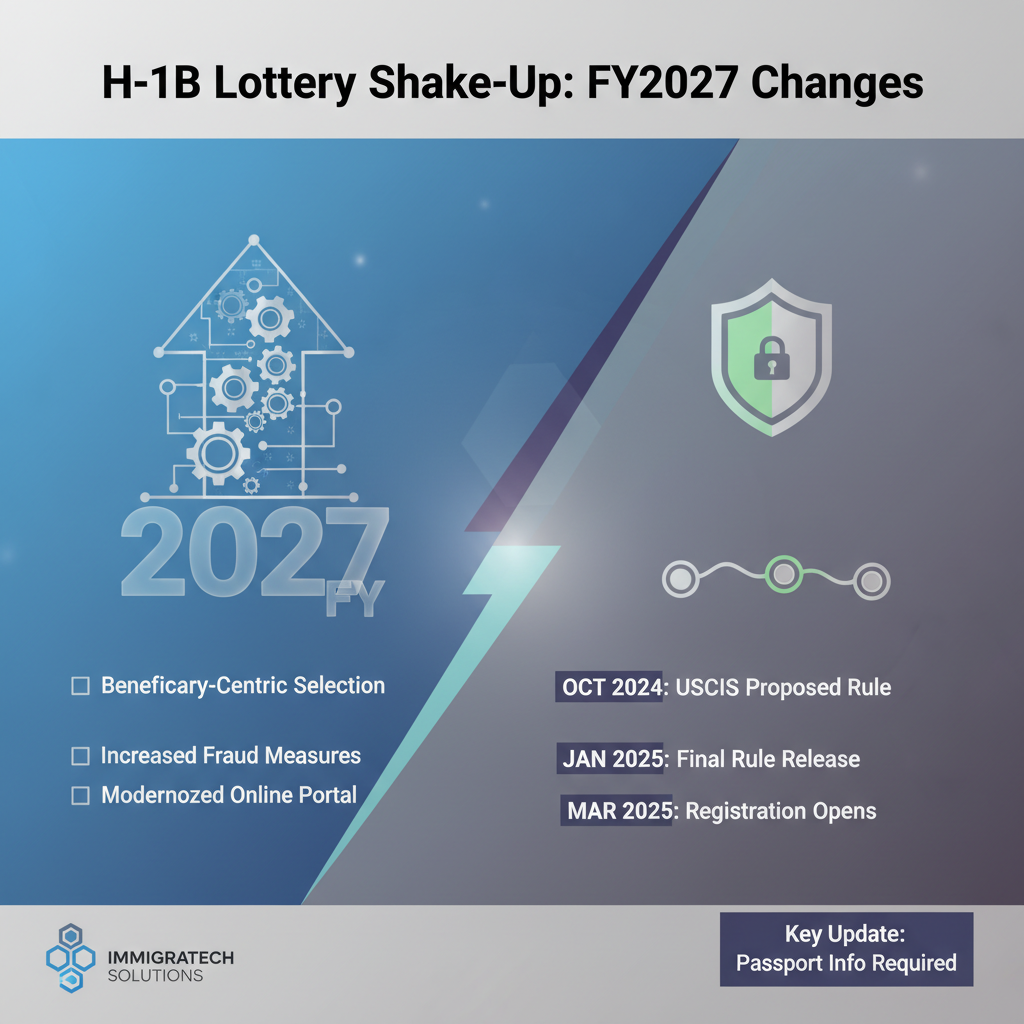
The recent H-1B Visa Lottery Changes for FY2027 (Legal News) have introduced a new framework for how beneficiaries are selected, aiming to enhance fairness and reduce the potential for fraud. These changes directly impact how employers and prospective H-1B workers approach the annual lottery, making expert legal counsel more crucial than ever.
What This News Means for Immigrants in Orlando and Across Florida
The H-1B visa is a lifeline for many seeking to contribute their skills to the U.S. economy. For residents of Florida, a state with a dynamic and growing economy, these changes have particular significance.
Why this news is showing up now
The H-1B visa program is governed by an annual cap, currently set at 65,000 visas for the regular cap and an additional 20,000 for those with a U.S. master's degree or higher. Because demand consistently outstrips supply, U.S. Citizenship and Immigration Services (USCIS) conducts a lottery to select registrations for petition filing. The lottery for Fiscal Year (FY) 2027 typically opened for registration in March 2026, with results announced shortly thereafter. Leading up to and following this period, USCIS often implements or finalizes rule changes to address program integrity, efficiency, or perceived loopholes.
The most recent significant changes, which became fully effective for the FY2025 cap season and therefore applied to FY2027, centered on reforming the lottery selection process. Prior to these changes, it was possible for multiple employers to register the same beneficiary, increasing that individual's chances of selection. This practice, while not illegal, was seen by many, including USCIS, as inflating registration numbers and creating an unfair advantage. The new rules aim to level the playing field by focusing the lottery on the individual beneficiary rather than the number of registrations submitted on their behalf.
How it can affect Florida residents
Florida's economy is a vibrant tapestry of technology, healthcare, tourism, and aerospace industries, all of which rely heavily on skilled foreign talent. Cities like Orlando, Tampa, Miami, and Jacksonville are hubs for companies that frequently sponsor H-1B visas. For example, Central Florida's growing tech sector along the I-4 corridor, including simulation and modeling, IT, and advanced manufacturing, attracts numerous H-1B professionals.
These changes directly impact:
- Prospective H-1B Beneficiaries in Florida: If you are a foreign national currently studying or working in Florida on a different visa (e.g., F-1 OPT, L-1, TN) and aspire to an H-1B, these rules mean a more equitable chance in the lottery. Your selection will now depend solely on your own unique registration, irrespective of how many employers registered for you. This reduces the artificial inflation of odds and ensures that each eligible beneficiary has a truly equal shot.
- Florida Employers: Companies in Orlando and across Florida that sponsor H-1B visas must now adapt their strategies. Instead of encouraging multiple registrations for a single candidate, their focus should shift to ensuring a robust, compliant, and timely single registration for each desired beneficiary. This also means a greater emphasis on identifying and sponsoring the most qualified candidates, as the "numbers game" aspect has been significantly diminished.
- Educational Institutions: Universities and colleges throughout Florida, such as the University of Central Florida, University of Florida, and Florida International University, educate thousands of international students. These students often seek H-1B sponsorship after graduation. The new rules offer them a fairer path to post-graduation employment in the U.S.
The changes underscore the importance of meticulous preparation, accurate information, and strategic planning for both employers and beneficiaries. It’s no longer about maximizing registrations, but about maximizing the quality and integrity of each submission.
Need Help? Navigating the H-1B lottery changes requires expert guidance. Our Orlando immigration team is ready to assist. Call +1 786-791-3106 for a free consultation, or message us online. Se Habla Español.
What H-1B Visa Lottery Changes for FY2027 Is (and Why It Matters)
The H-1B visa program is a cornerstone of U.S. immigration policy, designed to allow U.S. employers to temporarily employ foreign workers in specialty occupations. These are occupations that generally require a bachelor's degree or higher in a specific field, such as IT professionals, engineers, scientists, architects, and certain types of medical professionals. The "lottery changes" for FY2027 refer to the modifications USCIS has made to the random selection process that occurs when the number of H-1B registrations exceeds the annual cap.
A plain-English definition
Imagine a highly sought-after concert where tickets are limited. Instead of everyone rushing to buy tickets, you first register your interest. If too many people register, a lottery is held to decide who gets the chance to buy a ticket. The H-1B visa works similarly. Each year, there's a limit (cap) on how many new H-1B visas can be issued. Because far more people want an H-1B visa than are available, USCIS uses an electronic lottery system. An employer registers a prospective employee (beneficiary) for the lottery. If selected, that employer then gets to file the full H-1B petition. The "changes" for FY2027 mean that USCIS has altered how this lottery is conducted, specifically to ensure that each individual person (beneficiary) only gets one chance in the lottery, no matter how many different companies might want to sponsor them. This is a significant shift from previous years where multiple registrations for one person were allowed, potentially skewing the odds.
Key terms you need to know
Understanding the terminology is crucial for navigating the H-1B process:
- H-1B Visa: A nonimmigrant visa that allows U.S. employers to temporarily employ foreign workers in specialty occupations.
- USCIS (U.S. Citizenship and Immigration Services): The government agency responsible for administering immigration and naturalization applications and benefits. USCIS official website.
- Beneficiary: The foreign national who seeks to obtain the H-1B visa.
- Petitioner: The U.S. employer who sponsors the foreign national for the H-1B visa.
- Specialty Occupation: An occupation that requires theoretical and practical application of a body of highly specialized knowledge and a bachelor's degree or higher in the specific specialty (or its equivalent) as a minimum for entry into the occupation in the United States.
- Annual Cap: The numerical limit set by Congress on the number of H-1B visas issued each fiscal year (currently 65,000 for the regular cap and an additional 20,000 for those with a U.S. master's degree or higher).
- Cap-Subject H-1B: An H-1B petition that is subject to the annual numerical cap.
- Cap-Exempt H-1B: Certain H-1B petitions that are not subject to the annual cap, such as those filed by institutions of higher education, non-profit organizations affiliated with higher education, or governmental research organizations.
- LCA (Labor Condition Application): Form ETA-9035, a certification from the U.S. Department of Labor (DOL) that an employer will pay the H-1B worker at least the prevailing wage for the occupation in the area of employment and will provide working conditions that will not adversely affect other workers.
- Electronic Registration Process: The online system where prospective H-1B employers submit basic information about the company and the beneficiary during a designated registration period. This is the first step for cap-subject H-1B visas.
- Lottery: The random selection process conducted by USCIS when the number of electronic registrations exceeds the annual cap.
- Selection Notice: The notification sent by USCIS to petitioners whose registrations have been selected in the lottery, granting them permission to file an H-1B petition.
- FY2027: Fiscal Year 2027, which begins on October 1, 2026, and ends on September 30, 2027. H-1B visas approved for this cycle will typically have an October 1, 2026, start date.
The core of the recent changes is centered on the integrity of the electronic registration process and the lottery itself. By implementing a "beneficiary-centric" selection process, USCIS aims to eliminate the advantage gained by individuals who had multiple employers submit registrations on their behalf. This means that instead of pooling multiple registrations for one individual, each unique beneficiary is entered into the lottery only once, regardless of how many employers register for them. If selected, USCIS then identifies all valid registrations submitted for that beneficiary and allows any one of those employers to file the H-1B petition.
Current Immigration Law: The Foundation
The H-1B visa program is rooted in federal immigration law, primarily the Immigration and Nationality Act (INA). Understanding these foundational laws is essential, as the new lottery changes operate within this existing legal framework.
Federal requirements
The authority for the H-1B visa is found in the INA at Section 101(a)(15)(H)(i)(b), which defines the H-1B nonimmigrant classification. Further regulations governing the H-1B program are detailed in the Code of Federal Regulations, specifically at 8 CFR 214.2(h). Key federal requirements include:
- Specialty Occupation: The position offered must qualify as a specialty occupation, meaning it requires a bachelor's degree or its equivalent in a specific field.
- Educational Attainment: The beneficiary must hold the required bachelor's or higher degree (or its equivalent) or possess a license to practice in a specialty occupation, or have work experience equivalent to a bachelor's degree.
- Employer-Employee Relationship: A valid employer-employee relationship must exist between the petitioning U.S. employer and the H-1B beneficiary.
- Labor Condition Application (LCA): Before filing an H-1B petition, the employer must obtain a certified LCA (Form ETA-9035) from the U.S. Department of Labor. This ensures that the H-1B worker will be paid at least the prevailing wage or the actual wage paid to similarly employed workers, whichever is higher, and that working conditions will not adversely affect U.S. workers.
- Annual Cap: As mentioned, there's an annual limit of 65,000 H-1B visas, with an additional 20,000 for those with a U.S. master's degree or higher. This cap is the primary reason for the lottery system.
The recent changes to the lottery process were codified under a final rule published by USCIS, updating 8 CFR 214.2(h) and other related sections to implement the "beneficiary-centric" selection process and enhance program integrity. This means the legal framework for the H-1B remains largely the same, but the *method* of selecting who gets to apply under the cap has been significantly altered.
Florida-specific considerations
While immigration law is federal, its impact is felt locally. Florida does not have its own state-specific H-1B visa laws; the federal regulations apply uniformly. However, the unique economic landscape of Florida means these federal laws play out in specific ways:
- High Demand: Florida's booming economy, particularly in sectors like tech, finance, aerospace, and healthcare, means a high concentration of employers seeking H-1B talent. This leads to intense competition in the annual lottery for foreign nationals aspiring to work in cities like Orlando, Miami, and Tampa.
- Orlando's Tech Hub: The Orlando metropolitan area, with its robust simulation and training, digital media, and software development industries, sees a significant number of H-1B applications. The changes to the lottery are especially relevant for local tech companies and the international graduates from universities in Central Florida.
- Local USCIS Office: While H-1B petitions are processed at regional service centers, the Orlando USCIS Field Office handles other immigration matters. For H-1B beneficiaries who may later pursue Adjustment of Status (e.g., to a green card), interactions with local offices become relevant.
Important: All H-1B petitions are filed using Form I-129, Petition for a Nonimmigrant Worker. This form is the core document for requesting H-1B classification. Employers must also be prepared to submit extensive supporting documentation, which we'll detail in the next section.
Need Help? Our Orlando immigration team is ready to assist. Call +1 786-791-3106 for a free consultation, or message us online. Se Habla Español.

How to Navigate the H-1B Process Under New Rules: A Complete Step-by-Step Guide
The H-1B process is complex and requires meticulous preparation. With the new lottery rules for FY2027 in effect, understanding each step is more critical than ever.
1) Employer Assessment and LCA Filing
The process begins with the U.S. employer identifying a need for a foreign worker in a specialty occupation. The employer must confirm that the position meets the H-1B requirements and that the prospective employee has the necessary qualifications.
- Determine Eligibility: The employer must verify that the job position qualifies as a specialty occupation and that the beneficiary possesses the requisite education (bachelor's degree or higher, or its equivalent).
- Prevailing Wage Determination: The employer must determine the appropriate prevailing wage for the occupation in the specific geographic area of employment. This is crucial for the LCA.
- File LCA (Form ETA-9035): The employer must file a Labor Condition Application (LCA) with the U.S. Department of Labor (DOL) for certification. This application attests that the employer will pay the H-1B worker at least the prevailing wage and offer working conditions that meet federal standards. The DOL typically processes LCAs within 7 business days.
Required Documents (for LCA):
- Employer's Federal Employer Identification Number (EIN)
- Company name, address, and contact information
- Job title, duties, and minimum educational/experience requirements
- Proposed wage rate for the H-1B worker
- Prevailing wage determination source and information
- Worksite address(es)
2) H-1B Electronic Registration (Lottery)
Once the LCA is certified (or while it's pending, if confident), the employer registers the beneficiary for the annual H-1B cap lottery during the designated registration period, typically in March each year. For FY2027, this period was March 2026.
- Create a USCIS Online Account: The employer (or their authorized representative, like Imigrar) must have a registrant account on the USCIS online portal.
- Submit Electronic Registration: During the registration window, the employer submits a separate electronic registration for each beneficiary. This includes basic information about the employer and the beneficiary.
Important: Under the new rules, each unique beneficiary can only have one registration submitted on their behalf. If multiple employers wish to sponsor the same beneficiary, they can each submit a registration, but the beneficiary will only be entered into the lottery once. If selected, any of the registering employers can then proceed to file the petition. This is a critical change to prevent individuals from gaining an unfair advantage through multiple employer registrations. - Pay Registration Fee: A non-refundable fee (currently $10 per registration) must be paid at the time of submission.
Required Information (for Registration):
- Employer's legal name, address, and EIN
- Employer's authorized signatory information
- Beneficiary's full legal name, date of birth, country of birth, country of citizenship, passport number
- Beneficiary's gender
- Whether the beneficiary holds a U.S. master's or higher degree (for the master's cap exemption)
- Attorney or representative information (if applicable)
3) Lottery Selection and Petition Filing
After the registration period closes, USCIS conducts the lottery. If a registration is selected, the employer receives a selection notice and can then proceed to file the full H-1B petition.
- Receive Selection Notice: USCIS typically announces lottery results within a few weeks of the registration period closing. If selected, the employer’s online account will show a "Selected" status, and a formal selection notice will be issued.
- Prepare H-1B Petition (Form I-129): The employer then prepares and files Form I-129, Petition for a Nonimmigrant Worker, along with the certified LCA and extensive supporting documentation. This must be filed within the designated filing window, which is usually 90 days from the selection date (e.g., April 1st to June 30th for an April 1st selection).
- Submit Petition: The complete petition package, including all required fees, is mailed to the appropriate USCIS Service Center.
Required Documents (for Form I-129 Petition):
- Certified LCA (Form ETA-9035)
- Beneficiary's educational documents (diplomas, transcripts, foreign degree evaluations)
- Beneficiary's resume/CV
- Letters from previous employers confirming experience
- Copies of beneficiary's passport, visa, I-94 record, and previous I-797 approval notices (if applicable)
- Employer's support letter detailing the job duties, salary, and why the position qualifies as a specialty occupation
- Company documents (business license, tax returns, financial statements, articles of incorporation, organizational charts, marketing materials)
- Client letters or contracts (if the beneficiary will work at a third-party site)
- Any other evidence proving the employer-employee relationship and the specialty nature of the job.
4) Premium Processing (Optional)
For an additional fee, employers can opt for Premium Processing, which guarantees USCIS action (approval, denial, Request for Evidence (RFE), or Notice of Intent to Deny (NOID)) within 15 calendar days.
- File Form I-907: If opting for Premium Processing, the employer files Form I-907, Request for Premium Processing Service, along with the Form I-129 petition or after it has been filed.
- Pay Premium Processing Fee: An additional fee (currently $2,805 as of early 2026) is required for this service.
Required Documents (for Premium Processing):
- Form I-907
- Check or money order for the Premium Processing fee
5) Petition Adjudication and Approval
USCIS reviews the petition. If approved, an Approval Notice (Form I-797) is issued.
- USCIS Review: USCIS adjudicators review the petition and supporting documents. They may issue a Request for Evidence (RFE) if more information is needed.
- Approval: If approved, USCIS sends an Approval Notice (Form I-797). For beneficiaries already in the U.S. and eligible for a change of status, the approval notice will also indicate the change to H-1B status and a new I-94 record. The


