The Reporting That Sparked This Guide
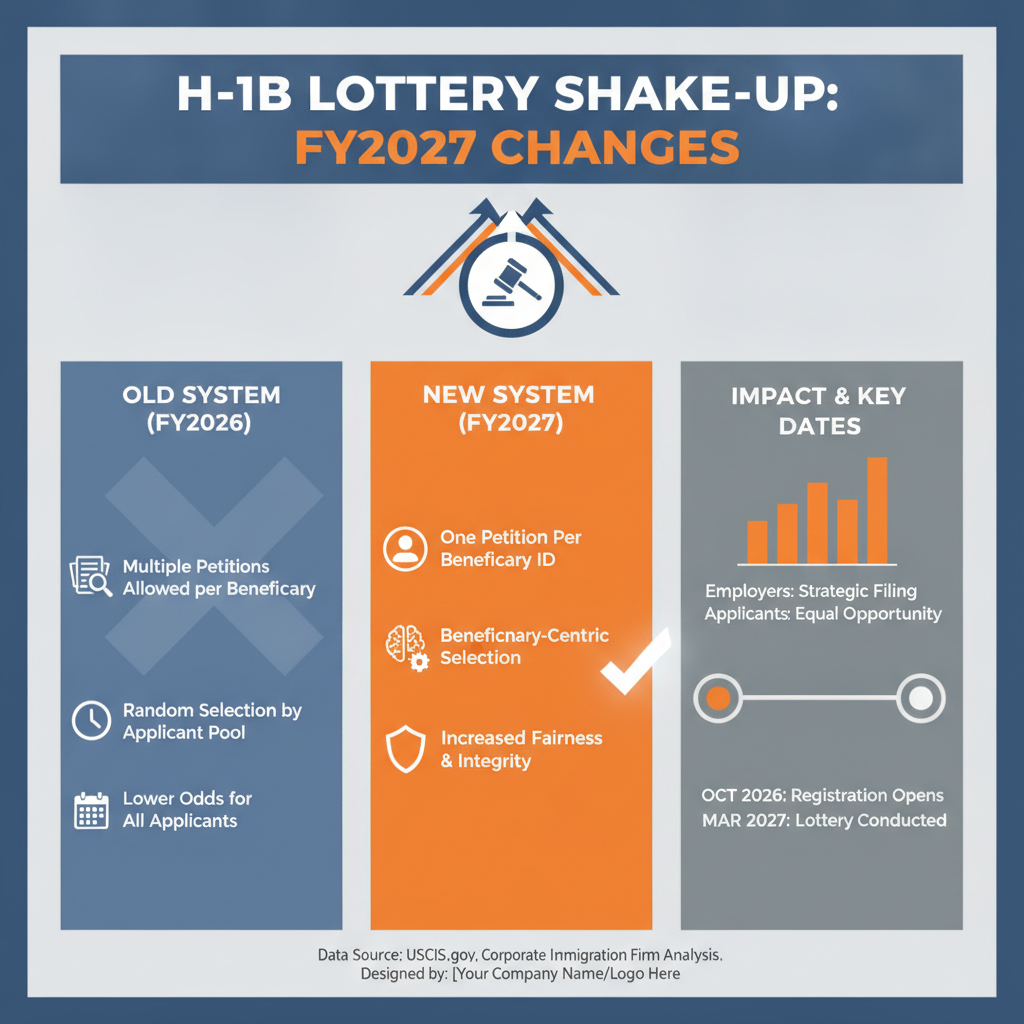
The information presented in this comprehensive guide is based on recent developments in immigration law and policy regarding the H-1B visa program. For further details on the evolving landscape of immigration news, please refer to:
What This News Means for Immigrants in Orlando and Across Florida
The H-1B visa program, a cornerstone for highly skilled foreign professionals seeking to work in the United States, has recently undergone significant changes. These aren't minor tweaks; they represent a fundamental shift in how the annual H-1B cap lottery is conducted, specifically impacting the Fiscal Year 2027 (FY2027) application cycle and beyond. For individuals and businesses in Orlando, Central Florida, and across the nation, understanding these modifications is not just beneficial—it's critical for success.Why this news is showing up now
While the H-1B cap lottery for FY2027 technically concluded its registration phase in March 2026, and petitions are currently being filed or adjudicated, the implications of the new rules are still a trending topic. This is because the FY2027 lottery was the *first* cycle to implement the groundbreaking "per beneficiary" selection process. The results and the ongoing adjudication of these petitions are providing real-world data and insights into how these changes are working, their effectiveness in reducing fraud, and their impact on legitimate applicants. As we look ahead to the next lottery cycle (FY2028, with registration expected in March 2027), the lessons learned and the operational procedures established during FY2027 are paramount. The immigration community, including firms like Imigrar, is actively analyzing these outcomes to better prepare future applicants. The conversation around these changes remains vital as employers and prospective employees strategize for upcoming opportunities.How it can affect Florida residents
Florida, especially vibrant hubs like Orlando, Miami, and Tampa, relies heavily on a diverse and skilled workforce. Industries such as technology, healthcare, tourism, and aerospace frequently sponsor H-1B visas to fill specialty occupation roles. * **For Skilled Professionals in Florida:** If you're an international student graduating from a Florida university (like UCF, UF, or FIU) or a professional working on Optional Practical Training (OPT) in Orlando, these changes directly affect your path to long-term employment in the U.S. The new rules aim to level the playing field, potentially increasing your chances if you have multiple legitimate job offers. However, it also means your employer must be diligent in ensuring their registration is valid and that they are not participating in fraudulent schemes. * **For Florida Employers:** Businesses along the I-4 corridor and throughout the state, from growing tech startups in Orlando's "Medical City" to major theme park operators and healthcare providers, must now adapt their H-1B recruitment strategies. The focus shifts entirely to the individual beneficiary, demanding stricter compliance and ethical practices from employers. This could mean a more transparent and fair system for securing top talent, but it also necessitates a clear understanding of the new registration protocols to avoid costly errors or potential legal repercussions. * **Reduced Fraud and Increased Fairness:** Historically, some employers engaged in practices that artificially inflated registration numbers, diminishing the chances for legitimate candidates. The "per beneficiary" selection model is designed to combat this fraud, ensuring that each unique individual has an equal chance, regardless of how many employers registered them. This creates a fairer system for everyone involved, directly benefiting deserving individuals and the Florida companies seeking to hire them. The H-1B visa remains a critical pathway for highly skilled individuals to contribute to Florida's economy and culture. Understanding these changes is the first step toward successfully navigating this complex process.Need Expert Guidance on H-1B Changes? Don't let new rules complicate your immigration journey. Our Orlando immigration team at Imigrar is here to simplify the process. Call +1 786-791-3106 for a free consultation, or message us online. Se Habla Español.
What H-1B Visa Lottery Changes Are (and Why They Matter)
The H-1B visa program allows U.S. employers to temporarily employ foreign workers in specialty occupations. These occupations generally require a bachelor's degree or higher in a specific field. Due to high demand, the number of H-1B visas issued each fiscal year is capped by Congress, necessitating a lottery system when demand exceeds supply. The recent changes primarily concern *how* this lottery is conducted.A plain-English definition
At its core, the H-1B visa allows a U.S. company to hire a foreign professional for a specific job that requires specialized knowledge and usually a bachelor's degree or higher. Think of it as a temporary work permit for highly skilled individuals. Because more people want H-1B visas than are available each year, USCIS (U.S. Citizenship and Immigration Services) uses a lottery to select who gets to apply. The "changes" for FY2027 mean that this lottery now focuses on the *individual person* (the beneficiary) rather than the *number of times* that person was registered by different employers. Before, one person could be registered multiple times by different companies, potentially skewing the odds. Now, each person gets one fair shot, no matter how many employers want to hire them.Key terms you need to know
Navigating the H-1B process requires understanding specific terminology. Here are the crucial terms, especially in light of the new rules: * **USCIS (U.S. Citizenship and Immigration Services):** The government agency responsible for overseeing lawful immigration to the United States. They administer the H-1B program and conduct the lottery. (USCIS official website) * **H-1B Cap:** The annual limit on the number of H-1B visas issued. Congress currently sets this at 65,000 for the regular cap and an additional 20,000 for those with a U.S. master's degree or higher (the "master's cap"). * **Cap-Subject:** Refers to H-1B petitions that are subject to the annual cap. Most private sector positions fall under this category. * **Cap-Exempt:** Certain employers are exempt from the annual cap, such as institutions of higher education, non-profit organizations affiliated with higher education, and non-profit research organizations. * **Petitioner:** The U.S. employer sponsoring the H-1B visa. * **Beneficiary:** The foreign national employee for whom the H-1B visa is being sought. * **Specialty Occupation:** A job that requires theoretical and practical application of a body of highly specialized knowledge, and a bachelor's or higher degree in the specific specialty (or its equivalent) as a minimum for entry into the occupation. * **LCA (Labor Condition Application):** Form ETA Form 9035. An application filed with the Department of Labor (DOL) by the employer, attesting that they will pay the H-1B worker at least the prevailing wage or the actual wage paid to similarly qualified workers, and that working conditions will not adversely affect other employees. This must be certified before filing the H-1B petition. * **H-1B Registration Period:** A designated window (usually in March) during which prospective employers submit electronic registrations for potential H-1B beneficiaries. This is the stage where the lottery occurs. * **Lottery (Selection Process):** When the number of registrations exceeds the annual cap, USCIS conducts a random selection process. The significant change here is the shift to a *per beneficiary* selection, meaning each unique individual is entered only once, regardless of how many employers register them. * **Selection Notice:** Notification from USCIS to employers whose registrations have been selected in the lottery, granting them permission to file an H-1B petition for that specific beneficiary. * **RFE (Request for Evidence):** A notice from USCIS asking for additional documentation or information to support an H-1B petition. * **Change of Status (COS):** If the beneficiary is already in the U.S. in a valid nonimmigrant status (e.g., F-1 OPT), they can request to change their status to H-1B without leaving the country. * **Consular Processing:** If the beneficiary is outside the U.S. or chooses to leave, they will apply for the H-1B visa stamp at a U.S. embassy or consulate abroad after the petition is approved. These new rules matter immensely because they aim to restore integrity to the H-1B lottery process. By focusing on the unique individual, USCIS seeks to eliminate the unfair advantage gained by some through multiple registrations from affiliated employers, thereby increasing the chances for genuinely qualified candidates and their sponsoring employers. This shift is a significant step towards a more equitable and transparent system.Current Immigration Law: The Foundation
The H-1B visa program operates under specific sections of the Immigration and Nationality Act (INA) and federal regulations. Understanding this legal framework is essential for anyone involved in the H-1B process. The primary legal authority for the H-1B visa is found in the **Immigration and Nationality Act (INA) at Section 101(a)(15)(H)(i)(b)**, which defines the H-1B nonimmigrant classification. Further details regarding eligibility, petition requirements, and duration of stay are outlined in **INA Section 214(g)** (for the annual cap) and **INA Section 214(i)** (defining specialty occupation and dual intent). The regulations governing the H-1B program are found at **8 CFR § 214.2(h)**. These statutes and regulations form the bedrock of the H-1B visa program.Federal requirements
To qualify for an H-1B visa, both the employer and the beneficiary must meet stringent federal requirements: * **For the Position (Specialty Occupation):** The job must qualify as a **specialty occupation**, meaning it requires theoretical and practical application of a body of highly specialized knowledge. This typically means the minimum requirement for the position is a U.S. bachelor's degree or its equivalent in a specific field. Examples include IT professionals, engineers, doctors, architects, and certain types of managers. * **For the Beneficiary:** The foreign national must possess the qualifications required for the specialty occupation, usually a bachelor's degree or higher in the specific field, or its equivalent through a combination of education and experience. They must also hold any necessary licenses to practice the occupation in the specific state (e.g., medical licenses for doctors). * **Employer-Employee Relationship:** There must be a valid employer-employee relationship between the petitioning U.S. employer and the H-1B beneficiary, as defined by USCIS. The employer must have the right to control the beneficiary's work. * **Prevailing Wage:** The employer must attest on the **Labor Condition Application (LCA)** (ETA Form 9035) that they will pay the H-1B worker at least the prevailing wage for the occupation in the area of intended employment, or the actual wage paid to other similarly qualified employees, whichever is higher. This protects both U.S. and foreign workers from unfair wage practices. * **Cap-Subject vs. Cap-Exempt:** Most H-1B petitions are **cap-subject**, meaning they count against the annual numerical limit. However, certain employers, such as universities, government research organizations, and non-profits affiliated with universities, are **cap-exempt**. This means they can file H-1B petitions at any time of the year, and their employees are not subject to the lottery.Florida-specific considerations
While H-1B law is federal, its application has unique nuances in Florida due to the state's diverse economy and rapid growth. * **High Demand in Key Sectors:** Florida's booming technology sector, particularly in the Orlando-Tampa corridor, contributes to a high demand for H-1B workers in IT, software development, and engineering. The state's massive tourism and hospitality industry also requires specialized talent, as do its growing healthcare and aerospace sectors. This high demand means that competition for H-1B visas remains fierce for Florida-based employers and prospective employees. * **Educational Institutions:** Florida is home to numerous top-tier universities, such as the University of Central Florida (UCF) in Orlando, the University of Florida, and Florida International University. Graduates from these institutions often seek H-1B sponsorship, and the universities themselves are significant cap-exempt H-1B employers. * **Orlando USCIS Field Office:** While H-1B petitions are primarily adjudicated by USCIS service centers, the Orlando USCIS Field Office may handle certain related matters, such as interviews for those seeking **Adjustment of Status** from H-1B to green card, or other local inquiries. For the H-1B petition itself, the process is centralized at USCIS service centers. * **State Licensing:** Many **specialty occupations** in Florida require specific state licenses. For example, a foreign national working as a medical doctor, engineer, or architect in Florida must obtain the appropriate state licensing before they can practice, even if their H-1B petition is approved. This is a critical step that must not be overlooked. Understanding the federal requirements and how they intersect with Florida's unique economic and regulatory landscape is crucial for a successful H-1B application. It underscores the importance of working with experienced legal counsel who can navigate both the broad legal framework and the specific regional context. **Important:** All official forms and detailed instructions can be found on the USCIS official website. Always refer to the latest versions. Key forms for the H-1B process include: * **Form ETA Form 9035 (Labor Condition Application):** Filed with the Department of Labor. * **Form I-129 (Petition for a Nonimmigrant Worker):** The primary form for the H-1B petition. * **Form I-907 (Request for Premium Processing Service):** Optional form for expedited processing.How to Navigate the New H-1B Lottery Process: A Complete Step-by-Step Guide
The H-1B visa lottery changes for FY2027 introduced a fundamental shift in the registration and selection process. This guide outlines the steps under the *new* per-beneficiary selection system, applicable for the FY2027 lottery (which concluded its registration phase in March 2026) and onward, including the upcoming FY2028 lottery (registration expected March 2027).1) Employer Assessment & LCA Filing
Before any registration can occur, the employer must assess the position and file a **Labor Condition Application (LCA)**. This is a critical preliminary step. * **Employer's Role:** The U.S. employer must determine if the position qualifies as a **specialty occupation** and if the potential beneficiary meets the minimum educational and experiential requirements. * **Prevailing Wage Determination:** The employer must research and determine the **prevailing wage** for the specific occupation in the geographic area of employment (e.g., Orlando, FL). This ensures fair compensation for H-1B workers. * **LCA Filing:** The employer then files **Form ETA Form 9035**, the Labor Condition Application, with the U.S. Department of Labor (DOL). This form attests that the employer will pay the H-1B worker the higher of the prevailing wage or the actual wage, and that employment conditions will not adversely affect other workers. * **Required Documents (for LCA):** * Detailed job description and requirements. * Prevailing wage determination source (e.g., DOL's FLCDataCenter). * Employer's FEIN (Federal Employer Identification Number). * **Timeline:** The DOL typically processes LCAs within 7 business days. A certified LCA is mandatory before an H-1B petition can be filed.2) H-1B Registration (Per Beneficiary)
This is where the significant FY2027 change comes into play. The lottery selection is now based on unique beneficiaries, not multiple registrations for one person. * **Online Account Creation:** The employer (or their authorized representative, like Imigrar) must create an online registrant account with USCIS. * **Beneficiary Information Submission:** During the designated **H-1B Registration Period** (historically in March), the employer submits an electronic registration for *each unique beneficiary* they wish to sponsor. Each beneficiary can only have *one* registration submitted on their behalf for a given fiscal year, even if multiple employers are interested in sponsoring them. * **Important:** If multiple employers genuinely wish to sponsor the *same beneficiary*, each employer must submit a separate registration. However, the system is designed to identify and treat these as a single entry for that beneficiary in the lottery, preventing duplicate entries from artificially inflating selection odds. * **Registration Fee:** A non-refundable fee (currently $10 per registration) must be paid for each submitted registration. * **Required Information (for Registration):** * Employer's legal name, FEIN, and mailing address. * Employer's authorized signatory information. * Beneficiary's full legal name, date of birth, country of birth, country of citizenship, passport number, and gender. * Beneficiary's highest level of education and institution. * Whether the beneficiary qualifies for the U.S. master's cap. * **Timeline:** The registration period typically opens in early March and lasts for approximately two to three weeks.3) Lottery Selection & Notification
After the registration period closes, USCIS conducts the electronic lottery. * **Random Selection:** If the number of eligible registrations exceeds the annual cap, USCIS conducts a random selection process, first for the **master's cap** and then for the **regular cap**. Under the new rules, this selection is unique per beneficiary. * **Notification:** USCIS notifies selected registrants (employers) through their online accounts. The **selection notices** indicate that the employer is eligible to file an H-1B petition for the named beneficiary. Non-selected registrants are also notified. * **Important:** Being selected in the lottery does *not* guarantee H-1B approval; it only grants the employer permission to file a full petition. * **Timeline:** Lottery results are typically announced by late March or early April.4) H-1B Petition Filing (Form I-129)
Only employers with a selected registration can proceed to this step. This is the comprehensive application phase. * **Petition Preparation:** The employer, usually with the assistance of an immigration attorney, prepares and files **Form I-129**, Petition for a Nonimmigrant Worker, along with extensive supporting documentation. * **Supporting Documents:** This package must include detailed evidence demonstrating the **specialty occupation** nature of the job, the beneficiary's qualifications, the employer's ability to pay the wage, and the certified LCA. * **Filing Window:** USCIS specifies a filing window (e.g., April 1 to June 30) during which selected petitions must be submitted. * **Required Documents (for Form I-129):** * Certified **LCA** (ETA Form 9035). * Employer's support letter detailing the job, beneficiary's qualifications, and why the position is a **specialty occupation**. * Beneficiary's educational degrees, transcripts, and foreign credential evaluations. * Beneficiary's resume/CV. * Copies of beneficiary's passport, visa, I-94 record, and previous U.S. immigration documents (e.g., EAD for OPT). * Employer's financial statements, tax returns, and business licenses to prove ability to pay and legitimate business operations. * Detailed contracts, statements of work, and client letters for third-party placement cases. * Photographs meeting USCIS specifications. * Any relevant professional licenses (e.g., Florida state licenses). * **Timeline:** The filing window is typically 90 days, starting from April 1st. Missing this deadline will result in denial.5) USCIS Processing & RFE Response
Once filed, USCIS reviews the petition. * **Initial Review:** USCIS conducts an initial review of the petition package. * **Requests for Evidence (RFEs):** It is common for USCIS to issue an **RFE** if they require more information or clarification on any aspect of the petition (e.g., specialty occupation, employer-employee relationship, beneficiary qualifications). * **Response to RFE:** A prompt and thorough response to an RFE is crucial. This typically involves submitting additional documents and a legal argument supporting the petition. * **Premium Processing (Optional):** Employers can opt for **premium processing** by filing Form I-907 and paying an additional fee, guaranteeing USCIS action (approval, denial, RFE, or Notice of Intent to Deny) within 15 calendar days. * **Timeline:** Regular processing times can vary significantly, from several months to over a year. Check USCIS Processing Times for current estimates. RFE responses typically have a deadline of 60 to 90 days.6) Petition Approval & Visa Stamping/Change of Status
The final stage involves the approval of the petition and the beneficiary obtaining their H-1B status. * **Petition Approval (Form I-797):** If approved, USCIS sends an I-797 Approval Notice. * **Change of Status (COS):** If the beneficiary is already in the U.S. and maintains valid nonimmigrant status, their status will automatically change to H-1B on October 1st (the start of the fiscal year), provided the petition requested a change of status. * **Consular Processing:** If the beneficiary is outside the U.S., or if the petition did not request a change of status, they must attend an interview at a U.S. embassy or consulate in their home country to obtain the H-1B visa stamp. * **Required Documents (for Consular Processing):** * Original I-797 H-1B Approval Notice. * Valid passport. * DS-160 confirmation page. * Appointment confirmation page. * Passport-style photographs. * Educational and professional documents (degrees, transcripts, resume). * Employment verification letter from the petitioning employer. * Proof of financial support. * **Timeline:** Consular processing times vary by embassy. Check the U.S. Department of State website for current wait times. This detailed process highlights the complexity and the strict adherence required at each stage. The new lottery rules emphasize individual eligibility and legitimate employer intent, making professional legal guidance more valuable than ever.