Immigration Law

H-1B Lottery Shake-Up: FY2027 Changes & Your Path to a U.S.

Published July 30, 2026Leer en Español
William J. Vasquez, Esq.
Reviewed by William J. Vasquez, Esq.
H-1B Lottery Shake-Up: FY2027 Changes & Your Path to a U.S.
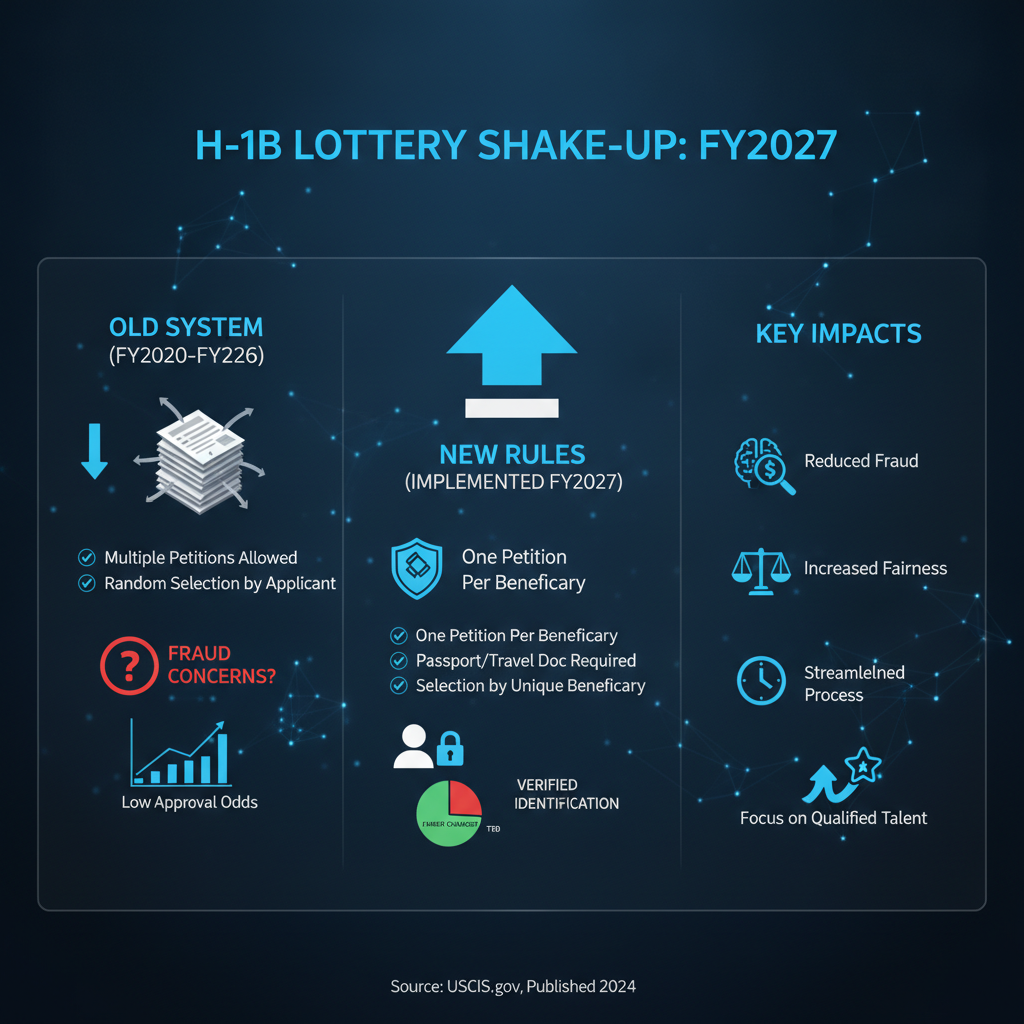
H-1B Visa Lottery Changes for FY2027 (Legal News) ## What This News Means for Immigrants in Orlando and Across Florida The H-1B visa program is a cornerstone for many skilled professionals seeking to contribute their talents to the U.S. economy. For years, the overwhelming demand for these visas has necessitated a lottery system, and each year, new rules and refinements emerge, directly impacting the hopes and plans of countless individuals and employers. The recent legal news regarding **H-1B visa lottery changes for FY2027** is critically important, particularly for those in technology, healthcare, education, and other specialty occupations throughout Florida. ### Why this news is showing up now As of July 30, 2026, we are well past the initial registration and selection period for the **FY2027 H-1B lottery** (which typically occurs in March of the calendar year preceding the fiscal year, meaning March 2026 for FY2027). The "news" surfacing now likely pertains to several key areas: 1. **Post-Lottery Clarifications and Enforcement:** USCIS often issues clarifications, policy memos, or announces enhanced enforcement measures *after* a lottery cycle, based on observations and data from the recently concluded registration and petition filing period. These could address ambiguities, strengthen fraud detection, or refine existing processes for future cycles. 2. **Lessons Learned from Recent Cycles:** The beneficiary-centric selection process, a significant change implemented for FY2025, has now completed its second full cycle (FY2026) and potentially its third (FY2027). USCIS is likely analyzing the effectiveness of these changes in combating fraud and ensuring a fairer selection, leading to new guidance or adjustments for **FY2028** and beyond, which are being discussed now. 3. **Anticipation of Future Rules:** The immigration landscape is constantly evolving. Discussions around legislative reforms or administrative adjustments, even if not immediately implemented, can create significant "news" as stakeholders prepare for potential shifts. This news helps keep the community informed about what might be coming down the pipeline. For anyone who participated in the **FY2027 H-1B lottery**, or is planning to participate in future lotteries, understanding these ongoing developments is crucial. It dictates how petitions are filed, what evidence is required, and what the overall chances of success might be. ### How it can affect Florida residents Florida's economy is diverse and growing, with significant demand for skilled workers in various sectors. * **Tech Hubs:** Cities like Orlando, Tampa, and Miami are burgeoning technology hubs, attracting IT professionals, software developers, and engineers who often rely on the H-1B visa. Changes to the lottery directly impact the ability of Florida tech companies to recruit and retain international talent. * **Healthcare Industry:** Florida has a large and aging population, creating a constant need for doctors, nurses, and other medical professionals. Many foreign-trained healthcare workers utilize the H-1B visa, making these changes highly relevant to hospitals and clinics across the state. * **Tourism and Hospitality:** While less common for direct H-1B, specialized roles in tourism management, data analytics, or international marketing within Florida’s vast tourism sector can also be H-1B eligible. * **Higher Education:** Florida boasts numerous universities and research institutions that sponsor H-1B visas for professors, researchers, and other academic staff. * **Orlando USCIS Field Office:** For those in Central Florida, the local **Orlando USCIS Field Office** plays a role in processing certain applications related to H-1B status changes or extensions, and understanding national policy shifts is vital for local practitioners and applicants. These changes can mean increased scrutiny on petitions, new documentation requirements, or shifts in the overall strategy for employers and beneficiaries. For example, enhanced fraud detection measures might lead to more **Requests for Evidence (RFEs)**, requiring applicants and their employers to provide more robust documentation proving a bona fide job offer and specialty occupation eligibility. This directly impacts the lives and careers of those living and working along the **I-4 corridor** and beyond, from Jacksonville to Naples.

Need Clarity on H-1B Changes? The H-1B process is complex and evolving. Don't navigate it alone. Our Orlando immigration team at Imigrar is ready to assist you and your employer. Call +1 786-791-3106 for a free consultation, or message us online. Se Habla Español.

H-1B Lottery Shake-Up: FY2027 Changes & Your Path to a U.S. - Key Statistics

Call Us Now: +1 786-791-3106

## What the H-1B Visa Is (and Why It Matters) The **H-1B visa** is a non-immigrant visa that allows U.S. employers to temporarily employ foreign workers in **specialty occupations**. These occupations generally require a bachelor's degree or higher in a specific field. The H-1B program is vital for U.S. companies that need to fill positions requiring highly specialized knowledge and skills that may be in short supply in the U.S. workforce. ### A plain-English definition Think of the H-1B visa as a special work permit for highly skilled professionals. If a U.S. company needs someone with a specific university degree (like in engineering, computer science, medicine, or architecture) for a job that requires that degree, and they can't find a qualified U.S. worker, they can sponsor a foreign national for an H-1B visa. This visa allows the foreign national to work in the U.S. for that employer for an initial period of three years, extendable up to a maximum of six years. ### Key terms you need to know Understanding the **H-1B process** requires familiarity with several key terms: * **Specialty Occupation:** A job that requires theoretical and practical application of a body of highly specialized knowledge, and a bachelor's or higher degree in the specific specialty (or its equivalent) as a minimum for entry into the occupation. * **Cap-Subject H-1B:** Most H-1B visas are subject to an annual numerical limit, or "cap." Currently, this cap is 65,000 visas each fiscal year, with an additional 20,000 visas reserved for those with a U.S. master's degree or higher (the "Master's Cap"). * **Cap-Exempt H-1B:** Certain employers are exempt from the annual cap. These include institutions of higher education, non-profit organizations related to or affiliated with institutions of higher education, and non-profit research organizations or governmental research organizations. * **Beneficiary:** The foreign national who seeks the H-1B visa. * **Petitioner:** The U.S. employer who files the H-1B petition on behalf of the beneficiary. * **Labor Condition Application (LCA):** **Form ETA-9035**. An application filed by the employer with the U.S. Department of Labor (DOL) attesting that they will pay the H-1B worker at least the prevailing wage or the actual wage, whichever is higher, and will provide working conditions that do not adversely affect other workers. This must be certified before the H-1B petition can be filed with USCIS. * **USCIS:** U.S. Citizenship and Immigration Services. The government agency that processes immigration benefits, including H-1B petitions. * **DHS:** Department of Homeland Security, which oversees USCIS. * **DOL:** Department of Labor. * **Fiscal Year (FY):** The U.S. government's fiscal year runs from October 1 to September 30. H-1B visas are allocated for a specific fiscal year (e.g., **FY2027** visas are for work starting October 1, 2026). * **H-1B Cap Registration (Lottery):** Due to demand exceeding the annual cap, USCIS conducts an electronic registration process. Employers register prospective H-1B beneficiaries, and USCIS conducts a lottery to select enough registrations to meet the annual cap. * **Premium Processing:** An optional service offered by USCIS for certain petitions, including H-1B, which guarantees processing within a specific timeframe (currently 15 calendar days) for an additional fee. * **Request for Evidence (RFE):** A formal request from USCIS for additional documentation or information to support an H-1B petition. * **Cap-Gap Extension:** A provision that allows certain F-1 students whose H-1B petitions are filed and accepted to extend their **F-1 status** and work authorization beyond their OPT end date until the H-1B start date of October 1. ## Current Immigration Law: The Foundation The legal framework for the H-1B visa program is primarily found within the **Immigration and Nationality Act (INA)**, specifically **INA § 101(a)(15)(H)(i)(b)**, which defines the H-1B nonimmigrant classification. Further regulations are codified in the Code of Federal Regulations (CFR) at **8 CFR § 214.2(h)**. These laws and regulations outline the eligibility requirements for both employers and beneficiaries, the application process, and the numerical limitations. ### Federal requirements The core federal requirements for an H-1B visa include: * **Specialty Occupation:** The offered position must qualify as a specialty occupation. This means the job duties must be complex enough to require a bachelor's degree or higher in a specific field. * **Beneficiary's Qualifications:** The beneficiary must possess the required degree (or its equivalent through a combination of education and experience) for the specialty occupation. Foreign degrees must be evaluated to determine U.S. equivalency. * **Employer-Employee Relationship:** There must be a valid employer-employee relationship, meaning the petitioning employer has the right to control the H-1B worker's employment. * **Certified LCA:** The employer must file and obtain a certified **Labor Condition Application (Form ETA-9035)** from the U.S. Department of Labor. This ensures that the H-1B worker will be paid at least the prevailing wage for the occupation in the area of intended employment, or the actual wage paid to other employees with similar experience and qualifications, whichever is higher. * **Numerical Cap:** For cap-subject H-1B visas, the employer must successfully register the beneficiary in the annual lottery and receive a selection notice from USCIS. ### Florida-specific considerations While H-1B laws are federal, their practical application has localized nuances. For Florida residents and businesses: * **Prevailing Wage Determinations:** The **Department of Labor's Online Wage Library** provides prevailing wage data specific to geographic areas, including various regions within Florida (e.g., Orlando-Kissimmee-Sanford, Miami-Fort Lauderdale-West Palm Beach). Employers must ensure their LCA complies with these local wage standards. * **Industry Demand:** Florida's major industries – tourism, aerospace, healthcare, and increasingly technology – influence the types of H-1B petitions filed. USCIS officers are familiar with the common occupations in these sectors. * **Orlando USCIS Field Office:** While H-1B petitions are centrally processed by USCIS service centers, the **Orlando USCIS Field Office** handles interviews for certain related processes, such as **Adjustment of Status (Form I-485)**, though less directly involved in initial H-1B petition adjudication. For Central Florida residents, understanding the local office's role in related immigration matters is important. * **Florida Universities:** Many large universities in Florida (e.g., University of Central Florida, University of Florida, Florida State University) are **cap-exempt** H-1B employers, allowing them to petition for foreign faculty and researchers outside the annual lottery. All H-1B petitions are filed using **Form I-129, Petition for a Nonimmigrant Worker**. If an employer wishes to expedite processing, they can file **Form I-907, Request for Premium Processing Service**. For the most accurate and up-to-date information, always refer to the USCIS official website. ## How to Apply for an H-1B Visa: A Complete Step-by-Step Guide The H-1B visa application process is intricate, especially with the annual lottery and recent changes. This guide focuses on the **cap-subject H-1B** process, which involves the lottery. ### 1) Employer Determines Eligibility & Files LCA The first crucial step lies with the employer. They must determine if the position qualifies as a **specialty occupation** and if the potential beneficiary meets the academic requirements. * **Job Analysis:** The employer analyzes the job duties to ensure they require a bachelor's degree or higher in a specific field. * **Prevailing Wage Determination:** The employer must obtain a prevailing wage determination for the specific occupation and geographic location (e.g., Orlando, FL) from the **Department of Labor (DOL)**. This ensures fair compensation for the H-1B worker. * **Labor Condition Application (LCA) Filing:** The employer files **Form ETA-9035, Labor Condition Application**, with the DOL. This form attests to compliance with wage and working condition requirements. The DOL typically certifies the LCA within 7-10 business days. **Important:** A certified LCA is mandatory before an H-1B petition can be filed with USCIS. **Required Documents for this step (Employer):** * Detailed job description * Information on the employer's business and industry * Wage data (e.g., from DOL's Online Wage Library) ### 2) H-1B Cap Registration (Lottery) This is where the recent **FY2027 H-1B lottery changes** are most relevant. Since **FY2025**, USCIS has implemented a beneficiary-centric selection process to reduce fraud. * **Registration Window:** Typically, in March of the calendar year preceding the fiscal year (e.g., March 2026 for FY2027). The employer (or their authorized representative) electronically registers each prospective H-1B beneficiary. * **Beneficiary-Centric Selection:** Each unique beneficiary can only be registered *once* per fiscal year, regardless of how many employers register for them. If multiple employers register the same beneficiary, USCIS will consider all valid registrations for that beneficiary, but the beneficiary's name is only entered into the lottery once. This aims to prevent individuals from gaining an unfair advantage through multiple registrations. * **Registration Fee:** A small, non-refundable fee (e.g., $10 for FY2027, though subject to change) is required per registration. * **Lottery Selection:** USCIS conducts the lottery, typically selecting enough registrations to meet the annual cap (65,000 regular cap + 20,000 Master's cap). * **Notification:** Employers are notified of selection status via their **USCIS online account**. Selected registrations receive a selection notice, which includes instructions for filing the H-1B petition. Non-selected registrations are also notified. **Required Information for this step (Employer):** * Employer's legal name, EIN, and address * Beneficiary's full name, date of birth, country of birth, country of citizenship, passport number * Beneficiary's gender * Beneficiary's highest degree attained and the name of the U.S. institution (if applicable) * Whether the beneficiary is eligible for the Master's Cap ### 3) Petition Filing (Upon Selection) If a registration is selected, the employer can then proceed with filing the full **H-1B petition**. * **Filing Window:** Employers have a specific **90-day window** (e.g., April 1 to June 30 for FY2027) to file the **Form I-129, Petition for a Nonimmigrant Worker**, along with all supporting documentation and the certified LCA. * **Comprehensive Documentation:** This stage requires extensive evidence to prove eligibility for both the employer and the beneficiary. * **Fees:** Various filing fees are required, including the base filing fee, ACWIA fee, fraud prevention and detection fee, and potentially a public law fee for certain employers. * **Premium Processing (Optional):** Employers may opt to file **Form I-907, Request for Premium Processing Service**, for expedited adjudication. **Required Documents for this step (Employer & Beneficiary):** * Certified **Form ETA-9035 (LCA)** * **Form I-129, Petition for a Nonimmigrant Worker** * Employer's letter of support (petition letter) * Evidence of specialty occupation (e.g., job description, organizational charts, industry analyses) * Beneficiary's educational documents (degree certificates, transcripts, foreign degree evaluations) * Beneficiary's resume/CV * Professional licenses (if applicable) * Expert opinion letters (if specialty occupation or degree equivalency is challenged) * Employer's financial statements, tax returns, and business licenses (proving ability to pay and business viability) * Copies of beneficiary's passport, visa, **Form I-94**, previous **I-797 approval notices** (if applicable) * **Form I-907** and fee (if requesting Premium Processing) ### 4) USCIS Processing & Adjudication Once the petition is filed, USCIS reviews the case. * **Receipt Notice:** USCIS issues a **Form I-797C, Notice of Action**, acknowledging receipt of the petition. * **Adjudication:** A USCIS officer reviews the petition and supporting documents. * **Request for Evidence (RFE):** It is common to receive an RFE if USCIS requires more information or clarification on any aspect of the petition (e.g., specialty occupation, employer-employee relationship, beneficiary qualifications). Responding to an RFE accurately and promptly is crucial. * **Approval/Denial:** If approved, USCIS issues **Form I-797, Approval Notice**. If denied, an explanation is provided. **Reminder:** USCIS processing times can vary significantly. Check the USCIS Processing Times page for current estimates. ### 5) Visa Interview (for those outside U.S.) / Change of Status (for those inside U.S.) The next steps depend on whether the beneficiary is inside or outside the U.S. * **Consular Processing (Outside U.S.):** If the beneficiary is outside the U.S., they will attend a visa interview at a U.S. embassy or consulate in their home country. Upon approval, the H-1B visa stamp will be placed in their passport, allowing them to enter the U.S. * **Change of Status (Inside U.S.):** If the beneficiary is already in the U.S. in a valid non-immigrant status (e.g., F-1 OPT, L-1, H-4), and the H-1B petition requested a change of status, then upon approval, their status automatically changes to H-1B on October 1st. No interview is typically required. **Required Documents for Visa Interview (Consular Processing):** * Valid passport * **Form DS-160, Online Nonimmigrant Visa Application** confirmation page * Appointment confirmation page * **Form I-797, H-1B Approval Notice** * LCA * Employer's petition letter * Educational documents, resume * Photographs * Proof of ties to home country (optional but recommended) ### 6) Visa Stamping / Approval & Start Date * **Visa Stamping:** For those undergoing consular processing, the H-1B visa stamp is placed in the passport. * **Approval:** For those changing status in the U.S., the **Form I-797 Approval Notice** serves as proof of status. * **Start Date:** H-1B visas for cap-subject petitions generally become effective on **October 1st** of the fiscal year for which they are approved (e.g., October 1, 2026, for **FY2027**). The beneficiary can begin working for the petitioning employer on or after this date. ## Practical Steps You Can Take Today Even if the **FY2027 H-1B lottery** has passed, or you're looking ahead to **FY2028**, there are crucial steps you can take now to prepare and increase your chances of success. ### Actionable checklist: * **1. Review Your Credentials:** Ensure your academic degrees, transcripts, and professional experience align perfectly with your target **specialty occupation**. If you have foreign credentials, consider getting a **U.S. equivalency evaluation** proactively. * **2. Build a Strong Resume/CV:** Detail your skills, projects, and achievements that directly relate to your desired H-1B role. Highlight any specialized knowledge. * **3. Network Strategically:** Connect with employers in your field, especially those known to sponsor H-1B visas. For Central Florida residents, explore opportunities in the tech parks near UCF, or healthcare systems around Orlando. * **4. Understand the Role:** Have a clear understanding of the job duties and how they meet the **specialty occupation** criteria. This is critical for both you and your potential employer. * **5. Research Potential Employers:** Identify companies that have a history of sponsoring H-1B visas and understand their requirements. Check if they are **cap-exempt** (universities, non-profits) if that applies to your situation. * **6. Stay Informed:** Regularly check the USCIS official website and reputable immigration news sources for updates on policies, fees, and timelines for upcoming lottery cycles. * **7. Consult with an Immigration Attorney:** This is perhaps the most important step. An experienced attorney can assess your eligibility, advise your employer, and guide you through the complex process. ### Document preparation guidance Start gathering essential documents well in advance. Having everything organized will streamline the petition filing process, especially if you're selected in the lottery. * **Personal Documents:** * Valid passport (ensure it has at least 6 months validity beyond your intended stay) * Birth certificate * Marriage certificate (if applicable) * Previous U.S. visas and **I-94 arrival/departure records** * All previous **I-20s (for F-1 students)** or **DS-2019s (for J-1 exchange visitors)** * Any previous **I-797 Approval Notices** from USCIS * **Educational Documents:** * Original or certified copies of all university degrees and diplomas * Official academic transcripts from all post-secondary institutions * Detailed course descriptions (especially for foreign degrees) * **Foreign degree evaluation** report (if applicable) * **Professional Documents:** * Comprehensive resume/CV * Letters of recommendation from previous employers/professors * Professional licenses or certifications (if required for your occupation) * Evidence of specialized skills (e.g., portfolio, publications, awards) * **Employer Documents (to be prepared by employer, but you should be aware):** * Detailed job offer letter * Company profile, brochures, and organizational charts * Evidence of financial stability (tax returns, annual reports) * Certified **LCA (Form ETA-9035)** ### Timeline expectations The

Have Questions About Your Case?

Schedule a free consultation with our attorney-reviewed team today