


The landscape of U.S. immigration is constantly evolving, and few areas see as much change and as high a demand as the H-1B specialty occupation visa program. For Fiscal Year 2027 (FY2027), significant changes to the H-1B visa lottery system have reshaped how employers and foreign national beneficiaries approach this critical pathway to skilled employment in the United States. At Imigrar, an Orlando-based immigration law firm dedicated to keeping families together, we understand the profound impact these changes have on individuals, families, and businesses.
This comprehensive guide breaks down the new rules, offers practical advice, and outlines the steps necessary to navigate the H-1B process successfully. Whether you are an aspiring H-1B worker in Orlando, an employer across Florida, or an international talent nationwide, understanding these updates is crucial for your future.
The reporting that sparked this guide
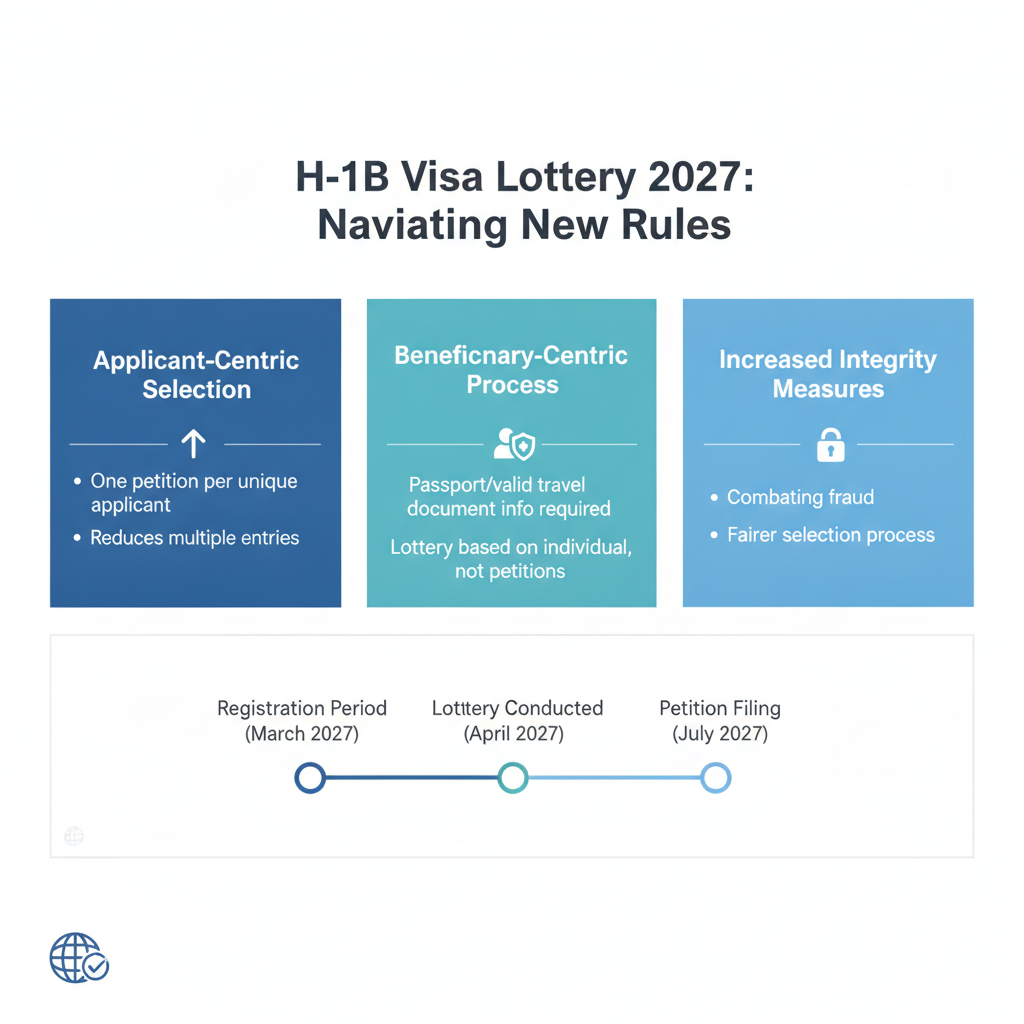
Our commitment to providing timely and accurate information is driven by the dynamic nature of immigration law. The changes discussed in this guide, particularly those affecting the H-1B visa lottery for FY2027, have been a focal point in legal news and policy discussions.
H-1B Visa Lottery Changes for FY2027 (Legal News)
What This News Means for Immigrants in Orlando and Across Florida
The H-1B visa program is a cornerstone for U.S. companies seeking to employ highly skilled foreign workers in specialty occupations. These roles often require a bachelor's degree or higher in a specific field, encompassing critical sectors like technology, engineering, medicine, and education. For Florida, a state experiencing rapid growth in tech, healthcare, and tourism, the H-1B visa is vital for sustaining economic development and innovation. The recent changes to the lottery system, effective for FY2027, carry significant implications for everyone involved.
Why this news is showing up now
As of June 18, 2026, the H-1B visa landscape for FY2027 is still very much in motion. The U.S. Citizenship and Immigration Services (USCIS) concluded the initial H-1B cap registration period in March 2026, and the lottery selection results were announced by late March/early April 2026. Currently, we are well within the April 1, 2026, to June 30, 2026, filing window for employers whose registrations were selected. This means thousands of employers and beneficiaries are actively preparing and submitting their detailed H-1B petitions. The "news" is trending because the *impact* of the new beneficiary-centric selection rule is now being fully realized as petitions are filed and adjudicated. Individuals and employers are grappling with how these changes affect their strategies, processing times, and overall chances of success. It's a period of intense activity and critical decision-making for those hoping to secure an H-1B visa for the fiscal year beginning October 1, 2026.
How it can affect Florida residents
Florida, particularly Central Florida, is a hub for innovation, technology, and diverse industries that heavily rely on skilled foreign talent. Cities like Orlando, Tampa, and Miami have burgeoning tech sectors, world-class universities, and significant healthcare industries. The H-1B visa allows these sectors to bring in the specialized expertise needed to thrive. For Florida residents, especially those on F-1 student visas nearing graduation or those with Opt-in status looking for long-term opportunities, the H-1B is often the next crucial step. The new rules directly impact their strategy:
- Increased Clarity for Beneficiaries: The beneficiary-centric approach reduces the potential for fraud, meaning a single individual can only have one registration submitted on their behalf in a given lottery year, even if multiple employers are interested. This theoretically levels the playing field for genuine candidates.
- Employer Strategy Shift: Florida employers, from tech startups in the Orlando innovation district to established corporations along the I-4 corridor, must now focus on submitting a single, strong registration for their desired candidate, rather than relying on multiple registrations through various affiliates.
- Impact on Local Talent Pool: The changes are intended to ensure that the H-1B program serves its purpose of bringing in highly skilled talent for specialty occupations, potentially making the process more competitive but fairer for those with legitimate job offers.
- Orlando USCIS Field Office: While H-1B petitions are processed centrally, local field offices like the Orlando USCIS Field Office may handle certain related applications (e.g., premium processing requests, or interviews for dependents), so staying informed about overall processing trends is always wise.
Navigating the H-1B changes can be complex. Our Orlando immigration team is ready to assist. Call +1 786-791-3106 for a free consultation, or message us online. Se Habla Español.
What H-1B Visa Lottery Changes for FY2027 Is (and Why It Matters)
The H-1B visa program allows U.S. employers to temporarily employ foreign workers in specialty occupations. These occupations generally require a bachelor's degree or higher in a specific field. Due to high demand, USCIS utilizes a lottery system to select petitions when the number of registrations exceeds the annual cap. The changes for FY2027 are designed to improve the integrity of the lottery process and reduce opportunities for fraud.
A plain-English definition
Imagine a highly competitive job market where more people want a specific type of job than there are jobs available. The H-1B visa is for those "specialty" jobs, and because there are always more qualified foreign workers and willing U.S. employers than available visas, the government uses a lottery. For FY2027, the big change is how this lottery works: instead of letting employers register the same person multiple times to boost their chances, the system now focuses on the *person* (the beneficiary). This means each unique person can only be registered once, no matter how many employers want to sponsor them. If that person is selected, then any employer who registered them can file a petition. This makes the system fairer and aims to prevent companies from gaming the system by submitting many registrations for one individual.
Key terms you need to know
- H-1B Visa: A nonimmigrant visa that allows U.S. employers to temporarily employ foreign workers in specialty occupations.
- Specialty Occupation: An occupation that requires theoretical and practical application of a body of highly specialized knowledge, and a bachelor's degree or higher in the specific specialty (or its equivalent) as a minimum for entry into the occupation in the U.S.
- Annual Cap: The statutory limit on the number of H-1B visas issued each fiscal year. Currently, it is 65,000 for the regular cap and an additional 20,000 for those with a U.S. master's degree or higher (the "master's cap").
- H-1B Lottery: The random selection process USCIS uses when the number of eligible registrations exceeds the annual cap.
- FY2027 (Fiscal Year 2027): Refers to the government's fiscal year, which runs from October 1, 2026, to September 30, 2027. H-1B visas approved for this cycle will typically have an October 1, 2026 start date.
- Beneficiary: The foreign national worker whom the employer wishes to sponsor for an H-1B visa.
- Petitioner: The U.S. employer filing the H-1B petition on behalf of the beneficiary.
- H-1B Registration Period: The annual period (typically in March) during which employers electronically submit registrations for prospective H-1B beneficiaries to USCIS.
- Selection Process: The lottery conducted by USCIS to select enough beneficiaries to meet the annual H-1B cap.
- Beneficiary-Centric Selection: The new rule for FY2027 where selection is based on unique beneficiaries, not on the number of registrations submitted on their behalf. If a beneficiary is selected, any employer that submitted a registration for that beneficiary can file a petition. This prevents multiple selections for the same individual from different companies.
- Employer-Employee Relationship: A critical requirement for H-1B petitions, demonstrating that the U.S. employer has the right to control the work of the H-1B employee.
- Labor Condition Application (LCA): Form ETA-9035, certified by the Department of Labor, confirming that the employer will pay the H-1B worker at least the prevailing wage or the actual wage paid to similarly qualified workers, whichever is higher, and will provide working conditions that will not adversely affect other workers.
- USCIS: U.S. Citizenship and Immigration Services, the government agency that oversees lawful immigration to the United States.
Current Immigration Law: The Foundation
The H-1B visa program is governed by specific provisions of the Immigration and Nationality Act (INA) and associated regulations. Understanding this legal framework is crucial for compliance.
Federal requirements
The authority for the H-1B visa is found primarily in Section 101(a)(15)(H)(i)(b) of the Immigration and Nationality Act (INA), defining the H-1B nonimmigrant classification. The numerical limitations (the "cap") are established under INA § 214(g). Key federal requirements include:
- Specialty Occupation: The job offered must qualify as a specialty occupation. This means it generally requires a U.S. bachelor's degree or its equivalent in a specific field.
- Educational Qualification: The beneficiary must possess the required degree or its equivalent, or hold an unrestricted state license, or have work experience equivalent to a bachelor's degree.
- Employer-Employee Relationship: A valid employer-employee relationship must exist between the petitioner and the beneficiary, as defined by USCIS.
- Labor Condition Application (LCA): The employer must obtain a certified Form ETA-9035 from the U.S. Department of Labor (DOL) before filing the H-1B petition. This form attests to compliance with wage and working condition requirements.
- Prevailing Wage: The employer must pay the H-1B worker at least the prevailing wage for the occupation in the area of intended employment, or the actual wage paid to other employees with similar experience and qualifications, whichever is higher.
- Cap-Subject vs. Cap-Exempt: Most H-1B petitions are subject to the annual cap. However, certain employers, such as institutions of higher education, related or affiliated nonprofit entities, nonprofit research organizations, and government research organizations, are "cap-exempt."
For detailed information on H-1B regulations and policy, always refer to the official USCIS official website.
Florida-specific considerations
While the H-1B program is federal, its impact and application have unique considerations in Florida:
- Industry Demand: Florida's growing sectors, including aerospace, defense, modeling and simulation (especially in Orlando), life sciences, IT, and advanced manufacturing, frequently utilize the H-1B program to fill high-skill gaps.
- Educational Institutions: Universities like the University of Central Florida (UCF) in Orlando, the University of Florida, and Florida State University not only sponsor H-1B visas for their faculty and researchers (often cap-exempt) but also produce many international graduates who seek H-1B sponsorship.
- Economic Contribution: H-1B workers contribute significantly to Florida's economy, paying taxes and driving innovation, particularly in major metro areas like Orlando, which benefit from a diverse, skilled workforce.
- Local Legal Expertise: Given the complexities, having an immigration law firm in Orlando like Imigrar, which understands both federal law and local economic dynamics, is invaluable for Florida-based employers and beneficiaries.
How to Navigate the New H-1B Visa Lottery Rules: A Complete Step-by-Step Guide
The H-1B process for FY2027, with its new beneficiary-centric selection rule, requires careful planning and execution. Here’s a detailed guide:
1) Understand the New Beneficiary-Centric Lottery System
What it means: For FY2027 and subsequent years, USCIS shifted from a "per registration" model to a "per beneficiary" model. This means that if a beneficiary has multiple job offers and multiple employers submit registrations on their behalf, the beneficiary is entered into the lottery only *once*. If that beneficiary is selected, *any* of the employers who registered them can then proceed to file an H-1B petition. This change aims to curb fraudulent practices where employers might submit many registrations for the same individual to increase the odds of selection, without a genuine intent to hire.
Action:
- Beneficiaries: If you have multiple job offers, inform all potential employers that only one registration will be counted for you. Discuss which employer will submit the initial registration, or allow all to submit, knowing that only your name will be entered once.
- Employers: Focus on submitting a single, high-quality registration for each beneficiary you genuinely intend to hire. Understand that if your beneficiary is selected, USCIS will notify *all* registrants for that beneficiary, and any of them can file the petition.
2) Employer Sponsorship & LCA Filing
What it means: Before an employer can even register for the H-1B lottery, they must determine if the position qualifies as a specialty occupation and commit to certain wage and working conditions. This is formalized through the Labor Condition Application (LCA).
Action:
- Determine Specialty Occupation: The employer must ensure the job duties require at least a bachelor's degree in a specific field.
- Establish Prevailing Wage: The employer must research and determine the prevailing wage for the occupation in the geographic area of employment. Resources include the DOL's Foreign Labor Certification Data Center (FLCDataCenter.com).
- File LCA (Form ETA-9035): The employer files an LCA with the U.S. Department of Labor (DOL). This typically takes 7-10 business days for certification. The LCA must be certified *before* the H-1B petition can be filed (though not necessarily before registration).
- Employer's Federal Employer Identification Number (FEIN)
- Employer's legal name and address
- Contact person information
- Job title, duties, and required qualifications
- Proposed wage rate
- Worksite address(es)
3) H-1B Registration Process (March 2026 for FY2027)
What it means: This is the initial electronic submission phase where employers register potential H-1B beneficiaries with USCIS.
Action:
- Create/Access USCIS Online Account: Employers (or their authorized legal representatives) must create or access a "registrant" account on the USCIS online portal.
- Submit Registration: During the designated registration period (typically in March, e.g., March 6-22, 2026, for FY2027), submit the electronic registration for each beneficiary. Each registration requires a $10.00 fee.
- Verify Information: Double-check all beneficiary information (name, date of birth, country of birth/citizenship, passport number) as even minor errors can cause issues later.
- Employer's legal name, address, and FEIN
- Employer's authorized signatory information
- Beneficiary's full legal name, date of birth, country of birth, country of citizenship, and passport number
4) Lottery Selection & Notification (Late March/Early April 2026)
What it means: USCIS conducts the lottery if the number of registrations exceeds the annual cap.
Action:
- Wait for Notification: USCIS typically announces selection results by the end of March or early April. Employers will receive a notification in their online USCIS accounts indicating "Selected," "Not Selected," or "Denied."
- Check Status: Regularly check the USCIS online account for status updates.
5) Petition Filing (April 1, 2026 - June 30, 2026 for FY2027)
What it means: If a registration is selected, the employer can proceed to file the full H-1B petition with USCIS. This is the most detailed and document-intensive step.
Action:
- Prepare Form I-129: Complete Form I-129, Petition for a Nonimmigrant Worker, with all required supplements (H-1B Data Collection and Filing Fee Exemption Supplement, H-1B and H-1B1 Qualifications, & U.S. Worker Protection Act Supplement).
- Gather Supporting Documents: Collect all necessary evidence proving the specialty occupation, beneficiary's qualifications, employer's ability to pay, and the employer-employee relationship.
- Submit Petition: File the complete petition package with the correct USCIS service center. The filing window is typically 90 days, from April 1 to June 30 for the FY2027 cycle.
- Certified LCA (Form ETA-9035)
- Proof of beneficiary's education: Degrees, transcripts, evaluation of foreign degrees (if applicable).
- Beneficiary's resume/CV
- Offer letter/employment contract
- Detailed job description
- Employer's organizational chart
- Company profile, articles of incorporation, business licenses
- Evidence of employer's financial viability (e.g., tax returns, annual reports)
- Copy of beneficiary's passport, visa, I-94 record, and previous U.S. immigration documents (if applicable)
- H-1B filing fees (Base Filing Fee, ACWIA Fee, Fraud Prevention and Detection Fee, Public Law 114-113 Fee for certain employers).
6) USCIS Adjudication & Approval
What it means: USCIS reviews the petition and supporting evidence to determine if all requirements are met.
Action:
- Respond to RFEs: If USCIS needs more information, they will issue a Request for Evidence (RFE). Respond promptly and comprehensively with the help of your attorney.
- Premium Processing (Optional): For an additional fee, employers can opt for premium processing, guaranteeing a decision within 15 calendar days. This can be crucial for beneficiaries needing an October 1 start date.
7) Visa Stamping / Change of Status
What it means: Once the H-1B petition is approved, the beneficiary either obtains an H-1B visa stamp at a U.S. consulate abroad or changes their status within the U.S.
Action:
- Change of Status (within U.S.): If the beneficiary is already in the U.S. in a valid nonimmigrant status (e.g., F-1 OPT) and the H-1B petition included a request for Change of Status (COS), their status automatically changes to H-1B effective October 1.
- Consular Processing (outside U.S.): If the beneficiary is outside the U.S. or needs to travel, they must schedule an interview at a U.S. embassy or consulate in their home country to obtain an H-1B visa stamp.
- Valid passport
- DS-160 confirmation page
- Appointment confirmation page
- Original Form I-797 Approval Notice
- LCA (Form ETA-9035)
- Employer's letter verifying employment
- Pay stubs (if previously employed in the U.S.)
- Educational documents (degrees, transcripts)
- Marriage certificate/birth certificates for dependents (H-4 visa applicants)
Don't navigate the H-1B maze alone. Imigrar's experienced attorneys in Orlando provide clear guidance and support. Call +1 786-791-3106 for a free consultation, or message us online. Se Habla Español.
Practical Steps You Can Take Today
Proactive preparation is key to a successful H-1B application. Here’s an actionable checklist:
- Verify Your Educational Credentials: Ensure your foreign degrees are evaluated by a reputable credential evaluation service to determine their U.S. equivalency. Have official transcripts and diplomas readily available.
- Secure Strong Job Offers: The H-1B process starts with a genuine job offer in a specialty occupation. Focus on employers who understand and are committed to sponsoring H-1B visas.
- Understand the Beneficiary-Centric Rules: Discuss the new lottery rules with all potential sponsoring employers. Ensure everyone understands that only one registration per beneficiary counts, and that if you are selected, any employer who registered you can file the petition.
- Gather Personal Documents: Collect copies of your passport, birth certificate, marriage certificate (if applicable), previous U.S. visas, I-94 records, and any previous USCIS notices (e.g., EAD cards, I-20s for F-1 students).
- Maintain Communication with Your Employer: Stay in close contact with your sponsoring employer and their legal team throughout the registration and petition filing process. Be responsive to requests for information or documents.
- Consult with an Experienced Immigration Attorney EARLY: An attorney can assess your eligibility, advise your employer on the LCA and petition requirements, and guide both parties through the complex process. This is especially vital with the new rules.
- Review Employer's Compliance: Ensure your prospective employer is fully compliant with H-1B regulations, including wage requirements and working conditions.
Document Preparation Guidance:
- Translations: Any document not in English must be accompanied by a certified English translation.
- Copies: Always provide copies, not originals, unless specifically requested by USCIS.
- Organization: Keep all your documents well-organized and readily accessible.
Timeline Expectations:
- March 2026: H-1B Cap Registration Period (Completed)
- Late March/Early April 2026: Lottery Selection Results Announced (Completed)
- April 1, 2026 - June 30, 2026: H-1B Petition Filing Period for Selected Registrations (Currently Ongoing)
- June 2026 - September 2026: USCIS Adjudication of Petitions (can extend longer without premium processing)
- October 1, 2026: Earliest Start Date for Approved H-1B Petitions
Warning: The H-1B process is highly time-sensitive. Missing deadlines or submitting incomplete information can lead to rejection or denial, losing your chance for the current fiscal year.

How Imigrar Helps Immigrants in Orlando
At Imigrar, our mission is to "Keep Families Together" by providing expert, compassionate, and results-driven


