


The reporting that sparked this guide
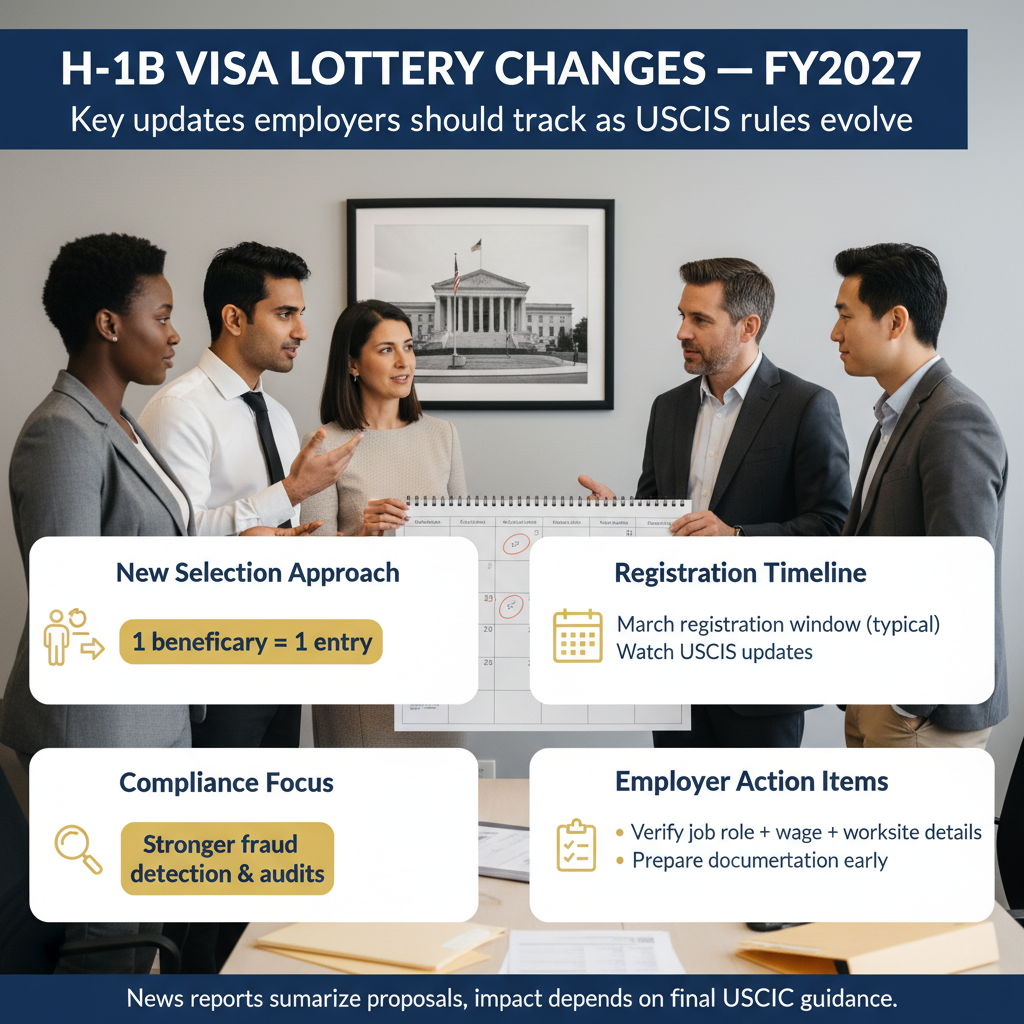
This article was prompted by recent coverage and ongoing updates in national immigration reporting, including:
H-1B Visa Lottery Changes for FY2027 (Legal News)
Important: News coverage often summarizes proposals, agency announcements, and draft rules. The practical impact depends on what USCIS and the Department of Homeland Security (DHS) ultimately publish and implement. This guide explains the most common FY2027-facing changes employers and beneficiaries should prepare for, and how to build a compliant, audit-ready H-1B case.
Need Help? Our Orlando immigration team is ready to assist. Call +1 786-791-3106 for a free consultation, or message us online. Se Habla Español.
What This News Means for Immigrants in Orlando and Across Florida
Why this news is showing up now
The H-1B program is one of the most competitive U.S. work visa pathways. Each year, USCIS runs an electronic registration process and then a lottery (selection) for the annual cap (generally 65,000 regular cap plus 20,000 for U.S. master’s degree holders). Because demand far exceeds supply, even small policy tweaks can change who gets selected and how cases are prepared.
FY2027 planning is surfacing now because:
- Employers are building recruiting pipelines for 2026 graduates and experienced hires.
- USCIS continues refining lottery integrity measures (to prevent duplicate or improper registrations).
- In recent years, DHS/USCIS have emphasized compliance—site visits, specialty occupation scrutiny, and wage-level consistency.
- Timing pressures are real: the H-1B registration typically occurs in a tight 90-day window-style seasonal cadence (registration, selection, filing), and missing internal deadlines can cost a full year.
Reminder: Even if a “new rule” is announced, effective dates matter. Some changes apply to the registration season immediately following publication; others apply later. Strategic planning now reduces last-minute errors.
How it can affect Florida residents
For Central Florida residents—especially along the I-4 corridor (Orlando, Lake Mary, Sanford, Kissimmee, Celebration, and into Tampa)—H-1B demand is high in:
- Healthcare systems and medical groups (IT, analysts, data roles, some clinical roles depending on licensing).
- Hospitality and travel technology (product, engineering, analytics).
- Defense, simulation, aerospace, and engineering.
- Higher education and research (cap-exempt options may apply).
If your case is in Orlando, your planning may also intersect with:
- Local employer compliance practices and HR timelines.
- Travel planning through Orlando International Airport (MCO) during registration/filing season.
- The Orlando USCIS Field Office for certain downstream filings (for example, family-based Adjustment of Status via Form I-485, if your long-term strategy includes permanent residence).
Warning: H-1B decisions can affect more than work authorization. They can impact F-1 STEM OPT planning, dependent status (H-4), and future green card strategy tied to your Priority Date.
What H-1B Visa Lottery Changes for FY2027 Is (and Why It Matters)
A plain-English definition
“H-1B lottery changes for FY2027” refers to anticipated or newly implemented USCIS/DHS adjustments to how employers register candidates, how USCIS selects registrations, and what documentation and compliance steps are required to file an H-1B petition after selection.
In plain terms: the government may change the “rules of the game” for the H-1B cap season—who can enter, how entries are counted, how fraud is prevented, and what proof is required to win and keep the benefit.
Key terms you need to know
- H-1B cap: The annual numerical limit for most new H-1B petitions (regular cap and advanced degree cap).
- Electronic registration: The online system employers use to register a beneficiary before filing a full H-1B petition.
- Selection notice: USCIS notice that a registration was selected and the employer can file the H-1B petition during a defined filing period.
- Specialty occupation: A role that typically requires at least a bachelor’s degree in a specific specialty (or equivalent) related to the job duties.
- LCA (Labor Condition Application): Filed with the Department of Labor (DOL) to confirm wage and working condition requirements before the H-1B petition is filed.
- RFE (Request for Evidence): USCIS request for additional evidence. RFEs are common in specialty occupation, employer-employee relationship, and wage-level cases.
- Cap-exempt: Certain employers (like universities and some nonprofit research organizations) may be exempt from the annual cap.
- Change of Status: If you are in the U.S. in another status (like F-1) and the H-1B is approved, you may change to H-1B without leaving the U.S., if eligible.
Important: “Lottery changes” do not necessarily mean more visas. Often they mean stricter registration rules, more verification, new attestations, or different selection mechanics designed to reduce abuse.
Need Help? Our Orlando immigration team is ready to assist. Call +1 786-791-3106 for a free consultation, or message us online. Se Habla Español.
Current Immigration Law: The Foundation
Even when USCIS updates procedures, H-1B adjudications still rest on existing statutes, regulations, and agency guidance. Understanding the baseline helps you spot what is truly “new” versus what is simply being enforced more strictly.
Federal requirements
The H-1B category is grounded in the Immigration and Nationality Act (INA) and implementing regulations. Key authorities include:
- INA § 101(a)(15)(H)(i)(b) (defining H-1B specialty occupation workers).
- INA § 214(i) (specialty occupation definition and degree requirements).
- 8 C.F.R. § 214.2(h) (core H classification rules, including H-1B).
- DOL LCA rules under 20 C.F.R. Part 655, Subparts H and I (wage, notice, and working conditions).
USCIS forms and processes commonly involved:
- Form I-129 (Petition for a Nonimmigrant Worker) — the main H-1B petition form.
- Form I-907 (Premium Processing Service) — optional for faster USCIS processing when available.
- Form I-539 (Application to Extend/Change Nonimmigrant Status) — often for dependents (H-4) or related status changes.
- Form I-765 (Application for Employment Authorization) — for certain categories (e.g., H-4 EAD in limited situations, or F-1 OPT), not for standard H-1B work authorization.
- Form I-130 and Form I-485 may appear in long-term planning if a family-based path or employment-based green card strategy is pursued later; these relate to Adjustment of Status and can affect travel/work planning.
Official references you can verify directly:
- USCIS official website
- USCIS Forms
- USCIS Processing Times
- U.S. Department of State (visa stamping abroad)
- Executive Office for Immigration Review (immigration court—relevant if status issues escalate)
Reminder: USCIS adjudicates the petition; DOL certifies the LCA; the Department of State issues the visa stamp (if you travel and need stamping); and CBP admits you at the port of entry.
Florida-specific considerations
H-1B is federal, so Florida does not create separate H-1B eligibility rules. However, Florida realities matter in practice:
- Industry concentration: Central Florida has strong demand in tech, engineering, healthcare administration, and hospitality tech—each has different “specialty occupation” documentation patterns.
- Licensing: Some roles in healthcare, education, and engineering may require Florida licensing. USCIS may question whether you can perform duties without the license.
- Worksite changes: Along the I-4 corridor, employers often shift worksites (client sites, hybrid arrangements). H-1B compliance depends heavily on correct LCA postings and amendment triggers.
If your case is in Orlando and you later pursue Adjustment of Status with Form I-485, the Orlando USCIS Field Office may be involved in interviews or local processing steps. That makes it even more important to keep your immigration history consistent and well-documented.
How to Prepare for FY2027 H-1B Lottery Changes: A Complete Step-by-Step Guide
This step-by-step roadmap is designed for employers and beneficiaries preparing for the FY2027 cap season under “new rules” conditions—meaning heightened scrutiny, stronger anti-duplication controls, and a premium on clean documentation.
1) Confirm eligibility and choose the right H-1B strategy
Start by confirming whether you actually need the cap lottery or if a cap-exempt or alternative work authorization option exists. This is where many Florida employers save time and reduce risk.
Documents to gather:
- Current resume/CV and detailed job history
- Degree documents (diploma, transcripts, evaluations if foreign degree)
- Passport biographic page and current U.S. status documents (I-94, visa stamp)
- Prior immigration documents (I-20s, EAD cards, approval notices)
- Draft job description with minimum requirements and day-to-day duties
Important: If you are on F-1 OPT/STEM OPT, map out timing carefully. The H-1B “cap-gap” and start date rules can affect whether you can keep working between OPT expiration and October 1.
2) Build a “specialty occupation” evidence file before registration
Even though registration is short and does not require uploading the full packet, FY2027-era enforcement trends favor employers who prepare the case like it will be audited. That means aligning the job title, duties, degree field, wage level, and worksite details early.
Documents to gather:
- Detailed job description (percent time by duty)
- Organizational chart showing role placement and supervision
- Evidence of the business (website, brochures, contracts, invoices)
- Worksite plan (remote/hybrid policy; office lease; client letters if applicable)
- Comparable job postings requiring similar degrees (industry proof)
Warning: A common RFE trigger is mismatch: a low wage level paired with highly complex duties, or a generalized degree requirement (“any bachelor’s”) rather than a specific specialty tied to the work.
3) Prepare the DOL Labor Condition Application (LCA) strategy
The LCA is not filed at registration, but it becomes critical immediately after selection. You should pre-plan the prevailing wage, SOC code, wage level, and worksites now so you can file quickly if selected.
Documents to gather:
- Worksite address(es) and remote-work details
- Proposed wage and payroll records (if already employed)
- Prevailing wage research notes (internal or counsel-prepared)
- Company FEIN verification and entity documents
- Public Access File (PAF) template items (notice, wage memo)
Reminder: LCA notice/posting rules must be followed. Noncompliance can create DOL exposure even if USCIS approves the H-1B.
4) Complete the electronic registration accurately (and ethically)
USCIS has prioritized integrity in the registration system. Under newer enforcement approaches, inaccurate registrations, duplicate filings, or “gaming” the system can lead to denial, revocation, or fraud findings.
Documents to gather:
- Beneficiary passport information (exact spelling, number, expiration)
- Employer legal name, EIN, address, authorized signatory details
- Attorney G-28 details if represented (prepared by counsel)
- Evidence supporting the existence of a bona fide job offer (offer letter draft)
Important: Ensure one legitimate registration per employer per beneficiary, unless USCIS rules explicitly allow otherwise. If multiple related entities are involved, get legal advice to avoid an “improper multiple registration” allegation.
5) If selected, file a complete H-1B petition package during the filing window
After selection, the employer must file the H-1B petition (typically Form I-129 with H supplement and H-1B data collection) within the specific USCIS filing period. Missing the deadline usually means losing the selection.
Documents to gather:
- USCIS selection notice
- Certified LCA
- Form I-129 and supporting H-1B supplements
- Company support letter describing role, duties, degree requirement, wage, worksite
- Beneficiary evidence: degrees, transcripts, evaluations, licenses (if required)
- Status documents: I-94, prior approvals, OPT/STEM EAD, I-20s
- Filing fee checks and fee breakdown memo
- Form I-907 (optional) if premium processing is chosen
Warning: USCIS fee rules can be strict, and incorrect fees can cause rejection. Always verify current fees on USCIS Forms and the specific form page instructions.
6) Plan for approval, travel/visa stamping, and start-date compliance
If you are in the U.S. and eligible for change of status, your H-1B status typically starts on October 1 (for cap-subject cases). If you travel, you may need H-1B visa stamping at a U.S. consulate before re-entry.
Documents to gather:
- USCIS approval notice (I-797)
- Updated employment verification letter
- Paystubs (once employment begins) and work authorization records
- Visa stamping documents (DS-160 confirmation, appointment, photo) if traveling
- Supporting documents for dependents (marriage/birth certificates, Form I-539 if changing/extending in the U.S.)
Reminder: For visa stamping steps and consular guidance, see U.S. Department of State.
7) Maintain compliance after approval (amendments, extensions, and green card strategy)
H-1B compliance does not stop at approval. Employers must track material changes (job duties, location, salary changes) that could require an amended petition. Beneficiaries should keep records to support future extensions or permanent residence filings.
Documents to gather:
- Paystubs and W-2s (proof of maintenance of status)
- Updated job descriptions and promotion letters
- Worksite change documentation (new address, remote policy)
- Immigration history file (all I-797s, I-94s, visas)
- Green card planning documents (PERM drafts, or family-based options like Form I-130)
Important: If your long-term plan includes a green card, your Priority Date strategy matters. A well-timed employment-based process can protect your ability to extend H-1B beyond six years in some circumstances.
Need Help? Our Orlando immigration team is ready to assist. Call +1 786-791-3106 for a free consultation, or message us online. Se Habla Español.
Practical Steps You Can Take Today
Whether you are an employer in Orange County or a beneficiary living in Orlando, Winter Park, Kissimmee, or elsewhere in Central Florida, preparation is what separates a smooth filing from an RFE or missed season.
Actionable checklist (do these now)
- Confirm your cap season target: Identify whether FY2027 is your first cap attempt or a re-try after non-selection.
- Audit your job description: Ensure duties match a specific degree field and are consistent with the wage level and SOC code.
- Collect degree proof early: Order transcripts, obtain credential evaluations for foreign degrees, and gather experience letters if equivalency is needed.
- Map worksites: If hybrid/remote, document the primary worksite and any secondary locations; plan LCA postings accordingly.
- Review immigration timelines: Track OPT/STEM OPT end dates, grace periods, and travel plans. Don’t assume “cap-gap” automatically applies.
- Prepare for identity consistency: Ensure passport name spelling matches prior filings; correct discrepancies before registration.
- Budget for fees: USCIS and attorney fees should be planned in advance; avoid last-minute payment issues.
Document preparation guidance
Create a single PDF folder (or secure shared drive) with:
- Passports (current and old), all visa stamps, and I-94 records
- All prior I-797 approval notices
- I-20 history and OPT/STEM EAD cards (if applicable)
- Diplomas/transcripts + credential evaluation (if foreign degree)
- Updated resume and LinkedIn printout (yes—USCIS sometimes compares public profiles to petition claims)
- Offer letter and detailed job description
Warning: Inconsistencies between your resume, LinkedIn, and petition duties can trigger credibility concerns. Align everything before filing.
Timeline expectations (planning for FY2027)
While USCIS publishes exact dates each season, most H-1B cap cycles follow a predictable pattern:
- Registration preparation: 6–10 weeks before registration opens (internal employer intake, job description finalization).
- Registration window: Typically a few weeks in March (USCIS announces exact dates).
- Selection notifications: Often by late March/early April, with possible later rounds if USCIS needs more filings.
- Filing window: A defined period after selection (often 90 days, but USCIS controls the dates).
- Start date: Cap-subject H-1B employment typically begins October 1.
To check current adjudication estimates, use USCIS Processing Times.
How Imigrar Helps Immigrants in Orlando
Imigrar is an immigration law firm based in Orlando, Florida, serving clients nationwide. We help employers and professionals navigate high-stakes work visa filings with a focus on accuracy, compliance, and long-term stability—because our mission is to Keep Families Together.
How we support H-1B cap cases under evolving FY2027 rules:
- Registration risk review: We evaluate related-entity issues, prior filings, and compliance red flags before registration is submitted.
- Specialty occupation strategy: We build evidence tailored to your role (tech, healthcare admin, engineering, education, etc.).
- RFE readiness: We prepare the case anticipating common RFEs—so responses are faster and stronger.
- Family planning: We advise on H-4 status, travel, and future green card options, including how Priority Date strategy can protect long-term goals.
- Orlando-local perspective: For Central Florida residents, we understand local employer practices and the realities of hybrid work across Orange County and the I-4 corridor.
Se Habla Español. We offer a free consultation to discuss your FY2027 H-1B plan and alternatives if the cap is not the best path.
Frequently Asked Questions
Q: Who is eligible to be entered into the H-1B lottery for FY2027?
A: Generally, you must have (1) a U.S. employer offering a job in a specialty occupation, and (2) the required degree (or equivalent) in a field related to the job. The employer—not the employee—submits the electronic registration and later files Form I-129 if selected. If you have a U.S. master’s degree (or higher) from a qualifying institution, you may be eligible for the advanced degree cap, which can improve odds.
Q: I live in Orlando on F-1 OPT. How do FY2027 changes affect my status?
A: The biggest impact is timing. If selected and filed correctly with a change of status request, you may be able to transition from F-1 to H-1B on October 1. If your OPT expires before then, you may rely on cap-gap rules if eligible. Important: Travel during cap-gap can be risky. If your case is in Orlando and you have travel plans through MCO, talk to counsel before leaving the U.S. so you don’t accidentally abandon a pending change of status.
Q: What is the expected timeline from registration to approval?
A: Registration typically occurs in March; selections are often announced by late March/early April; filings occur during a USCIS-defined window; and approvals depend on processing speed. Standard processing can take months, while premium processing (via Form I-907) can shorten the decision timeframe when available. For current estimates, check USCIS Processing Times. Reminder: Even with an early approval, cap-subject start date is usually October 1.
Q: What documents are most important for a strong H-1B petition?
A: The strongest cases align job duties, degree field, wage level, and the employer’s business needs. Key documents include: certified LCA; employer support letter; organizational chart; contracts/work orders if placed at a third-party site; beneficiary degree evidence (diploma/transcripts/evaluation); and proof of maintaining current status (I-94, prior approvals, OPT EAD/I-20s if applicable). Warning: Missing or inconsistent worksite details are a common RFE trigger in hybrid/remote arrangements.
Q: How much does an H-1B case cost in government fees and legal fees?
A: Costs vary by employer size, whether premium processing is used, and which fee categories apply. Government fees can include the base petition fee, anti-fraud fee, and other statutory fees depending on the employer. Legal fees vary based on complexity (third-party placement, multiple worksites, prior status issues, etc.). Important: Always verify current USCIS fees on USCIS Forms and confirm who pays which fees under DOL/USCIS rules.
Q: What happens if my H-1B is denied after selection?
A: If USCIS denies the petition, you generally cannot “reuse” that selection. You may consider refiling only if the denial is due to correctable issues and the filing window is still open, but that’s fact-specific. If you are in the U.S., denial can also affect your underlying status and grace periods. If your case is in Orlando and you are nearing the end of OPT or another status, you should get immediate legal advice to avoid accruing unlawful presence and to explore alternatives (cap-exempt H-1B, O-1, TN if eligible, L-1, or school options).
Q: Can FY2027 “lottery changes” increase my chances of selection?
A: Some integrity-focused changes can reduce improper registrations and may improve fairness, but they do not necessarily increase the number of visas. Your best “chance” improvement comes from lawful strategy: correct advanced degree eligibility, considering cap-exempt options, and ensuring your employer is ready to file immediately if selected. Reminder: Avoid any approach that looks like duplicate or coordinated registrations across related entities.
Common Mistakes (and How to Avoid Them)
Mistake #1: Treating registration as “just a quick form”
Because registration is short, some employers wait until selection to think about specialty occupation, wage level, and worksite issues. That often leads to rushed LCAs, inconsistent job descriptions, and avoidable RFEs.
How to avoid it: Build the specialty occupation file before registration and pre-plan LCA details so you can file quickly and accurately after selection.
Mistake #2: Inconsistent worksite and remote-work documentation
Hybrid work is common in Orlando and across Florida. USCIS may scrutinize where the work will actually be performed and whether the LCA covers that location.
How to avoid it: Document the primary worksite, remote-work policy, and any client sites; confirm LCA posting compliance; and amend when required.
Mistake #3: Ignoring long-term status planning (especially for families)
H-1B decisions affect spouses and children, travel, and future green card planning. Families often discover too late that a dependent’s status or work authorization is at risk.
How to avoid it: Build a 12–24 month plan that includes dependents (H-4), travel/stamping, and permanent residence strategy tied to your Priority Date. If family sponsorship is relevant, understand pathways like Form I-130 and Form I-485 for Adjustment of Status.
Need Help? Our Orlando immigration team is ready to assist. Call +1 786-791-3106 for a free consultation, or message us online. Se Habla Español.
Closing: Protect Your FY2027 H-1B Plan Now
FY2027 H-1B lottery changes—whether they involve tighter registration controls, new verification expectations, or stronger post-selection scrutiny—reward one thing: preparation. If you are a professional in Orlando or an employer hiring along the I-4 corridor, the best time to reduce risk is before registration opens, not after selection.
Important: If you are also pursuing family-based options (like Form I-130) or considering Adjustment of Status through Form I-485, coordinate strategies to avoid travel, timing, or status conflicts.
For official updates and to verify program requirements, consult:
- USCIS official website
- USCIS Forms
- USCIS Processing Times
- U.S. Department of State
- Executive Office for Immigration Review
Need Help? Our Orlando immigration team is ready to assist. Call +1 786-791-3106 for a free consultation, or message us online. Se Habla Español.
Se Habla Español. Call Imigrar at +1 786-791-3106 to discuss your H-1B FY2027 strategy, alternatives if the cap is not ideal, and a long-term plan to help you and your family stay secure in the United States.


