Immigration Law

H-1B Visa Lottery Changes for FY2027: A Comprehensive Guide for

Published April 6, 2026Leer en Español
William J. Vasquez, Esq.
Reviewed by William J. Vasquez, Esq.
H-1B Visa Lottery Changes for FY2027: A Comprehensive Guide for
H-1B Visa Lottery Changes for FY2027 (Legal News) ## What This News Means for Immigrants in Orlando and Across Florida The H-1B visa program is a cornerstone of the U.S. economy, enabling American employers to hire foreign workers in specialty occupations. For aspiring immigrants and businesses in Orlando, Central Florida, and across the nation, the annual H-1B lottery is a high-stakes event. News surrounding changes to this process, especially for the upcoming fiscal year 2027 (FY2027), carries significant weight. At Imigrar, we understand that these updates can be complex and often raise more questions than answers. Our mission is to keep families together and empower individuals through accurate, timely immigration guidance. ### Why this news is showing up now As of April 6, 2026, discussions and official announcements regarding the H-1B visa lottery changes for FY2027 are at the forefront of immigration news. USCIS typically finalizes and announces changes to the H-1B cap registration process well in advance of the actual registration period. Given that the FY2027 registration period usually occurs in March 2026, the specific rules and procedures would have been published in late 2025 or early 2026. This timing allows employers and potential beneficiaries to prepare thoroughly. The ongoing evolution of H-1B policy reflects USCIS's efforts to enhance program integrity, combat fraud, and streamline processes, ensuring the system serves its intended purpose. These changes are crucial for managing the overwhelming demand for H-1B visas, which consistently far exceeds the annual cap. ### How it can affect Florida residents Florida, with its booming tech sector, tourism industry, and diverse economy, attracts a significant number of H-1B professionals. Cities like Orlando, Tampa, and Miami are hubs for innovation and specialized talent. For Florida residents who are international students on F-1 visas (especially those on Optional Practical Training – OPT), or individuals already working in the U.S. on other nonimmigrant visas, these changes directly impact their professional trajectory and long-term immigration goals. Employers across the state, from startups to large corporations, rely on the H-1B program to fill critical talent gaps. Any modification to the lottery system can affect their ability to recruit and retain essential employees, influencing Florida's economic growth and global competitiveness. Understanding these shifts is vital for career planning, business strategy, and maintaining legal immigration status in the Sunshine State. ## What H-1B Visa Lottery Changes for FY2027 Is (and Why It Matters) The H-1B visa program allows U.S. employers to temporarily employ foreign workers in specialty occupations. These occupations generally require a bachelor's degree or higher in a specific specialty. Due to overwhelming demand, the number of H-1B petitions filed each year far exceeds the annual cap set by Congress. This necessitates a lottery system to select eligible registrations. The "H-1B Visa Lottery Changes for FY2027" refers to the new rules, procedures, and potentially increased fees that USCIS has implemented or proposed for the H-1B cap registration and petition process for the fiscal year starting October 1, 2026. These changes are designed to improve the integrity of the lottery, reduce fraud, and ensure a more equitable selection process. ### A plain-English definition Simply put, the H-1B visa is for skilled workers, and because there are more applicants than available visas, USCIS uses a computer-generated lottery to pick who gets to apply. The "changes for FY2027" are the new rules for *how* that lottery works and *who* gets selected. Historically, a significant issue was the submission of multiple registrations for the same beneficiary by different employers, often by related entities, to increase their chances of selection. The most significant recent change, which is expected to continue and be refined for FY2027, is the shift to a **beneficiary-centric selection process**. This means that instead of selecting registrations based on each submission, USCIS now selects based on each unique beneficiary. If a beneficiary has multiple registrations filed on their behalf, they are still only entered into the lottery once. This drastically reduces the advantage of submitting multiple registrations and aims to make the lottery fairer. Additionally, USCIS has been increasing fees and strengthening anti-fraud measures, which are also part of these "changes." ### Key terms you need to know Navigating the H-1B process requires familiarity with specific terminology: * **H-1B Cap**: The annual limit on the number of H-1B visas issued. Congress sets this at 65,000 for the regular cap and an additional 20,000 for the U.S. Master's Cap (for those with a U.S. master's degree or higher). * **FY (Fiscal Year)**: The U.S. government's fiscal year runs from October 1st to September 30th. FY2027 begins on October 1, 2026. * **USCIS (U.S. Citizenship and Immigration Services)**: The government agency that oversees lawful immigration to the United States. * **Beneficiary**: The foreign national worker who will be employed in the specialty occupation. * **Petitioner/Registrant**: The U.S. employer who files the H-1B registration and, if selected, the H-1B petition on behalf of the beneficiary. * **H-1B Registration**: The initial electronic process where employers submit basic information about the company and the prospective H-1B worker to enter them into the lottery. * **Lottery Selection**: The random computer-generated process by which USCIS selects sufficient registrations to meet the H-1B cap. * **Form I-129, Petition for a Nonimmigrant Worker**: The primary form filed by the employer once an H-1B registration is selected. * **LCA (Labor Condition Application)**: **Form ETA-9035** filed with the U.S. Department of Labor (DOL) before an H-1B petition can be submitted. It attests that the employer will pay the H-1B worker at least the prevailing wage or the actual wage paid to others with similar experience, whichever is higher, and will provide working conditions that will not adversely affect other workers. * **Specialty Occupation**: An occupation that requires theoretical and practical application of a body of highly specialized knowledge, and a bachelor's or higher degree in the specific specialty (or its equivalent) as a minimum for entry into the occupation. * **Premium Processing**: An optional service that allows petitioners to pay an additional fee to have USCIS process their petition within 15 calendar days. The fee for this service has also recently increased. * **RFE (Request for Evidence)**: A notice from USCIS asking for more information or documentation to support the petition. * **Cap-Exempt**: Certain employers (e.g., institutions of higher education, non-profit organizations affiliated with higher education, government research organizations) are exempt from the annual H-1B cap. These changes are significant because they directly impact the fairness and success rate of H-1B applicants. For individuals and businesses in Orlando and throughout Florida, understanding these terms and the underlying motivations for the changes is the first step toward a successful H-1B journey.

Need Help Navigating H-1B Changes? Our Orlando immigration team at Imigrar is ready to assist. We specialize in complex work visa applications and can guide you through the latest H-1B regulations. Call +1 786-791-3106 for a free consultation, or message us online. Se Habla Español.
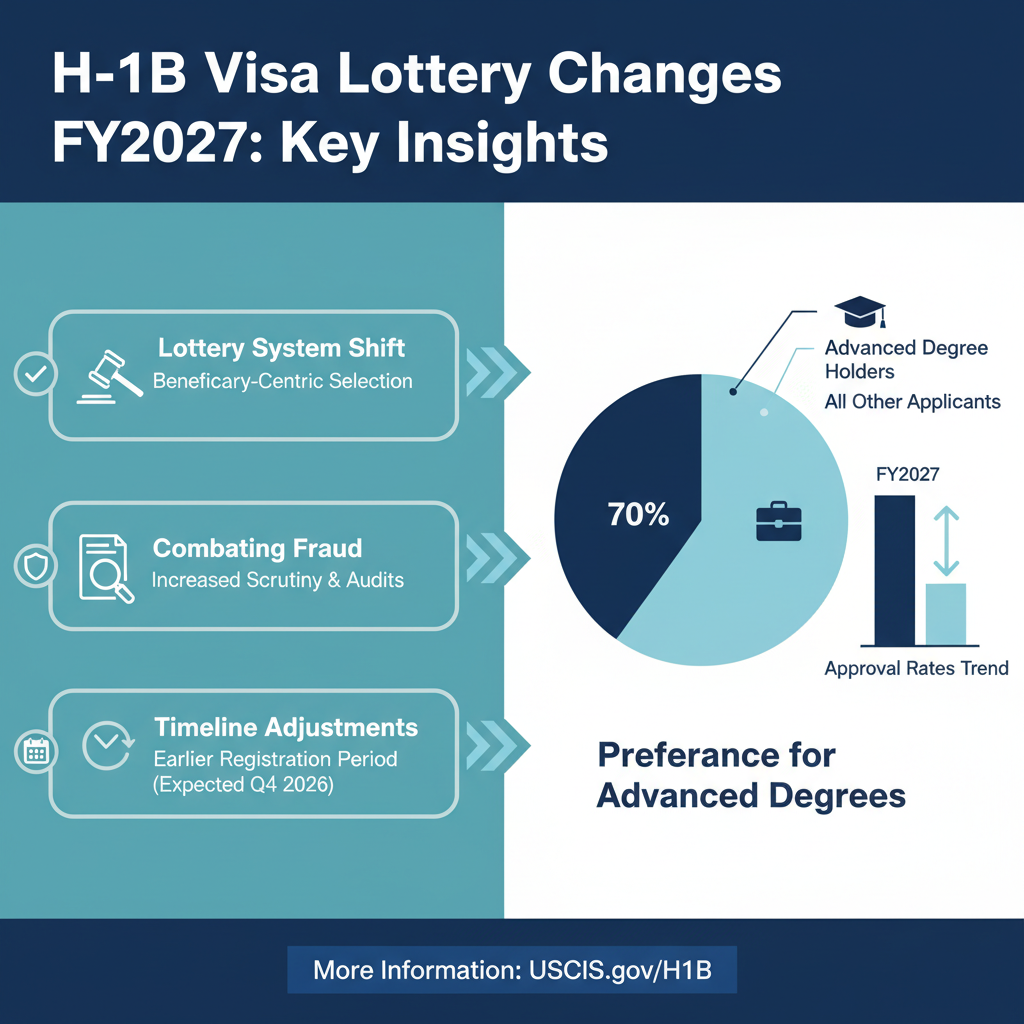
H-1B Visa Lottery Changes for FY2027: A Comprehensive Guide for - Key Statistics

Call Us Now: +1 786-791-3106

## Current Immigration Law: The Foundation The H-1B visa program is authorized under the Immigration and Nationality Act (INA), specifically **INA § 101(a)(15)(H)(i)(b)**. This statute defines the H-1B nonimmigrant classification for individuals coming to the U.S. temporarily to perform services in a specialty occupation. The annual numerical limits, or "caps," are established by Congress. The regulations governing the H-1B program are found in Title 8 of the Code of Federal Regulations, particularly 8 CFR § 214.2(h). Recent changes for FY2027 are built upon this established legal framework, primarily focusing on procedural adjustments, anti-fraud measures, and fee updates rather than fundamental changes to the underlying eligibility criteria. ### Federal requirements To qualify for an H-1B visa, both the employer and the beneficiary must meet specific federal requirements: * **For the Employer (Petitioner)**: * Must offer a **specialty occupation** position. * Must establish an employer-employee relationship with the beneficiary. * Must file a certified **Labor Condition Application (LCA) (Form ETA-9035)** with the U.S. Department of Labor, attesting to prevailing wage compliance and working conditions. * Must pay the H-1B worker at least the prevailing wage for the occupational classification in the area of employment or the actual wage paid by the employer to all other individuals with similar experience and qualifications for the specific employment, whichever is higher. * **For the Beneficiary (Foreign National)**: * Must possess a bachelor's degree or its equivalent, or a higher degree required by the specialty occupation, or hold an unrestricted state license, or have work experience equivalent to a bachelor's degree. * The degree must be in a field related to the specialty occupation. * Must meet the minimum requirements for the specific specialty occupation position. The H-1B cap registration process, including the new beneficiary-centric selection method for FY2027, falls under these federal regulations. USCIS also has broad authority to interpret and implement these laws through policy memoranda and operational instructions. You can always find the latest official information and forms on the USCIS official website. ### Florida-specific considerations While federal law governs the H-1B program, the local economic landscape in Florida can influence H-1B opportunities and employer needs. Florida has a robust economy with growing sectors in technology, healthcare, aerospace, and finance, particularly in major metropolitan areas like Orlando, Miami, and Tampa. This creates high demand for specialized talent, increasing the reliance on programs like the H-1B visa. * **Job Market**: The strong job market in specialty occupations in Orlando, for instance, means many employers are eager to sponsor H-1B visas. This can lead to more opportunities but also intensified competition for cap-subject visas. * **Prevailing Wage**: The prevailing wage for H-1B positions is determined by geographic location. For Central Florida residents, the prevailing wage will be based on data specific to the Orlando metropolitan area or other relevant regions within Florida, impacting the wage requirement for employers. * **Local Office Processing**: If your H-1B petition leads to a change of status and you reside in Florida, any subsequent interviews (though rare for initial H-1B petitions unless there are complex issues) or biometrics appointments would typically occur at the Orlando USCIS Field Office or other nearby USCIS facilities. * **Educational Institutions**: Florida is home to numerous universities and colleges, many of which are H-1B cap-exempt employers (e.g., University of Central Florida in Orlando). Graduates from these institutions, especially those with U.S. master's degrees, often seek H-1B sponsorship and benefit from the U.S. Master's Cap or cap-exempt employment. Understanding these local dynamics, alongside the federal requirements and the new FY2027 rules, is essential for a successful H-1B application in Florida. Keep in mind that all H-1B petitions are adjudicated by USCIS service centers, not local field offices, but local considerations are vital for the overall process. For example, processing times can be checked on the USCIS Processing Times page. ## How to Navigate the H-1B Visa Lottery Changes: A Complete Step-by-Step Guide The H-1B lottery process for FY2027, while incorporating new rules, generally follows a well-defined sequence. Here's a detailed guide, emphasizing how the recent changes impact each step: ### 1) Understand the New Rules for FY2027 and Employer Strategy Before anything else, both employers and beneficiaries must thoroughly understand the specific H-1B lottery changes for FY2027. The most critical update to grasp is the **beneficiary-centric selection process**. This fundamentally alters the strategy for employers. * **Old System**: Multiple employers could register the same beneficiary, and each registration had an equal chance of selection, leading to potential abuse. * **New System (FY2027)**: Each unique beneficiary is entered into the lottery *once*, regardless of how many employers register them. If a beneficiary is selected, USCIS notifies *all* employers who registered that beneficiary. The beneficiary and employer then choose which employer will file the H-1B petition. This change aims to curb fraud and ensure fairness. **Actionable Steps:** * **For Employers**: Review official USCIS announcements regarding the FY2027 H-1B cap registration period and new rules. Ensure your HR and legal teams are fully aware of the beneficiary-centric selection and its implications for registration strategy. Focus on legitimate job offers and strong employer-employee relationships. * **For Beneficiaries**: If multiple employers express interest, understand that only one selection notice will be issued for you, and you'll need to decide which employer's petition to proceed with. Communicate clearly with all potential sponsoring employers. * **Documents needed**: No specific documents yet, but gather information about the beneficiary (name, date of birth, country of birth, passport number, highest degree) and employer (EIN, legal name, address). ### 2) Establish Employer-Sponsor Relationship and LCA Filing Once the employer commits to sponsoring an H-1B visa, the first formal step is to establish the job offer and file the LCA. This step is critical and remains largely unchanged by the recent lottery modifications, though increased scrutiny is always a factor. **Detailed Explanation:** The employer must ensure the position qualifies as a **specialty occupation** and that they can meet the prevailing wage requirements for the specific location of employment (e.g., Orlando, Florida). The LCA process involves submitting **Form ETA-9035** to the Department of Labor. This form attests to the employer’s commitment to pay the prevailing wage or the actual wage (whichever is higher) and to provide suitable working conditions. The DOL typically certifies LCAs within 7 business days. A certified LCA is a prerequisite for filing the H-1B registration. **Required Documents for LCA:** * **Employer's Federal Employer Identification Number (EIN)** * **Employer's legal name and address** * **Beneficiary's name (optional at LCA stage but helpful)** * **Job title and duties** * **Location(s) of employment** (e.g., Orlando, FL) * **Wage offered to the beneficiary** * **Prevailing wage determination** (from DOL's Foreign Labor Certification Data Center or an independent wage survey) * **Period of employment** ### 3) H-1B Electronic Registration This is the gateway to the H-1B lottery and the step most directly impacted by the FY2027 changes. The registration period typically opens in early March and lasts for a few weeks (e.g., March 1 to March 17, 2026, for FY2027). **Detailed Explanation:** Employers (or their authorized representatives) must create a registrant account on the USCIS online portal. For each beneficiary they wish to sponsor, they submit an electronic registration. Each registration requires a non-refundable **$10 fee** (note: this fee is subject to change and has recently increased for subsequent years, so check for the exact FY2027 fee). Under the beneficiary-centric selection, each beneficiary can only be counted once in the lottery, regardless of how many registrations are submitted on their behalf. If selected, USCIS will issue a selection notice that includes a unique **beneficiary identification number**. **Required Information for H-1B Registration:** * **Employer's legal name, EIN, and mailing address** * **Employer's representative's name and contact information** * **Beneficiary's full name, date of birth, country of birth, country of citizenship, gender, and passport number** * **Indication of whether the beneficiary qualifies for the U.S. Master's Cap** * **Attorney/Accredited Representative information (if applicable)**

Worried About Missing Deadlines? The H-1B registration window is narrow and strict. Let Imigrar handle the complexities for you. Our experienced team ensures accurate and timely submissions. Call +1 786-791-3106 for expert assistance. Se Habla Español.

Call Us Now: +1 786-791-3106

### 4) Lottery Selection and Petition Filing If selected in the lottery, the employer receives a "Selection Notice" from USCIS, usually by late March or early April. This notice grants permission to file the H-1B petition. **Detailed Explanation:** Upon selection, the employer has a specific filing window (typically 90 days) to submit the complete H-1B petition to USCIS. This petition is **Form I-129, Petition for a Nonimmigrant Worker**, along with all supporting documentation and applicable fees. The filing location depends on the employer's address or the beneficiary's work location, usually one of the USCIS Service Centers. **Important:** Selection in the lottery does not guarantee H-1B approval; it only grants the opportunity to file the full petition. The petition must still prove that the beneficiary meets the specialty occupation requirements and that a valid employer-employee relationship exists. **Required Documents for Form I-129 Petition (if selected):** * **Certified LCA (Form ETA-9035)** * **H-1B Lottery Selection Notice** * **Form I-129 with required supplements** * **Employer's support letter** detailing the job offer, specialty occupation duties, salary, and qualifications required. * **Beneficiary's educational documents**: Diplomas, transcripts, foreign degree evaluations (if applicable). * **Beneficiary's professional licenses/certifications** (if applicable). * **Beneficiary's resume/CV** * **Beneficiary's passport copy, visa copies, I-94 records** * **Employer's financial statements, tax returns, and business documents** to prove ability to pay wages and legitimacy of business. * **Contract between employer and beneficiary** * **Organizational charts, client letters** (especially for IT consulting firms to prove employer-employee relationship). ### 5) Premium Processing (Optional) For an additional fee, employers can opt for premium processing to expedite the adjudication of the **Form I-129** petition. **Detailed Explanation:** By filing **Form I-907, Request for Premium Processing Service**, and paying the current fee (which was $2,805 as of early 2024 and is subject to annual adjustments), USCIS guarantees a response (approval, denial, RFE, or Notice of Intent to Deny) within 15 calendar days. This is highly recommended for beneficiaries who need a quicker decision, especially those whose OPT or other nonimmigrant status is expiring soon. **Required Documents for Premium Processing:** * **Form I-907, Request for Premium Processing Service** * **Applicable premium processing fee** ### 6) Responding to RFEs (If Applicable) It is common for USCIS to issue a **Request for Evidence (RFE)** if they need more information to make a decision on the H-1B petition. **Detailed Explanation:** An RFE means USCIS requires additional documents or clarifications to determine eligibility. Common RFE topics include proving a specialty occupation, establishing a valid employer-employee relationship, demonstrating the beneficiary's qualifications, or addressing wage issues. Responding to an RFE requires careful attention to detail and a thorough understanding of immigration law. The response window is typically 60 to 87 days. **Required Documents for RFE Response:** * **RFE letter from USCIS** * **Additional evidence specifically requested by USCIS** (e.g., detailed job descriptions, project plans, client letters, expert opinion letters, updated organizational charts, pay stubs, tax documents). * **Detailed legal brief** explaining how the submitted evidence satisfies USCIS's requests. ### 7) Visa Interview (Consular Processing) or Change of Status Once the H-1B petition is approved, the final step depends on the beneficiary's current location. **Detailed Explanation:** * **Change of Status (COS)**: If the beneficiary is already in the U.S. in a valid nonimmigrant status (e.g., F-1 OPT, L-1, H-4), and the H-1B petition requested a change of status, USCIS will automatically change their status to H-1B effective October 1st (the start of the fiscal year). They can then begin working for the H-1B employer. * **Consular Processing**: If the beneficiary is outside the U.S. or opted for consular processing, they must attend an H-1B visa interview at a U.S. embassy or consulate in their home country. Upon approval, the visa stamp is placed in their passport, allowing them to enter the U.S. in H-1B status effective October 1st (or later). **Required Documents for Consular Processing Interview:** * **Original H-1B Approval Notice (Form I-797)** * **Valid passport** * **DS-160 Confirmation Page** * **Visa interview appointment confirmation** * **Passport-style photos** * **Letter from the employer** * **LCA (Form ETA-9035)** * **Beneficiary's educational and work experience documents** * **Any other documents requested by the consulate** ## Practical Steps You Can Take Today Navigating the H-1B lottery, especially with new rules for FY2027, requires proactive planning. Here's a checklist of practical steps you can take today: * **Stay Informed**: Continuously monitor official USCIS announcements and reputable legal news sources for the latest updates on the FY2027 H-1B cap and any further rule refinements. The landscape is dynamic. * **Communicate with Your Employer**: If you are a beneficiary, discuss the H-1B sponsorship process and the new beneficiary-centric selection rule with your current or prospective employer. Clarify who will register on your behalf and the chosen strategy. * **Gather Your Documents**: Even before registration, start compiling all necessary personal and educational documents. This includes diplomas, transcripts, foreign degree evaluations, passport copies, and a detailed resume. Having these ready will save valuable time if selected. * **Review Job Duties**: Ensure your job duties align with a "specialty occupation" as defined by USCIS. Work with your employer to clearly articulate how your role requires a bachelor's degree or higher in a specific field. * **Understand Prevailing Wages**: Familiarize yourself with the prevailing wage requirements for your occupation and geographic area (e.g., Orange County, Florida). This ensures your employer meets the necessary standards. * **Consult an Experienced Immigration Attorney**: This is perhaps the most crucial step. An attorney can help interpret the new rules, advise on the best strategy, ensure all documentation is accurate and complete, and represent you throughout the process. This is especially important given the increased scrutiny on fraud. **Document Preparation Guidance:** * **Organize**: Keep all documents, both physical and digital, in a well-organized folder. * **Certify**: Obtain certified copies of diplomas and transcripts if needed. * **Translate**: Any foreign-language documents must be accompanied by a certified English translation. * **Photocopy**: Make copies of everything submitted to USCIS for your records. **Timeline Expectations (General, subject to change for FY2027):** * **Late 2025/Early 2026**: USCIS announces final rules and dates for FY2027 H-1B cap registration. * **March 2026 (approx. March 1-17)**: H-1B electronic registration period. * **Late March/Early April 2026**: Lottery selection results announced. * **April 1, 2026 - June 30, 2026 (approx. 90-day window)**: Filing period for selected H-1B petitions. * **October 1, 2026**: Earliest start date for approved H-1B petitions. **Warning:** Do not wait until the last minute. The H-1B process is complex and deadlines are strict. ## How Imigrar Helps Immigrants in Orlando At Imigrar, our core mission is to "Keep Families Together." We understand the profound impact that immigration processes, especially complex ones like the H-1B lottery, have on individuals and their loved ones. Based in Orlando, Florida, we serve clients nationwide, providing compassionate and expert legal guidance every step of the way. Our team has extensive experience navigating the intricacies of employment-based visas, including the H-1B program. We stay abreast of the latest USCIS regulations, policy changes, and legal precedents to ensure our clients receive the most accurate and up-to-date advice. For the H-1B Visa Lottery Changes for FY2027, our expertise is invaluable. We can: * **Interpret New Regulations**: Clearly explain how the beneficiary-centric selection and other FY2027 changes affect your specific situation. * **Strategic Planning**: Advise employers on the best approach for H-1B sponsorship under the new rules, focusing on compliance and maximizing chances of success. * **Comprehensive Petition Preparation**: Meticulously prepare and review all required documents, including the LCA, **Form I-129**, and supporting evidence, to build a strong case and minimize the risk of RFEs or denials. * **RFE Response Expertise**: If an RFE is issued, we provide robust and timely responses, addressing USCIS concerns effectively. * **Ongoing Support**: Guide beneficiaries through every stage, from registration to visa stamping or change of status, offering peace of mind. * **Local Insight**: While H-1B is federal, our Orlando location gives us insight into the specific needs and opportunities within Central Florida's

Have Questions About Your Case?

Schedule a free consultation with our attorney-reviewed team today