

The landscape of U.S. immigration law is constantly evolving, and for skilled foreign workers and their sponsoring employers, few changes carry as much weight as those affecting the H-1B visa program. As we approach the registration period for Fiscal Year 2027 (FY2027), significant new rules are coming into play, specifically designed to enhance the integrity of the H-1B cap lottery process. For anyone navigating the complex world of work visas, understanding these updates is not just helpful—it’s absolutely critical.
At Imigrar, an immigration law firm based in Orlando, Florida, we are committed to keeping families together and helping talented individuals achieve their professional dreams in the United States. Our team, fluent in both English and Spanish, provides expert guidance nationwide, ensuring our clients are well-prepared for every challenge and opportunity.
Need Expert H-1B Guidance? The FY2027 H-1B lottery changes are complex. Our Orlando immigration team is ready to assist you and your employer. Call +1 786-791-3106 for a free consultation, or message us online. Se Habla Español.
The reporting that sparked this guide
The information and analysis in this comprehensive guide are informed by recent developments reported across various legal news outlets concerning the H-1B visa program:
H-1B Visa Lottery Changes for FY2027 (Legal News)
What This News Means for Immigrants in Orlando and Across Florida
The H-1B visa program is a cornerstone for many skilled professionals seeking to work in the U.S., particularly in high-tech, medical, and specialized fields. These latest changes, specifically targeting the lottery process for Fiscal Year 2027 (FY2027), will have far-reaching implications.
Why this news is showing up now
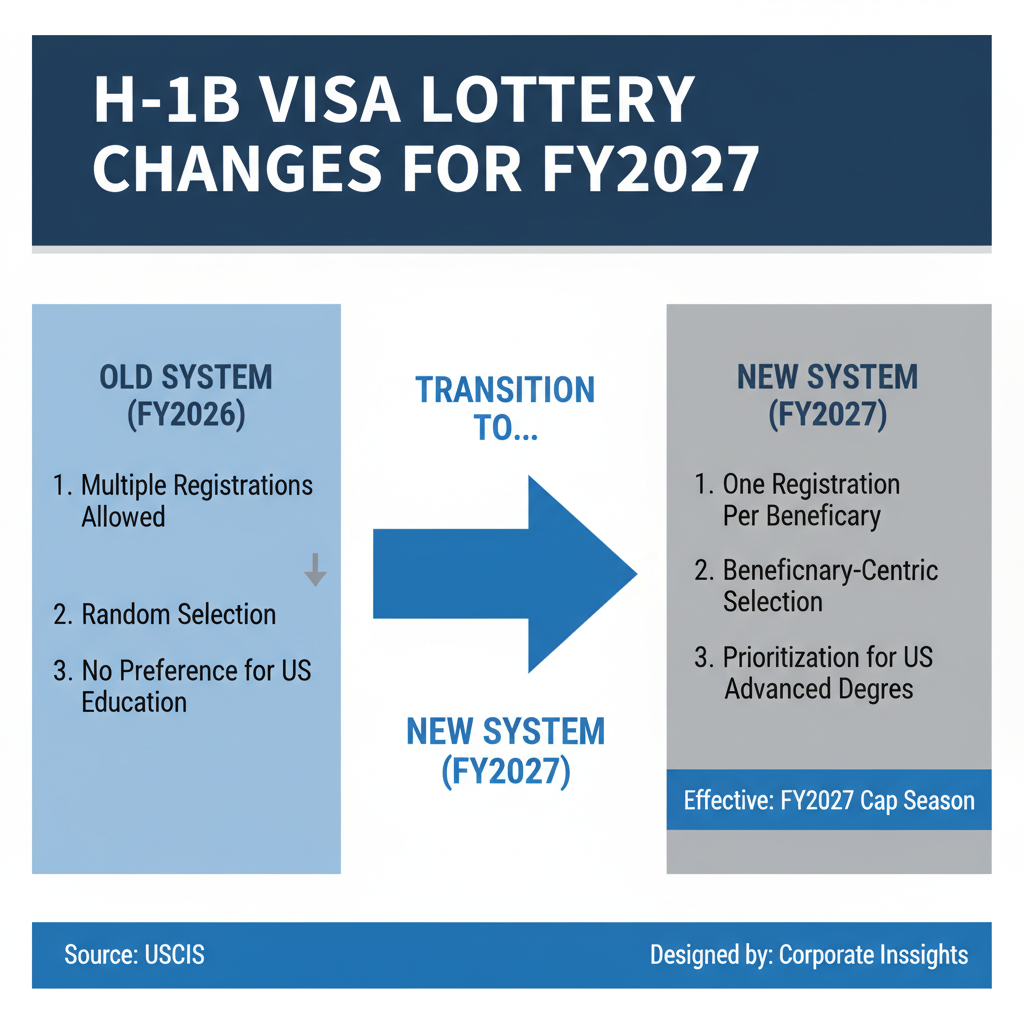
The discussion around H-1B changes isn't new, but the specific modifications for FY2027 stem from USCIS's ongoing efforts to combat fraud and abuse within the H-1B cap lottery system. Following previous lottery seasons that saw an unprecedented surge in registrations, largely attributed to multiple registrations submitted on behalf of the same beneficiary by different employers, USCIS recognized the need for a more equitable and transparent process. The final rule implementing these changes, effective for the FY2025 cap season, will naturally apply to the upcoming FY2027 cycle. This means that the system is shifting from an employer-centric registration model to a beneficiary-centric selection process, aiming to give every eligible individual a fair and equal chance.
The announcement of these changes typically occurs well in advance of the actual registration period, allowing employers and potential beneficiaries ample time to prepare. Given that the H-1B cap registration for FY2027 is projected to open in March 2026 (for an October 1, 2026 start date), now is the ideal time to understand and strategize around these new regulations.
How it can affect Florida residents
Florida, particularly the Orlando metropolitan area, is a rapidly growing hub for technology, aerospace, healthcare, and tourism. Companies along the I-4 corridor and throughout Orange County frequently rely on the H-1B program to attract and retain top talent. These new lottery rules will directly impact:
- Tech Professionals: With a burgeoning tech sector in cities like Orlando and Tampa, many software engineers, data scientists, and IT specialists in Florida are H-1B hopefuls. The new rules aim to reduce the competition from fraudulent multiple entries, potentially increasing the odds for legitimate candidates.
- Healthcare Workers: Hospitals and medical facilities across Florida depend on H-1B visas for specialized roles. These changes will streamline the process for their sponsored employees.
- Employers: Florida-based businesses, from startups to large corporations, will need to adapt their H-1B sponsorship strategies to comply with the beneficiary-centric selection. This means ensuring only one registration per individual, even if multiple employers are interested in sponsoring them.
- International Students: Graduates from Florida universities, many of whom utilize Optional Practical Training (OPT) and seek H-1B sponsorship, will find a more level playing field in the lottery.
For those living and working in Orlando, the Orlando USCIS Field Office handles various immigration matters, though H-1B petitions are processed centrally. However, local legal counsel, like Imigrar, is invaluable for navigating the overall process, especially if subsequent steps like Adjustment of Status become relevant.
What H-1B Visa Lottery Changes for FY2027 Is (and Why It Matters)
The H-1B visa program allows U.S. employers to temporarily employ foreign workers in specialty occupations. A specialty occupation generally requires a bachelor's degree or higher in a specific field. Due to high demand, the government imposes an annual cap on the number of H-1B visas issued, currently 65,000 for the regular cap and an additional 20,000 for the Master's Cap (for those with a U.S. master's degree or higher).
A plain-English definition
In simple terms, the "H-1B Visa Lottery Changes for FY2027" refers to the new way USCIS will select registrations for the H-1B visa program for the fiscal year starting October 1, 2026. Previously, employers submitted registrations for individual beneficiaries, and it was possible for one person to have multiple registrations if different employers submitted them. This led to concerns about fraud and unfair advantages. The new rule, effective for FY2025 and continuing for FY2027, changes this fundamentally: selection will now be based on the unique beneficiary, not on the number of registrations submitted on their behalf. This means if one person has five employers submit registrations for them, that person still only gets one entry in the lottery, greatly increasing fairness and reducing the incentive for fraudulent multiple filings.
Key terms you need to know
- H-1B Visa: A nonimmigrant visa that allows U.S. employers to temporarily employ foreign workers in specialty occupations.
- Specialty Occupation: An occupation that requires theoretical and practical application of a body of highly specialized knowledge, and a bachelor's degree or higher in the specific specialty (or its equivalent) as a minimum for entry into the occupation in the United States.
- Cap-Subject H-1B: H-1B petitions that are subject to the annual numerical limitations. Exemptions include petitions filed by institutions of higher education, non-profit organizations affiliated with higher education, or governmental research organizations.
- Fiscal Year (FY): The U.S. government's fiscal year runs from October 1 to September 30. H-1B visas are allocated for a specific fiscal year. FY2027 begins on October 1, 2026.
- H-1B Cap Lottery (or Selection Process): The randomized selection process used when the number of H-1B registrations exceeds the annual cap.
- Beneficiary: The foreign worker who is seeking the H-1B visa.
- Petitioner: The U.S. employer sponsoring the foreign worker for the H-1B visa.
- H-1B Electronic Registration Process: The online system employers use to register beneficiaries for the H-1B lottery. This typically occurs in March each year.
- Master's Cap: An additional 20,000 H-1B visas reserved for beneficiaries who have earned a U.S. master's degree or higher.
- Labor Condition Application (LCA): Form ETA-9035, certified by the U.S. Department of Labor (DOL), which must be filed by employers seeking to employ H-1B nonimmigrants. It attests that the employer will pay the H-1B worker at least the prevailing wage or the actual wage, whichever is higher, and provide working conditions that will not adversely affect other workers.
- Premium Processing: An expedited service offered by USCIS for certain petitions, including H-1B, guaranteeing a 15-calendar day processing time for an additional fee. Form I-907 is used for this.
- Beneficiary-Centric Selection: The core of the new rule. Instead of counting each registration submitted, USCIS will now identify each unique beneficiary named in the registrations. If a beneficiary has multiple registrations filed on their behalf, they will still only be entered into the lottery once. This aims to prevent fraudulent multiple entries and ensure a fairer chance for all unique individuals.
These changes are monumental because they directly address the integrity concerns that plagued previous lottery seasons. By shifting to a beneficiary-centric model, USCIS hopes to restore fairness and predictability to a highly competitive process, ensuring that every individual has a genuine, single chance at selection.
Current Immigration Law: The Foundation of the H-1B Program
The H-1B visa program is governed primarily by the Immigration and Nationality Act (INA) and its implementing regulations. Understanding these foundational laws is crucial for compliance.
Federal requirements
The legal framework for the H-1B visa is found in Section 101(a)(15)(H)(i)(b) and Section 214(g) of the Immigration and Nationality Act (INA), as well as in regulations at 8 CFR Part 214.2(h). Key federal requirements include:
- Specialty Occupation: The job offered must meet the definition of a specialty occupation, meaning it requires a theoretical and practical application of a body of highly specialized knowledge, and a bachelor's degree or higher in a specific specialty (or its equivalent) as a minimum for entry into the occupation.
- Qualifications of the Beneficiary: The foreign worker must possess the required degree or its equivalent, or hold an unrestricted state license, or have experience in the specialty occupation equivalent to a bachelor's degree.
- Employer-Employee Relationship: A valid employer-employee relationship must exist between the petitioner and the beneficiary.
- Wage Requirements: The employer must pay the H-1B worker at least the prevailing wage for the occupational classification in the area of employment or the actual wage paid by the employer to other employees with similar experience and qualifications, whichever is higher. This is attested to in the Labor Condition Application (LCA), Form ETA-9035, certified by the Department of Labor.
- Numerical Limitations (Cap): The annual cap is 65,000 regular H-1B visas and 20,000 for the Master's Cap.
- Duration of Stay: An H-1B visa is initially granted for up to three years and can be extended for a maximum total of six years, with certain exceptions for those pursuing lawful permanent residency.
The employer files Form I-129, Petition for a Nonimmigrant Worker, on behalf of the prospective H-1B employee. This form is central to the H-1B petition process. Additionally, Form I-907, Request for Premium Processing Service, can be filed to expedite the petition's processing.
For detailed information on these forms and requirements, always refer to the USCIS official website.
Florida-specific considerations
While H-1B laws are federal, their impact and application can have unique considerations depending on the local economic landscape. For Florida residents and businesses:
- High Demand in Tech and Healthcare: Florida's growing sectors mean a strong demand for H-1B talent. Employers in Orlando, Miami, and Tampa are particularly active in sponsoring H-1B visas. This high demand means the lottery remains competitive, making compliance with the new rules even more critical.
- Prevailing Wage Determinations: The Department of Labor’s prevailing wage data varies by geographic area. Employers in Central Florida need to ensure they are paying wages commensurate with the specific region (e.g., the Orlando-Kissimmee-Sanford Metropolitan Statistical Area).
- State University System: Florida's robust university system, including the University of Central Florida (UCF) in Orlando, produces a large number of international graduates seeking H-1B opportunities. These graduates, especially those with U.S. master's degrees, often qualify for the Master's Cap, which has a higher selection rate.
- Local Legal Expertise: Navigating the H-1B process, especially with the new rules, requires expert legal counsel familiar with both federal regulations and practical local implications. An Orlando-based firm like Imigrar can provide tailored advice.
Staying informed about the specific requirements and preparing thoroughly are paramount, regardless of whether your case is in Orlando or elsewhere nationwide.
Confused by H-1B Regulations? Don't risk your future. Imigrar's expert attorneys can help you understand and comply with all H-1B requirements. Call +1 786-791-3106 for a free consultation. We serve clients across Florida and the nation. Se Habla Español.
How to Navigate the H-1B Visa Lottery Changes for FY2027: A Complete Step-by-Step Guide
The H-1B process is multi-faceted, and with the new beneficiary-centric lottery rules for FY2027, careful planning is more essential than ever. Here’s a comprehensive step-by-step guide:
1) Understand the New Rules & Confirm Eligibility (Beneficiary-Centric Selection)
Before anything else, both the employer and the prospective H-1B beneficiary must fully grasp the new beneficiary-centric selection process. This is the most significant change. Ensure that:
- Beneficiary Awareness: The beneficiary understands that they can only have *one* lottery entry, regardless of how many employers register them. If multiple employers are interested, the beneficiary must decide which employer they prefer to proceed with if selected, or at least be aware of the implications.
- Employer Coordination: Employers must communicate with potential beneficiaries to confirm they are not already being registered by another entity for the same fiscal year, or if they are, to agree on a single registration to avoid issues. USCIS states that if a beneficiary is selected, and multiple petitioners registered that beneficiary, only one petition can ultimately be approved for that beneficiary for the same fiscal year.
- Eligibility Confirmation: Both the job and the applicant must meet H-1B requirements. The job must be a specialty occupation, and the applicant must possess the required bachelor's degree or its equivalent.
Required Documents (for initial assessment):
- Beneficiary's academic transcripts and diplomas (bachelor's degree or higher).
- Beneficiary's resume/CV.
- Job description from the prospective employer.
2) Employer Sponsorship & Labor Condition Application (LCA) Filing
The H-1B process is employer-driven. The employer must be willing and able to sponsor the H-1B visa. This involves:
- Wage Determination: The employer must determine the prevailing wage for the offered position in the specific geographic area (e.g., Orlando, FL) using the Department of Labor's Online Wage Library or a private wage survey.
- LCA Preparation & Filing (Form ETA-9035): The employer must prepare and electronically file the LCA with the Department of Labor (DOL). The LCA attests to paying the required wage and providing appropriate working conditions. This step is critical and typically takes 7-10 business days for certification. Important: A certified LCA is required *before* filing the H-1B petition, but *not* before the H-1B registration.
Required Documents:
- Detailed job description, including duties, minimum requirements, and salary.
- Employer's Federal Employer Identification Number (FEIN).
- Prevailing wage determination documentation.
3) H-1B Electronic Registration Process
This is the gateway to the lottery. The registration period for FY2027 is anticipated to be in March 2026. Key aspects:
- Online Account Creation: The employer (or their authorized representative) must create a USCIS online account.
- Beneficiary Information: For each prospective H-1B employee, the employer will submit basic information: beneficiary's full name, date of birth, country of birth, country of citizenship, passport number (if available), and whether they have a U.S. master's degree or higher.
- Employer Information: Employer's name, address, and FEIN.
- Registration Fee: A non-refundable fee (currently $10, but subject to change) for each registration.
- Single Entry per Beneficiary: Under the new rules, USCIS will consolidate multiple registrations for the same beneficiary into a single entry for selection purposes. If selected, any of the employers who registered that beneficiary may file a petition.
Required Information for Registration:
- Beneficiary's biographical data (as above).
- Employer's legal name and address.
- Employer's FEIN.
Reminder: The registration period is usually a short window, typically 2-3 weeks in March. Missing this deadline means waiting another year.
4) Lottery Selection & Petition Filing (If Selected)
After the registration period closes, USCIS conducts the lottery. This usually happens in late March or early April.
- Selection Notification: If a beneficiary is selected, USCIS will notify the registrant (employer or attorney) through their online account. The notification will include a unique selection number and the date by which the H-1B petition must be filed.
- Petition Preparation (Form I-129): If selected, the employer must then prepare and file the full H-1B petition, Form I-129, Petition for a Nonimmigrant Worker, along with all supporting documentation. This includes the certified LCA. The filing window is usually 90 days from the date of selection.
- Supporting Documentation: Comprehensive evidence proving the beneficiary's qualifications, the specialty occupation nature of the job, and the employer's ability to pay the required wage.
Required Documents (if selected, for Form I-129):
- Certified LCA (Form ETA-9035).
- Beneficiary's academic credentials (degrees, transcripts, evaluations).
- Beneficiary's resume/CV.
- Employer's business documents (articles of incorporation, financial statements, tax returns).
- Detailed job offer letter and description.
- Any previous immigration documents (e.g., OPT EAD, I-20s, previous visas).
- Company brochures, website printouts, and other evidence of business operations.
Warning: The H-1B petition must be filed accurately and completely within the specified filing window. Errors or omissions can lead to Requests for Evidence (RFEs) or even denial.
5) Premium Processing & RFE Responses
- Premium Processing (Form I-907): Employers can opt for Premium Processing, which guarantees a response (approval, denial, or RFE) within 15 calendar days for an additional fee. This can be filed concurrently with Form I-129 or at a later stage.
- Requests for Evidence (RFEs): If USCIS needs more information, they will issue an RFE. Responding to an RFE requires careful attention to detail and a thorough understanding of immigration law to provide the requested evidence effectively within the given deadline.
Required Documents (for RFE response):
- Specific documents requested by USCIS, often related to specialty occupation, employer-employee relationship, beneficiary qualifications, or wage compliance.
- Expert opinion letters (if applicable, e.g., for degree equivalency).
- Additional company financial or operational documents.
6) Visa Interview (Consular Processing) or Change of Status (Adjustment)
Once the H-1B petition is approved, the beneficiary's next steps depend on their current location and status:
- Change of Status (COS): If the beneficiary is already in the U.S. in a valid nonimmigrant status (e.g., F-1 OPT) and the H-1B petition requested a change of status, they will automatically change to H-1B status on October 1 (the start of the fiscal year).
- Consular Processing: If the beneficiary is outside the U.S. or needs to travel abroad, they will undergo consular processing. This involves scheduling an interview at a U.S. embassy or consulate in their home country to obtain the H-1B visa stamp in their passport.
Required Documents (for Consular Processing):
- Passport valid for at least six months beyond the intended period of stay.
- Form DS-160 (Nonimmigrant Visa Application) confirmation page.
- Appointment confirmation page.
- Visa fee payment receipt.
- Approved Form I-797 (H-1B Approval Notice).
- Original LCA.
- Letter from employer confirming employment.
- Academic credentials, resume, and other supporting documents submitted with the petition.
7) Maintaining H-1B Status
Upon approval and activation of H-1B status, the beneficiary must maintain their status by:
- Working only for the sponsoring employer in the approved position.
- Adhering to the terms and conditions of the H-1B petition.
- Notifying USCIS of any material changes, such as a change in job duties, work location, or employer (which may require a new or amended H-1B petition).
Important: H-1B status is tied to employment. If employment ends, the beneficiary typically has a 60-day grace period to find new employment, change status, or depart the U.S.
Practical Steps You Can Take Today to Prepare for FY2027 H-1B
Given the competitive nature of the H-1B lottery and the new rules, proactive preparation is essential for both employers and beneficiaries. Here's an actionable checklist:
Actionable Checklist:
- Verify Beneficiary Eligibility: Ensure the foreign national meets the educational and experiential requirements for a specialty occupation. Gather all academic transcripts, diplomas, and any necessary foreign degree evaluations now.
- Identify Sponsoring Employer: If you are a beneficiary, actively seek employers willing to sponsor H-1B visas. For employers, identify prospective candidates and confirm their qualifications.
- Understand the New Lottery Rules: Both parties must fully grasp the beneficiary-centric selection process. Beneficiaries should communicate openly with interested employers to ensure a coordinated approach to registration.
- Document Preparation Guidance: Start compiling all necessary documents. For beneficiaries, this includes passport, birth certificate, academic records, professional licenses, and a detailed resume. For employers, gather corporate documents, financial statements, and detailed job descriptions.
- Consult an Experienced Immigration Attorney: This is perhaps the most crucial step. An attorney can assess eligibility, guide through the new registration rules, prepare the LCA, and file a robust H-1B petition if selected.
- Monitor USCIS Announcements: Stay vigilant for official USCIS announcements regarding the exact FY2027 registration dates, fee changes, and any further clarifications on the new rules. The USCIS official website and U.S. Department of State websites are primary sources.
- Financial Planning: Be aware of the costs involved, including registration fees, filing fees, legal fees, and premium processing fees.
Timeline Expectations:
While specific dates for FY2027 are pending, the general timeline follows a pattern:
- October 2025 - February 2026: Initial consultations, eligibility assessments, employer outreach, and document gathering.
- March 2026 (typically early March): H-1B electronic registration period opens and closes (usually a 2-3 week window). This is when the $10 registration fee per beneficiary is paid.
- Late March / Early April 2026: USCIS conducts the lottery and announces selection results.
- April 1, 2026 - June 30, 2026 (approx.): The 90-day window for selected petitioners to file their Form I-129 H-1B petitions with USCIS.
- April 2026 - September 2026: USCIS processes petitions. Premium processing can expedite this. RFEs may be issued during this time.
- October 1, 2026: The start of Fiscal Year 2027. Approved H-1B petitions become effective for those changing status in the U.S. For consular processing, visa interviews begin.
Important: This timeline is a projection based on previous years and is subject to change by USCIS. Always refer to official USCIS announcements for precise dates.

How Imigrar Helps Immigrants in Orlando and Beyond with H-1B Visas
Navigating the H-1B visa process, especially with the new lottery changes for FY2027, demands meticulous attention to detail and a deep understanding of immigration law. Imigrar is uniquely positioned to provide the comprehensive support you need.
- Our Experience and Expertise: Our legal team has extensive experience with H-1B petitions, from initial eligibility assessment and LCA filing to complex RFE responses and appeals. We stay


