

The landscape of U.S. immigration law is constantly evolving, and few areas demand as much attention and strategic planning as the H-1B visa program. For many skilled professionals seeking to work in the United States, the H-1B visa is the primary pathway, making any changes to its lottery system critically important. As an immigration law firm dedicated to helping individuals and families "Keep Families Together," Imigrar understands the profound impact these changes have on your future.
Navigating complex H-1B changes can be daunting. Our experienced Orlando immigration team at Imigrar is here to guide you. Call +1 786-791-3106 for a free consultation, or message us online. Se Habla Español.
The reporting that sparked this guide
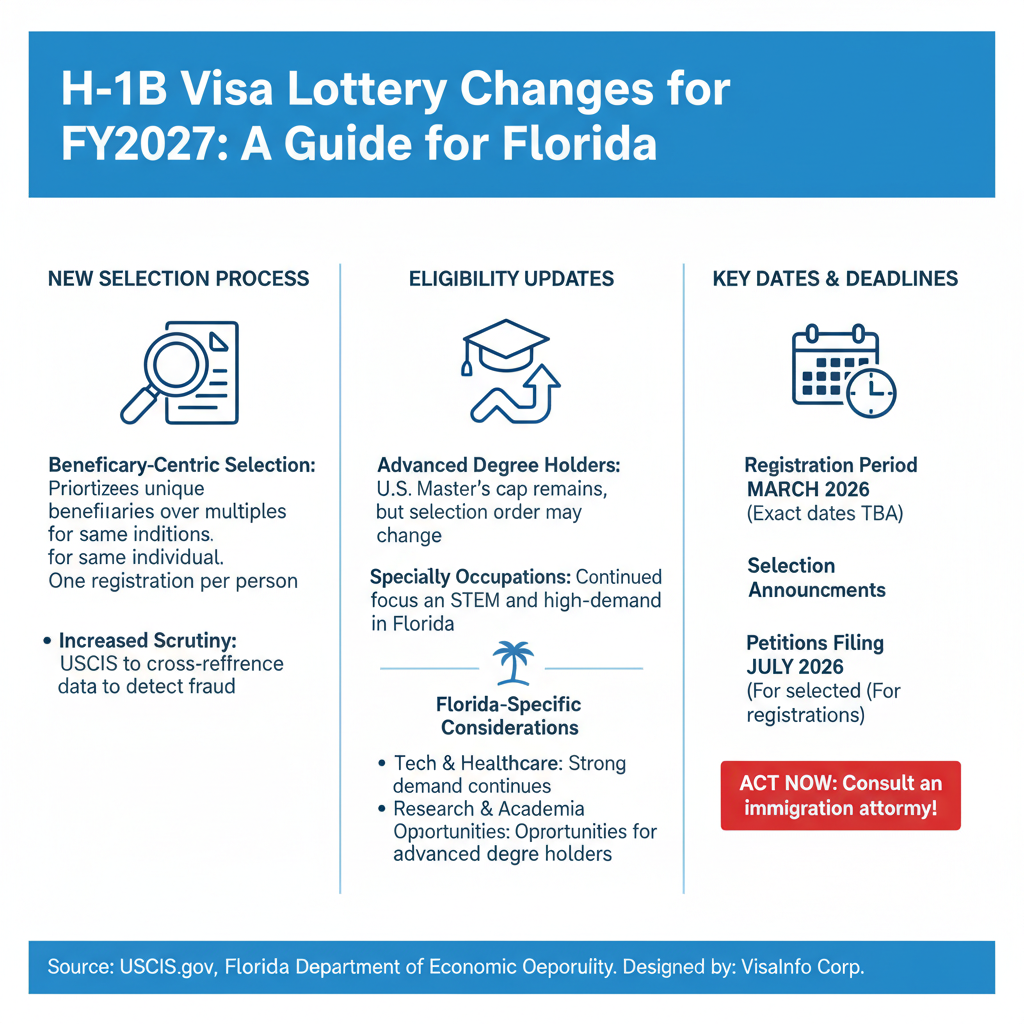
Our firm closely monitors developments in immigration law and policy, drawing insights from authoritative sources. The recent focus on the H-1B visa lottery changes for Fiscal Year 2027 (FY2027) comes from widespread reporting across legal news outlets:
H-1B Visa Lottery Changes for FY2027 (Legal News)
This news signals significant shifts in how the H-1B lottery is conducted, directly impacting prospective beneficiaries and petitioning employers alike. At Imigrar, we believe in keeping our community informed and prepared for these crucial updates.
What This News Means for Immigrants in Orlando and Across Florida
For individuals and businesses in Orlando, Central Florida, and throughout the state, changes to the H-1B visa lottery are not just abstract legal updates; they have tangible, real-world consequences. Florida is a dynamic hub for technology, tourism, aerospace, healthcare, and education—sectors that heavily rely on skilled foreign talent often sponsored through the H-1B program. Understanding these changes is paramount for anyone considering this path.
Why this news is showing up now
The United States Citizenship and Immigration Services (USCIS), a component of the Department of Homeland Security (DHS), typically announces changes to major visa programs, including the H-1B lottery, well in advance of the annual registration period. For FY2027, which begins on October 1, 2026, the registration period usually takes place in March of the calendar year (March 2026). As of today, April 27, 2026, the FY2027 H-1B lottery registration period has concluded, and selection notices are being or have already been issued. Therefore, the "news" surrounding these changes emerged earlier in the year as USCIS finalized and announced the new rules that would govern the FY2027 lottery process. The current discussion centers on the *impact* and *implications* of these rules, particularly for those who participated in the recent lottery or are planning for future fiscal years.
These changes are often driven by several factors: efforts to combat fraud, streamline processes, address policy priorities of the current administration, or respond to stakeholder feedback. The shift from a "per registration" model to a "per beneficiary" model, for example, was a direct response to widespread concerns about abuse where multiple employers would register the same individual, artificially inflating selection odds.
How it can affect Florida residents
Florida, with its rapidly growing tech sector in cities like Orlando and Tampa, its vast healthcare networks, and its world-class universities, is a significant consumer of H-1B visas. The I-4 corridor, in particular, is a hotbed for innovation and requires a steady influx of specialized talent. Here's how the H-1B lottery changes for FY2027 can specifically affect Florida residents:
- For H-1B Beneficiaries (Prospective Employees):
- Increased Fairness: If the changes aimed at reducing fraud (like the "per beneficiary" selection model) were implemented, it means that each individual now has an equal chance, regardless of how many employers registered them. This levels the playing field, which can be beneficial for those with genuine job offers.
- Uncertainty for Future Planning: Any change introduces a period of adjustment. Individuals who may have relied on previous strategies (e.g., getting multiple registrations) will need to adapt their approach for future lotteries.
- Emphasis on Employer Due Diligence: Beneficiaries must ensure their prospective employer is legitimate and capable of sponsoring them, as the integrity of the employer's registration is now even more critical.
- For Employers in Florida:
- Reduced Fraud, More Legitimate Selections: Employers who play by the rules will appreciate that the lottery is less susceptible to manipulation, potentially leading to a higher selection rate for their legitimate candidates.
- Strategic Planning for Talent Acquisition: Florida companies, especially those along the I-4 corridor in Orlando, will need to refine their talent acquisition strategies. Understanding the updated timelines, requirements, and potential for higher scrutiny will be crucial.
- Compliance Burden: New rules often come with new compliance requirements, potentially increasing the administrative burden for HR and legal departments.
- Impact on the Local Economy:
- Talent Retention: Florida's economy thrives on innovation. Ensuring a fair and efficient H-1B process helps retain top talent, contributing to economic growth in areas like Orlando's Medical City or Lake Nona's burgeoning tech scene.
- Educational Institutions: Universities across Florida, including the University of Central Florida (UCF), often sponsor H-1B visas for researchers and faculty. Changes can impact their ability to attract and retain global academic talent.
At Imigrar, we understand these local nuances. Our Orlando-based team is equipped to help both individuals and businesses navigate these changes effectively, ensuring compliance and maximizing chances of success.
What H-1B Visa Lottery Changes for FY2027 Is (and Why It Matters)
The H-1B visa program is a cornerstone of the U.S. immigration system for skilled foreign workers. Its "lottery" component is a direct result of demand far outstripping the annual supply of available visas. The changes for FY2027, particularly the shift to a "beneficiary-centric" selection process, represent a significant policy adjustment aimed at enhancing fairness and integrity.
A plain-English definition
The H-1B visa is a nonimmigrant visa that allows U.S. employers to temporarily employ foreign workers in specialty occupations. A specialty occupation generally requires a bachelor's degree or higher in a specific field. Examples include IT professionals, engineers, doctors, scientists, and architects. There's an annual limit, or "cap," on the number of H-1B visas issued each fiscal year. When the number of registrations or petitions exceeds this cap, USCIS conducts a random selection process – the "H-1B lottery."
The H-1B Visa Lottery Changes for FY2027 refer to new rules implemented by USCIS for the lottery process that concluded in March 2026, for visas that will become available starting October 1, 2026. The most impactful change (first implemented for FY2025 and continued for FY2027) is the transition from a "per registration" selection model to a "per beneficiary" model. Previously, if an employer submitted multiple registrations for the same beneficiary, each registration had an equal chance of being selected. This incentivized submitting numerous registrations for one individual, perceived as a loophole that reduced the overall fairness of the lottery. Under the new "beneficiary-centric" rule, each unique beneficiary is entered into the lottery only once, regardless of how many employers register them. If a beneficiary is selected, all employers who registered them are notified, and only one can proceed with filing the H-1B petition.
Why it matters: This change is critical because it aims to make the lottery truly random and fair. It prevents gaming the system and ensures that individuals with genuine job offers from single, legitimate employers have a better chance of selection, rather than being overshadowed by those with multiple, sometimes fraudulent, registrations.
Key terms you need to know
Understanding the H-1B process requires familiarity with specific terminology:
- USCIS (U.S. Citizenship and Immigration Services): The government agency responsible for administering immigration and naturalization benefits. This is where H-1B petitions are filed and processed. USCIS official website
- DHS (Department of Homeland Security): The federal department that oversees USCIS, among other agencies.
- Beneficiary: The foreign national who will be employed in the specialty occupation.
- Petitioner: The U.S. employer who files the H-1B petition on behalf of the beneficiary.
- LCA (Labor Condition Application): Form ETA-9035. An application filed with the Department of Labor (DOL) by the employer, attesting that they will pay the H-1B worker at least the prevailing wage or the actual wage paid to similarly qualified employees, whichever is higher, and provide working conditions that will not adversely affect other workers. This must be certified before filing the H-1B petition.
- Specialty Occupation: An occupation that requires theoretical and practical application of a body of highly specialized knowledge, and a bachelor's or higher degree in the specific specialty (or its equivalent) as a minimum for entry into the occupation.
- H-1B Cap: The annual statutory limit on the number of H-1B visas that can be issued. Currently, it is 65,000 for the regular cap and an additional 20,000 for those with a U.S. master's degree or higher (the "U.S. Master's Cap").
- Cap-Subject: Petitions that are subject to the annual H-1B cap. Most H-1B petitions fall into this category.
- Cap-Exempt: Certain employers are exempt from the annual cap, such as institutions of higher education, non-profit organizations affiliated with higher education, and non-profit research organizations or governmental research organizations. H-1B workers who already hold H-1B status and are seeking to transfer to a new employer, or extend their existing H-1B status, are also generally cap-exempt.
- Registration Period: The designated window, typically in March, during which prospective H-1B petitioners (employers) must electronically register their beneficiaries with USCIS to be considered for the lottery. For FY2027, this period was in March 2026.
- Selection Notice: Notification from USCIS indicating that a registered beneficiary has been selected in the lottery and that the employer may proceed with filing an H-1B petition.
- Fiscal Year (FY): The U.S. government's fiscal year runs from October 1 to September 30. H-1B visas approved for a specific fiscal year (e.g., FY2027) become available on October 1st of that year.
- Premium Processing: An optional service offered by USCIS that guarantees processing of certain petitions (including H-1B) within 15 calendar days for an additional fee. Employers can file Form I-907 for this service.
These terms form the backbone of understanding the H-1B process, especially in light of the new lottery rules. A clear grasp of each term is essential for anyone involved in an H-1B petition, whether as an employer or a prospective employee.
Current Immigration Law: The Foundation
The H-1B visa program is rooted in the Immigration and Nationality Act (INA), specifically Section 101(a)(15)(H)(i)(b) and Section 214(g). These sections define the H-1B nonimmigrant category and establish the annual numerical limitations (the cap). Regulations governing the H-1B program are found primarily in 8 CFR Part 214.2(h).
Federal requirements
To qualify for an H-1B visa, both the employer (petitioner) and the foreign national (beneficiary) must meet specific federal requirements:
- For the Beneficiary:
- Specialty Occupation: The foreign national must be qualified to perform services in a specialty occupation. This means holding a U.S. bachelor's degree or its equivalent, or a license in a specialty occupation field, or having work experience equivalent to a bachelor's degree.
- Degree/Experience Match: The beneficiary's degree or experience must be directly related to the specialty occupation.
- Employer-Employee Relationship: A valid employer-employee relationship must exist between the petitioning U.S. employer and the beneficiary.
- For the Petitioner (Employer):
- Specialty Occupation Job Offer: The employer must offer a job that qualifies as a specialty occupation.
- LCA Certification: The employer must obtain a certified Labor Condition Application (Form ETA-9035) from the Department of Labor. This form attests to compliance with wage and working condition requirements.
- Wage Requirements: The employer must pay the H-1B worker at least the prevailing wage for the occupational classification in the area of intended employment or the actual wage paid by the employer to other employees with similar experience and qualifications, whichever is higher.
- No Adverse Impact: The employment of the H-1B worker must not adversely affect the working conditions of U.S. workers similarly employed.
The core legal framework is consistent, but the *process* of obtaining an H-1B visa, particularly through the lottery, is what the FY2027 changes have primarily impacted. The new "beneficiary-centric" selection model for the lottery, codified by USCIS, falls under their regulatory authority to manage visa programs and combat fraud.
Official Forms: The primary form for an H-1B petition is Form I-129, Petition for a Nonimmigrant Worker. If the employer wishes to expedite processing, they would also file Form I-907, Request for Premium Processing Service. All official forms and instructions are available on the USCIS Forms page.
Florida-specific considerations
While federal law governs the H-1B program, Florida's economic landscape makes it a unique environment for H-1B beneficiaries and employers. Orlando, in particular, has a thriving tech and simulation industry, a growing medical sector (Medical City), and major hospitality and tourism companies. This means:
- High Demand: The concentration of high-tech firms, engineering companies, and healthcare providers in Central Florida ensures consistent demand for H-1B workers. This means competition in the lottery remains fierce, making the fairness of the FY2027 changes even more critical.
- Prevailing Wage Variations: Prevailing wages can vary significantly by geographic location. Employers in Orlando and other Florida metropolitan areas must ensure they are meeting the specific prevailing wage requirements for their area of intended employment.
- Orlando USCIS Field Office: While H-1B petitions are generally processed at USCIS service centers, beneficiaries already in the U.S. who need to attend interviews or address other status-related issues might interact with the Orlando USCIS Field Office, located at 5449 Forbes Pl, Orlando, FL 32812.
- Academic Institutions: Florida boasts a robust higher education system. Universities like the University of Central Florida (UCF), University of Florida (UF), and Florida International University (FIU) are often cap-exempt H-1B employers, allowing them to sponsor foreign researchers and faculty outside the annual lottery.
Understanding these local dynamics, combined with federal requirements, is crucial for a successful H-1B strategy in Florida. Imigrar's Orlando presence means we are intimately familiar with these regional considerations.
Don't let H-1B complexities derail your career plans. Imigrar's Orlando-based attorneys specialize in H-1B visas. Contact us at +1 786-791-3106 for expert guidance and a free consultation. ¡Hablamos Español!

How to Navigate the H-1B Visa Lottery Changes for FY2027: A Complete Step-by-Step Guide
The H-1B process, especially with recent changes, requires careful planning and execution. Here’s a comprehensive step-by-step guide for both employers and beneficiaries.
1) Employer Assessment, LCA Filing, and Attorney Consultation
This initial phase is critical for determining eligibility and preparing the groundwork.
- Employer Assessment: The U.S. employer must first confirm that the position offered qualifies as a specialty occupation and that they meet all requirements to be an H-1B petitioner. This includes verifying the employer-employee relationship and the ability to pay the required wage.
- Attorney Consultation:
- Action: Engage with an experienced immigration law firm like Imigrar.
- Guidance: An attorney will assess the job offer, the beneficiary's qualifications, and the employer's eligibility. They will advise on the best strategy, especially concerning the new "beneficiary-centric" lottery rules and how to ensure a legitimate, strong registration. For Central Florida residents, our Orlando team is ready to help.
- LCA (Labor Condition Application) Filing:
- Action: The employer, or their attorney, files Form ETA-9035 with the U.S. Department of Labor (DOL).
- Guidance: This application attests to wages and working conditions. It must be certified by the DOL before the H-1B petition (Form I-129) can be filed. The LCA process typically takes 7-10 business days.
- Required Documents (for LCA):
- Employer's Federal Employer Identification Number (FEIN).
- Job title and duties.
- Occupational classification (SOC code).
- Prevailing wage determination (often obtained from the DOL's Online Wage Library or a private wage survey).
- Worksite location(s).
- Beneficiary's proposed annual salary.
2) H-1B Registration (The Lottery Itself)
This is the crucial step where the lottery selection occurs under the new FY2027 rules.
- Registration Period:
- Action: During the designated registration period (typically in March preceding the fiscal year, e.g., March 2026 for FY2027), the employer (or their attorney) electronically registers the beneficiary with USCIS.
- Guidance: Each unique beneficiary is entered only once into the lottery, regardless of how many employers register them. This change for FY2027 (and prior FYs) means multiple registrations for a single individual no longer increase selection odds.
- Fee: A non-refundable registration fee (e.g., $10 for FY2027, though this fee is subject to change) is paid for each registration.
- Required Information (for Registration):
- Employer's legal name, FEIN, and mailing address.
- Employer's authorized signatory information.
- Beneficiary's full name, date of birth, country of birth, country of citizenship.
- Beneficiary's passport number.
- Beneficiary's highest level of education.
- Selection Notification:
- Action: USCIS announces the results of the lottery, usually by the end of March or early April (e.g., late March/early April 2026 for FY2027). Selected registrants receive a selection notice.
- Guidance: If a beneficiary is selected, all employers who registered them will receive a selection notice. The beneficiary must then choose which employer's petition to proceed with.
3) Petition Preparation & Filing (Form I-129)
Once selected, the employer has a limited window to file the full H-1B petition.
- Petition Preparation:
- Action: The employer, with their attorney, prepares and compiles the comprehensive Form I-129, Petition for a Nonimmigrant Worker, along with all supporting documentation.
- Guidance: This is a detailed application requiring extensive evidence. Accuracy and completeness are paramount to avoid Requests for Evidence (RFEs) or denials.
- Filing the Petition:
- Action: The complete petition package is mailed to the appropriate USCIS Service Center within the designated filing window (typically 90 days from the selection date).
- Fees: Various filing fees apply, including the Form I-129 base fee, ACWIA fee, fraud prevention and detection fee, and public law 114-113 fee (if applicable). These fees can total several thousand dollars and are generally the employer's responsibility.
- Required Documents (for I-129 Petition):
- Certified LCA (Form ETA-9035).
- Form I-129 and H-1B Data Collection and Filing Fee Exemption Supplement.
- Employer support letter detailing the job, beneficiary's qualifications, and why the position is a specialty occupation.
- Beneficiary's educational documents (degrees, transcripts, evaluations of foreign degrees).
- Beneficiary's resume/CV.
- Evidence of beneficiary's professional licenses (if applicable).
- Passport copies and I-94 record (if applicable, for beneficiaries currently in the U.S.).
- Employer's financial documents (e.g., tax returns, annual reports) to demonstrate ability to pay the wage.
- Evidence of employer's business operations (e.g., articles of incorporation, business licenses).
- Detailed job description and organizational chart.
- Client letters/statements (if the beneficiary will work at a third-party client site).
- Photographs (if required by USCIS).
- Premium Processing (Optional):
- Action: If expedited processing is desired, Form I-907, Request for Premium Processing Service, is filed with an additional fee.
- Guidance: This guarantees a response (approval, denial, RFE, or notice of intent to deny) within 15 calendar days.


