


The landscape of U.S. immigration law is constantly evolving, and staying informed is crucial for immigrants and their families. At Imigrar, we understand that these changes can bring both opportunities and challenges. Today, we're diving deep into significant updates concerning the H-1B visa lottery for Fiscal Year 2027, rules designed to enhance fairness and reduce fraud.
The Reporting That Sparked This Guide
Our comprehensive analysis is informed by recent developments in immigration policy and news. For background on the general discussions and updates, please refer to:
H-1B Visa Lottery Changes for FY2027 (Legal News)
What This News Means for Immigrants in Orlando and Across Florida
The H-1B visa program is a lifeline for many skilled foreign workers and the U.S. employers who rely on their talent. For those living, working, or aspiring to work in Orlando and throughout Florida, understanding these changes is not just important—it's essential for your future.
Why this news is showing up now
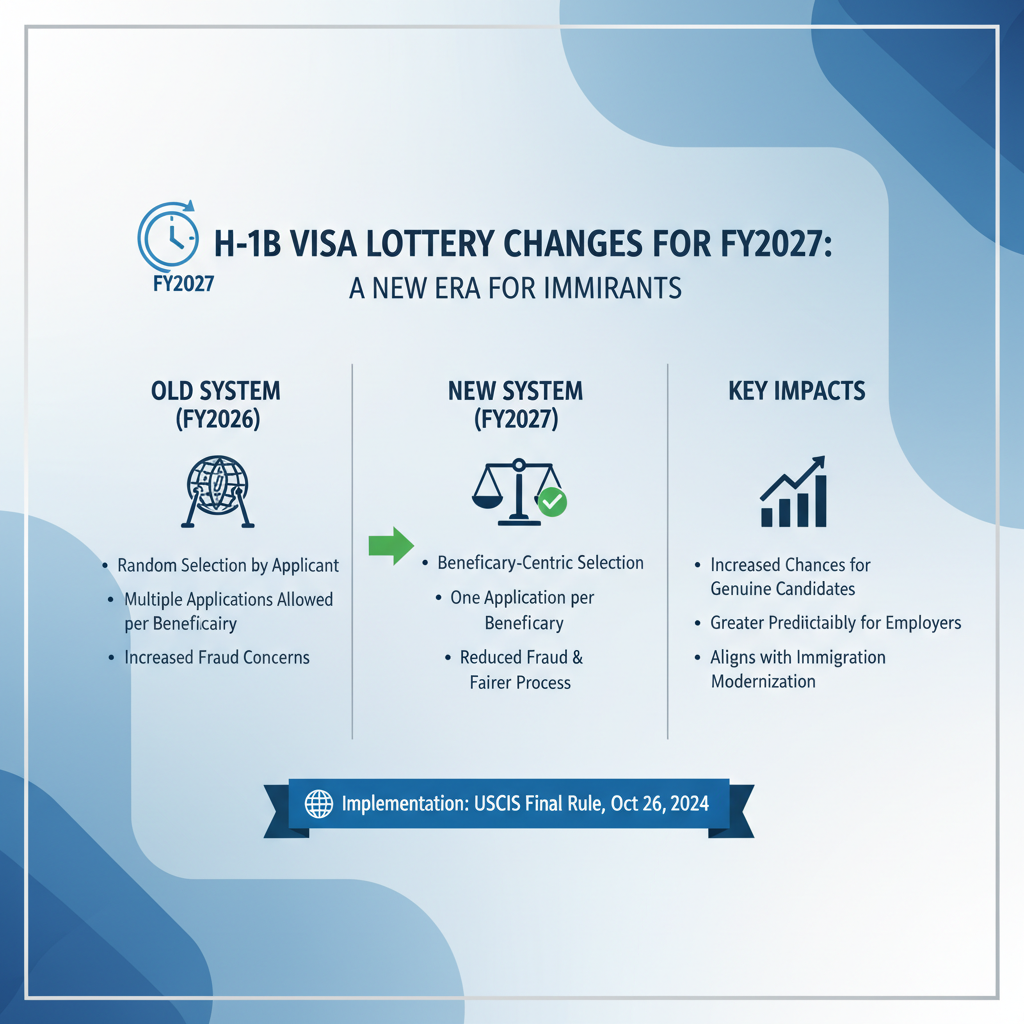
The U.S. Citizenship and Immigration Services (USCIS) has implemented a pivotal shift in the H-1B lottery selection process, effective for the Fiscal Year 2027 (FY2027) cap season. While the H-1B lottery for FY2027 typically concludes in March 2026, the official rule changes were finalized to govern this and future cap seasons. The primary driver behind this reform is to move from an employer-centric selection to a beneficiary-centric selection. This means that instead of allowing multiple employers to register the same individual multiple times, the lottery is now based on each unique beneficiary. This change aims to combat widespread fraud, where some employers would submit numerous registrations for the same individual, artificially inflating their chances of selection and distorting the demand for H-1B visas. The new rule ensures that each eligible beneficiary has an equal chance, regardless of how many employers register them.
How it can affect Florida residents
Florida is a vibrant economic hub, with growing sectors in technology, healthcare, tourism, and aerospace. Many companies along the I-4 corridor, from Orlando to Tampa, depend on highly skilled foreign professionals. Similarly, international students graduating from Florida's excellent universities, such as the University of Central Florida (UCF) or the University of Florida (UF), often seek H-1B sponsorship to continue their careers here, often utilizing their F-1 Optional Practical Training (OPT) status. For these individuals and their prospective employers, the new rules bring significant implications:
- Increased Fairness for Beneficiaries: If you are a foreign national in Florida hoping for an H-1B, your chances of selection are now truly based on a fair random draw, rather than being diluted by fraudulent multiple entries. This levels the playing field for all eligible candidates.
- Reduced Fraud and Abuse: Florida employers who previously faced unfair competition from bad actors engaging in registration fraud will find the process more transparent and equitable. This protects legitimate businesses and their foreign talent.
- Strategic Planning for Employers: Florida businesses will need to adjust their H-1B recruitment strategies. While they can still register eligible beneficiaries, they must ensure they are legitimate job offers. The focus shifts to identifying the most qualified candidates early and preparing robust petitions.
- Importance of Attorney Guidance: Given the complexities of the new system, it's more critical than ever for Florida residents and businesses to work with experienced immigration attorneys. Understanding compliance, preparing accurate registrations, and submitting strong petitions are paramount.
The changes are designed to fortify the integrity of the H-1B program, ensuring that it serves its intended purpose: bringing highly skilled foreign workers to fill critical gaps in the U.S. workforce, including here in Central Florida.
Navigating the H-1B changes can be complex. Our Orlando immigration team is ready to assist. Call +1 786-791-3106 for a free consultation, or message us online. Se Habla Español.
What H-1B Visa Lottery Changes for FY2027 Is (and Why It Matters)
To fully grasp the impact of the FY2027 H-1B lottery changes, it’s essential to understand the H-1B visa program itself and the specific modifications introduced by USCIS.
A plain-English definition
The H-1B visa is a non-immigrant visa that allows U.S. employers to temporarily employ foreign workers in specialty occupations. These are professions that generally require a bachelor's degree or higher in a specific field. Think of roles in IT, engineering, medicine, education, and finance. Because demand for H-1B visas far exceeds the limited number available each year (the annual cap), USCIS conducts a lottery to select which registrations can proceed with a full petition. The recent changes for FY2027 fundamentally alter how this lottery selection process works, moving from a system that could be gamed by multiple registrations from different employers to one that prioritizes a fair chance for each individual beneficiary.
Key terms you need to know
Understanding the jargon is crucial when dealing with immigration matters:
- H-1B Visa: A non-immigrant visa category for temporary workers in specialty occupations.
- Specialty Occupation: An occupation that requires theoretical and practical application of a body of highly specialized knowledge and a bachelor's or higher degree in the specific specialty.
- Annual Cap: The statutory limit on the number of H-1B visas issued each fiscal year. Currently, it's 65,000 for the regular cap, plus an additional 20,000 for those with a U.S. master's degree or higher (the "U.S. Master's Cap").
- H-1B Lottery: The random selection process conducted by USCIS when the number of eligible registrations exceeds the annual cap.
- Beneficiary: The foreign national worker who is the subject of the H-1B petition.
- Petitioner: The U.S. employer filing the H-1B petition on behalf of the beneficiary.
- DHS (Department of Homeland Security): The federal department that oversees USCIS and U.S. immigration policy.
- USCIS (U.S. Citizenship and Immigration Services): The government agency responsible for adjudicating immigration benefits, including H-1B petitions. You can find more information on the USCIS official website.
- Registration Period: The specific timeframe during which prospective employers (petitioners) must electronically register beneficiaries for the H-1B lottery. For FY2027, this typically happens in March 2026.
- Selection Period: The period immediately following the registration period when USCIS conducts the lottery and notifies selected registrants. For FY2027, this usually occurs in late March/early April 2026.
- Petition Filing Period: The window during which selected employers can submit a full H-1B petition (Form I-129) to USCIS. For FY2027, this typically runs from April 1 to June 30, 2026.
- Beneficiary-Centric Selection: The new system where each unique beneficiary is entered into the lottery only once, regardless of how many employers register them. If a beneficiary is selected, all employers who registered them for that fiscal year will be notified, and any of those employers may then file a petition on that beneficiary's behalf. This significantly reduces the incentive for multiple fraudulent registrations.
The switch to beneficiary-centric selection is a monumental change. Previously, if multiple employers registered the same foreign national, each registration counted as a separate entry in the lottery, artificially boosting the individual's chances of selection and reducing the overall odds for others. This led to widespread fraud, with some individuals having dozens of registrations filed on their behalf by sham companies. The new rule, finalized under the DHS, closes this loophole, ensuring that the lottery truly reflects the demand for unique individuals rather than the number of registrations filed.
Current Immigration Law: The Foundation
The H-1B visa program operates under specific provisions of the Immigration and Nationality Act (INA) and related federal regulations. Understanding this legal framework is crucial for anyone seeking or sponsoring an H-1B visa.
Federal requirements
The H-1B non-immigrant classification is governed by Section 101(a)(15)(H)(i)(b) and Section 214(g) of the INA (8 U.S.C. § 1101(a)(15)(H)(i)(b) and 8 U.S.C. § 1184(g)). Regulations are found in 8 CFR Part 214.
Key federal requirements include:
- Specialty Occupation: The job must qualify as a specialty occupation, meaning it requires a bachelor's degree or its equivalent as a minimum entry requirement. The beneficiary must hold the required degree or its equivalent in the specialty field.
- Employer-Employee Relationship: A valid employer-employee relationship must exist between the petitioner and the beneficiary, as defined by USCIS. The employer must have the right to control the beneficiary's work.
- Labor Condition Application (LCA): Before filing an H-1B petition, the employer must file and obtain certification of a Labor Condition Application (Form ETA-9035) from the U.S. Department of Labor (DOL). The LCA attests that the employer will pay the H-1B worker at least the prevailing wage or the actual wage, whichever is higher, and provide working conditions that will not adversely affect other workers. This helps protect both U.S. workers and H-1B employees.
- Annual Cap Compliance: Most H-1B petitions are subject to the annual statutory cap of 65,000 visas, with an additional 20,000 reserved for beneficiaries who have earned a U.S. master's degree or higher. Certain employers are cap-exempt, including institutions of higher education, non-profit organizations affiliated with higher education, and non-profit research organizations or governmental research organizations.
- Period of Stay: An H-1B visa is typically granted for an initial period of up to three years and can be extended for a total maximum stay of six years. There are exceptions for individuals with approved I-140 immigrant petitions or those in the PERM process beyond certain stages.
- Employer Attestations: Employers must make several attestations on the LCA regarding wages, working conditions, and the absence of a strike or lockout.
For official forms and detailed instructions, always refer to the USCIS Forms page.
Florida-specific considerations
While H-1B law is federal, its practical application has regional nuances. Florida's robust economy and diverse industries create a unique environment for H-1B workers:
- High Demand Industries: Florida, particularly the Orlando metropolitan area and the I-4 corridor, sees significant H-1B demand in sectors like:
- Technology: With a growing tech scene, especially around Orlando and its modeling and simulation cluster, software engineers, data scientists, and IT professionals are in high demand.
- Healthcare: Hospitals and medical facilities across Florida, including those in Orange County, frequently sponsor H-1B visas for doctors, nurses, and allied health professionals.
- Aerospace and Aviation: The Space Coast and related industries in Central Florida attract engineers and scientists.
- Hospitality and Tourism: While less common for the H-1B, certain specialized roles in large theme parks or international tourism companies may qualify.
- International Graduates: Florida's extensive university system produces thousands of international graduates annually, many of whom utilize F-1 OPT and seek H-1B sponsorship. The proximity of the Orlando USCIS Field Office can be relevant for certain in-person services, though H-1B petitions are generally processed at service centers.
- Local Economy Impact: H-1B workers contribute significantly to the local economy, bringing diverse skills, fostering innovation, and often establishing roots in communities like Orlando. Their presence supports local businesses and enhances Florida's global competitiveness.
For Central Florida residents and employers, understanding these dynamics, coupled with the new lottery rules, is vital for a successful H-1B journey. It underscores the importance of precise legal counsel tailored to both federal requirements and local economic realities.
Considering an H-1B visa? Let Imigrar guide you through the latest changes. Call +1 786-791-3106 for a free consultation, or message us online. Se Habla Español.
How to Navigate the New H-1B Lottery System: A Complete Step-by-Step Guide
The H-1B lottery process for FY2027 incorporates the new beneficiary-centric selection method, making it crucial to follow each step precisely. This guide outlines the typical timeline and requirements.
1) Understand the New Beneficiary-Centric Lottery Process
Before any action, ensure you grasp the core change: the lottery now focuses on the unique individual (the beneficiary), not the number of employers registering them. Each eligible beneficiary will only have one entry in the lottery pool, regardless of how many employers register them. If selected, USCIS will notify all employers who registered that specific beneficiary, and any of them can then proceed to file a petition. This change aims to drastically reduce the incentive for fraudulent multiple registrations.
- Key Action: Ensure your potential employers are aware of this rule. If multiple employers genuinely wish to sponsor you, they can still register you, but it doesn't increase your odds of selection.
- Documents (for understanding): Beneficiary's passport, educational documents, and resume to confirm eligibility for a specialty occupation.
2) Employer Files Labor Condition Application (LCA)
Prior to any H-1B registration or petition, the prospective employer must file a Labor Condition Application (Form ETA-9035) with the U.S. Department of Labor (DOL). This step is critical because a certified LCA is required before an H-1B petition can be filed. The DOL certifies that the employer will pay the prevailing wage or actual wage (whichever is higher) and that working conditions will not adversely affect U.S. workers.
- Key Action: Employer initiates LCA filing. This process takes approximately 7 business days for certification.
- Required Documents (Employer): Employer's Federal Employer Identification Number (FEIN), job title and duties, proposed wage, work location, and start/end dates.
- Official Reference: U.S. Department of Labor - Foreign Labor Certification
3) H-1B Registration Period (Typically March 2026 for FY2027)
Once the LCA is certified or while it's pending (though certification is needed for the petition, not registration), the employer must electronically register the beneficiary for the H-1B lottery through the myUSCIS online portal. This is a crucial window, usually lasting about three weeks in March.
- Key Action: Each employer wishing to sponsor a beneficiary must create a myUSCIS account, pay the non-refundable $10 registration fee, and submit basic information about both the petitioning employer and the beneficiary.
- Important: Under the new rules, only ONE registration per beneficiary will be considered in the lottery selection. If a beneficiary has multiple registrations, USCIS will use the most recent valid registration to determine eligibility for selection.
- Required Documents (for registration):
- Beneficiary Information: Full legal name, date of birth, country of birth, country of citizenship, passport number, gender.
- Employer Information: Legal name, mailing address, FEIN.
- Attorney/Representative Information: If applicable.
4) Lottery Selection and Notification (Typically Late March/Early April 2026)
After the registration period closes, USCIS conducts the random lottery selection. This usually happens within a few weeks.
- Key Action: USCIS notifies selected registrants through their myUSCIS online accounts. If selected, the status for that beneficiary will change to "Selected." If not selected, it will show "Not Selected" or "Denied" (if the registration was invalid).
- Important: If a beneficiary is selected, *all* employers who submitted a registration for that beneficiary will receive a selection notification. Any of those employers can then proceed to file an H-1B petition.
- Documents: Confirmation of selection notice from USCIS.
5) Petition Filing Period (Typically April 1 to June 30, 2026 for FY2027)
Only employers whose registrations were selected can file a full H-1B petition. This period typically starts on April 1 and lasts for 90 days. It's critical to file within this window.
- Key Action: The employer, with legal counsel, prepares and submits Form I-129, Petition for a Nonimmigrant Worker, along with extensive supporting documentation and required fees, to the appropriate USCIS service center.
- Required Documents (for petition filing):
- Certified LCA (Form ETA-9035).
- Form I-129 with all required supplements.
- Employer's letter of support outlining the job offer, specialty occupation details, and business necessity.
- Beneficiary's educational documents: Diplomas, transcripts, foreign degree evaluations (if applicable), professional licenses.
- Beneficiary's resume/CV.
- Beneficiary's passport, I-94 record, and previous visa stamps (if applicable).
- Employer's financial documents (e.g., tax returns, annual reports) to demonstrate ability to pay the wage.
- Company brochures, organizational charts, and other evidence of a legitimate business and employer-employee relationship.
- Applicable filing fees (currently: Base filing fee, ACWIA fee, Fraud Prevention and Detection fee, Public Law 114-113 fee, and optional premium processing fee).
6) USCIS Processing and Adjudication
After filing, USCIS reviews the petition. Processing times vary significantly. You can check current processing times on the USCIS Processing Times page.
- Key Action: Respond promptly and thoroughly to any Request for Evidence (RFE) issued by USCIS. An RFE indicates USCIS needs more information to make a decision.
- Premium Processing: Employers can opt for premium processing (Form I-907) for an additional fee, which guarantees a decision or RFE within 15 calendar days. This is highly recommended for time-sensitive cases.
- Documents: Any additional documents requested by USCIS in an RFE.
7) Visa Interview and Entry (if outside U.S.) / Change of Status (if inside U.S.)
If the H-1B petition is approved, the final step depends on the beneficiary's location.
- If Outside the U.S. (Consular Processing): The beneficiary will attend an interview at a U.S. embassy or consulate in their home country. Upon approval, an H-1B visa stamp will be placed in their passport, allowing them to enter the U.S. in H-1B status, typically starting October 1st.
- Required Documents: Valid passport, Form DS-160 confirmation page, interview appointment confirmation, I-797 approval notice, job offer letter, educational documents.
- Official Reference: U.S. Department of State
- If Inside the U.S. (Change of Status): If the beneficiary is already in the U.S. in a valid non-immigrant status (e.g., F-1 OPT) and the petition requested a change of status, their status will automatically change to H-1B on October 1st. They will receive a new I-94 record reflecting their H-1B status.
- Important: For those on F-1 OPT, the Cap-Gap Extension may apply, allowing them to remain in the U.S. and continue working until their H-1B status begins on October 1st.

Practical Steps You Can Take Today for Your H-1B Journey
The H-1B process is competitive and complex. Proactive preparation is key, especially with the new rules in place. Here are practical steps you can take now:
Actionable Checklist
- Verify Eligibility: Confirm you meet the educational and occupational requirements for an H-1B visa. Do you have a bachelor's degree (or foreign equivalent) in a specialty occupation field?
- Consult an Attorney EARLY: Engage with an experienced immigration lawyer from Imigrar as soon as possible. We can assess your specific situation, clarify the new rules, and guide you and your potential employer.
- Communicate with Potential Employers: If you are seeking sponsorship, ensure your prospective employers understand the new beneficiary-centric lottery rules. Encourage them to register you if they have a legitimate job offer.
- Gather Personal Documents: Start compiling all necessary personal documents, such as your passport, birth certificate, marriage certificate (if applicable), educational degrees, transcripts, and any professional licenses. Ensure foreign documents are translated and certified.
- Request Educational Evaluations: If your degree is from a foreign institution, obtain a comprehensive credential evaluation from a reputable service that confirms its U.S. equivalency.
- Prepare Your Resume/CV: Update your resume to clearly highlight your qualifications and experience relevant to specialty occupations.
- Understand Timelines: Familiarize yourself with the H-1B lottery calendar for FY2027 (March registration, April selection, April-June filing, October 1 start).
- Explore Alternatives: Discuss alternative visa options with your attorney in case the H-1B lottery is unsuccessful (e.g., O-1, L-1


