


At Imigrar, we understand that changes in immigration policy can create uncertainty and anxiety for individuals and businesses alike. As an immigration law firm based in Orlando, Florida, we are committed to keeping our community informed and prepared for significant developments. The H-1B visa program, a vital pathway for skilled foreign workers to contribute to the U.S. economy, is once again undergoing modifications for the upcoming Fiscal Year 2027 (FY2027) lottery. These changes are designed to enhance fairness and integrity in the selection process, and understanding them is crucial for anyone hoping to participate.
This comprehensive guide will break down the latest H-1B visa lottery changes, explain what they mean for you, and provide actionable steps to navigate the application process successfully. Our goal is to empower you with the knowledge needed to make informed decisions and "Keep Families Together."
The reporting that sparked this guide
The information and analysis presented in this guide are prompted by recent developments and discussions within the immigration legal community, as reported by various reputable sources. We continually monitor these updates to provide timely and accurate advice.
H-1B Visa Lottery Changes for FY2027 (Legal News)
What This News Means for Immigrants in Orlando and Across Florida
The H-1B visa program is a cornerstone of the U.S. economy, allowing American employers to temporarily employ foreign workers in specialty occupations. For Orlando and the broader Florida landscape, which boasts thriving tech, healthcare, aerospace, and tourism-related industries, the H-1B program is indispensable for attracting top talent.
Why this news is showing up now
As of August 25, 2026, discussions and official announcements regarding the H-1B visa lottery process for FY2027 are becoming increasingly prominent. U.S. Citizenship and Immigration Services (USCIS) regularly reviews and updates its procedures to address program integrity, combat fraud, and adapt to evolving needs. The changes for FY2027 are a continuation of these efforts, building on recent adjustments, most notably the shift to a beneficiary-centric selection process. These announcements typically precede the annual H-1B cap registration period, which traditionally opens in March (for FY2027, this would be March 2027), allowing employers and prospective beneficiaries ample time to prepare.
How it can affect Florida residents
For skilled professionals residing in Florida, whether on other nonimmigrant visas (like F-1 OPT, J-1, or L-1) or those seeking to come to the U.S. to work, these changes directly impact their prospects. Florida is a hub for innovation and growth, with major companies and startups along the I-4 corridor and beyond seeking specialized expertise. Universities like the University of Central Florida, University of Florida, and Florida International University graduate thousands of international students annually, many of whom aspire to secure H-1B visas. The new rules, particularly those aimed at reducing fraud and ensuring fairness, mean:
- **Increased Fairness:** The intent is to give every eligible beneficiary an equal chance, regardless of how many employers register them. This can level the playing field.
- **Employer Responsibility:** Employers in Orlando, Miami, Tampa, and across the state must be diligent in their registration practices, ensuring compliance with the new regulations.
- **Strategic Planning:** Both beneficiaries and petitioners need to strategically plan their H-1B applications well in advance, working closely with experienced legal counsel.
- **Impact on STEM Graduates:** Florida's strong STEM programs will continue to produce highly qualified candidates, for whom the H-1B is a critical next step. Understanding the new rules is paramount for these graduates and their potential employers.
Important: These changes underscore the need for meticulous preparation and adherence to USCIS guidelines. Errors or non-compliance can lead to disqualification or denial.
Need Help? Our Orlando immigration team is ready to assist. Navigating H-1B changes can be complex, but you don't have to do it alone. Call +1 786-791-3106 for a free consultation, or message us online. Se Habla Español.
What H-1B Visa Lottery Changes for FY2027 Are (and Why They Matter)
The H-1B visa is a nonimmigrant visa that allows U.S. employers to temporarily employ foreign workers in specialty occupations. These occupations generally require a bachelor's degree or higher in a specific field. Due to high demand, USCIS utilizes a lottery system to select petitions when the number of eligible registrations exceeds the annual cap.
A plain-English definition
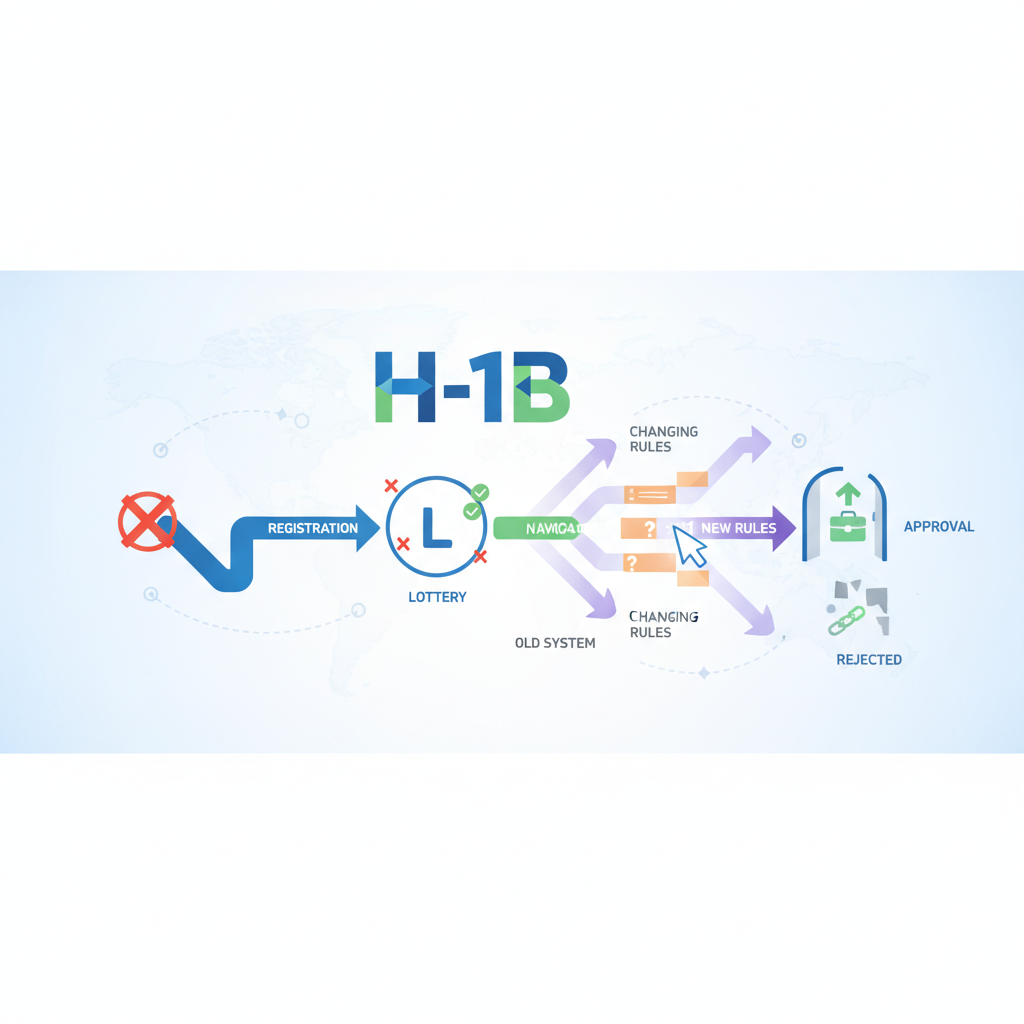
For FY2027, the most significant "change" is the continued implementation and refinement of the beneficiary-centric selection process. Previously, some individuals might have had multiple H-1B registrations submitted on their behalf by different employers, theoretically increasing their chances of selection. The new rule, first introduced for FY2025 and continued for FY2026, fundamentally alters this. Instead of selecting registrations based on each submission, USCIS now bases selection on each unique beneficiary. This means that regardless of how many employers register a single beneficiary, that individual is entered into the lottery only once. If selected, all employers who registered that beneficiary will receive a selection notice, and any one of them can then file the H-1B petition.
Why does this matter? It's a direct response to concerns about fraud and gaming the system. By ensuring that each prospective H-1B worker has only one chance in the lottery, USCIS aims to make the process fairer and more equitable for all eligible candidates. For employers, especially those in competitive markets like Orlando's tech sector, it means focusing on a strong, legitimate job offer rather than attempting to maximize lottery odds through multiple registrations.
Key terms you need to know
- H-1B Visa: A nonimmigrant visa that permits U.S. employers to temporarily employ foreign workers in specialty occupations.
- USCIS: U.S. Citizenship and Immigration Services, the government agency that oversees lawful immigration to the United States. USCIS official website
- Petitioner: The U.S. employer filing the H-1B petition on behalf of a foreign worker.
- Beneficiary: The foreign national worker for whom the H-1B petition is being filed.
- Annual Cap: The statutory limit on the number of H-1B visas issued each fiscal year. Currently, it's 65,000 for the regular cap and an additional 20,000 for those with a U.S. master's degree or higher.
- Lottery (Cap-Subject): The random selection process USCIS uses when the number of H-1B registrations exceeds the annual cap.
- FY (Fiscal Year): The federal government's fiscal year runs from October 1 to September 30. H-1B petitions approved for a given FY (e.g., FY2027) have an earliest start date of October 1 of that year (October 1, 2027).
- Registration Period: The specific window, typically in March, during which employers must electronically register prospective H-1B beneficiaries for the lottery.
- Selection Process: The method by which USCIS randomly chooses registrations from the pool to meet the annual cap. For FY2027, this is the beneficiary-centric selection.
Current Immigration Law: The Foundation of H-1B
The H-1B visa program operates under the authority of the Immigration and Nationality Act (INA), specifically Section 101(a)(15)(H)(i)(b), which defines "H-1B" as a nonimmigrant who is coming temporarily to the United States to perform services in a specialty occupation. The numerical limitations (caps) are set forth in INA Section 214(g).
Federal requirements
To be eligible for an H-1B visa, both the employer and the prospective employee must meet specific federal criteria:
- Specialty Occupation: The job must qualify as a specialty occupation, meaning it requires theoretical and practical application of a body of highly specialized knowledge, and a bachelor's degree or higher in the specific specialty (or its equivalent) for entry into the occupation.
- Educational Requirement: The beneficiary must possess a bachelor's degree or its equivalent, or a license in a specialty occupation field, or experience in the specialty occupation equivalent to a bachelor's degree.
- Employer-Employee Relationship: A valid employer-employee relationship must exist between the petitioning U.S. employer and the H-1B beneficiary.
- Labor Condition Application (LCA): Before filing an H-1B petition, the employer must file and obtain certification of a Labor Condition Application (Form ETA-9035) from the U.S. Department of Labor. The LCA attests that the employer will pay the H-1B worker at least the prevailing wage or the actual wage paid to other employees with similar experience and qualifications, and that employment of the H-1B worker will not adversely affect the working conditions of similarly employed U.S. workers.
- Annual Cap: As mentioned, there's an annual cap of 65,000 H-1B visas, with an additional 20,000 reserved for those with a U.S. master's degree or higher. Certain employers are cap-exempt (e.g., institutions of higher education, non-profit organizations affiliated with them, and non-profit research organizations).
All H-1B petitions are filed with USCIS using Form I-129, Petition for a Nonimmigrant Worker. This form is central to the entire process once a beneficiary is selected in the lottery.
Florida-specific considerations
While immigration law is federal, its application has local implications. For employers and beneficiaries in Florida, especially in areas like Orlando, Tampa, and Miami, understanding the local economic landscape and USCIS processing centers is important:
- Industry Demand: Florida's growing technology sector, particularly in simulation and training, aviation, and digital media in Orlando, creates high demand for specialized skills often filled by H-1B workers. The healthcare sector, finance, and engineering fields also heavily utilize H-1Bs.
- USCIS Field Offices: While H-1B petitions are processed by USCIS service centers, the Orlando USCIS Field Office handles other immigration matters. For H-1B beneficiaries, familiarity with local resources and legal counsel is essential.
- Prevailing Wages: The prevailing wage requirements vary by geographic area. Employers in Central Florida must ensure they meet the prevailing wage for their specific occupation and location as determined by the Department of Labor.
Reminder: No specific Florida state laws govern H-1B visas; all requirements are federal. However, choosing an immigration attorney familiar with the local business environment, like Imigrar in Orlando, can provide an added layer of insight and strategic advantage.
For more detailed information on H-1B program requirements, visit the USCIS official website on H-1B Specialty Occupations.
Need Help? Don't let the complexities of H-1B regulations overwhelm you. Our Orlando immigration attorneys have extensive experience with H-1B petitions. Call +1 786-791-3106 for a free consultation to discuss your specific situation. Se Habla Español.
How to Navigate the H-1B Visa Lottery Changes for FY2027: A Complete Step-by-Step Guide
The H-1B process is multi-faceted, involving several stages from initial eligibility assessment to petition approval and employment commencement. For FY2027, adherence to the new beneficiary-centric lottery rules is paramount.
1) Understand the New FY2027 H-1B Lottery Rules and Eligibility
Before any action is taken, both the employer (petitioner) and the foreign worker (beneficiary) must thoroughly understand the refined lottery rules. The core principle for FY2027 remains: each unique beneficiary will have only one entry in the lottery, regardless of how many registrations are submitted on their behalf by different employers. USCIS will identify duplicate registrations for the same individual and discard them, potentially leading to disqualification if fraudulent intent is suspected.
- Beneficiary Eligibility: Ensure the beneficiary meets the fundamental H-1B requirements: a bachelor's degree or its equivalent in a specialty occupation field. If claiming the master's cap, verify the U.S. master's degree (or higher) from a qualifying institution.
- Employer Eligibility: The petitioning employer must have a legitimate job offer in a specialty occupation and the ability to pay the required wage.
Required Documents (for initial assessment):
- Beneficiary's valid passport
- All educational degrees, diplomas, and transcripts (including foreign credential evaluations if applicable)
- Beneficiary's detailed resume/CV
- Professional licenses or certifications (if applicable)
- Job offer letter from the employer, detailing position, duties, and salary
- Employer's Federal Employer Identification Number (FEIN)
2) Employer Files H-1B Registration Electronically
The first official step for cap-subject H-1B visas is electronic registration. USCIS typically opens this window for approximately two to three weeks in March (for FY2027, this would be March 2027). The employer, or their authorized attorney, must create a USCIS online account and submit the registration.
- Registration Information: The registration requires basic identifying information for both the employer and the beneficiary.
- Registration Fee: A non-refundable fee (e.g., $10 for recent fiscal years) must be paid for each registration.
- Single Entry Per Beneficiary: Under the FY2027 rules, if multiple employers wish to sponsor the same beneficiary, each employer can submit a registration, but the beneficiary will only be counted once in the lottery pool. All legitimate registrations for a selected beneficiary will be selected.
Required Information (for registration):
- Employer's legal name, FEIN, and mailing address
- Employer's authorized signatory information
- Beneficiary's full legal name, date of birth, country of birth, country of citizenship
- Beneficiary's passport number
- Whether the beneficiary holds a U.S. master's or higher degree (to qualify for the master's cap)
3) Await Lottery Results and Selection Notification
Once the registration period closes, USCIS conducts the random lottery selection. Typically, results are announced by the end of March (for FY2027, this would be late March 2027).
- Notification: Employers (or their attorneys) will receive an electronic notification in their USCIS online accounts. Notices will indicate "Selected," "Not Selected," or "Denied" (if found to be a duplicate or invalid).
- What "Selected" Means: If a beneficiary is selected, all employers who submitted a legitimate registration for that beneficiary will receive a "Selected" notice. Any one of these selected employers can then proceed to file an H-1B petition on behalf of the beneficiary.
4) Prepare and File the H-1B Petition (Form I-129)
Upon selection, the employer has a specific 90-day window to prepare and file the full H-1B petition with USCIS. This is the most extensive and document-intensive stage.
- Labor Condition Application (LCA): The employer must first file and obtain a certified LCA from the U.S. Department of Labor (DOL). This must be certified before the Form I-129 can be filed.
- Petition Filing: The complete Form I-129, Petition for a Nonimmigrant Worker, along with all supporting documentation and filing fees, must be physically mailed to the correct USCIS service center within the designated filing window.
- Premium Processing: Employers may opt for premium processing by filing Form I-907, Request for Premium Processing Service, which guarantees USCIS action within 15 calendar days for an additional fee.
Required Documents (for H-1B Petition):
- Certified Form ETA-9035 (LCA)
- Completed and signed Form I-129 and H-1B supplement
- Employer's support letter detailing the job, beneficiary's qualifications, and why it's a specialty occupation
- Beneficiary's educational documents (degree, transcripts, evaluations)
- Beneficiary's resume/CV
- Copies of beneficiary's passport, current visa, and I-94 record
- Company documents (e.g., articles of incorporation, business licenses, tax returns, financial statements, organizational charts, client contracts) to establish the employer's legitimacy and ability to pay the wage.
- Evidence of employer-employee relationship (e.g., detailed job duties, supervision structure)
- Filing fees (check or money order)
5) Respond to Requests for Evidence (RFEs) or Notices of Intent to Deny (NOIDs)
It's common for USCIS to issue a Request for Evidence (RFE) if they require more information or clarification to make a decision on the petition. Less commonly, a Notice of Intent to Deny (NOID) may be issued.
- RFE: This is a request for additional documents or evidence to support claims made in the petition.
- NOID: This indicates USCIS intends to deny the petition and provides a final opportunity to submit evidence to overcome the grounds for denial.
- Timely Response: Both require a meticulous and timely response, typically within a specific deadline provided by USCIS.
Required Documents (for RFE/NOID response):
- Specific documents requested by USCIS to address their concerns (e.g., expert opinion letters, additional financial records, detailed job descriptions, work samples).
- A cover letter explaining how the submitted evidence addresses each point of the RFE/NOID.
6) Await Petition Adjudication and Change of Status/Consular Processing
After filing, or responding to an RFE, USCIS will adjudicate the petition. If approved, an approval notice (Form I-797) is issued.
- Change of Status (COS): If the beneficiary is already in the U.S. in a valid nonimmigrant status (e.g., F-1 OPT, L-1, H-4) and the H-1B petition requested a change of status, they will automatically change to H-1B status on October 1 (for FY2027, October 1, 2027).
- Consular Processing: If the beneficiary is outside the U.S. or did not request a change of status, they will need to attend a visa interview at a U.S. embassy or consulate in their home country to obtain an H-1B visa stamp.
7) Start Employment
The earliest an H-1B worker can begin employment under a cap-subject petition for FY2027 is October 1, 2027. This is regardless of when the petition was approved.
- I-9 Compliance: Employers must complete Form I-9, Employment Eligibility Verification, for all new hires, including H-1B workers.
Warning: Never begin H-1B employment before the official start date (October 1) or before your H-1B status becomes effective. Doing so can have severe immigration consequences.
Practical Steps You Can Take Today
Given that "today is 2026-08-25," and the FY2027 lottery is still several months away, proactive preparation is key. Here’s how you can get ready:
Actionable Checklist:
- Verify Beneficiary Eligibility: Ensure the beneficiary meets all educational and


