


The reporting that sparked this guide
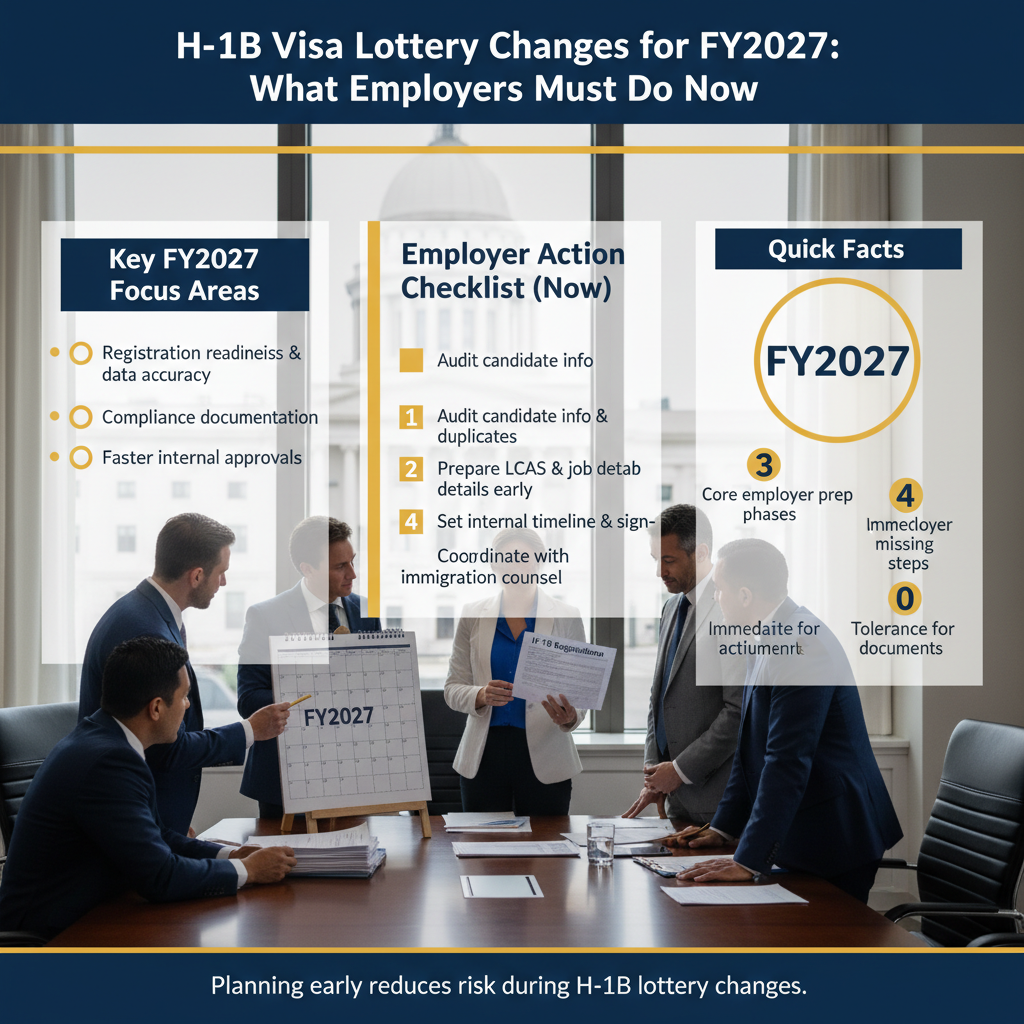
The immigration updates discussed below are based on recent coverage and ongoing reporting trends appearing in Legal News search results, including: H-1B Visa Lottery Changes for FY2027 (Legal News).
Important: News coverage often summarizes proposed rules, draft guidance, stakeholder alerts, and early implementation details. This guide explains how H-1B “lottery” changes typically roll out, what to watch for in FY2027, and how to protect your job offer, your status, and your long-term immigration plan.
Need Help? Our Orlando immigration team is ready to assist. Call +1 786-791-3106 for a free consultation, or message us online. Se Habla Español.
What This News Means for Immigrants in Orlando and Across Florida
Why this news is showing up now
H-1B rules tend to change in “waves” tied to the annual cap season and the federal fiscal year. The government typically refines the selection process, registration rules, and anti-fraud safeguards when:
- USCIS sees sharp increases in registrations and “multiple registration” concerns.
- Employers and workers report unpredictability in selection rates and adjudication outcomes.
- New compliance priorities emerge (wage levels, specialty occupation scrutiny, third-party worksites, and fraud detection).
- Technology upgrades and data-sharing allow tighter identity validation and enforcement.
For FY2027 specifically, the “trending” discussion reflects continued attention to how USCIS runs the electronic registration system, how it selects beneficiaries, and how it verifies that each registration represents a real job opportunity with a legitimate employer-employee relationship.
Reminder: H-1B planning is not a “March-only” task. If FY2027 changes affect registration mechanics, beneficiary eligibility evidence, or employer attestations, the impact starts months earlier—often in the fall and winter before registration opens.
How it can affect Florida residents
Florida—especially the I-4 corridor (Orlando, Lake Mary, Sanford, Kissimmee, and Tampa)—has a fast-growing market for tech, healthcare, engineering, hospitality management, and finance. That means many Central Florida residents are directly affected by H-1B policy shifts, including:
- International students in F-1 OPT/STEM OPT working in Orlando-area employers.
- Professionals on L-1, TN, E-2, or other work-authorized statuses seeking an H-1B “cap” option.
- Employers in Orange County and beyond hiring specialized talent from abroad.
If your case is in Orlando, you may also be coordinating multiple agencies and steps—USCIS filings, Department of Labor wage and LCA compliance, and (if traveling) consular processing through the U.S. Department of State.
Need Help? Our Orlando immigration team is ready to assist. Call +1 786-791-3106 for a free consultation, or message us online. Se Habla Español.
What H-1B Visa Lottery Changes for FY2027 Is (and Why It Matters)
A plain-English definition
The “H-1B lottery” is the selection process USCIS uses when more employers want to file new cap-subject H-1B petitions than the law allows each year. Employers first submit an electronic registration for a specific worker (the “beneficiary”). USCIS then selects enough registrations to meet:
- The regular H-1B cap (65,000), and
- The U.S. master’s cap (20,000) for qualifying advanced degrees.
“H-1B Visa Lottery Changes for FY2027” refers to anticipated adjustments to the way USCIS manages that registration and selection process—potentially affecting what information must be provided, how beneficiaries are identified, how duplicates are handled, and what compliance steps employers must complete before and after selection.
Key terms you need to know
- Cap-subject: New H-1B petitions counted against the annual numerical limit.
- Cap-exempt: Certain employers (e.g., universities, affiliated nonprofits, some research organizations) can file without the lottery.
- Electronic registration: The pre-filing step where employers register a beneficiary for the lottery.
- Beneficiary: The worker being sponsored for H-1B.
- Specialty occupation: A role that normally requires at least a bachelor’s degree in a specific field (a central H-1B requirement).
- LCA (Labor Condition Application): A Department of Labor certification about wages and working conditions (typically required before filing the petition).
- RFE: Request for Evidence—USCIS asks for more proof before deciding.
- Consular processing: Getting the H-1B visa stamp abroad and entering the U.S. in H-1B status.
- Change of status: Switching to H-1B status inside the U.S. without leaving.
- 90-day window: In many immigration contexts, this phrase refers to timing rules around entry and intent; in H-1B, timing issues often center on registration windows and filing windows after selection. Always confirm the exact window in your selection notice.
Warning: The H-1B “lottery” is not a personal application you file yourself. It is employer-driven, with strict compliance responsibilities. A change in the rules can increase employer risk—meaning some companies become more cautious unless filings are prepared correctly.
Current Immigration Law: The Foundation
Even when USCIS updates procedures, the H-1B program is rooted in federal statute and regulations. The annual cap is set by Congress, while USCIS and the Department of Labor implement the details through regulations, forms, and policy guidance.
Federal requirements
Core H-1B authority comes from the Immigration and Nationality Act (INA) and implementing regulations, including (among others) 8 U.S.C. § 1184 and 8 C.F.R. § 214.2(h). Key legal pillars include:
- The job must qualify as a specialty occupation.
- The worker must have the required education (or equivalent) for the role.
- The employer must comply with LCA wage and notice requirements under Department of Labor rules (commonly tied to 20 C.F.R. part 655).
- The petition is filed on Form I-129 (Petition for a Nonimmigrant Worker) with H Classification Supplement and supporting evidence.
- USCIS may investigate fraud and verify worksites, including third-party placements.
For official updates, forms, and instructions, start with the USCIS official website and the USCIS Forms page. For processing estimates and planning, check USCIS Processing Times.
Important: Although this article focuses on H-1B, many families also plan for long-term options like Adjustment of Status through family or employment sponsorship. In those contexts you may see forms like Form I-130 (family petition) and Form I-485 (green card application), and concepts like Priority Date. Those terms matter because an H-1B strategy is often a “bridge” to permanent residence.
Florida-specific considerations
Florida does not create H-1B visa rules (it’s federal), but Florida facts can shape your case:
- Worksite realities: Many Central Florida roles involve client sites along the I-4 corridor. Third-party worksites can increase scrutiny; documentation must clearly show supervision, specialty duties, and itinerary.
- Industry mix: Orlando’s tourism and hospitality economy also includes corporate tech, analytics, and engineering. USCIS will focus on whether the role truly requires a specific degree—not just “any bachelor’s.”
- Local adjudication touchpoints: The Orlando USCIS Field Office generally handles many in-person matters (like interviews for Adjustment of Status), while H-1B petitions are typically adjudicated at service centers. Still, your overall immigration path may involve local USCIS steps if you later file Form I-485.
- Travel planning: Florida residents often travel internationally. If you are selected and file for change of status, leaving the U.S. at the wrong time can disrupt the change of status and force consular processing.
If your case is in Orlando and you’re balancing OPT expiration, employer onboarding, and travel, a proactive timeline can prevent gaps in work authorization.
How to Prepare for FY2027 H-1B Changes: A Complete Step-by-Step Guide
The most reliable way to handle rule changes is to build a process that works even when USCIS tightens evidence requirements. Below is a practical preparation plan for employers and beneficiaries anticipating FY2027 updates.
1) Confirm the role qualifies as a specialty occupation (before registration)
Start by validating the job itself—because no lottery “win” helps if the petition later receives an RFE or denial for specialty occupation issues.
- Job duty analysis: Ensure the duties require specialized knowledge and align with a specific academic field.
- Degree mapping: Confirm the offered degree requirements are not overly broad (e.g., “any bachelor’s degree”).
- Worksite clarity: Identify where the work will be performed (Orlando office, remote, client site, hybrid) and who will supervise.
Documents to gather (Step 1):
- Detailed job description (duties broken down by percentage of time)
- Org chart showing the role’s placement and reporting line
- Offer letter with title, salary, location(s), and start date assumptions
- Evidence of similar roles requiring degrees (job postings, internal hiring standards)
- If third-party placement: draft statement of work (SOW) or client letter (where appropriate)
2) Validate beneficiary identity, credentials, and cap strategy
FY2027 changes may continue emphasizing beneficiary-based integrity and identity verification. Even under current practice, inconsistencies in names, passports, and degree records can cause registration and petition problems.
Documents to gather (Step 2):
- Passport biographic page (ensure it’s valid and consistent)
- Current U.S. immigration documents (I-94, visa stamp, approval notices)
- Resume/CV and LinkedIn profile consistency check
- Diplomas and transcripts (U.S. and foreign)
- Credential evaluation (if degree is foreign) and experience letters if using equivalency
- F-1 students: OPT EAD card, STEM OPT documents, I-20s, SEVIS history
Reminder: If you’re in F-1 OPT in Orlando and your OPT end date is near, timing becomes critical. You may need to coordinate cap-gap eligibility and avoid travel that could jeopardize status.
3) Build a compliant wage and LCA plan early
Even though the LCA is typically filed closer to the petition stage, your wage strategy should be set early—especially if FY2027 changes increase compliance checks.
Documents to gather (Step 3):
- Proposed salary and benefits summary
- Worksite addresses (including remote work address if applicable)
- Prevailing wage data (internal or counsel-supported analysis)
- Company support documents (EIN verification, business filings, brochures/website)
- Public access file (PAF) preparation checklist (employer-side compliance)
Warning: Wage and location mismatches are a common trigger for RFEs and site visit concerns—especially when the beneficiary works from home in Orange County or at rotating client sites along the I-4 corridor.
4) Complete the electronic registration accurately and consistently
The registration step is deceptively simple—but small errors can be fatal. If FY2027 introduces new fields, stricter identity validation, or revised attestations, accuracy matters even more.
Documents to gather (Step 4):
- Beneficiary passport details (exact spelling, number, expiration)
- Beneficiary date of birth and country of birth (match passport)
- Employer legal name, FEIN, and authorized signatory details
- Attorney/representative information (if represented)
- Master’s cap evidence (if claiming U.S. advanced degree eligibility)
Important: If USCIS continues tightening duplicate registration enforcement, employers should implement internal controls to avoid multiple registrations filed improperly for the same beneficiary across related entities.
Need Help? Our Orlando immigration team is ready to assist. Call +1 786-791-3106 for a free consultation, or message us online. Se Habla Español.
5) If selected, file the H-1B petition with strong evidence (and a “future RFE” mindset)
Selection only gives the employer the chance to file the petition. The petition must prove eligibility under the law and regulations, and it must match the registration details.
Documents to gather (Step 5):
- Form I-129 and H supplement (proper edition and signatures)
- Certified LCA
- Employer support letter detailing:
- specialty occupation analysis
- day-to-day duties
- tools/technologies used
- supervision and evaluation methods
- worksite details and itinerary (if applicable)
- Beneficiary degree evidence (diploma, transcripts, evaluations)
- Company documents (financials where appropriate, business operations proof)
- Client letters/SOWs (when third-party placement requires it)
- Maintaining status evidence (I-94, prior approvals, paystubs if in U.S.)
Reminder: If you plan a future green card path (PERM or family), keep records organized. Later filings—like Form I-130 or Form I-485—often require consistent employment and identity histories, and may depend on a Priority Date.
6) Plan for approval, start date, travel, and long-term strategy
Many H-1B problems occur after filing: travel at the wrong time, payroll mismatches, or job changes not reported properly.
Documents to gather (Step 6):
- Approval notice (Form I-797)
- Updated I-94 (if change of status approved)
- Pay records and job duty confirmations (for compliance)
- Travel itinerary and consular appointment planning (if consular processing)
- Future immigration plan notes (extensions, amendments, green card steps)
Warning: If you are in the U.S. and your petition requests a change of status, international travel before approval (or sometimes during sensitive periods) may cause USCIS to treat the change of status as abandoned, forcing consular processing.
Practical Steps You Can Take Today
Whether FY2027 brings modest adjustments or major procedural updates, the best results come from preparation. Here is a checklist you can start now.
Actionable checklist (do these now)
- 1) Build a “registration-ready” file with passport, degrees, transcripts, and immigration history.
- 2) Ask your employer to confirm the exact worksite plan (Orlando office, remote in Orange County, hybrid, or client site along the I-4 corridor).
- 3) Review job description specificity—ensure duties are technical/professional and tied to a specific degree field.
- 4) Confirm wage strategy early so the offered salary supports the LCA and avoids last-minute changes.
- 5) Identify cap-exempt alternatives if you work for (or can move to) a qualifying institution.
- 6) Create a travel plan and avoid risky trips during registration/filing/decision periods.
- 7) Track expiration dates (I-94, EAD, passport). A passport expiring soon can shorten approval periods.
Document preparation guidance
- Keep a single “source of truth” for your legal name spelling across all filings.
- Request transcripts early—some universities take weeks.
- If you have a foreign degree, obtain a credential evaluation and gather experience letters if needed.
- Save paystubs, W-2s, and offer letters—these can be crucial if USCIS questions maintenance of status.
Timeline expectations (planning for FY2027)
While USCIS publishes exact dates each year, a typical cap season rhythm looks like:
- Winter: Employers identify candidates; prepare job and credential documentation.
- Early spring: Electronic registration period opens (often a few weeks).
- Spring: USCIS announces selections; employers file full petitions during the filing window.
- Late spring/summer: Adjudications, RFEs, and approvals; premium processing may be available for faster decisions.
- Fall start date: Many cap-subject H-1Bs begin around October 1 (varies by year and case specifics).
Important: If you’re an F-1 student relying on cap-gap, your work authorization timing can hinge on filing dates and your OPT expiration. Avoid assuming you have 180 days of cushion—cap-gap rules are specific and fact-dependent.
How Imigrar Helps Immigrants in Orlando
Imigrar is an immigration law firm based in Orlando, Florida, serving clients nationwide. We help employers and professionals approach the H-1B process strategically—especially when rules change and uncertainty rises.
- We assess eligibility and risk (specialty occupation, wage, worksite, third-party placement).
- We prepare registration and petition filings with consistent, audit-ready documentation.
- We advise on status protection (F-1 OPT/STEM OPT transitions, travel, dependents).
- We coordinate long-term plans—so your H-1B supports future green card goals like Adjustment of Status when eligible.
If your case is in Orlando, we understand local employer needs and the realities of Central Florida hiring. We can also help you plan for later steps that may involve the Orlando USCIS Field Office (for example, if you later file Form I-485).
Call us for a free consultation at +1 786-791-3106. Se Habla Español.
Need Help? Our Orlando immigration team is ready to assist. Call +1 786-791-3106 for a free consultation, or message us online. Se Habla Español.
Frequently Asked Questions
Q: Am I eligible for the FY2027 H-1B lottery if I’m on F-1 OPT in Orlando?
A: Many F-1 OPT workers are eligible, but eligibility depends on whether the employer is filing a cap-subject H-1B for a qualifying specialty occupation and whether you have the required degree (or equivalent). You’ll also need to maintain valid status through filing and adjudication. For Central Florida residents, we strongly recommend confirming OPT/STEM OPT end dates, cap-gap possibilities, and travel plans before registration.
Q: Do FY2027 lottery changes affect my current immigration status?
A: The lottery changes primarily affect selection and filing procedures, but they can indirectly affect your status if delays or errors prevent timely filing. If your OPT expires, or your I-94 expires, you could fall out of status. Warning: Do not assume you have a grace period that covers everything—timing is case-specific. If you’re unsure, consult counsel and monitor official updates on the USCIS official website.
Q: How long does the H-1B process take after selection?
A: After selection, the employer must file the full petition within the filing window listed on the selection notice. Processing times vary by service center and workload. You can track estimates at USCIS Processing Times. Some employers choose premium processing (if available) to reduce uncertainty, especially when OPT end dates are approaching.
Q: What documents does USCIS usually require for an H-1B petition?
A: Typical filings include Form I-129, a certified LCA, employer support letter, evidence the role is a specialty occupation, and proof of the beneficiary’s qualifications (degrees, transcripts, evaluations). If you’re working at a third-party site, USCIS may request additional evidence (itinerary, client letters, SOWs, and proof of employer control). Use the USCIS Forms page to confirm form editions and instructions.
Q: How much does an H-1B case cost?
A: Costs can include USCIS filing fees, optional premium processing, fraud prevention fees, and legal fees. The exact amount depends on employer size, petition type, and whether there are dependents. Important: Certain fees must be paid by the employer under program rules; shifting them to the employee can create compliance risk. We review fee responsibility and payroll practices as part of a compliant strategy.
Q: What happens if my H-1B petition is denied after being selected?
A: A denial can affect your work authorization and status depending on your current category and expiration dates. Options may include refiling (if eligible and within the allowed period), changing employers (if another filing is possible), switching to another status, or preparing for departure and consular processing later. If removal proceedings are involved, the Executive Office for Immigration Review oversees immigration court matters. Denials should be analyzed carefully to determine whether a motion, appeal, or alternative strategy is appropriate.
Q: If I’m not selected, do I have any options to keep working in Florida?
A: Possibly. Options may include STEM OPT extension (if eligible), cap-exempt H-1B employment, L-1 (multinational transfer), TN (for certain Canadian/Mexican professionals), O-1 (extraordinary ability), E-2 (treaty investor) pathways, or a family-based plan leading to Adjustment of Status later (which could involve Form I-130 and Form I-485). The best option depends on your nationality, job, credentials, and employer structure.
Common Mistakes (and How to Avoid Them)
Mistake #1: Treating registration as “just a quick online form”
Small inconsistencies (passport numbers, name spelling, degree level) can cause big problems later when the petition must match the registration. Avoid this by creating a registration checklist, double-checking identity fields, and keeping a single standardized set of beneficiary data.
Mistake #2: Weak specialty occupation documentation
USCIS often scrutinizes whether the job truly requires a specific degree. Avoid this by preparing a duty-by-duty breakdown, mapping duties to coursework/skills, and documenting employer supervision—especially for hybrid/remote roles common in Orlando and across the I-4 corridor.
Mistake #3: Poor planning around status, travel, and start dates
Beneficiaries sometimes travel during a pending change of status or assume they can start work immediately upon selection. Avoid this by creating a written timeline, confirming I-94 and EAD expiration dates, and coordinating any international travel with counsel.

Closing: Protect Your FY2027 H-1B Plan Now
FY2027 H-1B lottery changes may increase the importance of clean registrations, consistent identity documentation, and stronger specialty occupation evidence. For Central Florida residents and employers—especially those hiring along the I-4 corridor—early preparation can be the difference between a smooth approval and months of delays.
Need personalized guidance? Contact Imigrar in Orlando, Florida. Call +1 786-791-3106 for a free consultation, or message us online. Se Habla Español. We’re here to help you Keep Families Together.


