


The reporting that sparked this guide
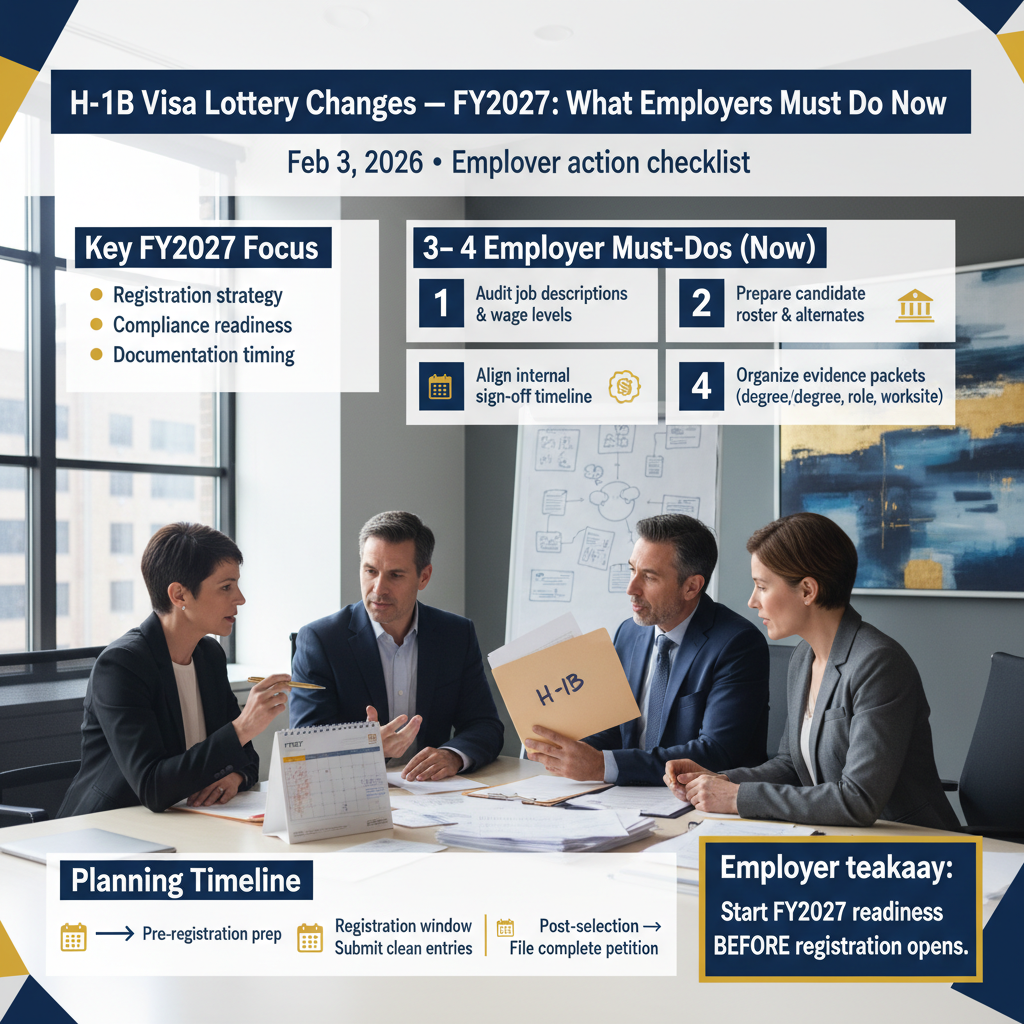
The reporting that sparked this guide is here: H-1B Visa Lottery Changes for FY2027 (Legal News).
Important: Because news coverage often summarizes complex agency rules, this article focuses on practical takeaways and the official framework that governs the H-1B process. For primary sources, we link to government references throughout, including the USCIS official website.
Need Help? Our Orlando immigration team is ready to assist. Call +1 786-791-3106 for a free consultation, or message us online. Se Habla Español.
What This News Means for Immigrants in Orlando and Across Florida
Why this news is showing up now
The H-1B program is one of the most competitive employment-based visa pathways in the United States. Each year, USCIS runs a selection process (commonly called the “H-1B lottery”) for cap-subject petitions—generally 65,000 regular cap numbers plus an additional 20,000 for the U.S. advanced degree exemption (the “master’s cap”).
For FY2027, the news cycle is heating up because employers and workers are preparing earlier than ever. Companies along the I-4 corridor—including Orlando’s tech, healthcare, hospitality, simulation, aerospace, and higher-education ecosystems—often rely on H-1B hiring to fill specialized roles. When USCIS updates selection mechanics, registration integrity rules, or evidence expectations, the practical effect is immediate: employers must adjust recruitment timelines, internal compliance, and documentation strategy.
Reminder: Even when a change sounds “procedural,” it can impact outcomes. A small change in how registrations are validated, how duplicates are detected, or how related entities are treated can determine whether a worker is selected—or whether a case is denied later in the process.
How it can affect Florida residents
For Central Florida residents—especially foreign nationals working in F-1 OPT/STEM OPT, TN, E-3, O-1, L-1, or dependent statuses—H-1B changes can affect:
- Timing: whether you can keep work authorization without gaps, including the F-1 “cap-gap” period when applicable.
- Employer strategy: whether your employer registers you, how they structure job offers, and how they document specialty occupation requirements.
- Risk: higher scrutiny can increase Requests for Evidence (RFEs) or denials if job duties, wage level, or degree alignment are weak.
- Family planning: spouses and children (H-4 dependents) may be affected by start dates, travel plans, and extension timing.
If your case is in Orlando, you may also be coordinating related filings—such as Adjustment of Status via Form I-485—or family-based filings like Form I-130. While those are different processes, real-life immigration planning often overlaps, especially when a household is balancing work authorization, travel, and long-term permanent residence strategy.
What H-1B Visa Lottery Changes for FY2027 Is (and Why It Matters)
A plain-English definition
“H-1B Visa Lottery Changes for FY2027” refers to new USCIS rules, procedures, and enforcement priorities that affect how employers register workers for the annual H-1B cap selection and how USCIS reviews and adjudicates the petitions that follow selection.
In plain English: the government may change (1) how it picks who gets a chance to file an H-1B petition, (2) what it considers a valid registration, and (3) what evidence employers must provide to prove the job qualifies and the worker is eligible.
Warning: Many people assume “winning the lottery” equals “approved H-1B.” It does not. Selection only gives an employer the chance to file a full petition. USCIS can still deny the case if the job is not a specialty occupation, the wage is not appropriate, the employer-employee relationship is unclear, or documents are inconsistent.
Key terms you need to know
- H-1B cap: The annual numerical limit for most new H-1B petitions.
- H-1B registration: The electronic pre-registration employers submit to USCIS during the annual registration period.
- Cap-subject: A petition that counts against the annual cap (most private-sector new H-1Bs).
- Cap-exempt: Certain employers (e.g., qualifying universities and nonprofit research entities) can file without the lottery.
- Specialty occupation: A role that normally requires at least a bachelor’s degree in a specific specialty (or equivalent) related to the job duties.
- LCA (Labor Condition Application): The Department of Labor filing that sets wage and worksite terms before the H-1B petition is filed.
- RFE: Request for Evidence—USCIS asks for additional documents before deciding.
- Premium processing: A paid USCIS service for faster adjudication for eligible petition types.
- Priority Date: Typically relevant in green card processes; still important for long-term planning when H-1B is a stepping stone to permanent residence.
- Adjustment of Status: The process to apply for a green card from inside the U.S., often using Form I-485.
While the FY2027 “lottery changes” may focus on registration integrity and selection mechanics, the biggest practical impact often shows up later—during petition adjudication—when USCIS applies heightened scrutiny to specialty occupation, wage level, and third-party placement arrangements.
Need Help? Our Orlando immigration team is ready to assist. Call +1 786-791-3106 for a free consultation, or message us online. Se Habla Español.
Current Immigration Law: The Foundation
The H-1B program is grounded primarily in the Immigration and Nationality Act (INA) and related federal regulations. Key legal foundations include:
- INA §214 (nonimmigrant admissions and conditions)
- INA §101(a)(15)(H) (H nonimmigrant classifications)
- 8 C.F.R. §214.2(h) (H-1B regulatory framework, specialty occupation, filing rules)
- Department of Labor H-1B labor condition rules (20 C.F.R. Part 655, Subparts H & I)
For official guidance and updates, start with the USCIS official website and the USCIS Forms page.
Federal requirements
At the federal level, most cap-subject H-1B cases follow this path:
- Employer submits an electronic registration during the registration window.
- USCIS selects registrations (sometimes in multiple rounds).
- Employer files the full H-1B petition with supporting evidence, including an approved LCA.
- USCIS adjudicates; if approved, employment typically starts October 1 of the fiscal year (unless cap-exempt or otherwise eligible for earlier start).
The core USCIS petition is Form I-129 (Petition for a Nonimmigrant Worker). Although this article focuses on H-1B, many families also have parallel filings such as Form I-130 (family petition) and Form I-485 (Adjustment of Status) as part of a broader plan.
Important: Processing varies widely. Check the USCIS Processing Times tool and plan for contingencies.
If consular processing is required (for example, if the worker is outside the U.S. or needs a visa stamp), the U.S. Department of State provides visa issuance information and appointment guidance.
Florida-specific considerations
Florida does not create the H-1B visa rules (this is federal law), but Florida employers and workers face real local considerations:
- Industry mix: Central Florida employers often use H-1B for software, data, engineering, healthcare, finance, and higher education—roles that must be documented carefully as specialty occupations.
- Worksite reality: Many roles are hybrid or involve multiple worksites across Orange County and the broader I-4 corridor (Orlando–Lakeland–Tampa). That affects LCA postings, worksite addresses, and compliance.
- Local adjudication touchpoints: While H-1B petitions are typically adjudicated at USCIS service centers, related benefits (like Form I-485 interviews) may involve The Orlando USCIS Field Office.
- Enforcement environment: Workers should be mindful of maintaining status, carrying proof of work authorization, and avoiding unauthorized employment—especially when changing employers.
If your situation intersects with removal proceedings or immigration court, information about the court system is available through the Executive Office for Immigration Review.
How to Prepare for FY2027 H-1B Lottery Changes: A Complete Step-by-Step Guide
The goal of this step-by-step guide is to help employers and workers build an H-1B case that can survive both the lottery registration integrity checks and the later petition adjudication. Think of it as “audit-proofing” your case.
Reminder: This guide is educational and not legal advice. Every case depends on facts, including job duties, wage, worksite, degree field, and immigration history.
1) Confirm the role qualifies as a specialty occupation (before registration)
Before anyone clicks “submit” on a registration, confirm the position is truly H-1B-eligible. USCIS commonly scrutinizes whether the job normally requires a bachelor���s degree in a specific specialty and whether the employer can show the need for that specialized knowledge.
Required documents to gather:
- Draft job description with detailed duties (percentage breakdown helps)
- Minimum requirements (degree level and acceptable majors)
- Organizational chart showing reporting structure
- Evidence of similar hires (prior job postings, prior employees’ degrees—redacted)
- Client/project descriptions (if applicable), with confidentiality protections
Warning: Generic job descriptions (e.g., “analyst,” “coordinator,” “manager”) without technical detail are a top reason for RFEs.
2) Validate the worker’s eligibility and degree-to-job alignment
USCIS evaluates not just the job, but also whether the beneficiary’s education (or equivalent experience) matches the specialty. For FY2027, employers should expect continued emphasis on consistency and credibility across registration, LCA, and petition evidence.
Required documents to gather:
- Passport biographic page and prior U.S. visa stamps (if any)
- Current I-94 record (and travel history, if relevant)
- All prior I-20s (F-1), EAD cards (OPT/STEM), DS-2019 (J-1), or approval notices
- Diplomas, transcripts, and credential evaluations (if degree is foreign)
- Resume/CV and experience letters (especially if using experience equivalency)
If your case is in Orlando and you are moving from F-1 OPT to H-1B, plan early for cap-gap and travel restrictions. A poorly timed trip can complicate reentry.
3) Build a compliant wage and worksite plan (LCA strategy)
The LCA is filed with the Department of Labor and must match the H-1B petition. Wage level, worksite location, and job classification must be internally consistent. Hybrid and multi-site roles across Orange County and the I-4 corridor require careful handling.
Required documents to gather:
- Worksite addresses (home address if remote, HQ address, client sites if any)
- Proposed salary, bonus structure, and benefits summary
- Prevailing wage analysis (internal or external)
- FEIN verification and company documents (for new entities)
- Public Access File (PAF) compliance checklist
Important: Mismatches between the LCA and the petition (or between the petition and what the worker actually does) can trigger denials or compliance issues later.
4) Submit a clean, defensible H-1B registration (and avoid duplicate pitfalls)
USCIS has increased attention on registration integrity in recent years. FY2027 changes may further tighten how USCIS identifies duplicates, related entities, or registrations that appear coordinated to increase selection odds.
The safest approach: ensure each registration reflects a real job offer from a real employer with the ability to employ and pay the worker. If multiple related companies are involved, get legal guidance to avoid a situation where USCIS views filings as improper.
Required documents to gather:
- Company legal name, DBA (if any), and FEIN confirmation
- Authorized signatory proof (corporate resolution or HR authorization)
- Worker’s passport name and details exactly as issued
- Internal memo documenting the business need for the role
- Recruiting file (optional but helpful): postings, interview notes, offer letter
Reminder: Even minor spelling inconsistencies can create delays or complications later when matching evidence.
5) If selected, file a “petition-ready” H-1B package with strong evidence
Selection is not the finish line. The petition must prove: (1) the job is a specialty occupation, (2) the worker is qualified, (3) the employer-employee relationship exists, and (4) the wage and worksite terms comply with the LCA.
Required documents to gather:
- Signed offer letter and detailed support letter from the employer
- Approved LCA
- Company evidence: website printouts, brochures, annual report, tax returns (as appropriate)
- Contracts, statements of work, and end-client letters (for third-party placement)
- Worker’s education documents, evaluations, and immigration history
- Form I-129 and H supplement (prepared carefully and consistently)
Warning: Third-party placement cases require especially strong documentation of supervision, control, and specific duties at each location.
6) Plan for timelines, travel, and status maintenance (especially F-1 cap-gap)
Your immigration status between selection and October 1 can be the most stressful part. If you are on OPT or STEM OPT, you may rely on cap-gap rules if a timely H-1B petition is filed and remains pending or approved.
Required documents to gather:
- Current EAD card (front/back) and OPT/STEM OPT approval notices
- Updated I-20 reflecting cap-gap (if applicable)
- Paystubs and employment verification letter
- Travel plans and passport validity (at least 6 months recommended)
- Contingency plan if not selected (STEM extension, cap-exempt options, etc.)
For Central Florida residents, travel planning matters because last-minute international travel can lead to missed RFEs, delayed mail, and reentry complications—especially if a change of status is pending.
7) Prepare for RFEs, compliance, and future green card strategy
Even strong cases can get RFEs. Employers should build an internal process to respond quickly and thoroughly. Also, many H-1B workers pursue permanent residence; early planning helps preserve options and avoid gaps.
Required documents to gather:
- RFE response binder template (job duties, org chart, wage proof, project docs)
- Ongoing performance reviews and work product summaries (as appropriate)
- Updated job description if duties evolve (track changes)
- Green card strategy notes (PERM timing, Priority Date planning)
- Family documents if relevant (marriage/birth certificates for dependents)
Important: If your family is also pursuing a separate route—like Form I-130 leading to Adjustment of Status with Form I-485—timing and travel rules can overlap. Coordinated planning is key.
Need Help? Our Orlando immigration team is ready to assist. Call +1 786-791-3106 for a free consultation, or message us online. Se Habla Español.
Practical Steps You Can Take Today
Whether you are an employer preparing to sponsor or a worker hoping to be sponsored, the best time to act is before the registration window opens. FY2027 changes (and increased integrity checks) reward preparation, consistency, and credible documentation.
Actionable checklist (do these now)
- Create a “petition-ready” job description with duty percentages and tools/technologies used.
- Confirm the degree requirement is specific and defensible (not “any bachelor���s degree”).
- Run a wage check and build a compensation plan that matches the role and location.
- Collect the worker’s immigration history documents (I-94s, approvals, EADs, I-20s).
- Order foreign credential evaluations early if needed (avoid last-minute delays).
- Map worksites: HQ, remote address, and any client sites across Orange County/I-4 corridor.
- Set an internal calendar for the registration window, selection notices, and filing deadlines.
Document preparation guidance
Organize documents in a shared, secure folder with consistent naming conventions. USCIS adjudications often hinge on credibility: dates, titles, addresses, and job duties must align across every document (offer letter, LCA, Form I-129, support letter, and third-party documentation).
Reminder: Keep copies of everything you submit. If USCIS issues an RFE, you will respond faster and with fewer inconsistencies.
Timeline expectations
While exact dates vary each year, a typical cap-subject cycle looks like this:
- Registration period: usually in March (USCIS announces exact dates).
- Selection notices: often by late March/early April; sometimes additional rounds later.
- Petition filing window: USCIS provides a filing period after selection (often at least 90-day window).
- Start date: typically October 1 for cap-subject change-of-status approvals.
Important: If you are counting on work authorization continuity, plan backward from October 1 and identify any risk periods. If you have a separate case involving Adjustment of Status (Form I-485), ask how EAD/AP timelines may intersect.
Many families also track other deadlines like 180 days rules that can apply in certain green card portability contexts (for example, job changes after pending I-485 for 180 days under AC21). While that is not an H-1B rule, it can matter for long-term planning.
How Imigrar Helps Immigrants in Orlando
Imigrar is an immigration law firm based in Orlando, Florida, serving clients nationwide with a focus on practical, family-centered solutions—our tagline is “Keep Families Together”. We help employers and workers build strong H-1B strategies that anticipate USCIS scrutiny and reduce avoidable risk.
Our support typically includes:
- Pre-registration case screening (specialty occupation, degree match, wage/worksite)
- Registration strategy and compliance review (especially for complex corporate structures)
- Full H-1B petition preparation and RFE responses
- Change-of-employer and extension filings
- Long-term planning: pathways to permanent residence, including Priority Date strategy and Adjustment of Status readiness
- Family coordination when cases overlap with Form I-130 or Form I-485
If your case is in Orlando, we can also help you think through logistics involving The Orlando USCIS Field Office for any related in-person matters (most H-1B filings are not handled at the field office, but many families have concurrent filings that are).
We offer a free consultation to discuss your FY2027 H-1B plan. Se Habla Español.
Frequently Asked Questions
Q: Who is eligible for the H-1B lottery for FY2027?
A: Eligibility depends on both the employer and the role. The employer must offer a U.S. job in a specialty occupation, and the worker must have the required degree (or equivalent) in a field related to the job duties. Most cap-subject cases must go through the registration/selection process. If you are unsure whether your job is “specialty” enough, get the job description reviewed before registration.
Q: If I live in Orlando, does my location change my odds in the lottery?
A: No. The lottery is federal and not based on Florida residency. However, your location can affect the strength of your petition because wage levels and worksites (including remote work in Orange County or across the I-4 corridor) must be documented correctly in the LCA and petition.
Q: How do FY2027 changes affect my immigration status if I’m on OPT or STEM OPT?
A: The biggest impact is timing and continuity of work authorization. If your employer files a timely H-1B change-of-status petition after selection, you may qualify for cap-gap benefits. But travel and filing errors can disrupt this. Warning: Do not assume you can travel internationally during cap-gap without risk—get legal guidance first.
Q: What documents will USCIS expect for a strong H-1B petition?
A: USCIS typically expects a detailed employer support letter, an approved LCA, evidence the role is a specialty occupation, and proof the worker is qualified. Common documents include: job description with duty percentages, organizational chart, project evidence, contracts (if third-party), passport/I-94, degree transcripts, and credential evaluations for foreign degrees. Consistency across documents is critical.
Q: How long does the H-1B process take for FY2027?
A: After registration and selection, USCIS provides a filing period (often a 90-day window) to submit the petition. Adjudication time varies by service center and workload. Use the USCIS Processing Times tool for the most current estimates. Premium processing may be available for faster decisions in eligible cases.
Q: How much does an H-1B case cost?
A: Costs generally include government filing fees (which can vary by employer size and case type), optional premium processing, and legal fees if you hire counsel. Employers are responsible for certain fees by law and policy, and cost-shifting to the employee can create compliance problems. We recommend a written fee plan before filing to avoid disputes or violations.
Q: What happens if my H-1B petition is denied after being selected?
A: A denial means the petition does not confer H-1B status. Next steps depend on your current status and timing. Some people may remain in the U.S. if they still have valid status (e.g., remaining OPT/STEM time), while others may need to depart or change status. You may also consider alternatives such as cap-exempt H-1B employment, O-1, L-1, TN (if eligible), or further study. If denied, request a copy of the full decision and consult counsel immediately to assess options.
Q: Can my spouse work if I get H-1B status?
A: H-4 spouses may be eligible for work authorization in limited circumstances (commonly when the H-1B principal reaches certain stages of the green card process). This is a planning issue tied to long-term strategy, including Priority Date and potential Adjustment of Status (Form I-485) timing.
Common Mistakes (and How to Avoid Them)
Mistake #1: Treating registration like a formality
Employers sometimes submit registrations without confirming specialty occupation strength, wage/worksite feasibility, or degree alignment. Then, after selection, they scramble and file a weak petition.
How to avoid it: Do a pre-registration legal review of the job description, degree requirement, and worksite plan. Build a petition-ready file before selection.
Mistake #2: Inconsistent addresses, titles, or duties across documents
USCIS compares the registration, LCA, Form I-129, support letters, and third-party documents. Inconsistencies can trigger RFEs or denials.
How to avoid it: Use one “source of truth” document for job title, SOC code, salary, and worksite addresses. Update everything together when changes occur.
Mistake #3: Ignoring status maintenance and travel risks
Workers on OPT/STEM OPT or other statuses may accidentally create gaps, violate status rules, or travel at the wrong time.
How to avoid it: Create a written timeline from now through October 1 and beyond. If travel is necessary, confirm whether the case is a change of status or consular processing and what that means for reentry.
Additional Official Resources (Bookmark These)
Need Help? Our Orlando immigration team is ready to assist. Call +1 786-791-3106 for a free consultation, or message us online. Se Habla Español.

Closing: Get an FY2027 H-1B Plan Built for the New Rules
FY2027 H-1B lottery changes—and the broader trend toward stricter review—mean employers and workers should prepare earlier, document more carefully, and avoid shortcuts that can trigger integrity flags or RFEs.
If your case is in Orlando, if you work in Orange County, or if your employer operates along the I-4 corridor, we can help you build a strategy that fits your job, your timeline, and your family’s needs—while keeping compliance front and center.
Need help now? Call Imigrar at +1 786-791-3106 for a free consultation or message us online. Se Habla Español. Our mission is to Keep Families Together.


