

The reporting that sparked this guide
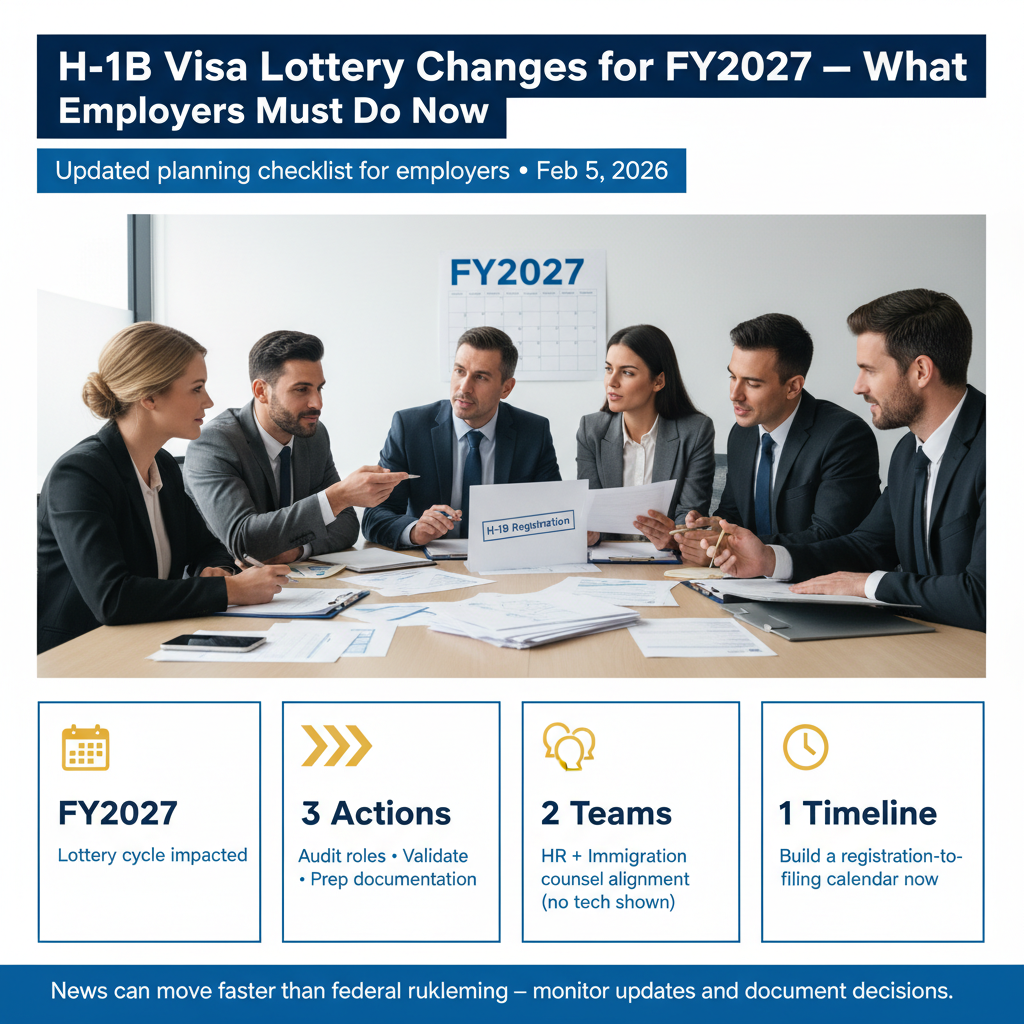
This article is based on trending coverage and ongoing updates appearing in immigration legal news feeds, including:
H-1B Visa Lottery Changes for FY2027 (Legal News)
Important: News coverage can move faster than the federal rulemaking process. In this guide, we explain what is known, what is likely, and how to prepare using the most reliable sources—especially USCIS and the Department of State.
Need Help? Our Orlando immigration team is ready to assist. Call +1 786-791-3106 for a free consultation, or message us online. Se Habla Español.
What This News Means for Immigrants in Orlando and Across Florida
Why this news is showing up now
Every year, the H-1B program becomes “trending” around the same time: late winter through spring. That’s because USCIS runs the cap-season registration process for the next fiscal year. For FY2027, legal news outlets are highlighting potential “lottery changes” because USCIS has been actively modernizing the H-1B system in recent years—tightening anti-fraud measures, adjusting selection mechanics, and expanding online filing tools.
Employers, HR teams, and foreign national professionals are paying close attention because small procedural changes can have big impacts—especially in a system where demand far exceeds supply and selection is randomized when the cap is reached.
Reminder: The H-1B cap is set by Congress. Most “lottery changes” are changes in process (registration, selection, filing, evidence, compliance), not an automatic increase in the number of visas available.
How it can affect Florida residents
Florida—especially the I-4 corridor (Orlando, Lake Mary, Sanford, Kissimmee, and Tampa)—has a growing technology, healthcare, hospitality, aerospace, and professional services economy. For Central Florida residents, H-1B updates matter because they can affect:
- F-1 students at UCF, Full Sail, Valencia College, and other schools who rely on OPT/STEM OPT and hope to move to H-1B.
- Employers in Orange County hiring specialized talent (software, data, engineering, accounting, healthcare administration).
- Families planning stability—because H-1B status can lead to future employment-based permanent residence and Adjustment of Status under Form I-485 when a Priority Date becomes current.
If your case is in Orlando, preparation and timing are everything. The H-1B process is unforgiving with deadlines, and even small errors can cause a missed cap season.
What H-1B Visa Lottery Changes for FY2027 Is (and Why It Matters)
A plain-English definition
“H-1B lottery changes for FY2027” refers to updates in how USCIS runs the annual H-1B cap process—especially the electronic registration system, how selections are made, and what employers must submit after selection.
Because there are more registrations than available H-1B cap numbers, USCIS uses a randomized selection process (the “lottery”) to decide which employers may file full H-1B cap petitions for the coming fiscal year.
Why it matters: If the process changes, it can impact your chance of selection, your filing strategy, and your risk of denial—particularly for cases involving job duties, degree requirements, wage levels, and third-party worksites.
Key terms you need to know
- H-1B Cap: The annual limit on new H-1B numbers (generally 65,000 regular cap plus 20,000 U.S. master’s cap).
- Electronic Registration: The online system where employers submit basic information and pay a registration fee before filing a full petition.
- Cap-Subject: Most new H-1Bs are cap-subject and require lottery selection.
- Cap-Exempt: Certain employers and situations are exempt (e.g., some universities, nonprofit research organizations, and certain concurrent H-1B employment).
- Specialty Occupation: A job that normally requires at least a bachelor’s degree in a specific specialty (a core H-1B requirement).
- LCA (Labor Condition Application): A Department of Labor filing that sets the wage and worksite terms.
- RFE (Request for Evidence): USCIS request for additional documents; common in specialty occupation and maintenance-of-status issues.
- Consular Processing: Getting the H-1B visa at a U.S. consulate abroad instead of changing status inside the U.S.
- Change of Status: Switching to H-1B status inside the U.S. (often from F-1). This is where “cap-gap” timing becomes critical.
Warning: “Lottery changes” can also mean increased scrutiny of duplicate registrations, affiliated companies, and job offers that appear non-genuine. Employers should assume enforcement-minded adjudication and document accordingly.
Current Immigration Law: The Foundation
The H-1B program is governed primarily by federal statute and implementing regulations. While headlines may focus on “changes,” the legal foundation remains stable: Congress created the H-1B category, and USCIS administers it through regulations and policy guidance.
Federal requirements
Key federal authorities include:
- Immigration and Nationality Act (INA) provisions for H nonimmigrants (commonly cited as INA §101(a)(15)(H)).
- Implementing regulations at 8 C.F.R. §214.2(h) (H-1B eligibility, petitions, amendments, and related rules).
- Department of Labor LCA rules at 20 C.F.R. Part 655 (wage and working condition requirements).
USCIS processing relies on specific forms and evidence standards, including:
- Form I-129 (Petition for a Nonimmigrant Worker) for H-1B filings.
- Form I-907 for premium processing (where available and appropriate).
- Form I-539 (sometimes used by dependents to change/extend status).
- Form I-130 and Form I-485 (not H-1B forms, but commonly relevant for long-term planning toward permanent residence and Adjustment of Status when a Priority Date is current).
Official references you can trust:
- USCIS official website
- USCIS Forms
- USCIS Processing Times
- U.S. Department of State
- Executive Office for Immigration Review
Florida-specific considerations
Immigration law is federal, so Florida does not create H-1B eligibility rules. However, Florida realities can affect the strength of your petition:
- Worksite geography: If the job is in Orange County or along the I-4 corridor, confirm the correct worksite address and commuting area for wage purposes.
- Third-party placements: Consulting and IT staffing are common in Florida. These cases may face heavier scrutiny regarding employer-employee relationship and specialty occupation duties.
- The Orlando USCIS Field Office generally handles in-person matters like interviews for family-based cases and Adjustment of Status—not most H-1B adjudications (which are typically handled by USCIS service centers). Still, your broader immigration strategy may involve the Orlando Field Office if you later file Form I-485.
Important: If you are considering a longer-term plan (employment-based green card), your H-1B decisions today can affect your later Priority Date and your ability to remain in status while waiting to file Form I-485.
Need Help? Our Orlando immigration team is ready to assist. Call +1 786-791-3106 for a free consultation, or message us online. Se Habla Español.
How to Prepare for the FY2027 H-1B Lottery Process: A Complete Step-by-Step Guide
Below is a practical, employer-and-beneficiary-friendly roadmap designed for cap-subject cases. Because “FY2027 lottery changes” may involve stricter integrity checks and evidence expectations, the safest approach is to prepare as if USCIS will scrutinize the job, the degree fit, and the employer’s legitimacy.
1) Confirm you actually need the H-1B cap (cap-subject vs. cap-exempt)
Before you spend time and money on a cap registration, confirm whether the job and employer are cap-subject. Some organizations and roles may be cap-exempt, allowing filing any time of year (no lottery).
Documents to gather:
- Employer’s corporate documents (articles of incorporation, FEIN confirmation)
- Nonprofit or affiliation documentation (if claiming cap-exempt status)
- Offer letter with job title, salary, duties, and worksite(s)
- Organizational chart showing reporting structure
2) Verify the role is a “specialty occupation” and map duties to the degree
The #1 substantive issue in H-1B adjudications is whether the job qualifies as a specialty occupation and whether the candidate’s degree is directly related. For FY2027, assume USCIS will continue to demand a clear, credible link between:
- Day-to-day duties
- Required education (minimum) for the role
- Industry norms
- Complexity and level of responsibility
Documents to gather:
- Detailed job description (10–15+ bullet duties with % time allocations)
- Degree requirements and “why” explanation (not just “bachelor’s required”)
- Beneficiary’s diploma(s) and transcripts
- Credential evaluation (if degree is foreign)
- Resume/CV and experience letters
- Industry evidence (e.g., OOH summaries, job ads, internal role descriptions)
3) Prepare the LCA strategy early (wage level, SOC code, worksites)
The LCA is not a USCIS form, but it is essential. It sets the wage, location, and occupational classification. Mistakes here can cause delays, RFEs, or denials—especially when there are multiple worksites or hybrid/remote arrangements.
Documents to gather:
- Worksite address(es), including remote work policy and supervision plan
- Proposed salary and compensation breakdown (bonuses, benefits)
- Selected SOC code rationale
- Prevailing wage documentation (if used)
- Internal wage leveling/job family documentation (if available)
Reminder: For Central Florida residents working hybrid roles along the I-4 corridor, confirm whether the “worksite” is the employer’s Orlando office, the employee’s home, a client site, or a mix—because the LCA may need to cover each location.
4) Complete the H-1B registration correctly and avoid “duplicate” red flags
USCIS requires employers to register during the registration period. If FY2027 emphasizes integrity checks (as recent years have), employers must be careful about:
- Multiple related entities registering for the same person without legitimate, distinct job offers
- “Shell” job offers without real work
- Unverifiable employer information
Documents to gather:
- Employer’s legal name, DBA (if any), FEIN, address, and authorized signatory info
- Beneficiary passport biographic page
- Beneficiary education summary (degree level for master’s cap eligibility)
- Proof of U.S. master’s degree (if applicable) and transcripts
Warning: If USCIS determines registrations were improperly coordinated or duplicative, it can invalidate selections and deny petitions. Build a clean, well-documented record.
5) After selection, file a strong H-1B petition package (Form I-129) within the filing window
Selection only gives you the opportunity to file. The full petition must prove eligibility and meet the deadline in the selection notice. Missing the deadline usually means waiting until the next year.
Documents to gather:
- Form I-129 and H supplement (completed and signed)
- Certified LCA
- Support letter describing the company, role, duties, degree requirement, and supervision
- Company documents: brochures, website printouts, lease, payroll records, tax returns (as appropriate)
- Client letters / SOW / itinerary (if placed at third-party sites)
- Beneficiary documents: passport, I-94, prior approval notices, OPT EAD (if applicable)
Important: If you are filing as a change of status from F-1, ensure maintenance of status is documented (I-20s, transcripts, enrollment, OPT/STEM OPT evidence). Timing mistakes can cause a denial or a request for consular processing instead.
6) Plan for timing: cap-gap, start date, travel, and dependents
Cap H-1Bs typically start October 1 (start of the fiscal year). If the beneficiary is in F-1 OPT that expires before October 1, cap-gap rules may extend work authorization in certain situations.
Documents to gather:
- Current I-94 and travel history
- All I-20s and OPT/STEM OPT EAD cards
- Marriage certificate and children’s birth certificates (for H-4 dependents)
- Form I-539 (if needed for dependents filing with change/extension)
Reminder: Travel during a pending change-of-status filing can create serious issues. Get legal advice before leaving the U.S. while the case is pending.
7) Prepare for compliance and possible RFEs (and respond fast)
Even strong cases can receive RFEs. Employers should be ready to prove the job is real, specialty-level, and that the beneficiary will be employed under the terms of the petition.
Documents to gather:
- Updated organizational charts and project plans
- Work product examples (non-confidential), project timelines
- Evidence of supervision (manager credentials, meeting schedules)
- Payroll records (after approval) to show wage compliance
Important: Many RFE deadlines are strict. Treat them like a 90-day window even if the notice gives a different date—build time for drafting, evidence collection, and shipping.
Practical Steps You Can Take Today
Whether you are an employer in Orlando or a professional hoping to be sponsored, you can take concrete steps now to reduce risk and improve readiness for FY2027.
Actionable checklist (do these now)
- Confirm degree fit: Make sure your diploma/transcripts clearly match the offered role; obtain a credential evaluation for foreign degrees.
- Build a stronger job description: Add specificity (tools, systems, regulatory frameworks, deliverables) and percentage allocations of duties.
- Align wage and level: Ensure the offered wage matches the role complexity and the correct location (Orlando/Orange County vs. remote).
- Clean up corporate records: Employer should have consistent addresses, FEIN verification, and a clear business presence.
- Document worksite control: If working at a client site, gather SOWs, letters, and supervision plans.
- Plan a backup option: Consider cap-exempt pathways, STEM OPT extensions, O-1 (extraordinary ability), L-1 (intracompany transfer), or family options like Form I-130 leading to Form I-485 if eligible.
Document preparation guidance
Create a shared folder with clearly labeled PDFs:
- Passport, visa stamps, I-94, prior USCIS notices
- All I-20s (for F-1), EAD cards, and OPT/STEM OPT documentation
- Diplomas/transcripts + credential evaluation
- Resume, letters of experience, and portfolio (as appropriate)
- Offer letter, job description, org chart, and manager bio
Timeline expectations
While each cap season has its own calendar, a safe planning model looks like this:
- 60–90 days before registration: finalize job description, degree mapping, and LCA strategy.
- Registration period: submit registration and fee promptly; double-check data.
- After selection: file the full Form I-129 petition within the USCIS filing window.
- Processing: check USCIS Processing Times; consider premium processing when strategically appropriate.
- Start date: many cap cases begin October 1; plan work authorization transitions carefully.
Important: If your case is in Orlando and you’re balancing travel, OPT expiration, or a planned move along the I-4 corridor, get a personalized timeline review—small timing errors can cause loss of status.
Need Help? Our Orlando immigration team is ready to assist. Call +1 786-791-3106 for a free consultation, or message us online. Se Habla Español.
How Imigrar Helps Immigrants in Orlando
Imigrar is an immigration law firm based in Orlando, Florida, serving clients nationwide. Our mission is to Keep Families Together while helping employers and professionals navigate complex work visa processes with confidence.
For H-1B cap cases, we help by:
- Assessing cap-subject vs. cap-exempt eligibility and realistic alternatives
- Building “specialty occupation” evidence tailored to the job and industry
- Supporting LCA strategy and worksite compliance planning
- Preparing strong filings to reduce RFEs and denials
- Advising on long-term planning (including employment-based green cards and family-based options involving Form I-130, Form I-485, Adjustment of Status, and Priority Date strategy)
Se Habla Español. We can assist both employers and beneficiaries in English and Spanish.
Reminder: A “lottery change” year is not the time to DIY a high-stakes filing—especially if you have travel plans, multiple worksites, or a third-party placement.
Frequently Asked Questions
Q: Who is eligible for the FY2027 H-1B lottery?
A: Generally, you need (1) a U.S. employer offering a job in a specialty occupation, (2) the required degree (or equivalent) related to the job, and (3) a cap-subject situation requiring registration. If you have a U.S. master’s degree (or higher) from an eligible institution, you may qualify for the advanced degree cap. Eligibility is proven later in the full Form I-129 filing—selection alone does not guarantee approval.
Q: Do FY2027 “lottery changes” affect my current immigration status (F-1, OPT, TPS, etc.)?
A: The lottery process itself does not change your current status. However, your strategy must protect lawful presence and work authorization. For example, F-1 students must maintain status and manage OPT expiration and cap-gap timing. If you are in another status, you must ensure you remain eligible to change status or plan for consular processing. Warning: Falling out of status can trigger denials and may create future inadmissibility issues.
Q: How long does the H-1B process take for cap cases?
A: The cap process has multiple phases: registration, selection, petition filing, and adjudication. After filing, processing times vary by service center and workload; check USCIS Processing Times. Premium processing (via Form I-907) may be available for faster adjudication, but it does not improve lottery selection chances.
Q: What documents are most important to avoid an RFE or denial?
A: The most important documents typically include: a detailed support letter, a credible job description with specialty-level duties, proof the degree matches the job (transcripts + evaluation if foreign), a properly certified LCA with correct worksites, and evidence the employer can and will employ the beneficiary (company documentation, project evidence, and supervision proof). For third-party worksites, add contracts/SOWs and client letters when possible.
Q: How much does an H-1B case cost (government fees and legal fees)?
A: Costs vary depending on employer size, whether premium processing is used, and which fee rules apply. Government filing fees can be significant and may include anti-fraud and training fees in addition to base filing fees. Legal fees vary by complexity (multiple worksites, amendments, cap-gap timing, RFEs). We recommend budgeting for both filing and potential RFE response costs. Contact Imigrar for a clear estimate after a case review.
Q: What happens if my H-1B registration is selected but USCIS denies the petition?
A: If USCIS denies the Form I-129 petition, the H-1B is not approved and you cannot start H-1B employment based on that filing. Next steps depend on your current status and timing. Options may include refiling (if allowed and within the filing window), considering alternative visa categories, or planning for consular processing where appropriate. Important: A denial can affect work authorization plans—especially for F-1 OPT holders—so contingency planning is essential.
Q: If my case is in Orlando, do I have to go to the Orlando USCIS Field Office?
A: Most H-1B petitions are adjudicated by USCIS service centers and do not require an in-person interview at the field office. However, the The Orlando USCIS Field Office may become relevant for other parts of your immigration journey—such as family-based filings, naturalization, or Adjustment of Status using Form I-485. If you have a mixed strategy (H-1B plus family-based), we coordinate timing carefully.
Common Mistakes (and How to Avoid Them)
Mistake #1: Treating “selection” like an approval
Lottery selection only gives the employer the chance to file. USCIS can still deny for specialty occupation, degree mismatch, wage/worksite issues, or missing evidence. Avoid this by building the petition like a litigation brief: clear facts, clear exhibits, and a strong legal narrative.
Mistake #2: Weak job descriptions and unclear degree requirements
Generic job descriptions (e.g., “analyze data, create reports”) invite RFEs. Avoid this by adding specific tools (SQL, Python, AWS, SAP, etc.), compliance frameworks, deliverables, and explaining why a specific degree is required.
Mistake #3: Worksite and LCA errors (especially with remote or client sites)
Incorrect worksites, missing locations, or unclear supervision plans can derail a case. Avoid this by mapping every location the employee will work, how they are supervised, and ensuring the LCA aligns. For Central Florida residents commuting across Orange County or the I-4 corridor, be especially careful with where the “primary” worksite is.
Need Help? Our Orlando immigration team is ready to assist. Call +1 786-791-3106 for a free consultation, or message us online. Se Habla Español.

Closing: Get Legal Guidance for FY2027 H-1B Changes
H-1B cap season is high-stakes in any year—and when the news cycle signals “FY2027 lottery changes,” it’s a sign that employers and applicants should prepare earlier, document more thoroughly, and plan backups.
If your case is in Orlando, or you’re hiring in Orange County or anywhere along the I-4 corridor, Imigrar can help you build a compliant, persuasive H-1B strategy while keeping your long-term goals in focus—whether that includes a future green card through employment or family options involving Form I-130 and Form I-485, Adjustment of Status, and Priority Date planning.
Need help now? Call Imigrar at +1 786-791-3106 for a free consultation or message us online. Se Habla Español.


