


The reporting that sparked this guide
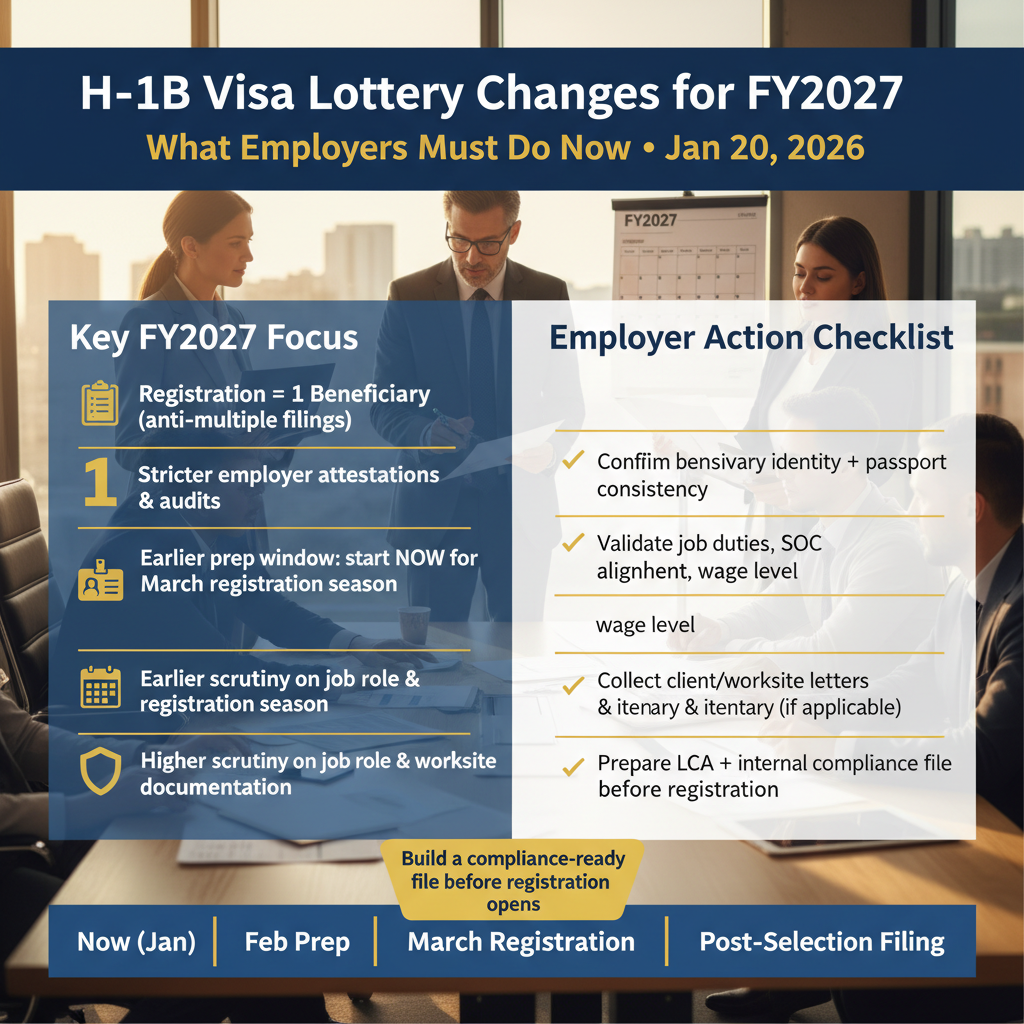
This article is based on trending coverage and ongoing updates in immigration law news, including: H-1B Visa Lottery Changes for FY2027 (Legal News).
Important: News coverage often summarizes proposed rules, agency guidance, and stakeholder reactions. Some FY2027 details may evolve as USCIS and the Department of Homeland Security (DHS) publish final rules, technical instructions, and updated filing guidance. For official updates, always cross-check with the USCIS official website and your legal counsel.
Need Help? Our Orlando immigration team is ready to assist. Call +1 786-791-3106 for a free consultation, or message us online. Se Habla Español.
What This News Means for Immigrants in Orlando and Across Florida
Why this news is showing up now
H-1B demand continues to outpace the annual cap, and USCIS has been under sustained pressure to strengthen lottery integrity, reduce duplicate/abusive registrations, and modernize how employers prove a real job opportunity exists. For FY2027, the “trending” conversation centers on expected operational and compliance shifts—especially around:
- How registrations are validated and tied to a legitimate job offer
- How USCIS detects and penalizes improper multiple registrations
- How employers document specialty occupation eligibility and wage compliance
- Timing and sequencing changes that may affect planning for students (F-1 OPT/STEM OPT) and employers
Reminder: The H-1B lottery (cap selection) is only one part of the process. Even after selection, the employer must file a strong petition and meet wage, job, and compliance rules—or USCIS can deny the case.
How it can affect Florida residents
Florida—especially the I-4 corridor (Orlando, Lake Mary, Sanford, Kissimmee, Tampa) and South Florida—has a growing tech, healthcare, hospitality, engineering, and finance workforce that relies on H-1B professionals. If you live or work in Orange County or Central Florida, FY2027 changes may impact:
- F-1 students at UCF, Full Sail, Valencia College and other schools trying to transition from OPT to H-1B
- Employers who hire specialized talent and must plan earlier for compliance, wage levels, and job descriptions
- Families whose dependent status (H-4) and work authorization planning depends on H-1B approvals and extensions
If your case is in Orlando, careful planning matters because travel, timing, and payroll compliance issues can cascade quickly. While H-1B petitions are generally adjudicated by USCIS service centers (not local field offices), your broader immigration strategy may involve the local system—especially if you later pursue Adjustment of Status through Form I-485 or family sponsorship with Form I-130.
What H-1B Visa Lottery Changes for FY2027 Is (and Why It Matters)
A plain-English definition
The “H-1B visa lottery” is USCIS’s selection process for picking which employers may file cap-subject H-1B petitions when the number of registrations exceeds the annual quota. “Changes for FY2027” refers to anticipated new rules and operational updates that may affect:
- How employers register candidates
- How USCIS selects registrations
- What documentation and attestations are required
- How USCIS prevents fraud and duplicate filings
- How timelines work from registration to petition filing to start date
Why it matters: for many professionals, the H-1B is the bridge from student or other temporary status to longer-term employment and, eventually, permanent residence. A small procedural change can mean the difference between “selected,” “not selected,” or “selected but denied.”
Key terms you need to know
- Cap-subject H-1B: Most first-time H-1Bs that count toward the annual cap.
- Regular cap: 65,000 new H-1Bs per fiscal year (subject to exemptions and set-asides as applicable).
- Master’s cap: Additional 20,000 for beneficiaries with qualifying U.S. master’s or higher degrees.
- Registration: The electronic entry submitted by an employer during the H-1B registration period.
- Petition: The full filing (typically Form I-129 with H supplement and supporting evidence) after selection.
- LCA (Labor Condition Application): Filed with the U.S. Department of Labor (DOL) to attest wages and working conditions.
- Specialty occupation: A role that normally requires at least a bachelor’s degree in a specific specialty (or equivalent) related to the job.
- RFE: Request for Evidence—USCIS asks for more proof before deciding.
- Consular processing: Getting the visa stamp abroad via the U.S. Department of State.
- Change of status: Switching to H-1B from inside the U.S. (if eligible) without leaving.
- Priority Date (future planning): Relevant for green card steps (PERM/I-140/I-485), not the H-1B lottery itself, but crucial for long-term strategy.
Need Help? Our Orlando immigration team is ready to assist. Call +1 786-791-3106 for a free consultation, or message us online. Se Habla Español.
Current Immigration Law: The Foundation
Even when the “lottery rules” shift, H-1B cases still rest on long-standing statutory and regulatory requirements. The primary legal framework includes:
- Immigration and Nationality Act (INA) § 214 (nonimmigrant admissions and conditions)
- INA § 212(n) (H-1B labor condition attestations and enforcement)
- 8 C.F.R. § 214.2(h) (H classification regulations)
- DOL H-1B regulations at 20 C.F.R. Part 655, Subparts H and I (LCA wage/condition rules)
Warning: “Lottery selection” does not waive specialty occupation, wage, or employer-employee relationship requirements. USCIS can still deny a selected case if the petition is weak or inconsistent.
Federal requirements
At a high level, a cap-subject H-1B case typically requires:
- A U.S. employer offering a real job in a specialty occupation
- A beneficiary with the required degree (or equivalent) related to the job
- An approved LCA from DOL for the correct worksite(s) and wage level
- A properly filed petition (generally Form I-129) during the filing window after selection
- Compliance with wage and working condition attestations under INA § 212(n)
USCIS guidance, forms, and updates are posted on the USCIS official website and the USCIS Forms page. Processing benchmarks can be checked at USCIS Processing Times.
Florida-specific considerations
Florida does not create the H-1B (it’s federal), but Florida realities can affect your case strategy:
- Worksite geography: Central Florida employers may place workers across Orange County and the I-4 corridor. Each worksite must be handled correctly for LCA posting and location rules.
- Hybrid/remote work: If you live in Orlando but work remotely for an out-of-state employer (or vice versa), the LCA and worksite addresses must be accurate.
- Local planning: The Orlando USCIS Field Office may become relevant later if you pursue family-based or employment-based Adjustment of Status using Form I-485, or if you have a family petition using Form I-130. (These are not H-1B forms, but many H-1B holders later use them.)
If you have removal proceedings or need immigration court information, consult the Executive Office for Immigration Review.
How to Prepare for FY2027 H-1B Lottery Changes: A Complete Step-by-Step Guide
Below is a practical, employer-and-beneficiary roadmap designed for FY2027 planning. Because USCIS may refine procedures, this guide focuses on durable best practices that remain essential even when the registration mechanics change.
1) Confirm the job qualifies as a “specialty occupation” (before registration)
Start with the job—not the candidate. USCIS looks for a role that normally requires at least a bachelor’s degree in a specific specialty and where the duties match that specialty.
- Important: Generic job descriptions are a top trigger for RFEs and denials.
Documents to prepare:
- Detailed job description (duties, tools/tech, reporting structure)
- Minimum requirements (degree field(s), experience, certifications)
- Organizational chart showing the position
- Evidence of specialty nature (industry postings, prior hires, internal role history)
- Worksite details (addresses for Orlando/Orange County or other locations)
2) Validate the candidate’s education and equivalency early
The beneficiary must meet the job’s minimum requirements by the time the petition is filed. International degrees may require evaluation, and missing transcripts can derail filing within a tight window.
Documents to prepare:
- Diplomas and transcripts (all post-secondary)
- Credential evaluation (if degree is foreign or unclear equivalency)
- Resume/CV and reference letters verifying specialized experience
- Passport biographic page and current immigration documents (I-94, visa stamp)
- For F-1: I-20s, OPT EAD card(s), STEM OPT I-983 (if applicable)
3) Build a compliant wage and worksite plan (LCA strategy)
The LCA is not a formality. Wage level selection, SOC code alignment, and worksite coverage must fit the real job. Hybrid/remote arrangements (common in Florida) require careful location planning.
Documents to prepare:
- Proposed salary and benefits summary
- Worksite list (including remote/home address if treated as a worksite)
- Draft LCA data (SOC code, wage level, period of employment)
- Company support letter details (projects, client sites if any)
- Public Access File (PAF) compliance checklist (employer-side)
4) Submit the H-1B registration correctly and consistently
FY2027 “changes” discussions often focus on tighter controls, stronger attestations, and more scrutiny of duplicate or coordinated registrations. The safest approach is:
- Ensure the employer’s registration matches the later petition exactly (name, passport, job details, entity)
- Avoid “mass filing” behavior that could be interpreted as gaming the system
- Document the legitimate business need for the specific candidate
Documents to prepare:
- Employer FEIN confirmation and entity documents
- Authorized signatory proof and company contact details
- Beneficiary passport details (ensure accuracy)
- Internal memo explaining role need and hiring rationale
5) If selected, file a complete H-1B petition within the filing window
After selection, USCIS provides a filing window. Missing it usually means losing the opportunity for that fiscal year. A strong petition package typically includes the approved LCA, detailed support letter, and evidence tying the job duties to the specialty degree.
Reminder: Many people know family-based forms like Form I-130 and Form I-485. For H-1B, the core petition is generally Form I-129 (filed by the employer). Still, your long-term plan may later involve Adjustment of Status via Form I-485 once an immigrant petition is available and your Priority Date is current.
Documents to prepare:
- Certified LCA
- Employer support letter (duties, specialty link, wage, worksite)
- Company evidence (business licenses, website, contracts, annual reports)
- Beneficiary degree evidence + evaluations
- Status evidence (I-94, paystubs, prior approvals, EADs)
- Filing fees checks and forms (as required by USCIS instructions)
6) Plan the “cap-gap,” start date, travel, and family strategy
Timing is often the make-or-break factor for Florida-based F-1 graduates. If selected and properly filed, some students may benefit from cap-gap work authorization rules (depending on their status and filing timing).
Documents to prepare:
- F-1 documents: updated I-20 reflecting cap-gap (as applicable)
- Travel history and current visa stamp validity
- H-4 dependent documents (marriage certificate, birth certificates)
- Prior immigration approval notices (I-797s)
7) Prepare for compliance after approval (site visits, amendments, extensions)
Approval is not the end. Employers must maintain LCA compliance and file amendments when material changes occur (job duties, worksite, salary, hours).
Documents to prepare:
- Onboarding packet confirming job duties and supervisor
- Payroll records and wage documentation
- Worksite posting evidence and PAF maintenance
- Change-management checklist (when to amend)
Need Help? Our Orlando immigration team is ready to assist. Call +1 786-791-3106 for a free consultation, or message us online. Se Habla Español.
Practical Steps You Can Take Today
Whether you’re an employer in Central Florida or a professional hoping to be sponsored, the best “FY2027 change-proof” strategy is to prepare earlier and document better.
Actionable checklist (do these now)
- 1) Audit your job description: Ensure duties require specialized knowledge and match a specific degree field.
- 2) Gather education documents: Order official transcripts; start a credential evaluation if needed.
- 3) Confirm worksite addresses: If your case is in Orlando and you work hybrid, document where you actually work (home + office) to plan LCA coverage.
- 4) Build a timeline backward from April: Registration usually occurs in early spring; plan drafting, LCA, and internal approvals weeks earlier.
- 5) Budget for fees and premium processing (if available/appropriate): Align with onboarding and project start dates.
- 6) Create a “Plan B”: STEM OPT extension, cap-exempt H-1B, O-1, L-1, TN (if eligible), or consular options.
- 7) Keep immigration status clean: Maintain valid I-94, avoid unauthorized work, and track expiration dates.
Document preparation guidance
- Use consistent naming across documents (employer entity name, beneficiary name as in passport).
- Keep a single source of truth for job duties and requirements—avoid conflicting versions.
- For third-party placements, document supervision, control, and project details carefully.
Timeline expectations
While USCIS timelines vary, a realistic planning framework looks like this:
- 8–12 weeks before registration: finalize job description, degree evaluation, wage strategy.
- Registration period: submit registration(s) accurately; monitor for selection updates.
- After selection: file the petition quickly—do not wait until the end of the window.
- Adjudication: check USCIS Processing Times and consider premium processing when timing is critical.
- Start date: many cap cases target an October 1 start, but exact rules depend on USCIS guidance for the fiscal year.
Warning: If you travel internationally at the wrong time (especially during a pending change of status), you may trigger consular processing requirements and disrupt work authorization.
How Imigrar Helps Immigrants in Orlando
Imigrar is an immigration law firm based in Orlando, Florida, serving clients nationwide. Our mission is to Keep Families Together while helping employers and professionals navigate complex work visa pathways with clarity and compliance.
- We help employers build strong specialty-occupation cases with clean, consistent documentation.
- We support F-1 students and professionals across Central Florida with timeline planning and status strategy.
- We advise families on longer-term pathways—so today’s H-1B plan aligns with future green card options like Adjustment of Status through Form I-485 and family sponsorship through Form I-130.
We offer a free consultation to discuss FY2027 readiness, eligibility concerns, and risk points. Se Habla Español.
Frequently Asked Questions
Q: Am I eligible for the FY2027 H-1B lottery if I’m on F-1 OPT in Orlando?
A: Many F-1 OPT holders are eligible if a U.S. employer offers a qualifying specialty occupation job and registers you during the registration period. You must also maintain valid status and meet the degree requirements. For Central Florida residents, confirm your worksite arrangement (office vs. remote) early so the LCA and petition match reality. If you’re near OPT expiration, discuss cap-gap timing and backup options with counsel.
Q: Do FY2027 lottery changes affect my current immigration status or my spouse’s H-4?
A: The lottery rules mainly affect selection and petition filing mechanics, but downstream effects can impact dependents. If the H-1B is not selected or is denied, the principal’s status plan may change, which can affect H-4 dependents’ ability to remain in status. If your family later plans permanent residence, your Priority Date strategy and eventual Adjustment of Status using Form I-485 may also be affected by gaps in status—so planning matters.
Q: How long does the H-1B process take from registration to approval?
A: Registration happens first; if selected, the employer files the petition during the USCIS filing window. Adjudication times vary by workload and whether premium processing is used. Check current estimates at USCIS Processing Times. Reminder: Even with selection, RFEs can add weeks or months, so build buffer time into your employment start planning.
Q: What documents are most important to avoid an RFE or denial?
A: The strongest cases typically include: (1) a detailed employer support letter mapping duties to the specialty degree, (2) a properly coded and waged LCA, (3) degree transcripts and evaluations, (4) evidence the company can pay the wage, and (5) consistent worksite details. If you later pursue family-based steps like Form I-130 or Adjustment of Status with Form I-485, keep civil documents (birth/marriage certificates) organized too.
Q: How much does an H-1B case cost in government fees and legal fees?
A: Costs vary depending on employer size, whether premium processing is used, and which statutory fees apply. Government fees can be significant, and employers generally must pay certain fees. Legal fees vary by complexity (e.g., multiple worksites, third-party placement, prior status issues). We recommend a written fee quote after reviewing the job, company profile, and candidate history.
Q: What happens if my H-1B is not selected or the petition is denied?
A: If not selected, you generally cannot file a cap-subject petition for that fiscal year (unless later rounds occur). If denied, options may include: maintaining or changing to another status, re-filing if appropriate, pursuing cap-exempt H-1B employment, or exploring other visa categories. Warning: Do not assume you can keep working—work authorization depends on your underlying status (OPT/EAD, etc.). Talk to counsel immediately to protect your lawful presence and future eligibility.
Q: Can I change employers after my H-1B is approved?
A: Often yes, through an H-1B “transfer” (new employer petition). Timing and portability rules depend on your status and whether the new petition is filed properly. If you are in Orlando and commuting along the I-4 corridor, worksite changes can trigger amendment needs—so notify counsel before changing location, duties, or salary.
Common Mistakes (and How to Avoid Them)
Mistake #1: Treating registration as “just a quick form”
Registration errors or inconsistencies can become fatal later when the petition must match the registration. Avoid this by standardizing names, passport details, job titles, and employer entity information.
Mistake #2: Weak specialty-occupation alignment
USCIS often scrutinizes whether the job truly requires a specific specialty degree. Avoid this by drafting a duty-by-duty explanation tied to coursework, tools, and industry standards—and by choosing an SOC code and wage level that fit.
Mistake #3: Ignoring worksite and remote-work compliance
In Florida, hybrid work is common. If your case is in Orlando but you work from home in Orange County part of the week, LCA planning and posting rules must be handled correctly. Avoid this by documenting all worksites and updating counsel before changes.
Need Help? Our Orlando immigration team is ready to assist. Call +1 786-791-3106 for a free consultation, or message us online. Se Habla Español.
Additional Official Resources (Use These for Verification)
Planning for the Long Term: From H-1B to a Green Card
Many H-1B professionals ultimately pursue permanent residence through employment-based sponsorship or family-based options. While that is separate from the FY2027 lottery, it’s smart to coordinate early so you don’t lose time later.
- Priority Date planning: your place in line in many employment-based categories.
- Adjustment of Status via Form I-485: if eligible and a visa number is available.
- Family sponsorship via Form I-130: if you have a qualifying U.S. citizen or permanent resident relative.
Reminder: Some processes have strict windows and deadlines (for example, a 90-day window may apply in certain contexts and policies, and many immigration benefits have time-sensitive rules). Always confirm the exact deadline that applies to your category and facts.
Special Notes for Orlando and Central Florida Applicants
For Central Florida residents, practical logistics can matter as much as legal eligibility:
- If your case is in Orlando... keep your address history, leases, and proof of residence organized—useful for future filings, driver’s license issues, and any later Adjustment of Status process.
- The Orlando USCIS Field Office... may be relevant later for interviews tied to Form I-485 or other benefits, even if your H-1B is handled elsewhere.
- Orange County and the I-4 corridor... often involve commuting and hybrid work—track where you actually perform services to avoid compliance surprises.
Warning: If you anticipate a move (e.g., Orlando to Tampa, or Orlando to Miami), tell your employer and immigration counsel before the move so you can evaluate LCA/amendment needs.
Closing: Don’t Wait for FY2027 “Final Details” to Start Preparing
The biggest advantage in a changing H-1B environment is early, organized preparation. Strong job descriptions, accurate worksite planning, clean education documentation, and consistent filings reduce RFEs and protect your timeline—especially for F-1 graduates and fast-moving employers in Florida.
Need Help? Our Orlando immigration team is ready to assist. Call +1 786-791-3106 for a free consultation, or message us online. Se Habla Español.

Call Imigrar: Orlando H-1B Lottery & Work Visa Legal Help
If you want a personalized plan for the FY2027 H-1B lottery—whether you’re an employer sponsoring talent or a professional trying to protect your status—contact Imigrar today.
Call +1 786-791-3106 for a free consultation or message us online. Se Habla Español. Our team is based in Orlando and serves clients nationwide—helping you move forward while we work to Keep Families Together.


