


The reporting that sparked this guide
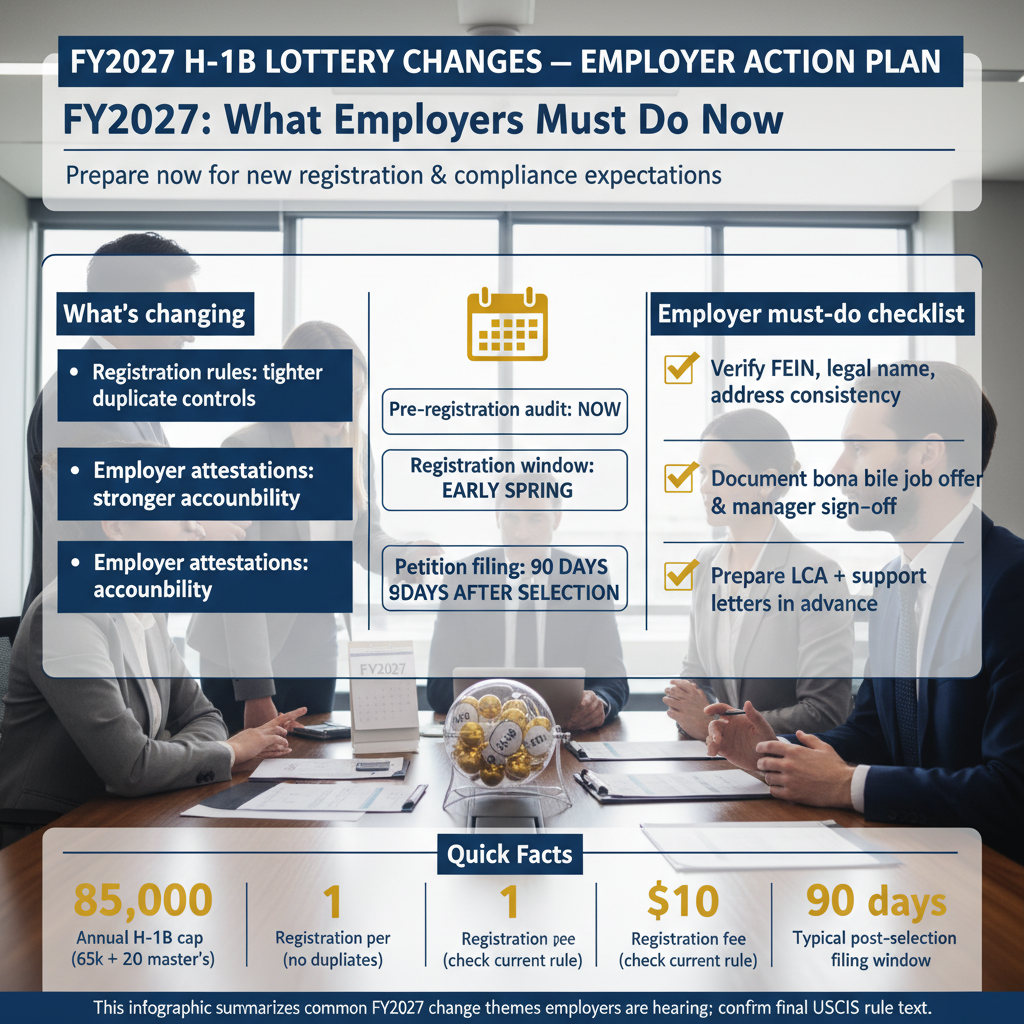
The reporting that sparked this guide: H-1B Visa Lottery Changes for FY2027 (Legal News)
Important: News coverage often summarizes complex rulemaking. This article explains the most common “FY2027 H-1B lottery change” themes employers and workers are hearing about, how the H-1B system works today, and how to prepare responsibly—using official government sources where possible. For the latest updates, always verify directly with the USCIS official website.
Need Help? Our Orlando immigration team is ready to assist. Call +1 786-791-3106 for a free consultation, or message us online. Se Habla Español.
What This News Means for Immigrants in Orlando and Across Florida
Why this news is showing up now
Every year, the H-1B program becomes “front-page immigration news” around the time USCIS opens the electronic registration system and then announces lottery selections. For FY2027, the attention is higher because employers and foreign national professionals are hearing about “new rules” or “lottery changes” that could affect:
- How H-1B registrations are submitted and validated
- How USCIS selects registrations when demand exceeds the cap
- How employers document specialty occupation roles and wage compliance
- What happens if a registration is flagged for errors, duplicates, or fraud indicators
Reminder: “FY2027” refers to the U.S. government fiscal year that starts October 1, 2026. That means the registration and lottery process typically occurs months earlier (usually in the first half of 2026). Planning must happen well before the start date.
How it can affect Florida residents
Florida is a major hub for healthcare, hospitality management, aerospace, finance, logistics, and tech—industries that often rely on H-1B talent. For Central Florida residents, including those along the I-4 corridor (Orlando, Lake Mary, Sanford, Kissimmee, and Tampa-area connections), H-1B changes can affect:
- International students on F-1 OPT or STEM OPT seeking cap-subject H-1B
- Employers trying to hire specialized talent in a tight labor market
- Families planning for H-4 dependents, travel, and long-term status stability
- Career timelines tied to start dates, onboarding, and project staffing
If your case is in Orlando, it’s also important to coordinate strategy around travel, extensions, and any future Adjustment of Status planning (when applicable) with realistic processing times. You can check official estimates at USCIS Processing Times.
What H-1B Visa Lottery Changes for FY2027 Is (and Why It Matters)
A plain-English definition
The “H-1B lottery” is USCIS’s selection process for cap-subject H-1B petitions when more registrations are submitted than the annual limit allows. Most cap-subject employers must first submit an electronic registration during a specific registration period. If selected, the employer may then file a full H-1B petition for the worker.
“H-1B Visa Lottery Changes for FY2027” is a catch-all phrase used in news coverage to describe updates that may change how USCIS:
- Runs the registration system
- Defines or enforces eligibility and selection integrity
- Reviews petitions after selection (including specialty occupation and wage issues)
Warning: A “lottery change” can mean a procedural change (how to register) or a legal change (what qualifies). Both can affect whether a case is selected, approved, or denied.
Key terms you need to know
- Cap-subject H-1B: Most private employers filing new H-1Bs are subject to the annual numerical limits.
- Regular cap: 65,000 H-1B numbers per fiscal year (statutory cap).
- Master’s cap: An additional 20,000 for workers with qualifying U.S. master’s degrees or higher.
- Registration: The electronic “pre-filing” step where employers submit basic information to enter the lottery.
- Selection notice: USCIS notice allowing the employer to file the full petition during a specific filing period.
- LCA (Labor Condition Application): The Department of Labor filing that sets wage, worksite, and compliance promises.
- Specialty occupation: A role that normally requires at least a bachelor’s degree in a specific specialty (or equivalent).
- RFE: Request for Evidence—USCIS asks for more documentation before deciding.
- Consular processing: Getting the visa stamp abroad through the U.S. Department of State.
Although this guide focuses on H-1B, many readers are planning a longer journey that may later involve family filings like Form I-130 or employment-based green card steps that eventually lead to Form I-485 (Adjustment of Status) when a Priority Date becomes current. Those pathways have separate rules, but H-1B planning often influences long-term strategy.
Need Help? Our Orlando immigration team is ready to assist. Call +1 786-791-3106 for a free consultation, or message us online. Se Habla Español.
Current Immigration Law: The Foundation
To understand any “FY2027 H-1B lottery changes,” you need the baseline legal framework. The H-1B category is created by the Immigration and Nationality Act (INA) and implemented through federal regulations. Key legal anchors include:
- INA § 214 (nonimmigrant admissions and conditions)
- 8 U.S.C. § 1184 (statutory authority for H classifications, including H-1B)
- 8 C.F.R. § 214.2(h) (regulatory requirements for H-1B petitions)
- INA § 212(n) / 8 U.S.C. § 1182(n) (Labor Condition Application and wage/working condition protections)
USCIS administers the petition process, while the Department of Labor (DOL) administers the LCA rules, and the Department of State handles visa issuance abroad.
Federal requirements
Under current federal rules, a typical cap-subject H-1B case has two major phases:
- Electronic registration in the USCIS system during the announced registration period.
- Full petition filing (usually on Form I-129) if selected, including an approved LCA and supporting evidence.
Employers must also comply with wage and notice obligations under DOL rules. USCIS guidance, forms, and updates are available on the USCIS official website and the forms library at USCIS Forms.
Important: H-1B is employer-specific. The job, wage, worksite(s), and duties described in the petition matter. Material changes may require an amended filing.
Florida-specific considerations
Immigration law is federal, so Florida does not create separate H-1B eligibility rules. However, Florida-specific realities can affect case strategy and documentation, including:
- Multi-site worksites across Orange County and the wider I-4 corridor (which can affect LCA postings, worksite addresses, and travel expectations).
- Healthcare licensing and credentialing timelines for certain roles (which can intersect with start dates and “specialty occupation” evidence).
- Seasonal or project-based staffing in hospitality and entertainment—USCIS may scrutinize whether the role is truly a specialty occupation and whether there is sufficient specialty-level work for the requested period.
If your case is in Orlando, planning should also consider how you will handle in-person identity verification, travel, and any future filings that might be processed through The Orlando USCIS Field Office (for benefits that require field office involvement). H-1B petitions themselves are generally handled by USCIS service centers, but overall immigration strategy often touches multiple USCIS components.
How to Prepare for FY2027 H-1B Lottery Changes: A Complete Step-by-Step Guide
Below is a practical, employer-and-worker-friendly roadmap designed for the FY2027 cycle. Because “new rules” can change exact procedures, this guide focuses on durable best practices that reduce risk even when USCIS updates details.
1) Confirm the role qualifies as a specialty occupation (before registration)
Start with the job itself. USCIS will evaluate whether the position normally requires at least a bachelor’s degree in a specific specialty and whether the candidate meets that requirement.
Documents to gather (employer):
- Detailed job description (day-to-day duties, percentage breakdown)
- Organizational chart showing where the position fits
- Minimum job requirements (degree field(s), experience, tools/technologies)
- Offer letter with salary, worksite address(es), and start date
- Evidence of projects/clients (statements of work, project plans, contracts where appropriate)
Documents to gather (employee/beneficiary):
- Diplomas, transcripts, and credential evaluations (if degree is foreign)
- Resume/CV and reference letters confirming specialized experience
- Passport biographic page and immigration history documents
- Prior I-20s, EADs (OPT/STEM), I-94 records (if applicable)
Warning: One of the most common post-selection problems is discovering the role is too generic or the degree requirement is too broad. Fixing that after selection can be difficult within the filing window.
2) Build a compliant wage and worksite plan (LCA strategy)
H-1B requires the employer to pay at least the required wage and to comply with worksite notice obligations. If your workforce is hybrid or remote (common across Central Florida), you need to map where the employee will actually work.
Documents to gather:
- Proposed worksite addresses (HQ, client sites, remote address if applicable)
- Wage analysis and internal pay data for similarly employed workers
- Job level justification (complexity, supervision level, experience required)
- Company support letter outline describing worksite and supervision
- Public Access File (PAF) compliance checklist (maintained by employer)
Important: The LCA is not filed with USCIS first, but it is required for the H-1B petition. If “FY2027 changes” increase scrutiny on wage levels or worksites, having a clean LCA strategy becomes even more critical.
3) Prepare the USCIS online registration carefully (avoid duplicates and data errors)
During the registration period, employers submit basic information to USCIS. If selected, USCIS issues a selection notice and allows the employer to file the full petition.
Documents/data to gather:
- Exact legal name of the company and EIN information
- Authorized signatory details (title, contact information)
- Beneficiary passport name, date of birth, country of citizenship
- Beneficiary education details (especially U.S. master’s eligibility)
- Prior H-1B history (cap-exempt/cap-subject, if any)
Warning: USCIS has historically taken a strict view of duplicate or improper registrations. If “FY2027 changes” include stronger integrity measures, accuracy and consistency across entries will matter even more.
4) If selected, file the full H-1B petition within the filing window
Selection is not approval. After selection, the employer must file a complete petition package—typically including Form I-129 and the H classification supplement, along with the certified LCA and supporting evidence.
Documents to gather:
- Selection notice from USCIS registration system
- Certified LCA
- Form I-129 and supporting supplements (as required)
- Employer support letter describing the role, specialty nature, and need
- Evidence of employer-employee relationship (supervision, evaluation, tools)
- Beneficiary degree documents and evaluations
- Maintenance of status evidence (I-94, prior approval notices, OPT EADs)
Reminder: Filing windows can be strict. Treat the selection notice like a deadline trigger and work backward to avoid last-minute issues.
5) Respond strategically to RFEs and compliance questions
Many H-1B cases receive an RFE, especially when USCIS questions specialty occupation, wage level, or worksite arrangements. A strong RFE response should be organized, evidence-driven, and consistent with the LCA and petition.
Documents to gather:
- RFE notice and deadline tracking sheet
- Expanded duty descriptions with real examples of projects
- Letters from managers describing specialized duties and supervision
- Industry evidence (job postings, OOH references, professional standards)
- Proof of contracts/projects (if consulting/client placement is involved)
Important: Missing an RFE deadline can lead to denial. Build internal systems to ensure responses are complete and timely.
6) Plan for start date, travel, dependents, and long-term options
If approved, cap-subject H-1B status typically begins October 1 of the fiscal year. Workers abroad may need visa stamping; workers in the U.S. may change status. Families often need H-4 planning.
Documents to gather:
- Approval notice and I-94 (if change of status approved)
- H-4 dependent documents (marriage certificate, birth certificates)
- Travel plans and consular appointment planning documents
- Prior immigration documents (F-1, J-1, TN, etc.)
Reminder: If you later pursue a green card, tracking your Priority Date and planning for Adjustment of Status timing can reduce gaps and stress. While family-based steps like Form I-130 and Form I-485 are separate from H-1B, many families coordinate multiple paths depending on eligibility.
Need Help? Our Orlando immigration team is ready to assist. Call +1 786-791-3106 for a free consultation, or message us online. Se Habla Español.
Practical Steps You Can Take Today
Whether you are an employer, an F-1 student on OPT, or a professional already in the U.S., you can take meaningful actions now to reduce risk for FY2027.
Actionable checklist (do these now)
- Confirm degree-to-job alignment: Make sure the job requires a specific specialty and your degree matches it.
- Audit your documents: Passport validity, transcripts, evaluations, prior approvals, I-94 history.
- Map worksites early: Especially for hybrid roles across Orange County or along the I-4 corridor.
- Prepare a “specialty occupation packet”: Duties, projects, tools, org chart, and manager letters.
- Plan your timeline: Registration period → selection → petition window → October 1 start date.
- Budget realistically: Filing fees, legal fees, credential evaluations, premium processing (if available/appropriate).
Document preparation guidance
Create a shared folder (securely) with clean, readable PDFs. Use consistent naming conventions. For example:
- “Passport_Biopage_Lastname.pdf”
- “Degree_Transcript_University.pdf”
- “Employer_OrgChart_Department.pdf”
- “JobDescription_DutiesPercentages.pdf”
Important: Consistency matters—job title, duties, salary, and worksite addresses should match across the offer letter, LCA, and USCIS petition.
Timeline expectations
While exact dates vary each year, a typical cap-subject H-1B timeline looks like this:
- Registration period: Usually a short window in the first half of the calendar year
- Selection notifications: Often shortly after the registration period closes (USCIS may also run later rounds)
- Petition filing window: A defined period stated on the selection notice
- Start date: October 1 (for cap-subject cases tied to that fiscal year)
For the most current processing estimates, check USCIS Processing Times.
How Imigrar Helps Immigrants in Orlando
Imigrar is an immigration law firm based in Orlando, Florida, serving clients nationwide. We help employers and professionals navigate H-1B strategy with a focus on compliance, clarity, and long-term planning—so families can build stable futures in the U.S. Our tagline is “Keep Families Together”.
Our support commonly includes:
- H-1B cap registration planning and risk review
- Specialty occupation analysis and evidence building
- Worksite/LCA strategy for hybrid and multi-location roles
- RFE response drafting and petition troubleshooting
- Coordination with dependent (H-4) planning and travel considerations
If your case is in Orlando or you live in Central Florida, we can also coordinate broader immigration planning that may later include family or employment green card strategies (including future Adjustment of Status planning when a Priority Date is current).
We offer a free consultation. Call +1 786-791-3106. Se Habla Español.
Frequently Asked Questions
Q: Who is eligible to be entered into the FY2027 H-1B lottery?
A: Generally, a U.S. employer (or U.S. agent in limited situations) may register a foreign national for a cap-subject H-1B if the offered role qualifies as a specialty occupation and the candidate meets the education/experience requirements. Most new cap-subject H-1Bs require registration first. Eligibility is ultimately proven in the full petition (typically with Form I-129) after selection.
Q: Will the FY2027 “lottery changes” affect my current immigration status (F-1, OPT, STEM OPT, etc.)?
A: The rule changes themselves do not automatically change your current status, but they can affect your strategy and timing. For example, if selection odds or filing procedures change, you may need stronger backup plans (STEM OPT extension timing, alternative visa categories, cap-exempt options, or travel planning). If you are nearing the end of OPT, talk to counsel early—don’t wait until the 90-day window before a critical deadline to start planning.
Q: How long does the H-1B process take for FY2027?
A: The process has multiple stages: registration → selection → petition filing → adjudication → start date (often October 1). Adjudication times vary by service center and workload. Always check the latest official estimates at USCIS Processing Times. If available, premium processing may shorten the decision timeline, but it does not improve selection chances.
Q: What documents are required after selection?
A: Most cases require: the USCIS selection notice, certified LCA, Form I-129, employer support letter, evidence the job is a specialty occupation, evidence the worker meets requirements (degrees/transcripts/evaluations), and proof of lawful status in the U.S. if requesting a change of status. Dependents may need marriage/birth certificates for H-4 filings. Keep copies of everything.
Q: How much does an H-1B case cost?
A: Costs can include USCIS filing fees, anti-fraud fees, ACWIA training fee (when applicable), optional premium processing fee (if requested), credential evaluations, and attorney fees. The exact amount depends on company size, case complexity, and whether dependents are included. Important: Certain fees must be paid by the employer under DOL rules—fee-shifting can create compliance risk.
Q: What happens if my H-1B petition is denied after selection?
A: A denial can mean you cannot start H-1B on October 1 under that petition. Your next steps depend on your current status and timing: you may consider refiling (if allowed and within the window), alternative classifications, cap-exempt H-1B options, returning to school, or consular strategies. If you are in the U.S., denial consequences can vary—get legal advice immediately to protect lawful presence and avoid status violations. If you later pursue a green card route, denial may also affect planning for Adjustment of Status and your Priority Date timeline.
Q: Do I need to live in Florida to hire Imigrar for an H-1B case?
A: No. Imigrar is based in Orlando, Florida, and serves clients nationwide. For Central Florida residents, we can also help coordinate local considerations like multi-site worksites across Orange County and the I-4 corridor, and broader immigration planning connected to family unity.
Common Mistakes (and How to Avoid Them)
Mistake #1: Treating selection as approval
Selection only gives you the right to file the petition. Avoid this by preparing the full evidence packet early and ensuring the LCA, job description, and candidate credentials align before registration.
Mistake #2: Inconsistent job details across documents
USCIS can question credibility when the job title, duties, wage, or worksite differs between the offer letter, LCA, and petition. Avoid this with a single “source of truth” job description and a final consistency review before filing.
Mistake #3: Waiting too late to handle worksites and hybrid work
Hybrid/remote arrangements can create LCA posting and worksite compliance issues. Avoid this by mapping worksites early, documenting supervision, and updating plans promptly if the employee’s location changes.
Need Help? Our Orlando immigration team is ready to assist. Call +1 786-791-3106 for a free consultation, or message us online. Se Habla Español.
Additional Official Resources (Recommended)
For accurate, up-to-date rules and procedures, consult these official sources:
- USCIS official website
- USCIS Forms
- USCIS Processing Times
- U.S. Department of State
- Executive Office for Immigration Review
Reminder: If you are dealing with immigration court issues in parallel (for example, a family member in proceedings), EOIR resources may matter. However, H-1B petitions are generally handled through USCIS and (for visa issuance) the Department of State.

Closing: Plan Early for FY2027
The biggest advantage in an H-1B cap season is preparation. If FY2027 brings tighter integrity checks, different selection mechanics, or increased evidence expectations, the winners will be the employers and professionals who treat H-1B as a compliance-driven legal process—not a last-minute form submission.
For Central Florida residents, especially those in Orange County and along the I-4 corridor, early planning can protect work authorization timelines, reduce RFE risk, and keep families stable while long-term options are explored.
Need Help? Our Orlando immigration team is ready to assist. Call +1 786-791-3106 for a free consultation, or message us online. Se Habla Español.
Se Habla Español. Call Imigrar at +1 786-791-3106 to discuss your FY2027 H-1B strategy and next steps.


