


The reporting that sparked this guide
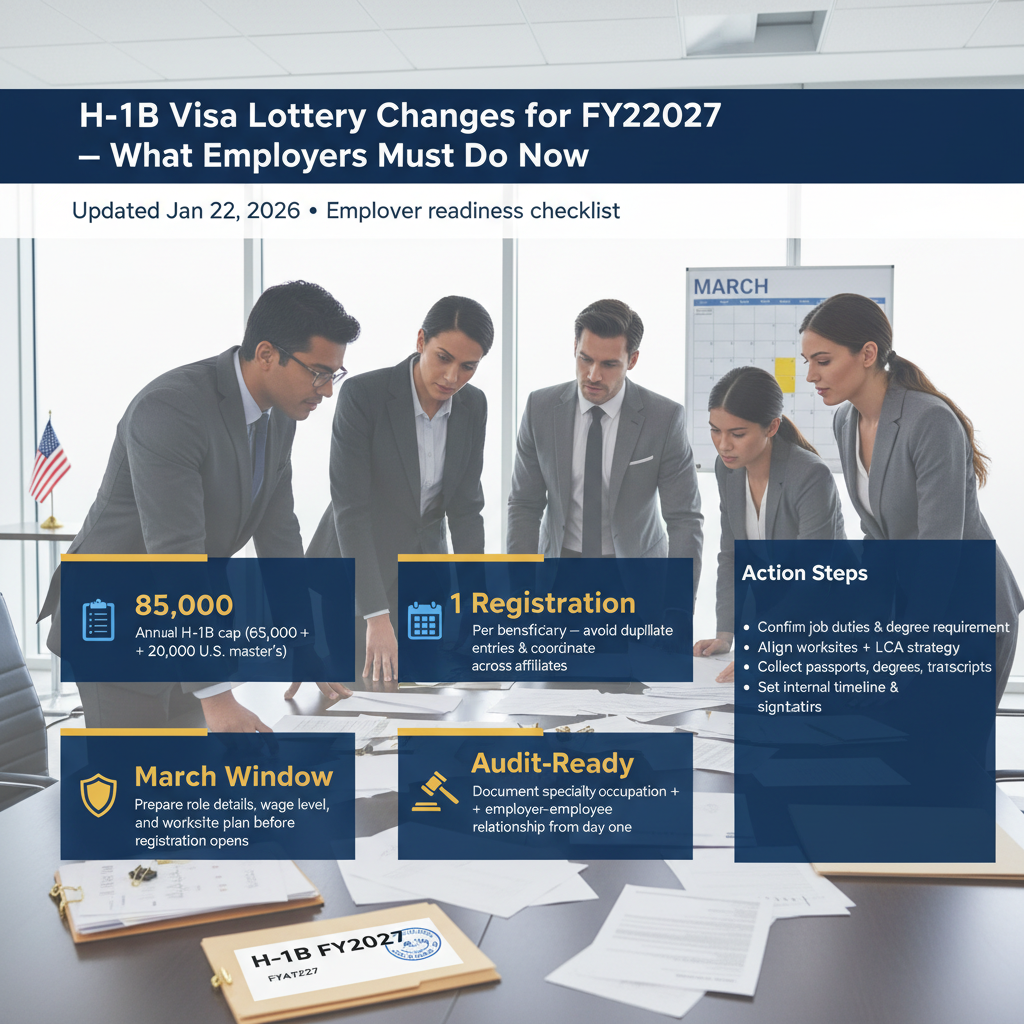
The reporting that sparked this guide: H-1B Visa Lottery Changes for FY2027 (Legal News)
Important: News coverage often summarizes proposed or newly finalized rules quickly. This article explains how H-1B “lottery” changes typically work, what to watch for in FY2027, and how to prepare in a compliant way using official guidance from agencies like USCIS official website.
Need Help? Our Orlando immigration team is ready to assist. Call +1 786-791-3106 for a free consultation, or message us online. Se Habla Español.
What This News Means for Immigrants in Orlando and Across Florida
Why this news is showing up now
The H-1B program is one of the most competitive U.S. work visa pathways. Each year, demand significantly exceeds the annual cap (generally 65,000 cap-subject H-1Bs plus 20,000 for U.S. master’s or higher degrees). As a result, USCIS uses an electronic registration system and a random selection process commonly called the “H-1B lottery.”
FY2027 planning is trending now because employers, universities, startups, hospitals, and tech companies along the I-4 corridor (Orlando–Kissimmee–Lakeland–Tampa) are already forecasting hiring needs. At the same time, federal agencies often adjust registration rules, anti-fraud controls, selection mechanics, filing windows, or documentation expectations to improve fairness and reduce duplicate filings.
Reminder: “FY2027” refers to the federal fiscal year that starts October 1, 2026. Most cap-subject H-1B cases for FY2027 will be selected in spring 2026 and—if approved—begin employment on October 1, 2026.
How it can affect Florida residents
For Central Florida residents, H-1B changes can affect:
- International students (F-1 OPT/STEM OPT) in Orlando-area schools who need an H-1B “cap” number before OPT expires.
- Employers in Orange County and across Florida who rely on specialized talent (IT, engineering, healthcare, finance, hospitality analytics).
- Families because H-1B changes also impact H-4 spouses and children, including H-4 EAD eligibility in certain situations.
- Timing and travel decisions, especially if a candidate is considering Adjustment of Status later or needs consular processing through the U.S. Department of State.
If your case is in Orlando, you may also be balancing local factors like employer onboarding timelines, summer graduation dates, and the practical reality that many HR teams need a clear compliance calendar months in advance.
What H-1B Visa Lottery Changes for FY2027 Is (and Why It Matters)
A plain-English definition
“H-1B lottery changes for FY2027” refers to potential updates to the rules and procedures USCIS uses to (1) collect electronic registrations, (2) prevent unfair duplicate entries, (3) select registrations up to the annual cap, and (4) manage the filing process after selection.
In plain terms: the government may change how employers enter candidates, how USCIS chooses winners, and what paperwork must be filed and when. Even small changes can have big effects on who gets selected and how quickly a petition can be approved.
Key terms you need to know
- H-1B Cap: The annual numerical limit for most new H-1B petitions.
- Electronic Registration: The online entry employers submit during the registration period before filing a full petition.
- Beneficiary: The worker the employer wants to sponsor.
- Petitioner: The U.S. employer filing the H-1B petition.
- Specialty Occupation: A role that typically requires at least a U.S. bachelor’s degree (or equivalent) in a specific field.
- LCA (Labor Condition Application): A Department of Labor filing that sets wage and working-condition rules for the H-1B worker.
- Cap-Gap: A rule that can extend F-1 work authorization in certain circumstances when an H-1B is timely filed.
- RFE (Request for Evidence): A USCIS request for additional documentation before approval.
- Premium Processing: An optional expedited service for certain petitions (availability and fees can change).
- Priority Date: More commonly used in green card cases; still important for long-term planning. (Priority Date is critical if your H-1B strategy is part of an employment-based permanent residence plan.)
Warning: H-1B is employer-driven. Workers cannot “self-petition” for a cap-subject H-1B. Your strategy must be built around a legitimate job offer, a compliant wage, and a documented specialty occupation.
Current Immigration Law: The Foundation
Before focusing on “what’s changing,” it helps to understand the legal framework that stays constant. H-1B eligibility is grounded in the Immigration and Nationality Act (INA) and implementing regulations.
Federal requirements
Key legal and regulatory sources include:
- INA § 101(a)(15)(H) (defining H nonimmigrant categories) and INA § 214 (admissions and conditions of nonimmigrants).
- 8 C.F.R. § 214.2(h) (core H-1B regulations, including specialty occupation standards and petition rules).
- Annual numerical limits and advanced degree exemption rules reflected in USCIS policy and cap announcements.
- Department of Labor requirements for LCAs under 20 C.F.R. Part 655, Subparts H and I (wage and working conditions).
The main USCIS form for an H-1B petition is Form I-129 (Petition for a Nonimmigrant Worker). Official instructions and updates are available at the USCIS official website and on USCIS Forms.
While this article focuses on H-1B, many readers are also planning family-based or employment-based green card steps later. Two forms you may hear about in long-term planning are Form I-130 (family petition) and Form I-485 (Adjustment of Status). Those are not H-1B forms, but they matter when your goal is to “Keep Families Together” through a stable immigration plan.
Florida-specific considerations
Immigration law is federal, so H-1B rules do not change state-by-state. However, Florida-specific realities can affect case strategy and timing:
- Industry mix: Central Florida employers often hire in hospitality tech, simulation/training, aerospace/defense contractors, healthcare systems, and fintech—each with different job description norms and degree requirements.
- Worksite compliance: If the worker is placed at third-party sites (common in IT consulting), the documentation burden is higher. This is frequent for projects along the I-4 corridor.
- Local processing and logistics: The Orlando USCIS Field Office generally handles many in-person services for other benefit types, but most H-1B adjudications are handled by USCIS service centers. Still, if your broader plan involves Adjustment of Status, Orlando-area scheduling and travel planning can matter.
- State enforcement environment: Employers should ensure I-9 compliance and consistent HR practices. While H-1B is federal, workplace compliance issues can create risk.
For court-related immigration matters (not typical for H-1B), the Executive Office for Immigration Review provides official information.
Need Help? Our Orlando immigration team is ready to assist. Call +1 786-791-3106 for a free consultation, or message us online. Se Habla Español.
How to Prepare for FY2027 H-1B Lottery Changes: A Complete Step-by-Step Guide
Because “new rules” can shift registration mechanics and documentation expectations, the safest approach is to build a compliance-first process that works under both current standards and likely FY2027 updates (for example, stronger anti-duplicate controls, clearer employer-employee relationship proof, and tighter specialty occupation documentation).
Important: The exact FY2027 registration dates and final procedures will be confirmed by USCIS. Always verify timelines and announcements on the USCIS official website.
1) Confirm the role qualifies as a “specialty occupation”
Start with the job itself—not the candidate. USCIS adjudicates whether the position normally requires a specific bachelor’s degree (or higher) and whether your business truly needs that level of specialized knowledge.
Documents to prepare:
- Detailed job description (duties broken down by percentage of time)
- Minimum requirements (degree field(s), experience, skills, tools)
- Organizational chart showing where the role sits
- Evidence of similar roles requiring degrees (job postings, industry data)
- Company brochure/website printouts describing services/products
If your case is in Orlando and the role is hybrid/remote, document where the employee will primarily work. Worksite details affect LCA compliance and may affect USCIS scrutiny.
2) Validate the candidate’s credentials and equivalency
The beneficiary must have the required degree (or equivalent through education + experience). International degrees may require evaluation. Licensure may be required for certain occupations.
Documents to prepare:
- Passport biographic page
- Current U.S. immigration documents (I-94, visa stamp, EAD if applicable)
- Diplomas, transcripts, and translations
- Credential evaluation (if degree is foreign or specialty is unclear)
- Resume/CV and reference letters verifying experience
- Professional licenses (if required)
Reminder: If the worker is currently in F-1 OPT/STEM OPT, confirm EAD validity and any STEM reporting obligations. That timeline drives H-1B strategy.
3) Prepare the wage and LCA strategy early
The LCA is a Department of Labor step, but it is central to H-1B compliance. You must pay at least the required wage and maintain a public access file. Wage level selection should match the job complexity.
Documents to prepare:
- Worksite address(es) and remote work policy
- Proposed salary and benefits summary
- Job requirements and SOC code analysis
- Prevailing wage documentation methodology
- Internal wage scale or comparable employee wage data (if available)
For Central Florida residents, multi-site worksites (Orlando + client sites along the I-4 corridor) require careful LCA planning. Mistakes here can trigger RFEs or compliance issues later.
4) Build a compliant registration plan (and avoid duplicate-entry risks)
USCIS has increased scrutiny of duplicate or coordinated registrations. FY2027 changes reported in the news may further tighten rules that prevent multiple registrations for the same person that are not truly independent job offers.
A compliant plan includes: one legitimate job offer per employer, consistent job details, and documentation showing the employer’s real need and the candidate’s fit.
Documents to prepare:
- Offer letter with role title, salary, location, start date (as applicable)
- Internal recruiting file (job posting, interview notes—kept internally)
- Corporate documents (EIN letter, articles, business licenses)
- Evidence of operations (contracts, invoices, client letters if relevant)
Warning: Do not “game” the system through multiple related entities or questionable offers. If USCIS views registrations as coordinated to increase odds, it can lead to denials, revocations, or fraud referrals.
5) If selected, file a strong Form I-129 H-1B petition package
Selection is not approval. After selection, the employer must file the full petition during the designated filing period. A strong filing anticipates common RFEs: specialty occupation, employer-employee relationship, worksite, and ability to pay.
Documents to prepare:
- Certified LCA
- Form I-129 and H supplement (as required)
- Company support letter describing the role and need
- Beneficiary support documents (degree, transcripts, evaluations)
- Itinerary and client letters (if third-party placement)
- Pay records and status documents if changing status in the U.S.
- Filing fee checks and fee-exemption analysis (where applicable)
Important: If the beneficiary will change employers later, portability rules may apply—but only after a properly filed petition. Plan the first filing carefully.
6) Track adjudication, respond to RFEs, and plan start-date logistics
After filing, monitor case status and be ready for an RFE. Many RFEs are winnable with organized evidence and clear explanations. If approved, confirm the start date (often October 1 for cap cases) and coordinate travel/visa stamping if needed.
Documents to prepare:
- RFE response exhibits (job duties, degree nexus, contracts, etc.)
- Updated organizational chart and project documentation
- Payroll setup plan and onboarding timeline
- Travel plan and consular appointment notes (if applicable)
You can monitor average adjudication windows at USCIS Processing Times.
Practical Steps You Can Take Today
Whether you are an employer or a prospective H-1B worker, preparation is the difference between a smooth filing and a stressful scramble.
Actionable checklist (start now)
- Confirm eligibility early: Map the job duties to a specific degree field and gather proof of the degree-job connection.
- Audit immigration timelines: If you’re on F-1 OPT, calculate your OPT end date and whether cap-gap could apply. Track the 90-day window concept in other contexts (for example, some immigration benefits have strict filing windows) and treat H-1B deadlines with the same discipline.
- Prepare credential evaluations: If the degree is foreign, get an evaluation early to avoid delays.
- Lock in worksite details: Hybrid/remote arrangements must be documented. If there are multiple worksites along the I-4 corridor, plan LCA coverage accordingly.
- Budget for fees and timing: Filing fees can be significant and vary by employer size and circumstances. Also plan for legal fees, evaluation costs, and potential premium processing.
- Organize a “petition-ready” file: Build a shared folder with corporate documents, job description templates, and prior approvals (if any).
Document preparation guidance
Create two binders (digital or physical):
- Employer binder: corporate formation, tax docs, payroll proof, organizational charts, marketing materials, contracts (as relevant).
- Employee binder: passport, I-94, prior approval notices, diplomas/transcripts, evaluations, experience letters, licenses.
Reminder: Keep personal documents consistent across filings (names, dates, degree titles). Small inconsistencies can trigger delays.
Timeline expectations (typical cap season planning)
- 6–4 months before registration: finalize job description, wage analysis, candidate documents.
- Registration period (often March): submit electronic registration(s) correctly.
- Selection notices (often late March/April): prepare petition package immediately.
- Filing window after selection: file Form I-129 with the certified LCA.
- Approval and start date: many cap cases start October 1 (if change of status is approved).
Warning: Do not assume there will be multiple lottery rounds. Some years there are, some years there are not. Build a backup plan (cap-exempt options, alternative statuses, or overseas placement).
Need Help? Our Orlando immigration team is ready to assist. Call +1 786-791-3106 for a free consultation, or message us online. Se Habla Español.
How Imigrar Helps Immigrants in Orlando
Imigrar is an immigration law firm based in Orlando, Florida, serving clients nationwide. Our mission is to Keep Families Together by building reliable immigration strategies—from temporary work visas like H-1B to long-term options like employment-based green cards and family-based pathways.
For H-1B cap cases and FY2027 rule changes, we help by:
- Assessing whether the role qualifies as a specialty occupation and reducing RFE risk
- Building compliant registration strategies that avoid duplicate-entry pitfalls
- Preparing LCAs and petition documentation with worksite and wage compliance in mind
- Planning status “bridges” for F-1 OPT holders and families (H-4 planning)
- Coordinating long-term plans involving Adjustment of Status, Priority Date tracking, and family considerations
Se Habla Español. We offer a free consultation to discuss your case facts, timing, and best next steps.
Frequently Asked Questions
Q: Who is eligible to be entered into the H-1B lottery?
A: The employer must have a real job offer for a specialty occupation role, and the worker must have the required degree (or equivalent). Most cap-subject H-1Bs require electronic registration first, then selection, then a full Form I-129 filing. If you’re unsure whether your degree matches the job, get a credential evaluation and a detailed job-duty breakdown before registration.
Q: If I’m on F-1 OPT in Orlando, how do H-1B changes affect my status?
A: If you’re on OPT/STEM OPT, the biggest issue is timing. A selected and timely filed H-1B petition may allow a cap-gap extension in some situations, but it depends on your OPT end date and whether the case is filed as a change of status. Plan early, keep your SEVIS reporting current, and avoid unauthorized work. If your case is in Orlando and your employer needs you on-site, align onboarding dates with your work authorization validity.
Q: How long does the H-1B process take for FY2027 cases?
A: For cap-subject cases, the process usually spans months: registration in spring 2026, selection shortly after, petition filing during the designated window, then adjudication. Many approved cap cases start October 1, 2026. Processing times vary by service center and workload—check USCIS Processing Times for current estimates.
Q: What documents are required after selection?
A: Commonly required items include a certified LCA, Form I-129, employer support letter, detailed job description, evidence of specialty occupation, beneficiary degree/transcripts/evaluations, immigration status documents (I-94, prior approvals), and—if applicable—client letters and an itinerary. Keep everything consistent and well-organized to reduce RFE risk.
Q: How much does an H-1B case cost?
A: Costs typically include USCIS filing fees, anti-fraud fees (where applicable), potential training fees depending on employer size and history, optional premium processing, and legal fees. There can also be costs for credential evaluations and translations. Because fees can change and depend on facts, we recommend a written fee quote after a document review.
Q: What happens if my H-1B is denied after selection?
A: A denial means the petition was not approved, and if you were relying on a change of status, your ability to remain/work in the U.S. may be affected depending on your underlying status and timing. Options may include refiling (if still within a valid window and allowed), appealing/motioning (in limited cases), exploring cap-exempt H-1B employment, switching to another status, or consular processing strategies. We also evaluate long-term alternatives—sometimes including family-based options such as Form I-130 or employment-based paths that later use Form I-485 for Adjustment of Status.
Q: Do FY2027 lottery changes mean multiple employers can’t sponsor me?
A: Multiple legitimate job offers from truly independent employers have historically been possible, but USCIS has increased scrutiny of coordinated filings and related entities. FY2027 changes reported in the news may tighten anti-duplicate controls further. The safest approach is to ensure each offer is real, well-documented, and not part of a scheme to increase selection odds.
Common Mistakes (and How to Avoid Them)
Mistake #1: Waiting until the last minute to define the job and wage
H-1B success is built on the job description, degree requirement, and wage strategy. Rushed job descriptions often look generic and trigger RFEs. How to avoid it: finalize duties, degree fields, and worksite details months ahead; document complexity and business need.
Mistake #2: Inconsistent information across registration, LCA, and the petition
Inconsistencies (title, salary, location, duties) can create credibility issues. How to avoid it: use a single “source of truth” job description and have legal counsel review all entries before submission.
Mistake #3: Under-documenting third-party placement or hybrid worksites
If the worker will be at a client site or working hybrid, USCIS may question who controls the work and whether the role is specialty occupation. How to avoid it: provide contracts, statements of work, client letters, and a clear itinerary; align LCA worksites with reality.
Need Help? Our Orlando immigration team is ready to assist. Call +1 786-791-3106 for a free consultation, or message us online. Se Habla Español.
Official Resources to Follow (FY2027 Updates)
Because rule changes can evolve quickly, rely on primary sources:
- USCIS official website (cap season announcements, policy updates)
- USCIS Forms (latest editions and instructions)
- USCIS Processing Times (service center timelines)
- U.S. Department of State (visa stamping, consular processing)
- Executive Office for Immigration Review (immigration court info, when relevant)
Reminder: If your long-term plan includes permanent residence, track visa bulletin movement and your Priority Date. The H-1B is often a bridge to a green card strategy that may later involve Form I-485 and Adjustment of Status.
Important: Some immigration deadlines are strict (often measured in days). Treat compliance like a countdown—whether it’s 180 days in certain employment authorization contexts or shorter agency response windows for RFEs.

Closing: Build an FY2027 H-1B Strategy That Protects Your Future
H-1B lottery changes can feel stressful—especially for international students, Florida employers, and families planning stability. The best response is a proactive, well-documented, compliance-first approach that anticipates tighter scrutiny and evolving procedures.
If your case is in Orlando, if you’re working along the I-4 corridor, or if you’re hiring nationwide, Imigrar can help you prepare for FY2027 with a clear timeline, a document plan, and a strategy that supports both short-term work authorization and long-term family stability.
Need Help? Our Orlando immigration team is ready to assist. Call +1 786-791-3106 for a free consultation, or message us online. Se Habla Español.


