


The reporting that sparked this guide
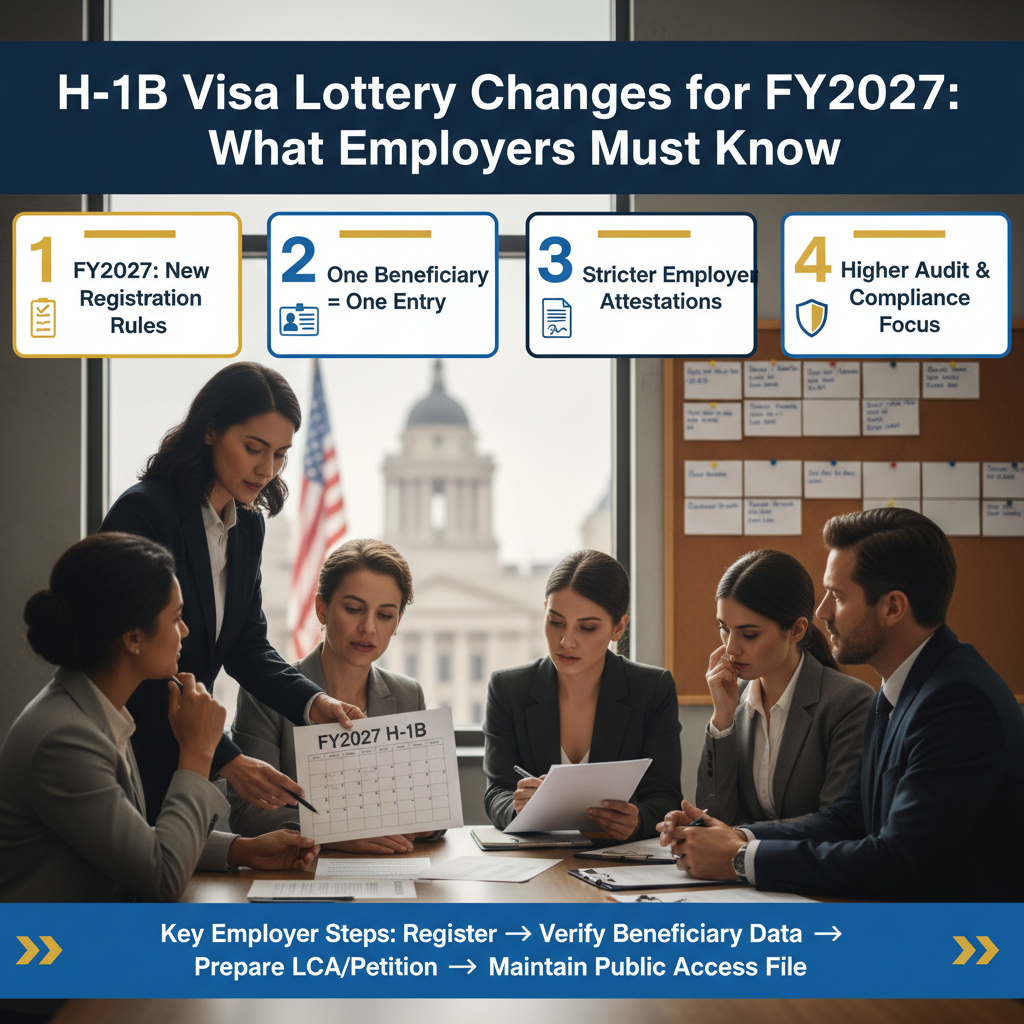
We’re following the latest coverage and developing updates as agencies publish final instructions. Here is the news reference that prompted this article: H-1B Visa Lottery Changes for FY2027 (Legal News)
Reminder: News reports often summarize proposed or developing policy. Always confirm the operative rules and dates on the USCIS official website and in the Federal Register when applicable.
Need Help? Our Orlando immigration team is ready to assist. Call +1 786-791-3106 for a free consultation, or message us online. Se Habla Español.
What This News Means for Immigrants in Orlando and Across Florida
Why this news is showing up now
The H-1B program remains one of the most competitive employment-based pathways in U.S. immigration. Each year, demand exceeds the annual cap (generally 65,000 regular cap plus 20,000 U.S. master’s cap), forcing USCIS to use a lottery selection system.
For FY2027, the “H-1B lottery changes” being discussed in the news are trending because USCIS and stakeholders (employers, universities, and foreign national professionals) are focused on:
- How USCIS will structure the registration and selection process (including anti-fraud measures and identity-based selection concepts).
- How employers must document a real job opportunity, wage compliance, and specialty occupation requirements.
- How increased compliance reviews and site-visit readiness can affect approvals and Requests for Evidence (RFEs).
Important: USCIS has already moved in recent years toward strengthening the integrity of the lottery process. As FY2027 approaches, even small procedural changes can have major consequences—missed deadlines, duplicate registrations, or weak documentation can mean losing a full year.
How it can affect Florida residents
Florida is a major hub for technology, healthcare, hospitality, aerospace, simulation, and higher education—industries that often rely on H-1B talent. For Central Florida residents, including those along the I-4 corridor (Orlando, Lake Mary, Sanford, Kissimmee, and Tampa-Daytona connections), lottery changes can affect:
- Timing: When employers must register, when selections are announced, and when petitions can be filed.
- Risk planning: Whether an F-1 student needs a STEM OPT strategy, cap-gap planning, or backup options.
- Cost: Filing fees, premium processing decisions, and compliance costs.
- Work authorization continuity: Avoiding gaps that could jeopardize lawful status.
If your case is in Orlando, planning is also influenced by local employer practices, school calendars (for F-1 students), and the practical reality that many families are coordinating immigration steps with housing, childcare, and career commitments.
What H-1B Visa Lottery Changes for FY2027 Is (and Why It Matters)
A plain-English definition
The “H-1B visa lottery” is the process USCIS uses to pick which employers can file H-1B cap-subject petitions when there are more registrations than available cap numbers. Employers submit an electronic registration during a designated period, then USCIS randomly selects enough registrations to meet the annual limits. Selected employers may then file full H-1B petitions for the named worker.
“H-1B Visa Lottery Changes for FY2027” refers to new or updated rules and procedures that may change how registrations are submitted, how USCIS selects cases, how fraud is detected, and what documentation is required at registration and petition stages.
Warning: Many people assume the lottery is “just random.” While selection is random, eligibility is not. Strong compliance and documentation can be the difference between approval and denial after selection.
Key terms you need to know
- Cap-subject: Subject to the annual H-1B numerical limit.
- Cap-exempt: Certain employers (e.g., some universities and nonprofit research organizations) may file H-1B without the cap/lottery.
- Registration: The short online submission employers file to enter the lottery.
- Petition: The full filing package after selection, typically using Form I-129 (Petition for a Nonimmigrant Worker).
- Specialty occupation: A job that typically requires at least a bachelor’s degree in a specific specialty (or equivalent) related to the position.
- LCA (Labor Condition Application): A Department of Labor filing tied to wage and working condition requirements (certified before the H-1B petition is filed).
- RFE: Request for Evidence—USCIS asks for more documentation before deciding.
- Consular processing: Applying for the visa at a U.S. consulate abroad after approval.
- Change of status: Switching to H-1B status inside the U.S. if eligible.
- Adjustment of Status: A green card process (not the H-1B itself), typically using Form I-485 when eligible.
- Priority Date: The place in line for certain green card categories; relevant for long-term planning beyond H-1B.
While H-1B is a nonimmigrant status, many people use it as a bridge to permanent residence. That’s why understanding Priority Date and long-term strategies (PERM labor certification, I-140, and eventually Adjustment of Status via Form I-485) matters—even when the immediate issue is the FY2027 lottery.
Need Help? Our Orlando immigration team is ready to assist. Call +1 786-791-3106 for a free consultation, or message us online. Se Habla Español.
Current Immigration Law: The Foundation
To understand FY2027 lottery changes, it helps to know the legal framework USCIS must follow. The H-1B category is governed primarily by the Immigration and Nationality Act (INA) and implementing regulations in the Code of Federal Regulations.
- INA provisions on nonimmigrant workers, including H classifications (see INA §101(a)(15)(H)).
- H-1B requirements and numerical limits reflected in INA §214 and related sections.
- Regulations primarily at 8 C.F.R. §214.2(h) (H nonimmigrants).
- Department of Labor LCA rules generally at 20 C.F.R. Part 655, Subparts H and I.
For the most current operational guidance, always cross-check USCIS policy updates and instructions on: USCIS official website, and for forms and filing instructions: USCIS Forms.
Federal requirements
At the federal level, the core H-1B requirements generally include:
- A bona fide job offer in a specialty occupation.
- The worker meets the job’s education/experience requirements (degree equivalency where applicable).
- Employer compliance with wage and working conditions through an LCA.
- Proper filing of Form I-129 with H classification supplements and supporting evidence.
- Compliance with site visits and recordkeeping (public access file for LCA-related documents).
Processing timing varies. You can monitor general timeframes at: USCIS Processing Times.
If an H-1B worker later pursues permanent residence, family-based processes may involve Form I-130 and employment-based processes may eventually lead to Form I-485 for Adjustment of Status when the Priority Date is current.
Florida-specific considerations
Immigration law is federal, but Florida-specific realities can shape strategy:
- Industry mix: Orlando and Central Florida have strong hospitality, healthcare, aerospace/defense contractors, and simulation/tech sectors—each with different “specialty occupation” documentation styles.
- Public universities and research: Some Florida employers may qualify as cap-exempt (reducing lottery risk).
- Worksite geography: Multi-site roles across Orange County and the I-4 corridor can complicate wage levels, LCAs, and “right to control” evidence.
- The Orlando USCIS Field Office: While many H-1B petitions are adjudicated at service centers, local field office considerations can arise for related filings (family-based Form I-485 interviews, travel documents, or other benefits).
Reminder: If your case is in Orlando and you’re coordinating multiple filings (for example, an H-1B petition plus a spouse’s Adjustment of Status plan), aligning timelines is critical—especially around travel, employment start dates, and maintaining lawful status.
How to Prepare for the FY2027 H-1B Lottery Changes: A Complete Step-by-Step Guide
Below is a practical roadmap employers and professionals can use to prepare for FY2027. Because the lottery is time-sensitive, the best strategy is to build the case early and be ready to file immediately after selection.
1) Confirm you actually need the lottery (cap-subject vs. cap-exempt)
Before spending time and money on a cap registration, confirm whether the employer and role are cap-subject. Some organizations may qualify for cap exemption, and some workers may already have been counted against the cap in the past.
Documents to gather:
- Employer corporate documents (articles, FEIN confirmation, business licenses).
- Organizational charts and affiliation agreements (for cap-exempt analysis).
- Worker’s prior immigration history (I-797 approvals, I-94s, visas).
- Prior H-1B approval notices if the worker was previously counted.
Important: Misclassifying a case can waste a full year. For Central Florida residents working with staffing models or third-party worksites, cap-subject analysis should be paired with “right to control” documentation planning.
2) Build a “specialty occupation” job description that matches the real role
USCIS scrutiny often focuses on whether the job truly requires a specific degree. A well-prepared job description should align with industry norms and the employer’s actual needs—not just generic templates.
Documents to gather:
- Detailed job description (duties, tools/tech, percentage breakdown by duty).
- Minimum requirements (degree field(s), experience, certifications).
- Organizational chart showing where the role sits and who supervises it.
- Comparable job postings (internal and external) showing consistent requirements.
- Evidence of projects, deliverables, and specialized knowledge needed.
If your case is in Orlando and the role involves client sites along the I-4 corridor, include documentation showing who directs the daily work, how performance is evaluated, and what the end-client relationship is.
3) Confirm the worker’s qualifications (education, equivalency, licensing)
The beneficiary must meet the stated minimum requirements. If the degree was earned abroad, you may need a professional credential evaluation. Some roles also require state licensure (common in healthcare).
Documents to gather:
- Diplomas and transcripts (U.S. and foreign).
- Credential evaluation (if needed) showing U.S. equivalency.
- Updated resume/CV and detailed experience letters.
- Professional licenses/certifications (and verification status).
- Passport biographic page and current immigration documents (I-94, visa, EAD if applicable).
Warning: Inconsistencies between the resume, LinkedIn profile, prior petitions, and new filings can trigger RFEs. Consistency review is a simple step that prevents avoidable delays.
4) Plan the wage and LCA strategy early (before the filing rush)
The LCA is central to H-1B compliance. The wage level must be appropriate for the job and location(s). Multi-location or hybrid roles require careful planning.
Documents to gather:
- Worksite addresses (including remote/hybrid arrangements).
- Proposed salary, bonuses, and benefits summary.
- Job level rationale (why Level 1/2/3/4 is appropriate).
- Company wage data or compensation policy (if used).
- Evidence of ability to pay (payroll records, tax returns, financial statements—especially for startups).
For Central Florida residents, pay attention to wage differences between Orange County and surrounding counties, especially if the worker will rotate worksites.
5) Register correctly and ethically (avoid duplicates and “gaming”)
USCIS has increased integrity measures in the registration system in recent years. Employers must avoid improper duplicate registrations and ensure each registration reflects a legitimate job offer.
Documents to gather:
- Employer USCIS online account information and authorized signatory details.
- Worker’s legal name, passport details, and country of citizenship.
- Internal documentation showing a real job opportunity (offer letter draft, headcount plan, project need).
- Evidence of the employer-employee relationship (especially for third-party placement).
Important: If FY2027 introduces additional identity verification or stricter employer attestations, errors at registration may become harder to fix later. Treat registration like a legal filing, not a quick form.
6) If selected, file a “decision-ready” H-1B petition package
Selection is only the first hurdle. The petition must prove eligibility. A decision-ready filing anticipates common RFEs: specialty occupation, employer-employee relationship, maintenance of status, and wage issues.
Documents to gather:
- Form I-129 and H supplements (completed and signed).
- Certified LCA.
- Support letter describing the role, specialty occupation basis, and company background.
- Company documents (brochures, website printouts, contracts, organizational chart).
- Worker documents (degree/evaluation, resume, immigration history).
- Third-party documentation (statements of work, end-client letters, itinerary if needed).
Track adjudication and plan travel carefully. If you anticipate travel, discuss consular processing and timing using resources from the U.S. Department of State.
7) Maintain status and plan the long-term path (family and green card strategy)
Many professionals in Florida are also balancing family goals. A spouse may be pursuing a family petition via Form I-130, or the worker may be preparing for a future green card process leading to Form I-485 Adjustment of Status when the Priority Date becomes current.
Documents to gather:
- Current I-94 and status documents for all family members.
- Marriage certificate and children’s birth certificates (if applicable).
- Prior immigration filings and notices.
- Travel history and any prior status violations documentation (if any).
- Long-term employment records for PERM/I-140 planning (job progression, evaluations).
Reminder: If you are considering any court-related immigration matter (removal proceedings, appeals), consult counsel and review official information at the Executive Office for Immigration Review.
Need Help? Our Orlando immigration team is ready to assist. Call +1 786-791-3106 for a free consultation, or message us online. Se Habla Español.
Practical Steps You Can Take Today
Whether you’re an employer preparing for FY2027 or a professional hoping to be sponsored, the best time to act is months before registration opens.
- Checklist item #1: Identify your target cap season and map deadlines backward (job offer, LCA planning, registration, petition prep).
- Checklist item #2: Gather all immigration history documents now (I-94s, prior approvals, EADs). Missing evidence can delay filing.
- Checklist item #3: Align the job description with the degree field and real duties (avoid “inflated” or vague descriptions).
- Checklist item #4: Prepare for compliance: public access file, payroll readiness, and worksite documentation.
- Checklist item #5: Create a backup plan (STEM OPT timing, cap-exempt options, O-1 exploration, L-1 if eligible).
- Checklist item #6: Review family timeline planning (travel, school enrollment, spouse work authorization strategy).
Timeline expectations: H-1B cap filings typically follow an annual cycle. Registration occurs first, then petition filing windows open for selected registrations. Case processing can vary widely; check USCIS Processing Times regularly. If premium processing is available for your case type, it can reduce uncertainty, but it does not guarantee approval.
Document preparation guidance: Treat your file like an audit-ready package. Keep copies of everything submitted, and maintain consistent records across HR, payroll, and immigration filings.
Warning: Avoid relying on “quick fixes” after selection. By the time you’re selected, it may be too late to correct structural weaknesses (wrong wage level, unclear job specialty, missing end-client documentation).
How Imigrar Helps Immigrants in Orlando
Imigrar is an immigration law firm based in Orlando, Florida, serving clients nationwide. Our mission is to Keep Families Together while helping professionals and employers navigate complex immigration processes with clarity and strategy.
For H-1B matters—especially when rules shift—we help by:
- Assessing cap-subject vs. cap-exempt options and building a realistic FY2027 plan.
- Designing a specialty occupation strategy tailored to your industry and job structure.
- Preparing strong petition packages to reduce RFEs and delays.
- Coordinating family immigration planning (including Form I-130 and Form I-485 Adjustment of Status strategies when appropriate).
- Guiding employers on compliance readiness and documentation best practices.
If your case is in Orlando, we can also help you plan around local logistics and your family’s needs in Orange County and across Central Florida.
Call us at +1 786-791-3106 for a free consultation. Se Habla Español.
Frequently Asked Questions
Q: Who is eligible for the FY2027 H-1B lottery?
A: Eligibility generally requires (1) a U.S. employer offering a job in a specialty occupation, and (2) a worker who meets the job’s degree/experience requirements. The lottery applies to cap-subject petitions. If an employer is cap-exempt or the worker was already counted against the cap and remains eligible for cap-exempt extensions/changes, the lottery may not apply. Important: Eligibility is determined at the petition stage, not just at registration.
Q: Will H-1B lottery changes affect my current immigration status (F-1, OPT, STEM OPT, etc.)?
A: They can. If selection timing or filing windows shift, it may affect cap-gap planning for F-1 students. Maintaining lawful status is critical—especially during transitions. If you are near a critical deadline (like OPT expiration), speak with counsel early. If you later pursue Adjustment of Status via Form I-485, status history can matter. Keep all I-94s and approval notices organized.
Q: How long does the H-1B process take after selection?
A: After selection, employers must file the full petition within the designated filing period. USCIS processing can take weeks to months depending on service center workload and whether premium processing is used. Check current ranges at USCIS Processing Times. Reminder: Consular visa appointment timing (if needed) can add additional weeks, depending on the post; see U.S. Department of State.
Q: What documents are required for an H-1B petition?
A: Typical filings include Form I-129, a certified LCA, employer support letter, company documents, and the worker’s education and immigration history. Third-party placement cases often require end-client letters, statements of work, and evidence of employer control. Important: Document needs vary by industry and job structure—there is no one-size-fits-all checklist.
Q: How much does an H-1B case cost?
A: Costs may include USCIS filing fees, optional premium processing fees, fraud prevention fees where applicable, and attorney fees. Employers are typically responsible for many required fees under Department of Labor rules. Because fee schedules can change, confirm current amounts and fee responsibility rules before filing. Warning: Improperly shifting required fees to the employee can create compliance problems.
Q: What happens if my H-1B petition is denied after selection?
A: A denial can mean you cannot start H-1B employment and may need to depart the U.S. or change to another lawful status depending on your situation. Some denials may be addressed through a motion or appeal, but strategy depends on the reason for denial and timing. If you are in proceedings, consult counsel and review EOIR resources at Executive Office for Immigration Review. Important: The best defense is a strong initial filing that anticipates common RFEs.
Q: Do these FY2027 changes impact my spouse and children?
A: Indirectly, yes. If the principal H-1B timeline changes, H-4 dependents’ change/extension timing may also shift. Families should plan travel and school schedules carefully. If your long-term plan includes a green card, tracking the Priority Date and eventual Adjustment of Status via Form I-485 can also impact spouse work authorization planning later.
Common Mistakes (and How to Avoid Them)
Mistake #1: Treating registration as “low stakes”
Registration errors—wrong passport details, inconsistent names, duplicate submissions, or weak employer attestations—can derail the case before it begins. How to avoid it: Use a controlled intake process, verify passport biographic data, and keep an internal log of registrations to prevent duplicates.
Mistake #2: Using a generic job description that doesn’t prove specialty occupation
USCIS often challenges vague roles, especially when duties are broad or don’t clearly require a specific degree field. How to avoid it: Provide duty percentages, tools/technologies used, project examples, and explain why the degree field is directly related.
Mistake #3: Not planning for compliance and third-party worksite scrutiny
Cases involving multiple worksites or end-clients can trigger “right to control” RFEs. How to avoid it: Prepare contracts, statements of work, end-client letters, supervision plans, and a clear itinerary where needed.
Reminder: Keep copies of everything submitted and track deadlines carefully. While other benefits (like family-based filings using Form I-130 or Form I-485) have their own timing rules, missing an H-1B cap filing window can cost an entire year. Think in terms of a 90-day window for preparation and internal approvals, and build buffers—don’t wait until the last minute.
Important: If you are dealing with status gaps or unlawful presence concerns, time can be critical. Some immigration benefits have strict limits (for example, certain reinstatement or motion deadlines), and other contexts can involve rules like 180 days in different legal frameworks. Get individualized legal advice quickly.
Need Help? Our Orlando immigration team is ready to assist. Call +1 786-791-3106 for a free consultation, or message us online. Se Habla Español.
Official Resources and Where to Monitor Updates
Because FY2027 changes may involve new procedures and announcements, monitor these official sources:
- USCIS official website (news, alerts, and program pages)
- USCIS Forms (current editions and instructions)
- USCIS Processing Times (case time estimates)
- U.S. Department of State (visa issuance and consular information)
- Executive Office for Immigration Review (immigration court resources)
Important: If USCIS issues new FY2027 registration instructions, follow them precisely. Even small technical changes can affect whether a registration is considered properly submitted.
Planning Notes for Orlando and Central Florida Applicants
For Central Florida residents, practical planning often comes down to coordination between employer HR, the worker, and family members—especially when travel and school schedules are involved.
- If your case is in Orlando, build extra time for document collection and signatures across time zones.
- The Orlando USCIS Field Office may be relevant for related benefits (like Form I-485 interviews), even if the H-1B petition is handled by a service center.
- Orange County employers with hybrid teams should document remote-work policies and worksite addresses carefully.
- For roles spanning the I-4 corridor, anticipate questions about supervision, reporting lines, and where the work is actually performed.
Closing Thoughts: Prepare Early, File Strong, Protect Your Status
The biggest takeaway from the FY2027 H-1B lottery change discussions is that preparation matters more than ever. Even though lottery selection is random, the ability to register correctly, file quickly after selection, and present a well-documented specialty occupation case is not random at all.
If you are also planning a family-based case (Form I-130) or a future green card filing (Form I-485 Adjustment of Status when your Priority Date is current), aligning your short-term H-1B plan with your long-term immigration goals can reduce risk and keep your family stable.

Call Imigrar: Orlando H-1B Guidance in English and Spanish
Rule changes can create uncertainty—but you don’t have to navigate them alone. Imigrar is here to help professionals, employers, and families in Orlando, across Florida, and nationwide.
Need Help? Call +1 786-791-3106 for a free consultation, or message us online. Se Habla Español.


