


The reporting that sparked this guide
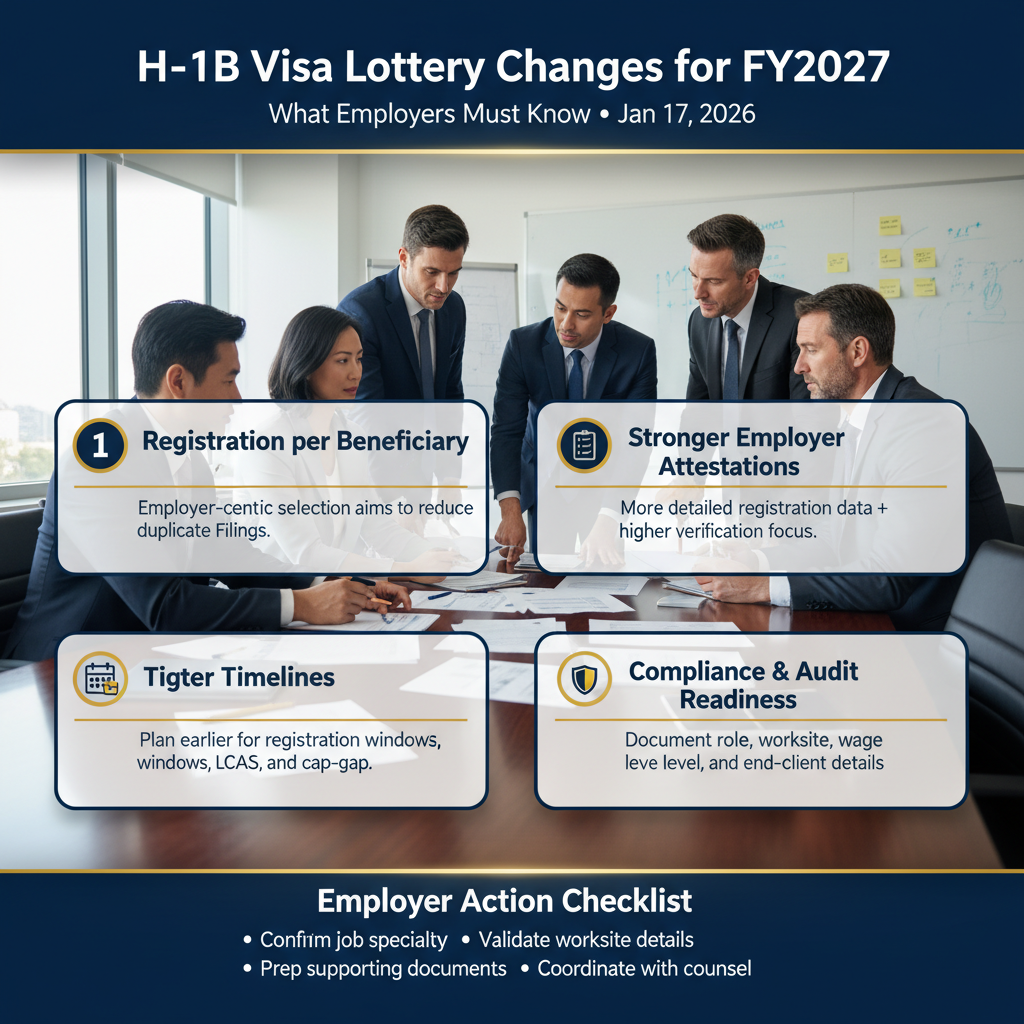
This article is based on trending coverage and ongoing legal analysis around upcoming H-1B program updates, including: H-1B Visa Lottery Changes for FY2027 (Legal News).
Important: News coverage often summarizes proposed or newly issued rules before agencies publish full operational details. This guide focuses on what is known, what is likely, and how to prepare using official government sources and current H-1B law.
Need Help? Our Orlando immigration team is ready to assist. Call +1 786-791-3106 for a free consultation, or message us online. Se Habla Español.
What This News Means for Immigrants in Orlando and Across Florida
Why this news is showing up now
The H-1B program runs on a federal fiscal year cycle. For most employers, the most intense activity happens every year between January and April: the pre-registration period opens, USCIS runs the lottery, and selected employers file full petitions. When the government signals “FY2027 changes,” it typically means one (or more) of the following is happening:
- USCIS is adjusting the registration/selection process to reduce fraud, duplicate registrations, or misuse.
- DHS is finalizing or proposing regulations that affect eligibility, specialty occupation analysis, employer-employee relationship rules, site visits, or evidence standards.
- Operational changes (new forms, new fees, new timelines, or new portal requirements) are being prepared for the next cap season.
Reminder: Even when rules are “final,” employers often need time to update internal processes, job descriptions, wage practices, vendor contracts, and documentation. For H-1B candidates in Florida—especially in fast-growing markets along the I-4 corridor—small changes can significantly impact selection odds and approval outcomes.
How it can affect Florida residents
Florida employers (including healthcare networks, IT consultancies, universities, hospitality tech, aerospace/defense contractors, and logistics firms) rely heavily on cap-subject H-1Bs. If FY2027 changes affect registration integrity, evidence requirements, or enforcement, Florida-based workers and employers may see:
- Different selection outcomes if USCIS changes how it identifies duplicates or related entities.
- More Requests for Evidence (RFEs) if job duties, degree requirements, or wage levels are scrutinized more strictly.
- More compliance pressure for worksites across Orange County and the broader I-4 corridor (Orlando–Lakeland–Tampa), especially for hybrid/remote arrangements.
- Timeline shifts that affect start dates, travel, and Adjustment of Status planning for families.
If your case is in Orlando, even though H-1B petitions are filed with USCIS service centers (not the local field office), your broader immigration strategy may still involve the local ecosystem—especially if you later pursue Form I-485 (employment-based green card) or family-based filings like Form I-130.
What H-1B Visa Lottery Changes for FY2027 Is (and Why It Matters)
A plain-English definition
The “H-1B visa lottery” is the selection process USCIS uses when more employers want to sponsor H-1B workers than the annual cap allows. Most private-sector H-1Bs are subject to the cap (typically 65,000 regular cap plus 20,000 for U.S. master’s degree holders). Employers submit an online registration during a designated period, and USCIS randomly selects enough registrations to meet the cap.
“H-1B Visa Lottery Changes for FY2027” refers to anticipated or newly issued government rule changes that could modify:
- How registrations are submitted and validated
- How USCIS detects duplicate or improper registrations
- What evidence is required at the petition stage
- How USCIS enforces specialty occupation and wage rules
- How quickly employers must act after selection
Warning: The H-1B process is unforgiving. A small error (wrong SOC code, inconsistent job duties, missing degree equivalency analysis, or incorrect worksite data) can lead to denial—even after lottery selection.
Key terms you need to know
- Cap-subject H-1B: H-1B petitions counted toward the annual limit.
- Cap-exempt H-1B: Certain employers (universities, nonprofit research organizations, etc.) not subject to the cap.
- Registration: The initial electronic entry submitted during the registration window.
- Beneficiary: The foreign national worker the employer wants to sponsor.
- Specialty occupation: A job that normally requires at least a bachelor’s degree in a specific specialty.
- LCA (Labor Condition Application): A Department of Labor filing confirming wage and working condition commitments.
- RFE: Request for Evidence—USCIS asks for more documents before deciding.
- Consular processing: Getting the H-1B visa stamp abroad through the U.S. Department of State.
- Change of status: Switching to H-1B from another status while in the U.S.
- Priority Date: A green card timeline marker (more relevant later, but planning starts early).
Need Help? Our Orlando immigration team is ready to assist. Call +1 786-791-3106 for a free consultation, or message us online. Se Habla Español.
Current Immigration Law: The Foundation
To understand what might change for FY2027, it helps to know the legal baseline. H-1B classification is governed primarily by:
- Immigration and Nationality Act (INA) provisions at 8 U.S.C. § 1101(a)(15)(H)(i)(b) (H-1B classification) and 8 U.S.C. § 1184 (admission of nonimmigrants)
- USCIS regulations at 8 C.F.R. § 214.2(h) (H classifications)
- Department of Labor regulations at 20 C.F.R. Part 655, Subparts H and I (LCA requirements, wage obligations)
USCIS operational guidance, forms, and filing instructions are published on the USCIS official website. Official form libraries and editions are available at USCIS Forms.
Federal requirements
Most H-1B cases require (1) a valid employer-employee relationship, (2) a qualifying specialty occupation position, (3) a qualified worker (degree or equivalent), and (4) an approved LCA.
Key USCIS/DOL components include:
- Form I-129 (Petition for a Nonimmigrant Worker) with H Classification Supplement
- Certified LCA (ETA Form 9035/9035E) from the Department of Labor
- Employer support letter, job description, and organizational evidence
- Worker’s education documents and credential evaluations (if needed)
Reminder: Although this article focuses on H-1B, many readers are planning family or green card steps too. In those strategies, you may also encounter Form I-130, Form I-485, and concepts like Adjustment of Status and Priority Date.
Florida-specific considerations
Immigration is federal law, so Florida does not create separate H-1B eligibility rules. However, Florida-specific realities can affect case strength:
- Worksite geography: Multi-site assignments across Orange County and the I-4 corridor can trigger LCA posting and amendment issues.
- Hybrid/remote work: Remote work from home in Central Florida may require LCA notice compliance and careful worksite documentation.
- Industry patterns: Staffing/consulting models common in Florida can receive extra scrutiny on employer control and specialty occupation duties.
If your case is in Orlando and you later file a family or employment green card application, the Orlando USCIS Field Office may become relevant for interviews and local processing steps. For case planning, you can monitor general timelines at USCIS Processing Times.
How to Prepare for FY2027 H-1B Lottery Changes: A Complete Step-by-Step Guide
1) Confirm whether your employer is cap-subject (and whether you have cap-exempt options)
Before you spend time on a lottery strategy, confirm if you even need the lottery. Some workers can avoid the cap through cap-exempt employers (certain higher education institutions, nonprofit entities affiliated with universities, and nonprofit/government research organizations).
- Required documents (employer):
- Proof of employer type (university charter, nonprofit determination letter, affiliation documentation)
- Organizational chart and description of operations
- Prior H-1B approval notices (if any)
- Required documents (employee):
- Current immigration status documents (I-94, approval notices)
- Resume/CV
- Diplomas and transcripts
Important: If you can pursue cap-exempt H-1B first, you may later move to cap-subject employment through “cap-exempt to cap-subject” pathways—but timing and strategy matter.
2) Build a “specialty occupation” job description that matches real business needs
FY2027 changes may increase scrutiny of job duties, degree requirements, and wage levels. A strong case starts with a credible, detailed job description that clearly requires a specific bachelor’s degree (or higher) in a related field.
- Required documents (employer):
- Detailed job description (daily/weekly duties, tools/tech, deliverables)
- Minimum hiring requirements (degree field, experience, certifications)
- Worksite location(s) and hybrid/remote policy
- Organizational chart showing the role’s placement
- Required documents (employee):
- Degree(s), transcripts, and course descriptions (if helpful)
- Professional licenses (if applicable)
- Experience letters to support equivalency (if no U.S. bachelor’s)
Warning: “Generic” job descriptions are a top trigger for RFEs. USCIS often expects specificity: what you will build, analyze, manage, design, or test—plus how your degree directly supports those tasks.
3) Set the wage and worksite strategy early (LCA planning)
The LCA is not a formality. The wage level must align with the role, location, and requirements. If FY2027 changes tighten enforcement, mismatched wages and worksites can become a bigger risk.
- Required documents (employer):
- Worksite address(es) including home office address if remote
- Proposed salary and compensation breakdown (bonuses, benefits)
- Job requirements and SOC code rationale
- Internal wage memo or comparable wage data (best practice)
- Required documents (employee):
- Current pay statements (if already employed)
- Offer letter or employment agreement
For Central Florida residents, hybrid work between downtown Orlando, Lake Nona, and home offices in Orange County can create multiple “places of employment.” Planning now helps avoid amendments later.
4) Prepare the FY2027 registration package (and compliance safeguards)
USCIS registration is electronic, but the “package” is really your internal file: accurate beneficiary data, passport info, degree level, and employer identifiers. If FY2027 changes add validation steps, employers should tighten quality control.
- Required documents/data (employer):
- Legal company name, FEIN, and address
- Authorized signatory details
- Business formation documents (articles, annual reports)
- Evidence of operations (website, marketing materials, invoices)
- Required documents/data (employee):
- Passport biographic page
- Current U.S. immigration documents (if in the U.S.)
- Degree level confirmation (especially for the master’s cap)
Important: USCIS has increasingly focused on preventing improper multiple registrations for the same beneficiary. Employers should implement written policies: who can register, how related entities coordinate, and how to document legitimate separate job offers if applicable.
5) If selected, file the full H-1B petition correctly and consistently
Selection is only the beginning. The petition must match the registration details and satisfy all legal requirements. Employers file Form I-129 with supporting evidence and the certified LCA.
- Required documents (employer):
- Signed employer support letter
- Certified LCA
- Company financials (as appropriate): tax returns, payroll records, bank letters
- Client letters, SOWs, or end-client documentation (if third-party placement)
- Evidence of employer control (supervision plan, reporting structure)
- Required documents (employee):
- Diplomas/transcripts + credential evaluation (if foreign degree)
- Resume
- Prior immigration approvals (I-797s) and I-94
- Visa stamps (if any) and travel history summary (best practice)
Reminder: If the worker is in the U.S., the petition may request a change of status. If outside the U.S. (or if change of status is not possible), the worker may use consular processing through the U.S. Department of State.
6) Plan for outcomes: approval, RFE, denial, or “not selected”
A smart FY2027 strategy includes backup options. Lottery uncertainty is real, and rule changes may shift odds.
- Required documents (varies by path):
- Alternative status eligibility documents (F-1 STEM OPT, O-1 evidence, L-1 qualifying relationship)
- Family-based options: Form I-130 filings, marriage/birth certificates (if applicable)
- Employment-based green card planning documents (PERM recruitment file, degree evaluations)
If your case is in Orlando and you are considering Adjustment of Status later through Form I-485, timing around your Priority Date and visa bulletin movement becomes crucial.
Need Help? Our Orlando immigration team is ready to assist. Call +1 786-791-3106 for a free consultation, or message us online. Se Habla Español.
Practical Steps You Can Take Today
Whether you are an employer preparing for FY2027 or a worker trying to protect your status, you can take meaningful steps now—before USCIS opens the next registration season.
- Checklist item #1: Confirm your exact degree field and collect transcripts early. If your degree is foreign, plan for a credential evaluation.
- Checklist item #2: Align the job title, duties, and minimum requirements with a credible specialty occupation narrative.
- Checklist item #3: Map every worksite location (including remote addresses) and decide whether travel is required.
- Checklist item #4: Create an internal compliance file: wage memo, supervision plan, and documentation of employer control.
- Checklist item #5: Review your current status expiration dates and plan around key deadlines like 180 days (common internal planning horizon for extensions/changes) and any 90-day window your employer uses for onboarding and filing readiness.
- Checklist item #6: Track official announcements on the USCIS official website and confirm form editions at USCIS Forms.
Timeline expectations (typical cap cycle):
- January–March: Employers finalize candidates, job descriptions, and registration readiness.
- March: USCIS registration window usually opens; lottery selection follows.
- April–June: Selected employers file full H-1B petitions (exact filing window set by USCIS).
- October 1: Earliest start date for cap-subject H-1B employment for that fiscal year.
Important: If FY2027 rule changes alter the registration window, selection method, or evidence standards, employers should assume more lead time is needed—not less.
How Imigrar Helps Immigrants in Orlando
Imigrar is an immigration law firm based in Orlando, Florida, serving clients nationwide. Our mission is simple: Keep Families Together. For H-1B employers and workers, we focus on building cases that are both approvable and audit-ready.
- Strategic H-1B cap planning (including cap-exempt alternatives)
- Specialty occupation case-building and RFE response strategy
- Worksite/LCA compliance planning for hybrid and multi-location roles
- Long-term planning: pathways from H-1B to permanent residence, including Form I-485 Adjustment of Status strategy when eligible
- Family-based coordination where relevant, including Form I-130 planning to support household stability
We offer a free consultation by phone at +1 786-791-3106. Se Habla Español.
Frequently Asked Questions
Q: Who is eligible to be entered into the FY2027 H-1B lottery?
A: A U.S. employer (or U.S. agent in limited situations) must have a real job offer for a role that qualifies as a specialty occupation and must register the worker during the USCIS registration window. The worker must have at least a U.S. bachelor’s degree (or foreign equivalent) in a field related to the job. If you are unsure whether your degree matches the role, it’s worth getting a legal review before registration to reduce RFE/denial risk.
Q: Will FY2027 rule changes affect my current immigration status (F-1, OPT, TPS, etc.)?
A: The H-1B lottery process itself does not automatically change your current status. However, timeline shifts can affect “cap-gap” planning for F-1 students and can impact when an employer can file a change of status. If your status expires soon, you need a backup plan. If your case is in Orlando, we often coordinate timing across school DSOs, employers, and USCIS filings to avoid gaps.
Q: How long does H-1B processing take after selection?
A: Processing time depends on the service center, workload, and whether premium processing is requested (when available). You can check general ranges at USCIS Processing Times. Many employers plan for several months. Reminder: Even if approved early, most cap-subject H-1Bs cannot start before October 1 for that fiscal year.
Q: What documents are most important for avoiding an RFE under stricter FY2027 scrutiny?
A: The most important documents usually include: (1) a detailed employer support letter tying duties to a specific degree field, (2) a well-supported SOC code/wage level rationale, (3) proof the employer will supervise and control the work (especially for third-party or hybrid roles), and (4) the worker’s degree/transcripts plus credential evaluation if foreign. Consistency across the registration, LCA, and Form I-129 packet is critical.
Q: How much does an H-1B case cost?
A: Costs typically include government filing fees (which can vary based on employer size and case type), optional premium processing fees (if requested/available), and attorney fees. Employers generally must pay required H-1B fees and may not pass certain costs to the employee under DOL rules. Because fees can change, confirm current amounts on the USCIS official website and discuss a budget with counsel before registration.
Q: What happens if my H-1B is denied after being selected?
A: A denial can happen if USCIS finds the job is not a specialty occupation, the wage/worksite plan is not compliant, the employer-employee relationship is weak, or documents are inconsistent. Next steps depend on your status and timing: you may file a motion/appeal in limited circumstances, refile if allowed, or pivot to alternatives (cap-exempt H-1B, O-1, L-1, continued F-1/STEM OPT, or family-based options like Form I-130). If removal proceedings are involved, matters may fall under the immigration courts and the Executive Office for Immigration Review.
Q: If I am not selected in the FY2027 lottery, do I have any options?
A: Yes. Options may include cap-exempt employment, O-1 for individuals with extraordinary ability, L-1 for intracompany transferees, continuing F-1 OPT/STEM OPT if eligible, or pursuing permanent residence via an employer if you qualify. Family-based options may also apply depending on your situation. The best plan depends on your deadlines, including any 90-day window your employer needs to onboard or file, and your current status expiration.
Common Mistakes (and How to Avoid Them)
Mistake #1: Treating registration as “easy” and waiting too late to prepare
Registration is quick, but the underlying case must be strong. If FY2027 changes add validation or enforcement, last-minute registrations can lead to errors in beneficiary data, degree level, or employer identifiers. How to avoid it: Build a complete internal file in advance and run a quality-control check before submission.
Mistake #2: Weak specialty occupation evidence (generic duties, unclear degree requirement)
USCIS often challenges roles that appear entry-level, overly broad, or not tied to a specific field of study. How to avoid it: Use detailed duty descriptions, show complexity, and connect duties to coursework/skills from the beneficiary’s degree.
Mistake #3: Worksite and wage mismatches (especially with hybrid/remote work)
Florida’s hybrid work patterns can create compliance pitfalls if the LCA location does not match where work actually occurs. How to avoid it: Confirm all worksites (including home offices), document posting compliance, and plan amendments proactively when locations change.
Important: This is also where long-term planning matters. If your goal is a green card later through Form I-485 Adjustment of Status, maintaining clean compliance history can reduce risk when your Priority Date becomes current.
Additional Official Resources (Recommended Reading)
- USCIS official website
- USCIS Forms
- USCIS Processing Times
- U.S. Department of State
- Executive Office for Immigration Review
Need Help? Our Orlando immigration team is ready to assist. Call +1 786-791-3106 for a free consultation, or message us online. Se Habla Español.

Closing: Talk to an Orlando H-1B Lawyer Before FY2027 Registration Opens
FY2027 H-1B lottery changes may affect how employers register, how USCIS screens for duplicates, and how strictly petitions are reviewed after selection. The best time to protect your case is before the registration window opens—when you can still strengthen the job description, wage strategy, worksite plan, and evidence file.
For Central Florida residents and employers along the I-4 corridor, proactive planning can prevent delays, RFEs, and denials—and can also support long-term goals like permanent residence and family stability.
Call Imigrar at +1 786-791-3106 for a free consultation or contact us online. Se Habla Español. Keep Families Together.


