


The reporting that sparked this guide
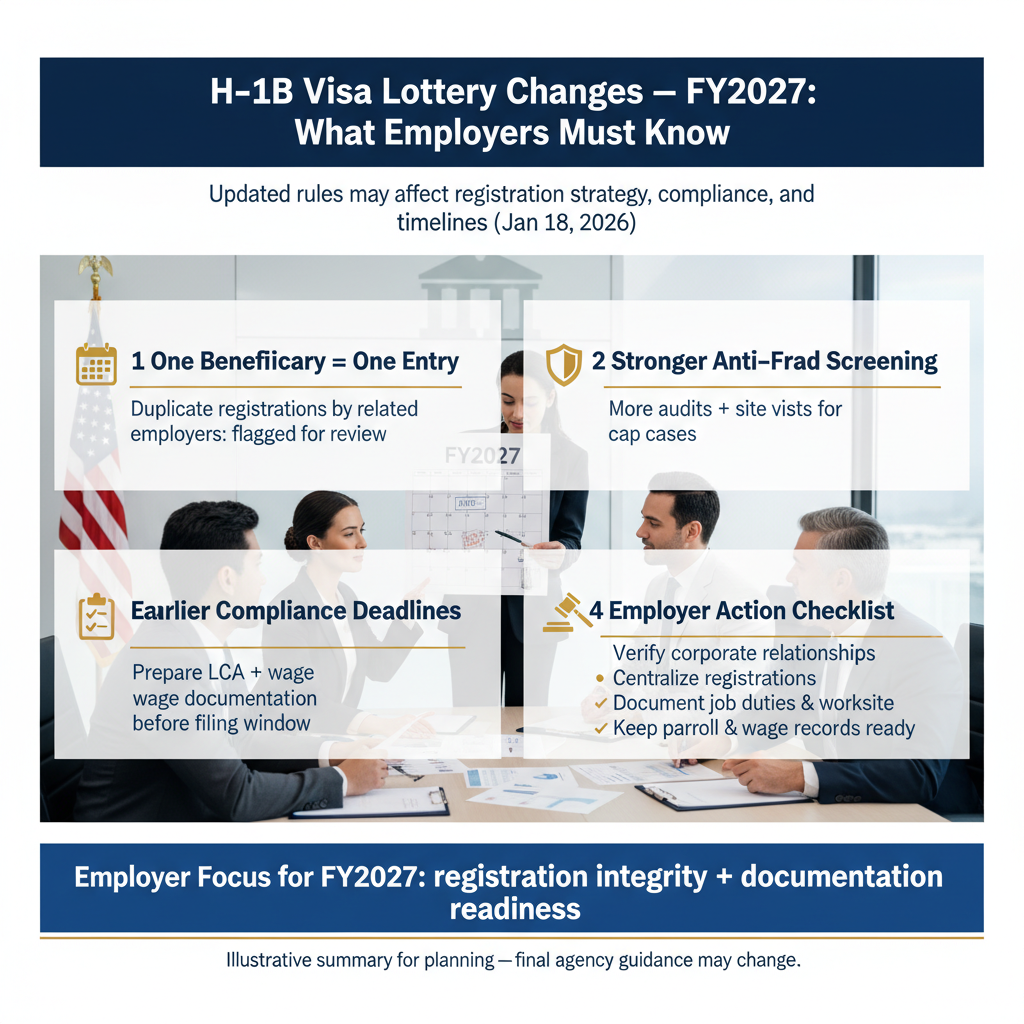
This article is based on trending coverage and ongoing updates in immigration law reporting, including: H-1B Visa Lottery Changes for FY2027 (Legal News).
Important: News reports often summarize proposed rules, agency announcements, and policy shifts before final implementation details are fully published. For the most reliable, up-to-date requirements, always cross-check with USCIS official website and formal Federal Register publications.
Need Help? Our Orlando immigration team is ready to assist. Call +1 786-791-3106 for a free consultation, or message us online. Se Habla Español.
What This News Means for Immigrants in Orlando and Across Florida
Why this news is showing up now
The H-1B cap season is one of the most competitive parts of the U.S. immigration system. Each year, employers race to register candidates during the electronic registration period, hoping the worker is selected in the lottery so the employer can file an H-1B petition.
For FY2027, news coverage is focusing on “lottery changes” because USCIS has been steadily modernizing the selection and registration process to reduce fraud, increase fairness, and improve data integrity. Recent years have already brought major changes—especially the shift to a beneficiary-centric selection model (one selection per person, not per registration). FY2027 coverage suggests additional refinements may affect:
- How USCIS validates identity and eligibility information at the registration stage
- How duplicate, inconsistent, or suspicious registrations are handled
- How employers document the job offer and specialty occupation requirements
- How USCIS manages timelines, fees, and compliance reviews
Reminder: Even “small” rule tweaks can have big consequences in a system where selection rates can be low and timing is strict—often a 90-day window or less for specific actions once selection occurs.
How it can affect Florida residents
Florida—especially the I-4 corridor from Tampa to Orlando to Daytona—has a fast-growing tech, healthcare, hospitality, engineering, and finance workforce. For Central Florida residents, the H-1B lottery is often the bridge from:
- F-1 OPT / STEM OPT to long-term work authorization
- J-1 trainee/intern pathways to employment-based status (where eligible)
- Other nonimmigrant statuses to a specialty-occupation role
If your case is in Orlando, these changes matter because local employers may adjust recruiting timelines, compliance procedures, and internal documentation. For workers, it can affect whether you’re registered, whether your registration is considered valid, and how quickly your employer can move after selection.
Warning: Many H-1B problems happen before the petition is ever filed—during registration, job design, wage planning, and document preparation. That is where FY2027 changes may be most impactful.
What H-1B Visa Lottery Changes for FY2027 Is (and Why It Matters)
A plain-English definition
The “H-1B lottery” is the selection process USCIS uses when more employers want to file cap-subject H-1B petitions than the annual limit allows. Because Congress sets a cap (generally 65,000 regular cap plus 20,000 for U.S. master’s or higher degrees), USCIS runs a random selection process from properly submitted registrations.
“H-1B Visa Lottery Changes for FY2027” refers to new or updated rules and procedures that can change:
- How employers register candidates
- How USCIS determines whether a registration is valid
- How USCIS detects and addresses misuse (duplicate filings, sham job offers, etc.)
- How quickly and predictably the process moves
Why it matters: if your registration is rejected, invalidated, or not selected, you may lose the chance to file a cap-subject petition that year—and that can affect work authorization, travel plans, and long-term strategies such as Adjustment of Status later on.
Key terms you need to know
- Cap-subject H-1B: H-1B petitions counted toward the annual numerical limit.
- Cap-exempt H-1B: Certain employers (e.g., qualifying universities and nonprofit research organizations) may file without the annual cap.
- Electronic registration: The online pre-registration process employers must complete before filing a cap-subject petition.
- Beneficiary-centric selection: USCIS selects individuals rather than “entries,” reducing the benefit of multiple registrations for the same person.
- Specialty occupation: A job that normally requires at least a bachelor’s degree in a specific specialty (or equivalent) related to the job duties.
- LCA (Labor Condition Application): The employer’s filing with the U.S. Department of Labor attesting to wage and working condition requirements.
- RFE: Request for Evidence—USCIS asks for more documentation before deciding.
- Consular processing: Getting the visa stamp abroad and entering the U.S. in H-1B status.
- Change of status: Switching to H-1B status inside the U.S. (if eligible), often tied to the “cap-gap” period for F-1 students.
Important: The H-1B process is employer-driven. The employer is the petitioner; the worker is the beneficiary. That structure affects costs, evidence, and compliance responsibilities.
Need Help? Our Orlando immigration team is ready to assist. Call +1 786-791-3106 for a free consultation, or message us online. Se Habla Español.
Current Immigration Law: The Foundation
Even when USCIS updates procedures, the H-1B framework is grounded in federal statutes and regulations. Understanding the “foundation” helps you spot what is truly changing versus what remains the same.
Federal requirements
The H-1B category is authorized under the Immigration and Nationality Act (INA) and implemented through federal regulations. Key authorities include:
- INA § 101(a)(15)(H)(i)(b) (defining H-1B classification)
- INA § 214 (admission of nonimmigrants and related conditions)
- 8 CFR § 214.2(h) (core H-1B regulatory requirements, including specialty occupation, employer-employee relationship, validity period, and cap rules)
- INA § 212(n) and related Department of Labor rules (LCA wage and working conditions attestations)
USCIS implements H-1B petitions primarily through Form I-129 (Petition for a Nonimmigrant Worker), and the electronic registration system for cap-subject cases.
While this article focuses on H-1B, many families also ask how employment status connects to family-based processes such as Form I-130 and Form I-485 for Adjustment of Status. Those are separate pathways, but your nonimmigrant status and timelines can affect long-term planning, including your Priority Date in employment-based immigrant visa categories.
Official references you can rely on include: USCIS official website, USCIS Forms, U.S. Department of State, and USCIS Processing Times.
Florida-specific considerations
H-1B is federal law, so the eligibility rules do not change from state to state. However, Florida-specific realities can affect strategy and risk:
- Industry mix: Central Florida has many roles that can be challenged as “not specialty occupation” unless duties are documented carefully (e.g., some hospitality management, general business roles, certain analyst titles).
- Worksite and commuting patterns: The I-4 corridor often involves multi-site work, client sites, and hybrid arrangements. This affects LCA posting, worksite addresses, and compliance.
- Local adjudication and logistics: If your case is in Orlando, you may interact with the Orlando-area USCIS ecosystem for related filings (EAD/AP, family filings, extensions). The Orlando USCIS Field Office generally handles in-person appointments for certain benefits, while many H-1B petitions are adjudicated at USCIS service centers.
- State licensing: Some roles (e.g., certain healthcare positions) may require Florida licensure. USCIS may request proof you can perform the job at the time of filing or at least by start date, depending on the occupation.
Reminder: Even though H-1B is not filed at a local field office, your overall immigration “portfolio” may include filings that do involve local processing—especially for spouses and children, or if you later pursue permanent residence.
How to Prepare for FY2027 H-1B Lottery Changes: A Complete Step-by-Step Guide
Below is a practical, employer-and-worker-friendly roadmap you can follow to prepare for FY2027. Because USCIS can update registration instructions, always confirm the exact registration dates and requirements on USCIS official website.
1) Confirm the job qualifies as a “specialty occupation” (before registration)
The most common H-1B denial and RFE issues are not about the person—they’re about the job. Before the employer registers you, align the role’s duties, minimum requirements, and business need.
Documents to prepare:
- Detailed job description (day-to-day duties; percentage breakdown)
- Minimum education requirement (degree field and level)
- Organizational chart showing where the role fits
- Offer letter or employment agreement draft
- Evidence of specialty nature (industry postings, internal job ads, prior hires)
Important: If FY2027 changes increase scrutiny at the registration stage or soon after selection, you want the specialty-occupation analysis done early—before the employer pays fees or makes representations to USCIS.
2) Gather beneficiary identity and eligibility evidence (to avoid registration problems)
USCIS has prioritized integrity measures in recent years. Any FY2027 “lottery changes” may include tighter identity matching, data validation, or stricter treatment of inconsistent records.
Documents to prepare:
- Passport biographic page (valid and clear)
- Current immigration status documents (I-94, visa stamp, approval notices)
- All prior I-20s (for F-1), OPT/STEM EAD cards, and SEVIS history (if applicable)
- Prior approval notices (e.g., prior H-1B, L-1, O-1)
- Current resume/CV with exact dates
Warning: Inconsistent spellings, name order differences, multiple passports, or mismatched dates can trigger delays or questions. Fix data issues early.
3) Plan wage strategy and start the LCA process early
After selection, the employer typically must file an LCA and then submit the H-1B petition. Even if USCIS does not require LCA at registration, FY2027 changes may push employers to have wage and worksite planning done sooner.
Documents to prepare:
- Worksite address(es) and hybrid/remote policy
- Proposed wage and payroll schedule
- Job classification details (SOC code analysis support)
- Company financials or payroll records (helpful in some cases)
- Client letters / SOWs (if placed at third-party sites)
Reminder: LCAs are filed with the Department of Labor, not USCIS. But LCA issues often become USCIS issues when they lead to inconsistencies in the petition.
4) Complete the USCIS H-1B registration correctly (and ethically)
The employer (or its authorized attorney) submits the electronic registration during the registration period. Under the beneficiary-centric model, multiple employers can register the same worker, but any attempt to game the system can create serious risk.
Documents to prepare:
- Employer legal name, EIN, and contact information
- Authorized signatory details
- Beneficiary passport information and biographic details
- Degree level information for master’s cap eligibility (if applicable)
- Internal memo confirming the bona fide job offer
Warning: “Fake offers,” shell companies, or coordinated registrations without a real job can lead to denial, revocation, and potential findings of misrepresentation.
5) If selected, file the H-1B petition package (Form I-129 + evidence)
Selection is not approval. Once selected, the employer must file a complete petition within the filing window specified by USCIS. This is where strong documentation matters most.
Documents to prepare:
- Form I-129 and H Classification Supplement
- Certified LCA
- Employer support letter describing duties, requirements, and need
- Evidence of employer-employee relationship (especially for remote/third-party)
- Beneficiary degree evidence: diploma, transcripts, evaluations (if foreign degree)
- Professional licenses (if required for the occupation)
- Maintenance of status evidence (I-94, paystubs, prior approvals)
Important: If you are changing status in the U.S. (for example, from F-1 to H-1B), your status maintenance documents are critical.
6) Respond to RFEs quickly and strategically (if issued)
If USCIS issues an RFE, it is a request for additional evidence—not a denial. But the response must be complete, well-organized, and consistent with the record.
Documents to prepare (depending on the RFE):
- Expanded duty breakdown and project descriptions
- Expert opinion letters (in some specialty occupation cases)
- Additional company evidence (contracts, invoices, client letters)
- Wage level justification and SOC code analysis
- Updated org chart, supervision plan, and performance review structure
Reminder: RFEs have strict deadlines. Missing an RFE deadline can lead to denial.
7) After approval: start date, travel, and long-term planning
Once approved, the worker may begin H-1B employment on the approved start date (often October 1 for cap-subject cases). If you need a visa stamp, you may use consular processing via the U.S. Department of State.
Documents to prepare:
- I-797 approval notice
- Updated employment verification letter
- Recent paystubs (once employment begins)
- DS-160 confirmation and consular appointment documents (if traveling)
- Family documents for H-4 dependents (marriage/birth certificates)
Important: If you have a spouse pursuing work authorization (H-4 EAD eligibility depends on specific circumstances), plan early and monitor processing at USCIS Processing Times.
Need Help? Our Orlando immigration team is ready to assist. Call +1 786-791-3106 for a free consultation, or message us online. Se Habla Español.
Practical Steps You Can Take Today
Whether you are an employer in Orange County or a worker living in Central Florida, you can take concrete steps now to reduce risk and increase readiness for FY2027.
Actionable checklist (do these now)
- Confirm your timeline: Identify when your current work authorization expires (OPT, STEM OPT, other). Mark deadlines at least 180 days in advance for planning, even if the official H-1B cycle is shorter.
- Standardize your identity records: Make sure your passport name, prior I-94 records, I-20s, and USCIS filings match (or have documented explanations).
- Build a “specialty occupation packet” early: Draft job duties, minimum requirements, and an org chart before registration opens.
- Collect education evidence: Order official transcripts, get credential evaluations for foreign degrees, and gather experience letters if equivalency is needed.
- Map worksites and remote work: For hybrid roles along the I-4 corridor (Orlando, Lake Mary, Sanford, Kissimmee), confirm where the work will physically occur for LCA and compliance.
- Budget for fees: Employers should plan for filing fees, legal fees, and optional premium processing where available.
- Plan a backup: Consider cap-exempt options, alternative statuses, or continuing education if not selected.
Document preparation guidance
Create a shared folder (securely) with clearly labeled PDFs. Use consistent naming conventions (e.g., “LASTNAME_Firstname_Passport,” “Degree_Transcript,” “I-94,” “EAD_FrontBack”). For employers, maintain a compliance folder with:
- Signed offer letter and job description
- Wage determination notes and SOC code rationale
- Worksite addresses and remote work policy
- Supervision plan (who manages the worker, how performance is evaluated)
Reminder: If USCIS introduces FY2027 changes that require more consistent data at registration, having clean, consistent records can prevent disqualification or delays.
Timeline expectations (typical cap-subject cycle)
- Registration period: Usually in March (USCIS announces exact dates).
- Selection notifications: Typically late March/early April, but timing can vary.
- Petition filing window: USCIS provides a defined period after selection (often at least 90 days, but always follow USCIS instructions).
- Start date: Often October 1 for cap-subject H-1B.
- Processing time: Varies by service center and workload; check USCIS Processing Times.
How Imigrar Helps Immigrants in Orlando
At Imigrar, we help employers and workers navigate high-stakes employment immigration with a strategy-first approach—so you are not just “filing forms,” you are building an approvable case designed to survive scrutiny.
We support clients in Orlando, Orange County, and throughout the I-4 corridor, and we also represent clients nationwide. Our team focuses on:
- Pre-registration planning to reduce selection-stage and filing-stage risk
- Specialty occupation analysis and evidence building
- Hybrid/remote work and multi-site compliance planning
- RFE strategy and response drafting
- Long-term planning for families—because our mission is Keep Families Together
Se Habla Español. We offer a free consultation to discuss your goals, your timeline, and the best pathway forward given FY2027 changes.
Need Help? Our Orlando immigration team is ready to assist. Call +1 786-791-3106 for a free consultation, or message us online. Se Habla Español.
Frequently Asked Questions
Q: Who is eligible for the FY2027 H-1B lottery?
A: Generally, you must have a bona fide job offer from a U.S. employer for a position that qualifies as a specialty occupation, and you must meet the job’s education/experience requirements. The employer must submit a valid electronic registration during the registration period. If you have a U.S. master’s degree (or higher) from a qualifying institution, you may be eligible for the advanced degree exemption (the “master’s cap”), which can improve odds.
Q: Can the new FY2027 rules affect my current immigration status?
A: The lottery rule changes typically affect registration, selection, and petition adjudication—not your current status directly. However, if you are relying on a cap-subject H-1B to remain employed after OPT/STEM OPT, a non-selection or an invalid registration can indirectly affect your ability to stay and work. If you are nearing expiration, plan early and discuss alternatives. If you later pursue permanent residence through a family case (Form I-130) or employment sponsorship, your ability to maintain lawful status can matter for Adjustment of Status using Form I-485.
Q: How long does the process take from registration to approval?
A: A typical cap-subject cycle runs from March registration to an October 1 start date. After selection, the petition is filed during the USCIS filing window. Processing time varies by service center and whether premium processing is available/used. Always check current estimates at USCIS Processing Times. Reminder: Selection is not approval; build time for possible RFEs.
Q: What documents are required for an H-1B petition after selection?
A: Common documents include Form I-129, a certified LCA, employer support letter, proof the job is a specialty occupation, proof the worker meets requirements (degrees, transcripts, evaluations), immigration status documents (I-94, prior approvals), and worksite/contract evidence if applicable. If your case is in Orlando and you plan to travel for stamping, you may also need consular documents via U.S. Department of State.
Q: How much does an H-1B case cost?
A: Costs can include USCIS filing fees, the H-1B registration fee, optional premium processing (if available), attorney fees, and related compliance costs. By law and policy, many fees must be paid by the employer (not the employee), and improper fee shifting can create compliance problems. Because fees and programs can change, confirm current fee amounts and requirements on USCIS official website and consult counsel for compliant payment practices.
Q: What happens if my registration is not selected or my petition is denied?
A: If not selected, you generally cannot file a cap-subject H-1B petition for that fiscal year (unless later rounds occur and you’re selected). If denied, options depend on your current status and timeline: refiling is usually not possible for the same cap season unless the denial is overturned (e.g., motion/appeal) or another basis exists. You may need to consider alternative statuses, cap-exempt employers, further study, or departure. If you are placed into removal proceedings, proceedings are handled by EOIR; see Executive Office for Immigration Review for information—though you should speak with an attorney immediately.
Q: Do FY2027 changes mean multiple employers can’t register me anymore?
A: Multiple legitimate employers can generally register the same beneficiary if each has a real job offer and independent need. However, USCIS integrity measures target coordinated or fraudulent multiple registrations. Warning: If USCIS suspects registrations were arranged to manipulate selection odds without genuine positions, the case can be denied and may raise serious immigration consequences.
Q: If I live in Central Florida, do I file at the Orlando USCIS Field Office?
A: Most H-1B petitions are filed with USCIS service centers (or as directed by USCIS filing addresses), not at a local field office. The Orlando USCIS Field Office may be relevant for other benefits (family-based filings, interviews, certain appointments). Always follow USCIS filing instructions and confirm addresses on USCIS Forms.
Common Mistakes (and How to Avoid Them)
Mistake #1: Waiting until registration opens to define the job
Employers sometimes rush to register a candidate without a fully developed job description, wage plan, or worksite strategy. That can lead to weak petitions, inconsistent details, or avoidable RFEs.
How to avoid it: build the specialty occupation packet early, confirm minimum requirements, and align duties with the degree field before registration.
Mistake #2: Inconsistent identity and history information
Small inconsistencies (name formatting, passport numbers, date gaps in employment, mismatched I-94 records) can create registration issues or credibility concerns later.
How to avoid it: standardize records, keep a timeline of immigration history, and correct errors before filing.
Mistake #3: Treating remote or third-party placement as “no big deal”
Hybrid work, client sites, and consulting arrangements require careful documentation of supervision, duties, and worksite compliance. These cases are often more scrutinized.
How to avoid it: document the employer-employee relationship, provide project details, and ensure LCA/worksite details match reality.

Closing: Plan Early for FY2027—Selection Is Only the First Hurdle
The biggest takeaway from FY2027 H-1B lottery changes is that success is increasingly tied to preparation, consistency, and credibility—starting well before registration and continuing through petition filing and (if needed) consular processing.
For Central Florida residents, especially those working or studying in Orange County and along the I-4 corridor, early planning can be the difference between an approvable case and a last-minute scramble.
Important: If you are also considering family-based options (like Form I-130 or Form I-485 for Adjustment of Status), coordinate timelines carefully—your nonimmigrant strategy can affect long-term outcomes, including your Priority Date planning in other categories.
Need Help? Our Orlando immigration team is ready to assist. Call +1 786-791-3106 for a free consultation, or message us online. Se Habla Español.
Need help now? Call Imigrar at +1 786-791-3106 to schedule your free consultation, or message us online. Se Habla Español. We’re here to help you move forward—and to Keep Families Together.


