


The reporting that sparked this guide
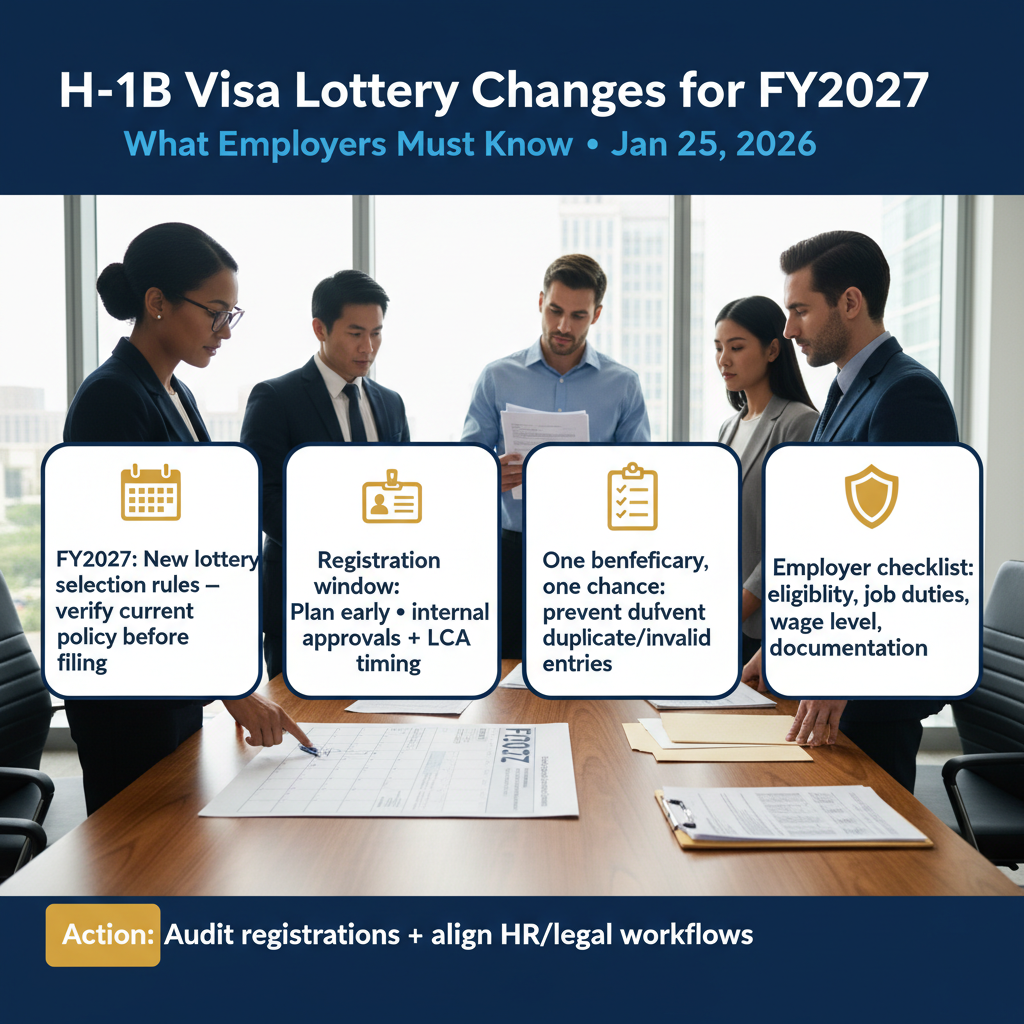
This article is based on trending coverage and ongoing analysis of proposed and newly implemented federal immigration policy updates: H-1B Visa Lottery Changes for FY2027 (Legal News).
Important: News coverage often summarizes complex rules quickly. Below, we translate the policy changes into practical steps for employers and foreign national professionals—especially those living and working in Florida—while linking to official government sources for verification.
Need Help? Our Orlando immigration team is ready to assist. Call +1 786-791-3106 for a free consultation, or message us online. Se Habla Español.
What This News Means for Immigrants in Orlando and Across Florida
Why this news is showing up now
The H-1B program has been under intense scrutiny because demand continues to far exceed the annual cap. In recent years, USCIS has also focused on preventing “gaming” of the lottery—especially scenarios where multiple registrations were filed for the same worker to increase selection odds.
For FY2027, the “lottery changes” being discussed in legal news typically relate to a combination of:
- Refinements to the electronic registration system and selection methodology
- Stricter integrity controls and enforcement against duplicate or improper registrations
- Potential updates to documentation expectations and employer attestations
- Operational timelines and how USCIS runs initial selection and any subsequent rounds
Reminder: Some changes may be final rules already in effect, while others may be proposed rules or policy guidance that evolves. Always verify against the USCIS official website and your specific case facts.
How it can affect Florida residents
Florida’s economy—especially along the I-4 corridor (Orlando, Lake Mary, Sanford, Kissimmee, and into Tampa)—relies heavily on global talent in technology, healthcare, education, hospitality management, engineering, and finance. If you are in Orange County or Central Florida on F-1 OPT/STEM OPT, L-1, TN, or another status, the FY2027 H-1B lottery framework can directly impact:
- Your ability to remain employed after OPT ends (and whether a “cap-gap” extension is available)
- Employer planning for start dates, staffing, and project timelines
- Risk management if a registration is deemed improper or if an employer is not eligible
- Long-term strategy toward permanent residence (PERM, I-140, and eventually Adjustment of Status)
If your case is in Orlando, even though many H-1B steps are handled by USCIS service centers rather than a local office, local factors still matter—like employer operations, payroll, worksites, and compliance readiness for potential audits. The Orlando USCIS Field Office is more relevant for in-person matters like interviews for certain benefits, but your overall immigration “ecosystem” often overlaps.
What H-1B Visa Lottery Changes for FY2027 Is (and Why It Matters)
A plain-English definition
The H-1B “lottery” is USCIS’s selection process for cap-subject H-1B petitions when the number of employers seeking H-1B workers exceeds the annual numerical limit (the “cap”). Employers first submit an online registration during a designated period. If selected, the employer may then file the full H-1B petition for that worker.
“H-1B Visa Lottery Changes for FY2027” refers to rule and process updates that affect how employers register, how USCIS selects registrations, what USCIS considers valid, and what happens if USCIS later finds issues such as duplicates, false attestations, or insufficient employer-employee relationship evidence.
Key terms you need to know
- Cap-subject H-1B: Most private-sector H-1B petitions are subject to the annual cap.
- Cap-exempt H-1B: Certain employers (e.g., qualifying universities, nonprofit research organizations) may file without lottery selection.
- Electronic registration: The online pre-registration employers submit to enter the lottery.
- Beneficiary-centric selection: A selection model designed to reduce the benefit of multiple registrations for the same person.
- Specialty occupation: The job must normally require at least a bachelor’s degree in a specific field (or equivalent).
- LCA (Labor Condition Application): A Department of Labor filing that supports the H-1B petition regarding wages and working conditions.
- RFE: Request for Evidence—USCIS asks for more documents before deciding.
- NOID: Notice of Intent to Deny—USCIS believes the petition should be denied unless you overcome concerns.
- Priority Date: More relevant to green cards than H-1B, but crucial if your long-term plan is permanent residence.
Warning: Confusing the lottery registration stage with the petition stage is one of the most common and costly errors. Selection does not mean approval—it only means you may file the full petition.
Current Immigration Law: The Foundation
Even when “new rules” make headlines, H-1B cases still rest on long-standing statutory and regulatory foundations. Understanding what does not change is as important as understanding what might.
Federal requirements
The H-1B category is rooted in the Immigration and Nationality Act (INA), primarily:
- INA § 101(a)(15)(H)(i)(b) (defining H-1B specialty occupation workers)
- INA § 214(i) (specialty occupation requirements)
- INA § 212(n) (Labor Condition Application and labor protections)
USCIS implements these through federal regulations (notably 8 C.F.R. § 214.2(h)) and policy guidance. Employers use USCIS petition forms and supporting evidence to prove:
- The job is a specialty occupation
- The worker has the required degree or equivalent
- The employer-employee relationship exists (including right to control)
- The LCA is certified and matches the offered position and worksite(s)
Common USCIS forms you may see in an H-1B strategy (directly or indirectly) include:
- Form I-129 (H-1B petition filed by employer)
- Form I-907 (Premium Processing request, when available)
- Form I-539 (change/extend nonimmigrant status for dependents in some scenarios)
- Form I-765 (work authorization for certain categories, e.g., F-1 OPT or H-4 EAD where eligible)
- Form I-130, Form I-485 (family-based options and Adjustment of Status, if an alternative path is needed)
For official guidance and updates, start at the USCIS official website and the USCIS Forms page.
Florida-specific considerations
Immigration is federal law, so Florida does not create H-1B eligibility rules. However, Florida-specific realities can affect your case:
- Multi-site worksites: Central Florida employers often have projects across Orange County and the broader I-4 corridor, which impacts LCA posting and worksite documentation.
- Third-party placement: Consulting and IT staffing models may trigger higher scrutiny about supervision, control, and end-client documentation.
- Public records and licensing: Certain regulated roles in healthcare or engineering may require Florida licensing—USCIS may ask how licensing aligns with H-1B duties.
- Local compliance readiness: Employers should be prepared for Department of Labor audits related to LCA obligations.
If your case is in Orlando and you anticipate any in-person immigration needs (like family-based processes or other benefits), the Orlando USCIS Field Office may be part of the broader plan—but H-1B filings themselves are typically adjudicated by USCIS service centers.
Need Help? Our Orlando immigration team is ready to assist. Call +1 786-791-3106 for a free consultation, or message us online. Se Habla Español.
How to Prepare for the FY2027 H-1B Lottery: A Complete Step-by-Step Guide
This step-by-step guide is written for (1) employers planning to register workers for the FY2027 H-1B cap season and (2) foreign nationals who want to reduce risk and improve readiness. While USCIS may refine the selection and integrity rules, the best strategy is the same: prepare early, document thoroughly, and avoid shortcuts.
1) Confirm the job qualifies as a specialty occupation
Before registration, ensure the position genuinely requires a bachelor’s degree (or higher) in a specific field and that the duties match that field. USCIS commonly challenges roles with broad degree acceptability or vague duties.
Documents to gather:
- Detailed job description (day-to-day tasks, tools, technologies, deliverables)
- Organizational chart showing where the role fits
- Minimum requirements policy for similar roles (internal HR documents)
- Examples of prior hires in the role and their degrees (redacted if needed)
- Industry evidence (job postings, wage surveys, OOH references)
2) Verify the worker’s qualifications and degree equivalency
The worker must have the required U.S. degree or a foreign equivalent. If the degree is not a perfect match, you may need evaluations or a combination of education and experience analysis.
Documents to gather:
- Diplomas and transcripts (all post-secondary education)
- Foreign credential evaluation (if degree is non-U.S.)
- Updated resume/CV and LinkedIn profile consistency check
- Experience letters from prior employers (duties, dates, full-time/part-time)
- Professional licenses (if applicable)
3) Plan the worksite(s), wage level, and LCA strategy
H-1B requires a certified LCA from the Department of Labor. Your wage level and worksite location(s) matter. Remote or hybrid arrangements require careful planning to avoid LCA mismatches.
Documents to gather:
- Worksite addresses (including remote work location if applicable)
- Proposed salary and compensation breakdown
- Position SOC code analysis and wage level rationale
- Company support letter outline referencing duties and supervision
- Remote work policy and supervision plan
Important: If the worker will be placed at a client site or rotate between sites along the I-4 corridor, document who supervises the worker, how work is assigned, and how performance is reviewed.
4) Prepare and submit the H-1B electronic registration correctly
The electronic registration is short, but mistakes can be fatal. FY2027 “lottery changes” discussions often emphasize integrity—meaning USCIS may more aggressively review duplicates, related entities, and improper submissions.
Documents/data to gather:
- Worker’s passport biographic page
- Exact legal name, date of birth, country of citizenship
- Employer FEIN details and legal entity name consistency
- Authorized signatory information
- Internal attestation records showing the job offer is bona fide
Warning: Multiple registrations for the same worker by the same employer (or by related entities without legitimate separate job offers) can lead to denial or revocation later—even if selected.
5) If selected, file the full H-1B petition package on time
Selection triggers a limited filing period. USCIS will reject late filings. Your petition must prove eligibility with evidence—not just assertions.
Documents to gather:
- Certified LCA
- Signed employer support letter (detailed duties, supervision, wage, worksite)
- Company documents (business license, brochures, website printouts, tax or payroll evidence as appropriate)
- Worker’s degree documents and evaluations
- Maintenance of status evidence (I-94, prior approval notices, paystubs, transcripts if F-1)
- Form I-129 and H Classification Supplement
- Form I-907 (if using premium processing and available)
Reminder: If the worker is in the U.S. and changing status (e.g., F-1 to H-1B), evidence of lawful status and compliance is essential.
6) Prepare for RFEs/NOIDs and post-filing compliance
Even strong cases can receive RFEs. FY2027 integrity messaging suggests continued scrutiny on specialty occupation, wage level, third-party worksites, and the employer-employee relationship.
Documents to gather (RFE-ready file):
- More detailed duty breakdown (percentage of time per duty)
- Project plans, SOWs, and end-client letters (if applicable)
- Proof of supervision (manager resume, reporting structure)
- Evidence of work product (redacted samples)
- Pay records and onboarding documents
Post-approval, employers must follow LCA rules (posting, wage compliance, public access file). Workers should track validity dates and travel risks.
Practical Steps You Can Take Today
Whether you’re an employer in Central Florida or a professional hoping to be sponsored, preparation months ahead of the registration window is the difference between a smooth filing and a last-minute scramble.
Actionable checklist
- Confirm your job title, duties, and minimum degree requirement are consistent across HR, offer letters, and internal postings.
- Collect degree documents and order a foreign credential evaluation early (if applicable).
- Map every worksite address (including remote) and confirm the LCA strategy supports it.
- Audit for “duplicate registration” risk across related entities, subsidiaries, or staffing partners.
- Create an RFE-ready evidence folder (projects, org chart, supervision details, wage rationale).
- Check immigration timelines: OPT end date, STEM OPT eligibility, and travel plans.
Document preparation guidance
Build a single, consistent “source of truth” packet. USCIS often detects inconsistencies between a resume, LinkedIn profile, degree field, and the offered role. Small inconsistencies can trigger RFEs.
Important: If you have a long-term green card plan, track your Priority Date strategy early. While the H-1B is temporary, many people use it as a bridge to permanent residence.
Timeline expectations
H-1B cap season generally follows an annual cycle (registration period, selection, filing, adjudication, and then an October 1 start date for cap-subject cases). Processing times vary year-to-year.
Check current estimates at USCIS Processing Times. If you may need consular processing, review the U.S. Department of State resources.
Warning: If your OPT ends before October 1, ask an attorney about cap-gap eligibility and risk management. Do not assume you are protected.
Need Help? Our Orlando immigration team is ready to assist. Call +1 786-791-3106 for a free consultation, or message us online. Se Habla Español.
How Imigrar Helps Immigrants in Orlando
At Imigrar, our mission is simple: Keep Families Together. Employment visas like H-1B often affect the entire household—spouses, children, housing, and long-term stability. We help employers and professionals build strong, compliant cases designed to withstand scrutiny.
Our Orlando-based team supports clients across Florida and nationwide with:
- H-1B cap registration strategy and risk screening (duplicate/related entity issues)
- Specialty occupation analysis and evidence development
- Third-party worksite and consulting model documentation
- Status planning for F-1 OPT/STEM OPT to H-1B transitions
- Long-term pathways, including family-based options (Form I-130) and Adjustment of Status (Form I-485) when appropriate
We offer a free consultation to discuss your situation and build a timeline that matches your work authorization end date, employer readiness, and FY2027 rule changes as they develop. Se Habla Español.
Frequently Asked Questions
Q: Who is eligible to be entered in the FY2027 H-1B lottery?
A: You must have a U.S. employer willing to sponsor you for a specialty occupation role and submit an electronic registration during the designated registration period. You also must have at least a bachelor’s degree (or equivalent) related to the job. If your degree is foreign or not a perfect match, a credential evaluation and detailed duty-to-degree alignment may be necessary.
Q: How do FY2027 lottery changes impact my current immigration status?
A: The lottery changes mainly affect registration integrity, selection, and petition filing rules—not your underlying status by themselves. However, they can indirectly affect you if your employer’s registration is invalidated or if you are not selected, which may leave you needing another option (STEM OPT extension, cap-exempt H-1B, O-1, TN, or family-based strategies). If you are considering Adjustment of Status through a family petition, the timing of your Priority Date and visa availability matters.
Q: What is the expected timeline for FY2027 H-1B—from registration to approval?
A: Typically, employers register first, then USCIS announces selections, then selected employers file full petitions during a limited filing period. Adjudication can take months unless premium processing is used (when available). Start dates for cap-subject H-1B are usually October 1 of the fiscal year. For up-to-date adjudication estimates, use USCIS Processing Times.
Q: What documents will USCIS want for the petition after selection?
A: Commonly: a certified LCA, a detailed employer support letter, proof the position is a specialty occupation, company documents showing the business is real and able to employ you, and your education/experience evidence. If you are in the U.S., you’ll also need proof you maintained status (I-94, approval notices, paystubs, transcripts if F-1). The employer files using Form I-129, and may add Form I-907 for premium processing if eligible.
Q: How much does an H-1B case cost, and who pays?
A: Costs usually include USCIS filing fees, potential fraud prevention/training fees where applicable, optional premium processing, plus attorney fees. As a compliance rule, employers generally must pay certain required fees and cannot shift them to the employee in a way that violates wage obligations. Because fee structures can change, confirm current amounts on the USCIS Forms and fee pages, and get legal advice tailored to your compensation structure.
Q: What happens if my registration is selected but my petition is denied?
A: A denial means the H-1B is not approved, and your next steps depend on your current status and timing. Some people can remain in the U.S. in another valid status; others may need to depart. If you receive an RFE or NOID first, responding thoroughly and on time is critical. If you fall out of status, removal proceedings could become a risk; immigration court information is available through the Executive Office for Immigration Review. Speak to counsel immediately to protect your options.
Q: If I’m not selected, what alternatives should I consider?
A: Options may include STEM OPT extension (if eligible), cap-exempt H-1B through a qualifying employer, L-1 for intracompany transferees, O-1 for extraordinary ability, TN for certain Canadian/Mexican professionals, E-2 (if eligible), or family-based options like Form I-130 leading to Form I-485 Adjustment of Status if a visa is available. The best alternative depends on your background, employer type, and timing.
Common Mistakes (and How to Avoid Them)
Mistake #1: Treating registration like a “placeholder” without a real job offer
USCIS expects a bona fide job opportunity. Submitting registrations without a real role, real duties, and real wage planning increases risk—especially under heightened FY2027 integrity messaging.
How to avoid it: Prepare a real job description, wage plan, and supervision structure before registration. Keep internal records supporting the offer.
Mistake #2: Duplicate registrations or “related entity” confusion
One of the biggest enforcement priorities has been improper multiple registrations for the same worker. Even if different entities file, USCIS may scrutinize whether they are truly separate and whether there are legitimately separate job offers.
How to avoid it: Conduct a corporate relationship audit (subsidiaries, affiliates, shared owners). Document why each registration is legitimate—or file only one.
Mistake #3: Weak specialty occupation evidence (especially for consulting/third-party worksites)
Consulting models often receive RFEs asking who controls the work, where it will be performed, and whether the duties require a specific degree.
How to avoid it: Provide end-client letters when possible, detailed SOWs, project plans, and a clear chain of supervision and control.
Additional Official Resources (Bookmark These)
- USCIS official website
- USCIS Forms
- USCIS Processing Times
- U.S. Department of State
- Executive Office for Immigration Review
Reminder: If you are dealing with multiple processes (employment + family), track deadlines carefully. Missing a filing window—whether it’s an H-1B filing period or a 90-day window for another benefit—can be case-ending. Also watch for compliance and response deadlines like 180 days in other immigration contexts where timing rules matter.
Need Help? Our Orlando immigration team is ready to assist. Call +1 786-791-3106 for a free consultation, or message us online. Se Habla Español.

Closing: Get a FY2027 H-1B Plan Built for the New Rules
FY2027 H-1B lottery changes are a reminder that the “registration” step is no longer a simple administrative task—it’s a compliance-sensitive filing that can shape the outcome of your entire year. For Central Florida residents and employers along the I-4 corridor, early planning is the best protection: align duties to degree requirements, document worksites and supervision, and eliminate duplicate-registration risk before USCIS does.
If you want a clear strategy—whether you’re an employer preparing multiple registrations or a professional trying to protect your status and long-term options—Imigrar can help.
Need help now? Call +1 786-791-3106 for a free consultation or message us online. Se Habla Español.


