


The reporting that sparked this guide
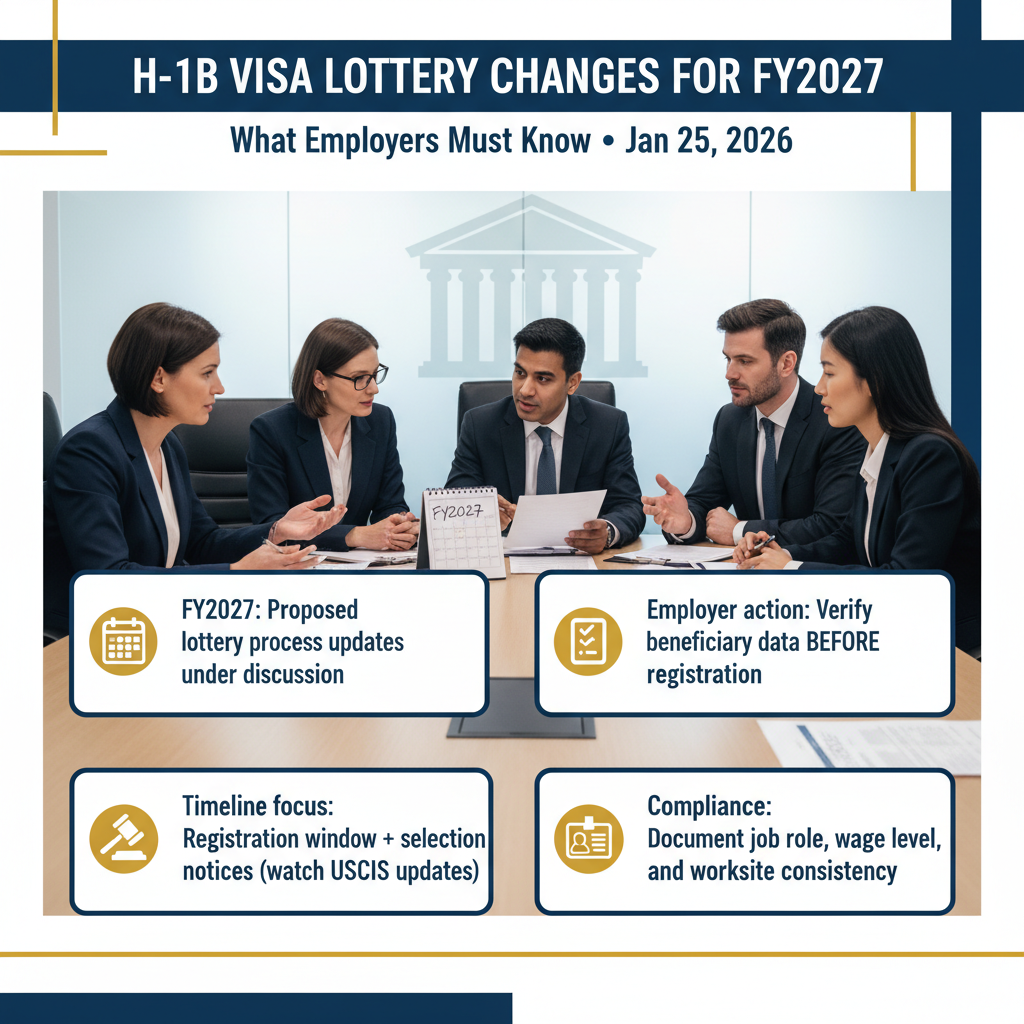
This article is based on trending immigration coverage and ongoing rulemaking discussions highlighted here:
H-1B Visa Lottery Changes for FY2027 (Legal News)
Important: News coverage often summarizes proposed or evolving agency actions. USCIS rules can change quickly through formal regulations, Federal Register notices, and policy alerts. For official updates, always verify details on the USCIS official website and consult counsel before filing.
Need Help? Our Orlando immigration team is ready to assist. Call +1 786-791-3106 for a free consultation, or message us online. Se Habla Español.
What This News Means for Immigrants in Orlando and Across Florida
Why this news is showing up now
Interest in “FY2027 H-1B lottery changes” is trending because the H-1B program remains one of the most competitive and time-sensitive employment-based pathways in the U.S. Each year, USCIS runs an electronic registration process for cap-subject H-1B petitions, and selection rates can fluctuate based on demand, compliance enforcement, and rule changes.
For FY2027, employers and foreign national professionals are watching for potential updates that may affect:
- How H-1B registrations are submitted and validated
- How USCIS selects registrations (and how duplicate or related submissions are handled)
- Documentation and attestations required at registration vs. petition stage
- Fraud-prevention measures and enforcement
- Timing, fees, and post-selection filing rules
Reminder: USCIS typically announces cap registration details in advance of the registration window. Employers planning FY2027 filings should begin preparation well before the registration period opens.
How it can affect Florida residents
Florida—especially the I-4 corridor (Orlando, Kissimmee, Lake Buena Vista, Lakeland, Tampa)—has a fast-growing economy with demand in technology, engineering, healthcare, hospitality management, finance, and higher education. For Central Florida residents, H-1B changes can affect:
- Students on F-1 OPT/STEM OPT working for Florida employers who need an H-1B to continue employment long-term
- Professionals already in the U.S. in another status (e.g., TN, E-3, L-1, O-1) considering a cap-subject H-1B strategy
- Employers in Orange County and surrounding counties that rely on global talent and must plan hiring timelines around the cap
- Families whose stability depends on maintaining valid status and work authorization for the principal worker and dependents
If your case is in Orlando, planning matters even more because delays in documentation, wage analysis, or internal company approvals can cause you to miss the registration window or the petition filing deadline after selection.
What H-1B Visa Lottery Changes for FY2027 Is (and Why It Matters)
A plain-English definition
The “H-1B visa lottery” is the common name for USCIS’s selection process used when more employers want to file cap-subject H-1B petitions than the number of H-1B visas available under the annual cap. Because demand typically exceeds supply, USCIS uses an electronic registration system and then randomly selects enough registrations to meet:
- The regular cap (generally 65,000)
- The U.S. master’s cap (generally 20,000 for qualifying advanced degrees)
“H-1B Visa Lottery Changes for FY2027” refers to anticipated or proposed adjustments to the way USCIS administers registration, selection, and/or filing—often aimed at fairness, integrity, and efficiency.
Key terms you need to know
- Cap-subject: An H-1B petition that counts toward the annual cap and generally must go through the lottery.
- Cap-exempt: Certain employers (e.g., universities, nonprofit research organizations) can file H-1Bs without the lottery.
- Registration: The employer’s electronic entry submitted during the USCIS registration period.
- Selection notice: USCIS notice that the registration was picked and the employer may file the full petition.
- Specialty occupation: A job that normally requires at least a bachelor’s degree in a specific specialty (or its equivalent).
- LCA (Labor Condition Application): A Department of Labor filing that sets wage and work condition attestations.
- Premium Processing: Optional faster processing for certain petitions (availability and fees can change).
- Status vs. visa: “Status” is your lawful presence in the U.S.; the “visa” is the travel document placed in your passport by a U.S. consulate.
- Adjustment of Status: A different process (often family-based or employment-based green card) that may be part of long-term planning; it is not the same as an H-1B petition.
- Priority Date: A green card concept tied to visa bulletin waiting lines; not directly the H-1B lottery, but crucial for long-term planning.
Warning: The H-1B process is employer-driven. Individuals cannot “self-petition” for a cap-subject H-1B without a sponsoring employer.
Current Immigration Law: The Foundation
The H-1B category is grounded in federal immigration law and regulations, primarily under the Immigration and Nationality Act (INA) and implementing regulations at 8 C.F.R. Part 214. The H-1B cap and selection mechanics are administered by USCIS, while wage and labor condition rules are administered by the U.S. Department of Labor.
Federal requirements
At a high level, cap-subject H-1B filings require:
- A valid employer-employee relationship
- A qualifying specialty occupation
- A beneficiary who meets the job’s degree requirements
- A certified LCA from the Department of Labor
- A properly filed petition package with required fees and evidence
USCIS forms commonly involved include:
- Form I-129 (Petition for a Nonimmigrant Worker) for the H-1B petition
- Form I-907 (Request for Premium Processing Service), if available and desired
For broader immigration planning, families often also encounter forms like Form I-130 and Form I-485 for family-based pathways and Adjustment of Status strategies, even if the immediate issue is H-1B.
Official references to monitor:
- USCIS official website
- USCIS Forms
- USCIS Processing Times
- U.S. Department of State (visa stamping and travel guidance)
- Executive Office for Immigration Review (immigration court information if removal proceedings arise)
Florida-specific considerations
H-1B is federal, so Florida does not create separate H-1B eligibility rules. However, Florida-specific realities affect outcomes:
- Industry mix: Central Florida employers may have more hybrid roles (e.g., “business analyst + operations”) that require careful specialty-occupation framing.
- Worksite compliance: Multi-location worksites across Orange County and the I-4 corridor can complicate LCA posting, worksite addresses, and amendment needs.
- Local processing and logistics: If your case is in Orlando, plan for document collection, notarizations, and travel for consular stamping if needed.
The Orlando USCIS Field Office typically handles many in-person matters (like interviews for Adjustment of Status), but most H-1B petitions are processed at USCIS service centers. Still, Orlando-based employees and employers should plan carefully around travel, status changes, and timing.
Need Help? Our Orlando immigration team is ready to assist. Call +1 786-791-3106 for a free consultation, or message us online. Se Habla Español.
How to Prepare for FY2027 H-1B Lottery Changes: A Complete Step-by-Step Guide
This step-by-step guide is designed for employers and foreign national professionals preparing for potential FY2027 H-1B lottery changes. Because rule details may evolve, the goal is to help you build a “ready-to-file” case that can adapt to new registration or documentation requirements.
1) Confirm the job qualifies as a specialty occupation
Before registration, confirm the offered role is likely to meet the specialty occupation standard. This is where many cases fail—especially roles with broad titles (e.g., “Coordinator,” “Analyst,” “Manager”) that do not clearly require a specific degree.
Documents to gather:
- Detailed job description (daily duties, tools/technologies, reporting lines)
- Minimum requirements (degree level and field, experience, certifications)
- Organizational chart showing where the role fits
- Evidence the role is professional-level in the industry (job postings, peer company ads)
- Worksite addresses (including remote/hybrid arrangements)
2) Validate the beneficiary’s eligibility (education and experience)
USCIS focuses on whether the foreign national meets the job requirements at filing time. If the person has a foreign degree, you may need a credentials evaluation. If relying on experience equivalency, the evidence must be strong and consistent.
Documents to gather:
- Passport biographic page and current U.S. immigration documents (I-94, visa stamp)
- Diplomas and transcripts (U.S. and foreign)
- Foreign credential evaluation (if needed)
- Resume/CV and LinkedIn profile (ensure consistency)
- Experience letters from prior employers (duties, dates, hours, skills)
- Licenses/certifications (if applicable)
3) Plan the wage and worksite strategy early (LCA planning)
The LCA is not just a formality. Wage level selection, SOC code choice, and worksite location(s) can affect compliance and risk. For Central Florida residents working across multiple sites along the I-4 corridor, this step is critical.
Documents to gather:
- Worksite(s) addresses and remote work policy
- Proposed salary, bonus/benefits summary
- Internal compensation data for similarly situated workers (if available)
- Employment agreement/offer letter draft
- Vendor/client letters (if third-party placement is involved)
Important: If the job involves third-party worksites, USCIS scrutiny can be higher. Strong evidence of the employer’s right to control the work is essential.
4) Prepare for electronic registration and integrity rules
Recent USCIS efforts have emphasized integrity in the registration system, including scrutiny of duplicate registrations and coordinated filings. For FY2027, employers should assume that USCIS may require clearer attestations, identity verification, or documentation that ties the registration to a real job offer.
Documents to gather:
- Company legal name, EIN, and formation documents
- Business address and FEIN verification documents
- Authorized signatory proof (corporate resolution or internal authorization)
- Company overview (website, brochures, investor deck)
- Payroll records and tax filings (as appropriate for employer credibility)
Warning: Employers should not submit multiple registrations for the same worker through related entities to increase odds. This can trigger denial or fraud findings.
5) If selected, file the full H-1B petition correctly and on time
Selection is not approval. After selection, the employer must file a complete petition package with USCIS within the specified filing period (USCIS will list the dates on the selection notice). Missing the filing window can forfeit the selection.
Documents to gather:
- Certified LCA
- Form I-129 and H classification supplement
- Support letter describing the job, specialty nature, and beneficiary qualifications
- Employer evidence (financials, client contracts if relevant, organizational charts)
- Beneficiary evidence (degrees, evaluations, experience letters)
- Filing fee checks and any required fee forms
- Form I-907 (if using Premium Processing and available)
Reminder: Keep copies of everything filed. If you later pursue a green card path with a Priority Date strategy, consistent job descriptions and timelines matter.
6) Maintain status, travel planning, and change-of-status strategy
If the beneficiary is in the U.S., the petition may request a change of status. Travel during a pending change-of-status can be risky. If the beneficiary is outside the U.S., consular processing and visa stamping will be required.
Documents to gather:
- All prior I-94 records and approval notices
- F-1 OPT/STEM OPT EAD and I-20s (if applicable)
- Prior approval notices for other statuses (TN, L-1, O-1, etc.)
- Dependent documents (spouse/children passports, I-94s, marriage/birth certificates)
- Travel itinerary and visa stamping plan (if consular processing)
Important: Some families may also be considering Adjustment of Status through Form I-130 or employment-based routes. Coordinate strategies to avoid unintended status gaps.
7) Prepare for RFEs, compliance, and post-approval obligations
USCIS may issue a Request for Evidence (RFE) about specialty occupation, employer-employee relationship, wage level, or the beneficiary’s qualifications. Employers must also comply with LCA posting and maintain a public access file.
Documents to gather:
- Public Access File components (LCA, wage memo, posting notices)
- Updated job description and work product samples (where appropriate)
- Timesheets and supervision records (especially for third-party worksites)
- Pay stubs and W-2s after approval
- Amendment triggers list (promotion, location change, material duty change)
Practical Steps You Can Take Today
Whether you are an employer in Orange County or a professional living in Orlando, the best H-1B strategy is proactive. Below is a practical checklist to reduce risk and improve readiness for FY2027 changes.
Actionable checklist
- Confirm your graduation and OPT/STEM OPT dates and map them against the H-1B cap timeline. If you are in the 90-day window before OPT expires, you need an urgent plan.
- Standardize your job description with clear specialty duties (not generic admin tasks). Align internal HR descriptions with what will be filed.
- Collect degree documents early, including transcripts and foreign credential evaluations. Delays here are common.
- Audit your immigration history: prior I-94s, status changes, and any gaps. Small inconsistencies can cause big problems.
- Plan for remote/hybrid worksites: list addresses, supervision structure, and how the employer controls work.
- Budget for fees (government filing fees, attorney fees, credential evaluations, and potential Premium Processing).
- Create a compliance folder for LCA posting and Public Access File documents.
Document preparation guidance
For the beneficiary, keep a single secure folder with:
- Passport, visas, I-94s, prior approval notices
- All I-20s (if F-1), EAD cards, OPT/STEM OPT documentation
- Diplomas, transcripts, evaluations, experience letters
For the employer, prepare:
- Corporate documents, FEIN verification, payroll evidence
- Job description, org chart, and supervision plan
- Worksite list for Central Florida and beyond
Reminder: If you later pursue a green card, you may file Form I-485 (if eligible) and track a Priority Date. Consistency across filings is key.
Timeline expectations
While USCIS timelines vary year to year, a realistic planning approach is:
- 2–3 months before registration: finalize role analysis, degree evaluations, and wage strategy
- Registration window: submit electronic registration on time (do not wait until the last day)
- After selection: file the H-1B petition within the specified filing period
- Adjudication: standard processing can take months; Premium Processing (if available) can shorten this
- Start date planning: cap cases typically aim for an October 1 start date, but confirm the specific FY rules
Check current estimates at USCIS Processing Times.
Need Help? Our Orlando immigration team is ready to assist. Call +1 786-791-3106 for a free consultation, or message us online. Se Habla Español.
How Imigrar Helps Immigrants in Orlando
At Imigrar, we help employers and professionals navigate complex immigration systems with a focus on stability and family unity—because our mission is to Keep Families Together.
Our team supports:
- H-1B cap registration strategy and petition filings
- RFE responses and risk mitigation
- Employer compliance planning (LCAs, postings, Public Access Files)
- Long-term planning toward permanent residence (including Priority Date strategy)
- Family-based options such as Form I-130 and Form I-485 where appropriate
If your case is in Orlando or you work for a Central Florida employer, we can help coordinate local logistics, remote worksite issues, and travel planning. We serve clients nationwide.
Se Habla Español. Call us to discuss your goals and build a plan that fits your timeline.
Free consultation available. Call +1 786-791-3106 or message us online.
Frequently Asked Questions
Q: Who is eligible to be entered in the FY2027 H-1B lottery?
A: The employer must offer a qualifying specialty occupation job and submit an electronic registration for the worker during the registration period. The worker must meet the job requirements (usually at least a bachelor’s degree in a specific field or equivalent). If you’re in Orlando on F-1 OPT, eligibility also depends on maintaining valid status through the filing and start-date timeline.
Q: Do FY2027 lottery changes affect my current immigration status?
A: Potentially. If you are in the U.S. (for example, F-1 OPT/STEM OPT), timing matters. A late or unsuccessful lottery can mean you must rely on other options to remain in status. If you are considering Adjustment of Status through a family petition (Form I-130) or an employment-based green card path (Form I-485 when eligible), coordinate carefully to avoid gaps and travel issues.
Q: How long does the H-1B process take after selection?
A: After selection, the employer must file the full petition within the filing window stated on the selection notice. Processing time then depends on the service center and whether Premium Processing is used (if available for your case type). Always check USCIS Processing Times for current estimates.
Q: What documents are required for an H-1B petition?
A: Common documents include a certified LCA, Form I-129, a detailed employer support letter, evidence the job is a specialty occupation, proof the beneficiary meets requirements (degrees, transcripts, evaluations, experience letters), and company documents. If the role is in multiple locations across Orange County or the I-4 corridor, worksite documentation is especially important.
Q: How much does an H-1B case cost?
A: Costs typically include USCIS filing fees, potential fraud prevention or training fees (depending on employer size and factors), optional Premium Processing fees, and attorney fees. There may also be costs for credential evaluations and document translations. We recommend employers budget early so the case isn’t delayed by internal approvals.
Q: What happens if the H-1B is denied after selection?
A: A denial means USCIS did not approve the petition—often due to specialty occupation concerns, employer-employee relationship evidence, or beneficiary qualification issues. Next steps may include refiling (if possible), filing a motion/appeal in some situations, or exploring alternatives (cap-exempt H-1B, O-1, L-1, TN, E-3, or a green card strategy). If denial creates status risk, act fast—sometimes you may have only 180 days or less in certain contexts to stabilize your situation, depending on your status and facts.
Q: If I live in Orlando, do I need to go to the Orlando USCIS Field Office for H-1B?
A: Usually no. Most H-1B petitions are filed and adjudicated by USCIS service centers. However, the Orlando USCIS Field Office may become relevant for other processes like Form I-485 interviews (employment- or family-based Adjustment of Status). Your attorney can help coordinate strategies if multiple filings are involved.
Common Mistakes (and How to Avoid Them)
Mistake #1: Treating the registration as “just a quick online step”
Registrations are simple to submit, but the underlying case must be real and supportable. If FY2027 changes require tighter attestations or validation, weak cases can be exposed earlier. Avoid this by preparing the job description, wage strategy, and beneficiary documents before registration opens.
Mistake #2: Using generic job descriptions that don’t prove a specialty occupation
USCIS wants to see specialized duties tied to a specific degree field. “Handles projects and supports operations” is not enough. Avoid this by drafting duty statements with percentages, tools/software, and how the degree is used daily.
Mistake #3: Not planning for worksites, remote work, and amendments
Central Florida employers often use hybrid arrangements across the I-4 corridor. Location changes can trigger amendment requirements. Avoid this by mapping worksites at the start, documenting supervision, and creating an internal process to flag changes before they happen.
Need Help? Our Orlando immigration team is ready to assist. Call +1 786-791-3106 for a free consultation, or message us online. Se Habla Español.

Closing: Build an FY2027 H-1B Plan Now—Before the Window Opens
FY2027 H-1B lottery changes may affect how employers register, how USCIS selects cases, and what evidence is expected. The best way to protect your opportunity is to prepare early: confirm the specialty occupation, align wages and worksites, organize documentation, and build a compliant filing strategy.
For Central Florida residents and Orlando-area employers—especially in Orange County and along the I-4 corridor—small timing mistakes can mean waiting another year. Don’t risk it.
Need legal guidance? Imigrar is here to help you move forward with clarity and confidence.
Call Imigrar at +1 786-791-3106 for a free consultation or message us online. Se Habla Español.


