


The reporting that sparked this guide
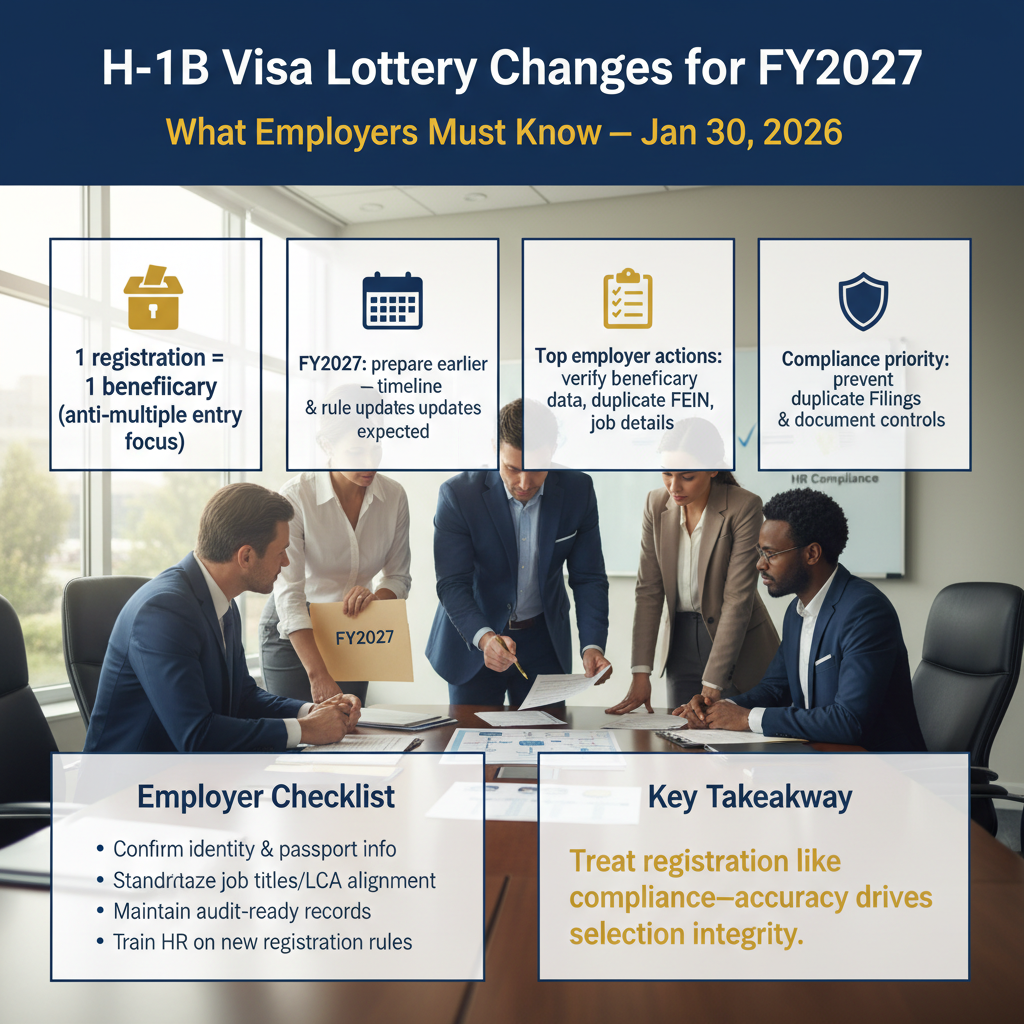
This article is based on trending coverage and ongoing rulemaking discussions about the H-1B program, including:
H-1B Visa Lottery Changes for FY2027 (Legal News)
Important: News coverage often summarizes proposals and agency statements before USCIS publishes final instructions. We wrote this guide to help employers and workers understand the direction of travel, what is already law, and how to prepare for likely FY2027 registration and lottery compliance changes.
Need Help? Our Orlando immigration team is ready to assist. Call +1 786-791-3106 for a free consultation, or message us online. Se Habla Español.
What This News Means for Immigrants in Orlando and Across Florida
Why this news is showing up now
The H-1B program remains one of the most competitive employment-based pathways in the U.S. Every year, USCIS runs an electronic registration system and then a lottery (a random selection process) because demand far exceeds the annual cap. When there are concerns about fraud, duplicate registrations, or shifting labor market needs, USCIS and DHS often adjust:
- How the lottery is run (what is selected: worker vs. registration)
- What employers must attest to during registration
- What evidence is required later at the petition stage
- How compliance is enforced (audits, site visits, and Requests for Evidence)
For FY2027 (the fiscal year that begins October 1, 2026), the “front end” of the H-1B process—registration and selection���is expected to receive heightened scrutiny. This trend is fueled by prior years’ concerns about multiple registrations for the same worker and the overall integrity of the selection process.
Reminder: Even when USCIS announces “changes,” some are policy clarifications, some are technical updates to the online system, and others require formal rulemaking. Employers and workers should plan early and avoid last-minute filings.
How it can affect Florida residents
Florida is home to major healthcare systems, engineering firms, universities, hospitality companies with corporate operations, and a fast-growing tech ecosystem along the I-4 corridor. For Central Florida residents—especially in Orlando, Orange County, and nearby counties—H-1B changes can affect:
- International students (F-1 OPT/STEM OPT) working for Florida employers who rely on the H-1B lottery to continue employment
- Employers trying to hire specialized talent quickly in a competitive market
- Families (H-4 spouses and children) planning stability, travel, and long-term options like Adjustment of Status
- Workers in other statuses (TN, E-3, O-1, L-1) considering whether switching to H-1B is still the best strategy
If your case is in Orlando, timing matters: the H-1B registration window is short, and the petition filing window after selection is strict. A small mistake during registration can lead to a lost year—especially for F-1 students nearing the end of work authorization.
What H-1B Visa Lottery Changes for FY2027 Is (and Why It Matters)
A plain-English definition
The “H-1B lottery” is the process USCIS uses to randomly select who may file an H-1B cap-subject petition when more registrations are received than the annual quota allows. “H-1B Visa Lottery Changes for FY2027” refers to anticipated updates to the rules and procedures governing:
- Electronic registration (who registers, what data is required, what fees apply)
- Selection methodology (how USCIS chooses winners)
- Anti-fraud and integrity measures (duplicate filings, related entities, genuine job offers)
- Post-selection filing requirements (evidence of specialty occupation, wage compliance, employer-employee relationship)
Why it matters: The H-1B is often the bridge between temporary work authorization (like OPT) and longer-term immigration strategies such as employment-based green cards. If the registration rules tighten or evidence requirements increase, both employers and workers need to prepare earlier and document more carefully.
Key terms you need to know
- H-1B Cap: The annual limit—generally 65,000 regular cap plus 20,000 for U.S. master’s or higher degree holders (the “master’s cap”).
- Electronic Registration: The online pre-registration process employers use before filing a full petition.
- Beneficiary-centric selection: A selection approach that aims to select the worker (beneficiary) rather than each employer registration. This is designed to reduce the impact of multiple registrations for the same person.
- Specialty Occupation: A role that normally requires at least a bachelor’s degree in a specific specialty or its equivalent.
- LCA (Labor Condition Application): A Department of Labor filing attesting to wage and working conditions requirements for H-1B workers.
- RFE (Request for Evidence): USCIS request for more documents before approving.
- Consular Processing: Getting the H-1B visa stamp at a U.S. consulate abroad to enter the U.S. in H-1B status.
- Change of Status: Switching to H-1B inside the U.S. without traveling, if eligible.
- Cap-Gap: Extension of F-1 status/work authorization for certain students with timely filed H-1B petitions.
- Priority Date: A concept tied to green card processes, not the H-1B lottery itself, but often part of long-term planning.
Warning: Many people assume “winning the lottery” means “approved.” It does not. Selection only allows the employer to file the petition. USCIS can still deny the case if the job, wage, employer, or worker qualifications do not meet requirements.
Current Immigration Law: The Foundation
Even when procedures change, the H-1B program is grounded in federal statutes and regulations. Key legal authorities include:
- Immigration and Nationality Act (INA) § 101(a)(15)(H) (H nonimmigrant category)
- INA § 214 (admission of nonimmigrants and conditions)
- INA § 212(n) (Labor Condition Application requirements and employer attestations)
- 8 C.F.R. § 214.2(h) (H-1B regulatory rules)
- 20 C.F.R. Part 655, Subparts H & I (Department of Labor LCA rules)
USCIS guidance and updates are published on the USCIS official website, including registration announcements, filing instructions, and policy manual updates.
Federal requirements
At a high level, a cap-subject H-1B petition generally requires:
- A U.S. employer offering a real job in a specialty occupation
- The worker to have the required degree (or equivalent experience) related to the job
- A certified LCA covering the position, wage level, location(s), and period of employment
- A properly filed petition, typically using Form I-129 (Petition for a Nonimmigrant Worker)
Depending on the worker’s situation, other forms and processes may be relevant for long-term planning. For example:
- Form I-130 (family petition) and Form I-485 (Adjustment of Status) may apply if the worker later pursues a family-based green card route.
- Priority Date becomes critical in employment-based green card cases (PERM/I-140/I-485), especially for backlogged categories.
Important: Always use the newest edition of USCIS forms and instructions via USCIS Forms.
Florida-specific considerations
Immigration is federal law, so Florida does not set H-1B eligibility standards. However, Florida-specific realities affect H-1B strategy:
- Worksite geography: If you live in Orange County and commute along the I-4 corridor (Orlando–Lake Mary–Sanford–Tampa), your worksite and any client sites must match the LCA. Moves can trigger amended filings.
- Tourism/hospitality corporate roles: Corporate IT, analytics, finance, and engineering roles can qualify; frontline service roles often do not meet specialty occupation standards.
- Healthcare licensing: Certain roles may require Florida licensure (or proof of eligibility). Licensing can become an RFE issue.
- Local processing touchpoints: The Orlando USCIS Field Office primarily handles in-person services for certain benefits (like naturalization interviews). Most H-1B petitions are adjudicated at USCIS service centers, but Orlando-based workers often coordinate travel, biometrics (if needed for other filings), and long-term Adjustment of Status planning locally.
For immigration court matters (not typical for H-1B), the authoritative resource is Executive Office for Immigration Review. For visa stamping and consular rules, see U.S. Department of State.
Need Help? Our Orlando immigration team is ready to assist. Call +1 786-791-3106 for a free consultation, or message us online. Se Habla Español.
How to Prepare for the FY2027 H-1B Lottery: A Complete Step-by-Step Guide
This step-by-step guide is designed for cap-subject H-1B cases (the lottery). Cap-exempt employers (certain universities, nonprofit research organizations, and affiliated entities) follow a different pathway and usually do not need the lottery.
Reminder: USCIS publishes specific registration dates each year. Build your plan backward from the registration opening and the post-selection filing window.
1) Confirm the job qualifies as a “specialty occupation” (and document it)
Start with the job—because the strongest worker profile cannot fix a weak job description. Employers should align the role with an occupation that normally requires a bachelor’s degree in a specific field.
Documents to gather:
- Detailed job description (duties, percentage breakdown, tools/technologies)
- Organizational chart showing reporting structure
- Offer letter with title, salary, location(s), start date
- Evidence of specialized nature of the role (project plans, technical requirements)
- Comparable job postings (internal and external) showing degree requirements
Warning: Overly generic job descriptions are a common reason for RFEs. If your case is in Orlando and the worker will rotate between Orange County client sites, the worksite plan must be clear and consistent with the LCA strategy.
2) Confirm the worker’s qualifications and evaluate degree equivalency early
USCIS will review whether the beneficiary’s education matches the specialty. If the degree is foreign, you may need a credential evaluation. If the degree is unrelated, you may need to document progressive experience and relevance.
Documents to gather:
- Passport biographic page and current U.S. immigration documents (I-94, visa stamp, EAD if applicable)
- Resume/CV
- Diplomas and transcripts (U.S. and foreign)
- Credential evaluation (if foreign degree)
- Letters from prior employers verifying duties, dates, and skills (for equivalency)
- Professional licenses (if required for the role)
Important: If the worker is on F-1 OPT/STEM OPT, align the job duties with the degree field and keep training plan documentation consistent. Small inconsistencies can create big issues later.
3) Plan the registration strategy to comply with integrity rules
FY2027 changes are expected to continue focusing on reducing duplicate registrations and strengthening attestations about genuine job offers. Employers should assume USCIS will scrutinize related entities and multiple registrations for the same beneficiary.
Documents to gather:
- Employer FEIN confirmation letter (or IRS documentation)
- Articles of incorporation/organization and business license
- Evidence of operations (website, lease, invoices, payroll summaries)
- Signed offer letter or employment agreement
- Internal memo on why the role is needed now (business necessity)
Reminder: If multiple affiliated companies want to register the same worker, get legal advice first. USCIS may treat certain “multiple registrations” as improper if they are not based on truly distinct job offers.
4) Prepare the LCA and wage compliance file before the petition window
After selection, timing is tight. The LCA must be certified before filing the H-1B petition. Wage level and worksite location drive the prevailing wage analysis and posting requirements.
Documents to gather:
- Worksite addresses (including remote work arrangements)
- Salary breakdown and pay schedule
- Prevailing wage documentation (as determined by employer methodology)
- Public Access File (PAF) components (posting notices, wage explanation)
- Benefits summary to show H-1B workers are treated consistently
Warning: Remote work can complicate LCAs. For Central Florida residents working from home in Orange County while the employer is elsewhere, the home location may need to be treated as a worksite for LCA purposes depending on the arrangement.
5) File the H-1B petition package correctly and completely (after selection)
If selected, the employer files the full H-1B petition (typically Form I-129 and H supplement) with supporting evidence. USCIS will evaluate specialty occupation, qualifications, employer-employee relationship, maintenance of status (if change of status), and more.
Documents to gather:
- USCIS selection notice and registration confirmation
- Certified LCA
- Form I-129 and supporting supplements (as applicable)
- Company support letter describing the role, projects, and supervision
- Beneficiary support documents (degree, transcripts, evaluations)
- Proof of maintenance of status (I-94 history, paystubs, prior approvals)
- Filing fee checks and forms (per USCIS instructions)
Important: Use official instructions and current fees. Always verify on USCIS official website before filing.
6) Respond to RFEs quickly and plan for start-date logistics
USCIS may issue an RFE asking for more evidence about the specialty occupation, worksite, wage level, or the worker’s qualifications. Responding well can be the difference between approval and denial.
Documents to gather:
- Project documentation (statements of work, deliverables, timelines)
- Updated organizational charts and supervision plan
- Additional expert opinion letters (if appropriate)
- Detailed itineraries for multi-site work (if applicable)
- Evidence of employer control (performance reviews, manager oversight)
Timeline note: Standard processing varies. Check USCIS Processing Times. Premium processing (if available for your case type) can shorten the decision timeframe, but it does not guarantee approval.
7) Coordinate travel, visa stamping, and long-term planning
Some workers will need visa stamping abroad. Others will change status inside the U.S. Your plan affects travel and family members’ status.
Documents to gather:
- Approval notice (Form I-797)
- Employment verification letter for travel
- Recent paystubs (if already employed)
- For dependents: marriage certificate, birth certificates, passports
- Consular appointment confirmation and DS-160 (if applicable)
Reminder: For visa stamping requirements and security checks, consult U.S. Department of State.
Practical Steps You Can Take Today
Whether you are an employer or a worker, the best way to handle FY2027 uncertainty is to prepare as if scrutiny will increase. Here is an actionable checklist you can start now.
Actionable checklist (do these now)
- Confirm eligibility early: Make sure the role is truly a specialty occupation and the degree match is defensible.
- Clean up job descriptions: Add duty percentages, tools, and project context. Avoid vague “assist with” language.
- Map worksites: List every location where work will be performed—especially along the I-4 corridor or at client sites.
- Build a qualifications file: Collect diplomas, transcripts, evaluations, and experience letters now.
- Plan for alternatives: If lottery odds are unfavorable, consider cap-exempt options, O-1, L-1, TN/E-3 (if eligible), or continuing STEM OPT where possible.
- Budget realistically: Government fees, legal fees, and potential premium processing should be planned ahead of the registration window.
- Track timelines: Put key dates on a calendar and avoid travel that could disrupt change-of-status plans.
Document preparation guidance
USCIS decisions often come down to documentation quality. Strong cases typically include:
- A detailed employer support letter connecting the job duties to a specific specialty degree
- Evidence the company has real projects and a need for the worker
- Clear proof of supervision and control (especially for consulting/client-site roles)
- Consistent, credible wage and LCA documentation
Important: Keep copies of everything submitted. If the worker later pursues a green card, consistent records can reduce risk and delays.
Timeline expectations (typical cap-subject flow)
- Registration window: Usually in March (USCIS announces exact dates)
- Selection notifications: Typically late March/early April, with possible later rounds
- Petition filing window: Usually at least 90-day window after selection (USCIS specifies exact deadlines on the selection notice)
- Earliest start date: October 1 (start of the fiscal year)
- Processing time: Varies by service center; check USCIS Processing Times
Warning: If you miss the post-selection filing deadline, you generally lose the opportunity for that fiscal year.
Need Help? Our Orlando immigration team is ready to assist. Call +1 786-791-3106 for a free consultation, or message us online. Se Habla Español.
How Imigrar Helps Immigrants in Orlando
At Imigrar, we help employers and workers navigate H-1B strategy with a focus on compliance, documentation, and long-term planning—because one filing often connects to the next step (extensions, H-4, and eventually permanent residence options).
Our team supports clients in Orlando, Orange County, and across Florida, and we serve clients nationwide. We can help you:
- Assess whether a job is a specialty occupation and strengthen the position description
- Prepare a compliant LCA and worksite strategy (including hybrid/remote scenarios)
- Build an evidence-forward petition designed to reduce RFEs
- Plan alternatives if not selected (cap-exempt, O-1, L-1, etc.)
- Coordinate family considerations and long-term options like Adjustment of Status when eligible
Free consultation: Call us to discuss your situation and build a plan before the registration window opens. Se Habla Español.
Tagline: Keep Families Together
Frequently Asked Questions
Q: Who is eligible to be entered into the FY2027 H-1B lottery?
A: Generally, a U.S. employer can register a beneficiary for the cap-subject H-1B lottery if the employer intends to sponsor the beneficiary for a qualifying specialty occupation role and will file a full petition if selected. The beneficiary must have the required degree (or equivalent) related to the job. Important: Registration is employer-driven; individuals cannot self-petition for H-1B.
Q: Will the FY2027 changes affect my current immigration status (F-1, OPT, STEM OPT, etc.)?
A: The rule changes primarily affect the H-1B registration and petition process, but they can indirectly affect your status planning. For example, an F-1 student relying on the lottery may need a backup plan if not selected. If selected and filed correctly, a timely change-of-status petition may trigger cap-gap benefits for eligible F-1 students. If your case is in Orlando and you are close to OPT expiration, planning should start months in advance.
Q: How long does the FY2027 H-1B process take from registration to approval?
A: Typical timing: registration in March, selection late March/early April, petition filing during the USCIS-designated 90-day window, and an earliest start date of October 1. Processing can take weeks to months depending on service center workload. Check USCIS Processing Times. Premium processing may shorten the decision timeframe when available.
Q: What documents are required for an H-1B petition after selection?
A: Common documents include the USCIS selection notice, certified LCA, Form I-129, employer support letter, job description, organizational chart, proof of business operations, beneficiary’s degrees/transcripts, credential evaluation (if needed), passport/I-94, and proof of maintenance of status. Reminder: Required evidence varies based on worksite type (in-house vs. client site), remote work, and the beneficiary’s current status.
Q: How much does an H-1B case cost in government fees and legal fees?
A: Costs vary by employer size, filing type, and whether premium processing is used. Government fees can include the base filing fee, anti-fraud fee, ACWIA training fee, and optional premium processing fee (if requested). Legal fees vary by complexity (client-site work, degree equivalency, multiple worksites, prior status issues). Important: Always confirm current USCIS fees and editions on USCIS official website and USCIS Forms.
Q: What happens if my H-1B petition is denied after being selected?
A: A denial can mean you cannot start H-1B employment on October 1, and you may need to pivot quickly to another lawful status option. Depending on your current status (for example, F-1 OPT), you may be able to continue working until your existing authorization ends, or you may need to stop work immediately. You may have options such as refiling (if time remains in the filing window and the issue is fixable), filing a motion/appeal in limited situations, or pursuing an alternative visa category. Warning: Overstaying or unauthorized employment can create serious long-term consequences.
Q: Do the FY2027 changes mean USCIS will reject duplicate registrations automatically?
A: USCIS has increasingly used data and integrity rules to detect and deter improper multiple registrations. The trend suggests closer review of registrations submitted by related entities and patterns that look like attempts to increase odds unfairly. The safest approach is to ensure every registration is tied to a real, bona fide job offer and that the employer can document the need for the position. Consult counsel before multiple affiliated companies register the same beneficiary.
Q: If I’m married to an H-1B worker, will these changes affect my H-4 benefits?
A: The changes primarily target registration/selection and petition integrity, but any delay or denial affects dependents too. H-4 status depends on the principal H-1B’s status. Some H-4 spouses may qualify for work authorization (H-4 EAD) in certain circumstances tied to the principal’s green card process. Long-term planning—especially around Priority Date and future Adjustment of Status eligibility—should be done early.
Common Mistakes (and How to Avoid Them)
Mistake #1: Treating registration as “just a quick online step”
Registration looks simple, but errors can be costly—wrong passport data, inconsistent employer information, or registering without a real, documented job offer can create integrity issues later.
How to avoid it: Build a pre-registration file with the offer letter, job description, and beneficiary identity documents. Double-check data entry and keep records of what was submitted.
Mistake #2: Weak specialty occupation documentation
Many denials stem from job descriptions that read like general business roles rather than specialized professional positions.
How to avoid it: Use duty percentages, explain tools/technologies, connect duties to a specific degree field, and include organizational charts and project evidence.
Mistake #3: Worksite and remote-work mismatches with the LCA
Hybrid work, client sites, and relocations along the I-4 corridor can trigger compliance problems if the LCA doesn’t match where work is actually performed.
How to avoid it: Identify all worksites early, plan LCA coverage carefully, and seek advice before any material change in location or job duties.
Closing Thoughts for Orlando and Central Florida H-1B Applicants
FY2027 H-1B lottery changes are trending because they may reshape how employers register beneficiaries and how USCIS enforces integrity. For workers and families in Orlando, Orange County, and across Central Florida, the practical takeaway is simple: start earlier, document more thoroughly, and plan a backup strategy.
Important: If you are also pursuing a family or employment-based green card route, keep your long-term plan consistent—future filings like Form I-130 or Form I-485 and the timing of Adjustment of Status can be affected by travel, status gaps, and employment changes. In many green card contexts, deadlines like 180 days can matter (for example, certain portability rules once an I-485 has been pending), so coordinated planning is critical.
For official updates and instructions, monitor:
Need Help? Our Orlando immigration team is ready to assist. Call +1 786-791-3106 for a free consultation, or message us online. Se Habla Español.

Talk to Imigrar Today
If you are an employer preparing for FY2027, or a worker trying to protect your status and your family’s stability, we can help you build a compliant, evidence-strong plan.
Call Imigrar at +1 786-791-3106 for a free consultation or message us online. Se Habla Español. We proudly serve Orlando, Orange County, and clients nationwide—because we believe in helping you Keep Families Together.


